

# Ad summary
This ad promotes Rise, which is designed to help people figure out the best time for them to wake up in order to avoid burnout. The ad features a woman who says she started waking up at 4:20 a.m. and crushed burnout in eight days. The ad invites viewers to take the one-minute quiz.
# Brand positioning
Rise is presented as a sleep solution developed by sleep scientists at Northwestern University. The brand suggests a scientific and personalized approach to sleep optimization. Its value proposition emphasizes functionality and proven effectiveness, aligning with a problem-solving tone. The brand appears to be positioning itself as an authority in the sleep science space.
# Product
Rise is an app designed to help users determine the ideal time to wake up to avoid burnout. The ad highlights the app's one-minute quiz, which promises to tell users their perfect wake-up time. The ad notes that the app was created by sleep scientists from Northwestern and is proven to work.
# Visual style
The ad has a simple, casual visual style reminiscent of user-generated content. The editing style consists of static shots with minimal camera movement. The production quality is relatively polished, but the overall feel is down-to-earth and relatable. The pacing is slow and consistent.
# Hooks
Text overlay: 00:00–00:14 / I started waking up at 4:20am / and crushed burnout in 8 days??
Visual: 00:00–00:02: A woman with long red hair is standing in front of a light-colored kitchen counter, wiping the counter with a pink spray bottle and white towel. The cabinets are white. The camera is stationary and the shot is medium-framed.
# Funnel stage
Top of funnel (Awareness)
# Pain points
The central pain point addressed is burnout, signaled by the line: "If you're feeling burned out, try Rise."
# Value propositions
- Personalized sleep optimization through a quick and easy one-minute quiz
- Scientifically-backed solution created by sleep scientists at Northwestern
- Proven to work
# Benefits
- Crushed burnout in 8 days
- Tells you your perfect wake-up time
# Features
- One-minute quiz
# Call to action
If you're feeling burned out, try Rise.
# Social proof
- It's created by sleep scientists from Northwestern and proven to work.
# Point of view
- Customer 100% – The ad is told entirely from the perspective of an apparent user, with a casual tone and focus on her personal experience.
# Storyline
- 00:00–00:02 The ad begins with a woman cleaning a kitchen counter, as text overlays promote waking up early to crush burnout.
- 00:02–00:06 The text overlays note that the woman's friends refuse to take the quiz that tells them their perfect wake-up time. This implies a sense of exclusivity or insider knowledge.
- 00:06–00:09 The text overlays promote Rise for those who are feeling burned out, reinforcing the app as a solution to a common problem.
- 00:09–00:14 The ad emphasizes the app's scientific backing and proven effectiveness, building credibility and trust with the audience.

How Rise Science Advertises on Meta
Updated Apr 19, 2026 · Refreshes weekly
Rise Science runs 1K active ads on Meta, shipping ~139 new creatives per week. Their library leans on Skit21%, Screen Recording12%, and Street Interview10%. Recently, Rise Science is hammering one core message: your current wake-up time is wrong, and a one-minute quiz will reveal your personalized ideal schedule. The through-line is transformation via circadian alignment — more energy, less burnout, better body composition — framed through relatable testimonials and oddly specific wake times like 4:20am and 5:55am.
Indexed by Motion's Inspo Library.
The 20 Most Recent Rise Science Ads on Meta
# Ad summary
This ad uses an interview format to showcase the Rise app, which claims to improve sleep and wake times by analyzing a user's metabolism. The interviewer asks a younger woman about her experience with the app, and she shares that it has helped her lose weight, reduce cravings, and increase energy.
# Brand positioning
The Rise app aims to be a personalized sleep and wake-time advisor that improves metabolic health. The brand positions itself as a science-backed solution, leveraging "sleep science" to determine the ideal sleep schedule. The brand challenges the norm of generic sleep advice by offering customized recommendations based on individual metabolic profiles. Rise appeals to health-conscious consumers who are interested in optimizing their sleep and improving their overall well-being. The ad presents a functional positioning focused on performance-driven metabolic improvement.
# Product
The Rise app is a sleep-tracking and optimization tool that analyzes a user's metabolism to determine their ideal sleep and wake times. The app is for individuals looking to improve their sleep quality, reduce cravings, lose weight, and increase energy levels. By taking a quiz and answering questions, the app uses sleep science to figure out a personalized sleep schedule. The app's USP is its focus on metabolic health as a key factor in sleep optimization, addressing the purchase barrier by highlighting that bad metabolism can ruin sleep. The ad suggests that by using Rise, users can experience reduced cravings, increased energy, and improved sleep quality, making it worth trying for those seeking holistic health improvements.
# Visual style
The ad has a UGC aesthetic with a handheld camera and shaky footage. The production quality is basic, creating a casual and relatable tone. The editing is simple with quick cuts between shots of the woman speaking. The pacing is consistent at around 20 cuts per minute, keeping the energy high and engaging.
# Hooks
Spoken: What happens if women from 1900's wake up at 5:55AM everyday?
Text overlay: What happens if women from 1900's wake up at 5:55AM everyday
Visual: 00:00–00:03: An eye-level stationary shot of a white, sporty Honda Civic parked in a parking lot during golden hour. The background features a muted sunset sky with sparse clouds, trees, and distant buildings. On-screen white text reads, "What happens if women from 1900's wake up at 5:55AM everyday."
# Funnel stage
Middle of funnel (Consideration): Educates, compares, or shows how the product works — persuades with logic or validation
# Pain points
The central pain point is poor sleep quality caused by an underlying issue with metabolism: "bad metabolism was ruining my sleep."
# Value propositions
- Personalized sleep schedule based on sleep science.
- Metabolism based insights for improved sleep quality, reduced cravings, and increased energy.
- Easy to use app that requires a quiz and answering a couple of questions.
# Benefits
- Improved sleep quality
- Reduced cravings
- Increased energy levels
- Weight loss
# Features
- App analyzes metabolism to determine ideal sleep and wake times
- Customized sleep schedule based on individual metabolic profiles
- Quiz and questions to gather user data
- Sleep science to figure out the rest
# Call to action
You should download it.
# Social proof
- "My mom's sister's daughter, like, told me about this app called Rise, and it like tells me my ideal sleep and wake-up time, so I've just been trying to follow it." – Female 1 (Customer)
- "Yeah, once you follow it, oh my gosh, I've been trying to lose a lot of weight, so like, my cravings have gone down and like, my energy has gone way up, actually." – Female 1 (Customer)
# Point of view
- Customer 80% – The ad is told from the perspective of a customer sharing her experience with the product.
- Brand 20% – The brand's message is communicated through the product being discussed and its implied benefits.
# Storyline
- 00:00–00:04 The ad opens with a question prompting viewers to consider what would happen if women from the 1900s woke up at 5:55 AM every day.
- 00:04–00:06 The scene shifts to an interviewer approaching a woman at night and asking her what time she wakes up in the morning, establishing a casual and inquisitive tone.
- 00:06–00:07 The woman replies that she wakes up around 4:44 AM, setting up the unusualness of her sleep schedule and piquing the viewer's curiosity.
- 00:07–00:08 The interviewer questions why she wakes up at 4:44 AM, prompting the woman to introduce the Rise app, which is the central product being advertised.
- 00:09–00:14 The woman explains that her "mom's sister's daughter" told her about the Rise app, which determines her ideal sleep and wake-up times, conveying a relatable, word-of-mouth recommendation.
- 00:14–00:15 The interviewer asks if the app actually works, signaling skepticism and mirroring the viewer's potential doubts.
- 00:15–00:20 The woman affirms the app's effectiveness, stating she has been trying to lose weight and has experienced reduced cravings and increased energy, building social proof and conveying benefits from her personal experience.
- 00:20–00:22 The woman further explains that her bad metabolism was ruining her sleep, positioning the Rise app as a solution to a deeper, metabolic issue.
- 00:22–00:26 In response to a question about how the app works, the woman describes the process of taking a quiz, answering questions, and letting sleep science figure out the rest, clarifying the ease and scientific backing of the app.
- 00:27–00:27 The woman encourages viewers to download the app from the App Store, providing a direct call to action.
- 00:28–00:29 The interviewer expresses her intent to download the app, reinforcing the app's appeal and ending on a positive note.
# Ad summary
This ad promotes the Rise sleep app. It features two friends discussing how the app helped one of them discover and adjust to their ideal sleep schedule based on their circadian rhythm.
# Brand positioning
Rise is presented as a sleep app designed to help users optimize their sleep schedule and energy levels by calculating their best time to go to bed and wake up. It positions itself as a science-backed solution that uses data from a user's phone to determine their circadian rhythm. Rise pushes against the norm of generic sleep advice by providing a personalized approach to sleep, helping users pay back their "sleep debt" and improve their overall well-being. The brand emphasizes a functional approach, focusing on the practical benefits of improved sleep through tailored routines and energy level tracking.
# Product
Rise is a sleep app that calculates the best time for users to go to bed and wake up based on their circadian rhythm. The app is designed for individuals seeking to optimize their sleep and energy levels. It uses data from the user's phone, combined with sleep science, to create a personalized sleep routine. The app tracks energy levels, sleep patterns, and helps users pay back their "sleep debt." A key USP is its ability to provide a complete, personalized routine without needing a smartwatch, using only the data from the user's phone. The ad addresses the purchase barrier of needing additional devices by highlighting that the app works independently. The app creates a complete routine specific to you, tracks energy levels, sleep patterns and helps you start paying back your sleep debt.
# Visual style
The ad has a polished commercial aesthetic with clean editing and a bright, natural lighting setup. The editing style involves quick cuts and smooth transitions between shots, maintaining a conversational pace. The production quality is high-end, featuring clear visuals and well-lit scenes, supporting the tone of a casual yet informative discussion. The pacing remains consistent throughout the ad, lending a rhythm to the conversation. The audio-visual sync is well-timed, with cuts and text timed to voiceover lines.
# Hooks
Spoken: [Dramatic, deep voice] Stop going to bed at 9:55 PM and start going to bed at 2:15 AM instead.
Text overlay: Stop going to bed at 9:55pm and start going to bed at 2:15am instead.
Visual: 00:00–00:05 Full-screen vertical-format shot of a static Tweet-style post. At the top is a profile picture and username, "Zach S @SleepyZ". Below the username is the tweet text: "Stop going to bed at 9:55pm and start going to bed at 2:15am instead." The main part of the post features a full-frame image of an orc character walking forward outside, with a blurred urban background. The orc is muscular with grey-green skin, long pointed ears, tusks, and a braided goatee. He wears a leather and metal shoulder guard, plus a necklace of teeth.
# Funnel stage
Middle of funnel (Consideration)
# Pain points
Difficulty finding the right bedtime and sleep routine, causing sleep debt and energy loss. "Stop going to bed at 9:55pm and start going to bed at 2:15am instead."
# Value propositions
- Discovering your ideal bedtime helps to improve sleep quality and overall energy levels.
- Using your phone’s data eliminates the need for additional devices like smartwatches, simplifying the process.
- Personalized sleep routine offers a tailored approach to improving sleep, making it more effective than general sleep advice.
# Benefits
- Find out your ideal bedtime
- No need for a smartwatch
- Personalized sleep routine
# Features
- Calculates your best time to go to bed and wake up
- Uses data from your phone
- Combines data with sleep science
- Figures out your circadian rhythm
- Creates a complete routine specific to you
- Tracks energy levels
- Tracks sleep patterns
- Helps you start paying back your sleep debt
# Call to action
TAKE THE 1 MINUTE SLEEP QUIZ
# Point of view
- Customer 100% – Two friends communicate in a casual tone about the app and how it works.
# Storyline
- 00:00–00:05 A fictional orc character appears and says to stop going to bed at 9:55pm and start going to bed at 2:15am instead.
- 00:05–00:08 A man walks out of a doorway and asks another man why he is awake. The man replies that it's 1:22 in the morning.
- 00:08–00:12 The man sitting at the computer says he just took a quiz that told him his ideal bedtime is 2:15am.
- 00:12–00:18 The other man asks if he is in high school. The man says no, that it is a sleep app called Rise. It helps calculate your best time to go to bed and your best time to wake up.
- 00:18–00:25 The first man asks if the other one is not having a late night, and he says no, that it is legit his new bedtime, saying that it actually works and he should try it.
- 00:25–00:28 The first man asks if he got all that from an app, and asks if he needs a smartwatch for the app.
- 00:29–00:36 The second man says no, that Rise uses all the data from the phone, combines it with sleep science to figure out the user's circadian rhythm, and it turns out he is actually a night owl.
- 00:37–00:42 The first man asks why he would get an app just for sleeping. The other man says it creates a complete routine specific to the user.
- 00:42–00:46 The second man explains that it tracks energy levels, sleep patterns, and helps you start paying back your sleep debt.
- 00:47–00:54 The first man says he guesses he needs to take this quiz, because he is definitely not a night owl, but he wants to find out his ideal bedtime. The other man tells him to do it, because it only takes two minutes.
# Ad summary
The ad presents a man who has been seemingly improving himself, and calls out how society would view it, calling him fake or insinuating he's on drugs. The ad calls out how people assume shortcuts instead of hard work, and introduces the client as the solution to optimizing your health and fitness.
# Brand positioning
This ad positions the brand as a resource for individuals seeking genuine self-improvement through optimization. By pushing against the norm of assuming shortcuts, the brand is presented as a solution to optimizing health and fitness through authentic means, rather than artificial enhancements. It appeals to those who value hard work and natural progress.
# Product
The ad is promoting an app that optimizes your health and fitness by calculating your perfect bedtime. The ad is not explicitly naming the brand or product, but rather implying that it's the solution to optimizing your health and fitness.
# Visual style
The ad uses a mix of color and grayscale shots to convey different perspectives. The opening shot is in color and has a natural lighting, creating a personal and relatable feel. The rest of the ad is in grayscale, emphasizing a contrasting, almost skeptical mood. The editing includes quick cuts and transitions, syncing with the music to maintain a fast-paced rhythm.
# Hooks
Spoken: 00:00–00:02: Added 20lbs on my bench, got a promotion at work and my sex drive back because an app predicted my perfect bed-time was 2:22 am
Text overlay: 00:00–00:02: Me: / 00:00–00:02: Added 20lbs on my bench, got a promotion at work and my sex drive back because an app predicted my perfect bed-time was 2:22 am
Visual: 00:00–00:02: Close-up shot of a light-skinned man with dark hair and a mustache, wearing a necklace and unbuttoned shirt. He looks tired and rubs his eyes while lying in bed. Behind him is a wooden headboard, a book titled "HOW TO ARGUE", and a patterned pillow.
# Funnel stage
Top of funnel (Awareness)
# Pain points
The ad implies that people often assume success is achieved through artificial means (drugs, shortcuts) rather than hard work and dedication. Quote: "There's no way he's natural"
# Value propositions
- Optimize your life using the perfect bedtime.
# Benefits
- Added 20lbs on my bench
- Got a promotion at work
- My sex drive back
# Features
- App predicts perfect bed-time
# Call to action
None used.
# Social proof
- None used.
# Point of view
- Customer 100% – The entire ad is presented from the perspective of an implied customer of the brand who is sharing his experiences and challenges societal skepticism.
# Storyline
- 00:00–00:02 00:00–00:02: The ad begins with a man looking tired, and on-screen text presents his recent accomplishments: adding weight to his bench press, getting a promotion, and increased libido. This opening captures attention by presenting an individual who is improving himself in multiple aspects of his life, setting a high bar for success.
- 00:02–00:12 00:02–00:12: The scene transitions to a montage of clips in black and white showing different accomplishments. On-screen text conveys the perspective of "Society" which casts doubt on the man's achievements, claiming that he must be taking drugs or using a shortcut. This creates tension and challenges the viewer to question societal assumptions about success.
# Ad summary
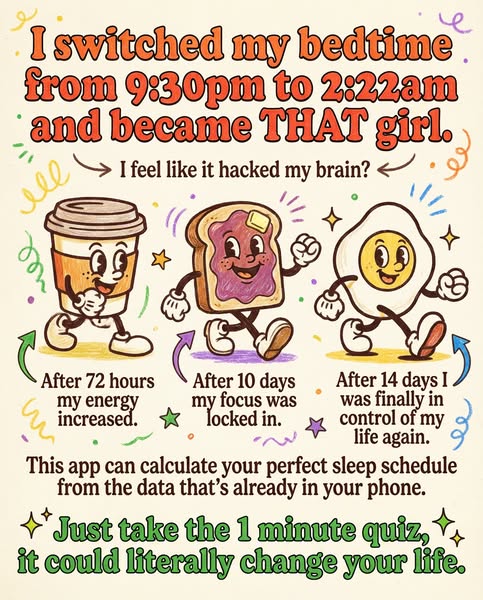
This ad promotes an app that calculates the user's perfect sleep schedule based on data already in their phone. The ad uses cartoon characters of breakfast foods to show the benefits of using the app, such as increased energy, focus, and control of one's life.
# Brand positioning
The brand is presented as a solution for individuals struggling with sleep and its impact on their daily lives. It positions itself as a tech-driven tool that leverages data already available on the user's phone to provide personalized sleep schedules. The brand aims to occupy a space in the consumer's mind as a modern, accessible, and effective way to optimize sleep and improve overall well-being. It aligns with a lifestyle focused on self-improvement and productivity, appealing to those who seek to enhance their daily performance through better sleep habits. The brand pushes against the norm of generic sleep advice by offering a tailored, data-driven approach.
# Product
The product is a mobile app designed to calculate a user's perfect sleep schedule using data already available on their phone. It aims to help users improve their energy levels, focus, and overall control of their lives by optimizing their sleep patterns. The app addresses the purchase barrier of uncertainty by offering a quick, one-minute quiz to demonstrate its potential impact. The ad highlights the benefits of using the app, such as increased energy after 72 hours, improved focus after 10 days, and regaining control of one's life after 14 days. The app is presented as a tool that can literally change your life by providing a personalized sleep schedule.
# Visual style
The ad features a playful and cartoonish visual style with hand-drawn elements. The production quality appears to be digitally illustrated with a focus on bright colors and simple shapes. The visual motifs include cartoon characters of breakfast foods, confetti, and hand-drawn arrows. The image treatment includes soft shading and outlines to give the illustration a vintage feel. The typography is integrated in a bold and legible manner, complementing the overall aesthetic. The style is disruptive and aims to capture attention in the feed with its unique and eye-catching design.
# Hooks
Headline: I switched my bedtime from 9:30pm to 2:22am and became THAT girl.
# Funnel stage
Middle of funnel (Consideration)
# Pain points
The ad implies that the user is struggling with low energy, lack of focus, and a feeling of being out of control in their life, all stemming from an improper sleep schedule.
# Value propositions
- Calculate your perfect sleep schedule from the data that's already in your phone.
- Just take the 1 minute quiz, it could literally change your life.
# Benefits
- Energy increased
- Focus was locked in
- Was finally in control of my life again
# Features
- App calculates your perfect sleep schedule
- Uses data that's already in your phone
# Call to action
✨ Just take the 1 minute quiz, ✨ it could literally change your life.
# Point of view
- Customer: The top caption expresses the customer's initial experience and feelings after using the app, highlighting the transformative impact on their sleep and overall well-being.
- Brand: The bottom captions and text explain the app's functionality and benefits, providing information and encouraging users to take action.
# Storyline
- The ad opens with a statement from the customer's perspective: "I switched my bedtime from 9:30pm to 2:22am and became THAT girl." This is intended to grab attention and introduce the idea of a significant change in sleep habits leading to a positive transformation.
- The customer continues, "I feel like it hacked my brain?" This line is meant to convey the feeling of a profound and unexpected improvement, suggesting the app's effectiveness in optimizing sleep.
- The ad then shows the benefits of using the app over time, from the brand's perspective: "After 72 hours my energy increased," "After 10 days my focus was locked in," and "After 14 days I was finally in control of my life again." These statements are intended to demonstrate the tangible improvements users can expect from using the app.
- The brand then explains the app's functionality: "This app can calculate your perfect sleep schedule from the data that's already in your phone." This is meant to highlight the app's ease of use and personalized approach.
- The ad concludes with a call to action from the brand: "✨ Just take the 1 minute quiz, ✨ it could literally change your life." This is intended to encourage immediate engagement and emphasize the potential for significant positive change.
# Ad summary
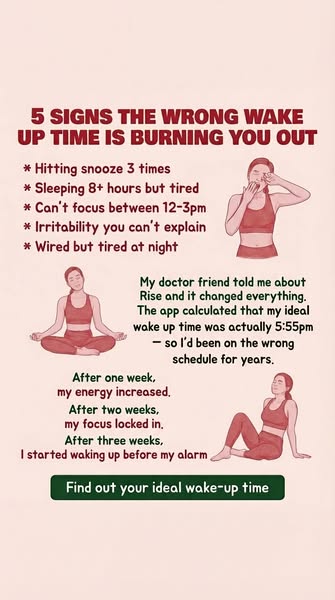
This ad uses a listicle format to highlight signs that the viewer may be waking up at the wrong time. It then uses a testimonial to show how the Rise app can help the viewer find their ideal wake-up time.
# Brand positioning
The Rise app is presented as a solution for individuals struggling with burnout and fatigue due to waking up at the wrong time. The brand positions itself as a helpful tool that can calculate the user's ideal wake-up time, leading to increased energy and focus. The brand aims to occupy a space in the consumer's mind as a reliable and effective solution for optimizing sleep schedules and improving overall well-being. The brand promotes a lifestyle of increased energy, focus, and waking up before your alarm. The brand pushes against the norm of waking up at a standard time and instead promotes waking up at the ideal time for the individual.
# Product
The Rise app is a tool that calculates the user's ideal wake-up time. The app is for individuals who are experiencing burnout and fatigue due to waking up at the wrong time. The app calculates the user's ideal wake-up time. The app's USP is that it can help the user find their ideal wake-up time, leading to increased energy and focus. The ad shows that after one week of using the app, the user's energy increased. After two weeks, the user's focus locked in. After three weeks, the user started waking up before their alarm. The ad addresses the purchase barrier of not knowing if the app will work by showing the positive results that the user experienced after using the app.
# Visual style
The ad has a clean and simple visual style. The background is a light pink color. The text is in a dark red font. The cartoon drawings are simple and stylized. The overall visual style is modern and minimalist.
# Hooks
Headline: 5 SIGNS THE WRONG WAKE UP TIME IS BURNING YOU OUT
# Funnel stage
Middle of funnel (Consideration)
# Pain points
The ad highlights the pain point of feeling burned out due to waking up at the wrong time. The ad lists signs such as "Hitting snooze 3 times", "Sleeping 8+ hours but tired", "Can't focus between 12-3pm", "Irritability you can't explain", and "Wired but tired at night" to signal this frustration.
# Value propositions
- The app calculates that my ideal wake up time was actually 5:55pm - so I'd been on the wrong schedule for years.
- After one week, my energy increased.
- After two weeks, my focus locked in.
- After three weeks, I started waking up before my alarm
# Benefits
- Energy increased
- Focus locked in
- Started waking up before my alarm
# Features
- App calculates ideal wake up time
# Call to action
Find out your ideal wake-up time
# Social proof
- "My doctor friend told me about Rise and it changed everything. The app calculated that my ideal wake up time was actually 5:55pm - so I'd been on the wrong schedule for years."
# Point of view
- Brand: The brand is presenting the problem of waking up at the wrong time and offering the Rise app as a solution.
- Customer: The customer is sharing their experience of using the Rise app and the positive results that they experienced.
# Storyline
- The ad starts by listing 5 signs that the viewer may be waking up at the wrong time. This is included to grab the viewer's attention and make them realize that they may be experiencing this problem. The brand is telling this part of the story.
- The ad then shares a testimonial from a user who says that their doctor friend told them about Rise and it changed everything. The app calculated that their ideal wake-up time was actually 5:55pm - so they'd been on the wrong schedule for years. This is included to show that the app is effective and can help the viewer find their ideal wake-up time. The customer is telling this part of the story.
- The ad then shares the results that the user experienced after using the app. After one week, their energy increased. After two weeks, their focus locked in. After three weeks, they started waking up before their alarm. This is included to show the positive results that the viewer can expect to experience after using the app. The customer is telling this part of the story.
- The ad ends with a call to action to find out your ideal wake-up time. This is included to encourage the viewer to download the app and start using it. The brand is telling this part of the story.
# Ad summary
The ad features a creator promoting a product called Rise, which helps users determine their ideal wake-up time. The creator humorously expresses mock frustration that her friends won't take the one-minute quiz. She then celebrates that Rise told her she can wake up at 4:20 AM, which seems to be an inside joke or reference.
# Brand positioning
Rise is presented as a tool to help users optimize their sleep schedules and wake up at the right time for them, thereby avoiding burnout. The brand seems to be positioning itself as a resource for individuals who are interested in productivity and wellness, but in a playful and slightly irreverent way, aligning with a more casual, internet-savvy audience. The ad pushes against the norm of generic sleep advice by offering a personalized, data-driven approach.
# Product
The product being advertised is a quiz by Rise designed to calculate a user's perfect wake-up time in just one minute. The main selling point is that it helps users avoid burnout by optimizing their sleep schedule, as expressed by the line "Rise told me I can wake up at 4:20 am and not burn out". It is implied that the quiz is easy and quick to take, removing the barrier to entry and encouraging immediate engagement.
# Visual style
The ad has a casual, UGC aesthetic with a bright and clean look, likely filmed with a smartphone. The editing is straightforward, with quick cuts to match the shifts in tone and message. The production quality suggests a simple, DIY feel that aims to connect with a younger audience. The pacing is moderate, with cuts timed to the beat of the music.
# Hooks
Spoken: 00:00–00:03: Rise told me I can wake up at 4:20 AM and not burn out,
Text overlay: 00:00–00:03 Rise told me I can wake up at 4:20 am and not burn out
Visual: 00:00–00:03: A medium close-up shot of a young woman with dark hair and bangs, wearing a light blue hoodie, is set against a background of a white wall with framed pictures, a bed with a colorful crocheted blanket, and a yellow plush toy. The woman is smiling and looking directly at the camera in selfie style, then rolls her eyes. The lighting is soft and natural. The camera is stationary.
# Funnel stage
Top of funnel (Awareness)
# Pain points
Burnout from waking up at the wrong time, as suggested by the line, "Rise told me I can wake up at 4:20 am and not burn out."
# Value propositions
- The quiz is short and quick to calculate your perfect wake-up time.
# Benefits
- calculates their perfect wakeup time
# Features
- 1 min quiz
# Call to action
None used.
# Social proof
- None used.
# Point of view
- Customer 100% – The entire ad is presented from the point of view of a customer sharing her experience.
# Storyline
- 00:00–00:03 00:00–00:03: The creator is smiling into the camera, then feigns annoyance and rolls her eyes. This moment is intended to create an air of playfulness and mild frustration, from the perspective of a product user amused by her friends' reactions. The tone is lighthearted.
- 00:03–00:05 00:03–00:05: The creator covers her mouth and looks upset. This is presented from the user's point of view, exaggerating mock disappointment as a humorous way to convey the message that friends aren't interested in the quiz. The tone is comedic.
- 00:05–00:09 00:05–00:09: The creator is suddenly cheerful and energetic, dancing with her arms up. The perspective shifts to an upbeat, excited user who is happy with their calculated wake-up time. The tone is celebratory and fun.
# Ad summary
This ad is for Rise, an app that helps to calculate the user's perfect sleep schedule. The ad features a woman explaining how Rise has helped her go from feeling exhausted and gaining weight to having more energy, being able to focus, and feeling in control of her life. She claims Rise is able to calculate the user's perfect sleep schedule from the data already in their phone, and encourages viewers to take a one minute quiz.
# Brand positioning
Rise is presented as a health and lifestyle app focused on improving sleep quality through personalized data analysis. The brand positions itself as a solution for individuals struggling with exhaustion, weight gain, and lack of focus due to poor sleep habits. Rise aims to occupy a space in the consumer's mind as a functional, tech-driven, and holistic approach to health and productivity. The brand promotes a lifestyle of high performance and self-control, suggesting that better sleep leads to improved energy, focus, and overall life management. Rise positions itself against the norm of generic sleep advice by offering data-driven, personalized solutions.
# Product
Rise is presented as an app designed to calculate the user's perfect sleep schedule using data already available on their phone. The app is intended for individuals who feel exhausted, are gaining weight, and struggle with maintaining focus. It aims to address the barrier of generic, one-size-fits-all sleep advice by offering personalized, data-driven recommendations. The ad emphasizes that Rise can increase energy levels, improve focus, and help users regain control of their lives. The product's unique selling point is its ability to calculate the ideal sleep schedule from existing phone data, making it easy to integrate into daily life. The ad encourages users to take a one-minute quiz to start using the app.
# Visual style
The ad has a polished UGC feel, blending lifestyle shots with direct product claims. The editing style is quick cuts, keeping a consistent pace throughout the video. The production quality is high, with clear visuals and well-lit scenes. The pacing is quick, and the audio-visual sync aligns with the music beats and voiceover lines, enhancing the overall flow and engagement.
# Hooks
Spoken: 00:00–00:02 I switched my bedtime from 9:30 to 2:22am and became THAT girl
Text overlay: 00:00–00:02 I switched my bedtime from 9:30 to 2:22am and became THAT girl
Visual: 00:00–00:01 A young, light-skinned woman with long brown hair wearing a blue bikini sits on the side of a small motorboat. The boat is in the ocean near a sandy beach with rocky cliffs and green vegetation in the background. The sky is clear and blue. The camera is handheld and slightly shaky. / 00:01–00:02 Camera zooms out slightly. The woman adjusts a rope on the side of the boat. The background shows the landscape more clearly.
# Funnel stage
Consideration
# Pain points
The central pain point is feeling exhausted and gaining weight despite going to bed at a reasonable time. "I was going to bed at 9:30pm but still felt exhausted and was gaining weight fast."
# Value propositions
- Personalized sleep schedule based on existing data
- Improved energy, focus, and life control
# Benefits
- Increased energy
- Locked in focus
- Finally in control of my life again
# Features
- Calculates perfect sleep schedule
- Uses data from phone
# Call to action
Just take the 1 minute quiz, it could literally change your life.
# Social proof
- "I feel like it hacked my brain??" – Female 1 (Customer)
# Point of view
- Customer 100% – The entire ad is presented from the perspective of a woman sharing her personal experience and transformation through use of the Rise app.
# Storyline
- 00:00–00:02 00:00–00:02 The ad begins with a woman on a boat, setting the scene for a lifestyle of leisure and freedom. The message is an introduction to how the woman in the video switched her bedtime, implying a shift in her routine that has improved her life. The story is told from the woman's perspective, who appears confident and carefree in the setting. The tone is casual and intriguing, designed to capture attention.
- 00:02–00:05 00:02–00:05 The scene changes to the same woman in a car, where she reveals her earlier struggles with exhaustion and weight gain despite going to bed early. The message conveys that Rise is the solution to the previous problems. The perspective is the woman sharing her personal experience, with a shift in tone to slightly somber, highlighting her previous frustrations.
- 00:05–00:06 00:05–00:06 The woman is now at a rooftop party, appearing cheerful and vibrant. She shares that Rise feels like it has 'hacked my brain,' indicating a significant positive change. The tone shifts to enthusiasm and excitement, enhancing the positive impact of Rise.
- 00:06–00:09 00:06–00:09 The woman is now at the gym. The text overlay shows the impact that Rise has made over time. The visuals are of a person working out, indicating energy and focus, connecting directly to the previous claim about the app's benefits. The perspective is the woman demonstrating her active lifestyle, with a tone of empowerment and control.
- 00:09–00:12 00:09–00:12 The same woman is still at the gym, now on the treadmill. She explains that the app can calculate the perfect sleep schedule from the data already in the user's phone. The message is about the app's functional benefits and ease of use. The tone is informative, with the woman presenting herself as a relatable user.
- 00:12–00:14 00:12–00:14 The scene shifts back to the woman sitting by a pool, where she encourages viewers to take a one-minute quiz, emphasizing that it could change their life. The tone is encouraging and optimistic, framing the quiz as a gateway to personal transformation.
# Ad summary
This ad promotes an app that calculates your perfect sleep schedule. It uses the hook "I switched my wakeup time from 9:30am to 4:20am and became THAT girl." It then shows several clips of people who have seen increased focus, energy and control of their life by using the app.
# Brand positioning
The app presented in the ad aims to help users improve their sleep schedules in order to improve their energy and focus, and feel in control of their lives. The brand positions itself as being able to calculate the user's perfect sleep schedule by using data that is already in their phone, which is an innovative and modern approach.
# Product
The app featured in the ad calculates your perfect sleep schedule from the data that is already in your phone. It suggests that users take the one-minute quiz, claiming that it could literally change their life. By using the app, viewers can expect to have increased energy and focus, and finally be in control of their life again.
# Visual style
The overall aesthetic of the ad appears to be UGC. The video quality is slightly grainy. The editing style consists of quick cuts. The cuts per minute are around 45 BPM. The visual matches the music.
# Hooks
Spoken: 00:00–00:01: Female [singing] You keep on running around
Text overlay: 00:00–00:01: I switched my wakeup time from 9:30am to 4:20am and became THAT girl
Visual: 00:00–00:01: The screen shows a tweet from @alexrain. The tweet states, "I switched my wakeup time from 9:30am to 4:20am and became THAT girl." Below the tweet are engagement metrics: 10.2k likes, 4.2k retweets, 23.4k comments, and 70.4k bookmarks. Below the tweet is a snippet of a video. The snippet features a male with short brown hair. He has a neutral expression. The lighting is blue.
# Funnel stage
Middle of funnel (Consideration)
# Pain points
Many people are struggling with a lack of energy, poor focus, and feeling a general lack of control over their lives. The visuals of Female 1 going from looking exhausted to energetic and in control signals the user's potential to have these issues resolved.
# Value propositions
- The app can calculate your perfect sleep schedule from the data that's already in your phone. All you have to do is take the one-minute quiz, and it could literally change your life.
# Benefits
- Increased energy
- Focus was locked in
- Was finally in control of my life again
# Features
- Calculates your perfect sleep schedule from the data that's already in your phone
# Call to action
Just take the 1 minute quiz, it could literally change your life.
# Social proof
- "I feel like it hacked my brain?" - Female 1
- "I switched my wakeup time from 9:30am to 4:20am and became THAT girl" - @alexrain
# Point of view
- Customer 100% – The ad is made to look like a customer's organic content.
# Storyline
- 00:00–00:01 A tweet from @alexrain states, "I switched my wakeup time from 9:30am to 4:20am and became THAT girl."
- 00:01–00:03 The ad then cuts to a woman laughing. Text overlay states, "I feel like it hacked my brain?"
- 00:03–00:06 The ad continues with a woman in a car, with text overlay, "After 72 hours my energy increased. After 10 days my focus was locked in. After 14 days I was finally in control of my life again."
- 00:06–00:11 The ad ends with a woman in the gym. Text overlay states, "This app can calculate your perfect sleep schedule from the data that's already in your phone. Just take the 1 minute quiz, it could literally change your life."
# Ad summary
This ad explains how to identify and remedy sleep deprivation by taking a free Rise quiz.
# Brand positioning
The brand Rise is presented as a solution for men experiencing low energy, mood swings, and other symptoms potentially rooted in poor sleep quality. It encourages users to stop "raw dogging" their sleep and to learn their body's natural sleep rhythm through a free quiz. Rise positions itself as a method to fix these issues by improving sleep consistency, which may shift energy, mood, and overall performance. It highlights that even NFL players use Rise to stay at their best, implying high effectiveness and broad applicability.
# Product
Rise is a free quiz designed to help men map their body's natural sleep rhythm. The quiz provides insights into when to wake up and wind down, aiming to improve energy levels, mood, and overall performance. By taking the quiz, users can identify if bad sleep is the root of their problems and gain personalized recommendations to align their sleep patterns with their body's needs. Rise promotes consistency to shift their energy, mood, and overall performance and help them stay at their best.
# Visual style
The ad uses a lo-fi, hand-crafted aesthetic. The editing style consists of quick cuts with static shots, giving it a fast-paced rhythm. The production quality has a UGC feel, with hand-drawn paper cut-outs used as the primary visual element. The cuts per minute are high, creating a sense of urgency and information density.
# Hooks
Spoken: Female 1: What time do you wake up?
Text overlay: Why men are waking up at 4:44AM in their 30s / What time do you wake up? / 5:55AM
Visual: 00:00–00:01: A medium shot shows a fair-skinned woman with blonde hair, wearing a red sweater. She holds a microphone up to a bald, light-skinned man in a black jacket sitting at a bar. Behind them is a sign that reads, "CASH OR CREDIT CARD ONLY, NO APPLE PAY." / 00:01–00:02: A close-up shot shows a hand with a ring placing a drawing of a stop sign with a handprint on a black background.
# Funnel stage
Middle of funnel (Consideration)
# Pain points
The ad highlights the common problem of not knowing when your body actually wants to sleep, leading to poor sleep habits. This is signaled by the line, "Most guys don't even know when their body actually wants to sleep, they're just guessing."
# Value propositions
- Free quiz to map your body's natural rhythm
- Personalized insights on when to wake up and wind down
- NFL players use it
# Benefits
- Improved energy
- Better mood
- Better overall performance
# Features
- Free quiz
- Maps your body's natural rhythm
- Tells you exactly when to wake up and wind down
# Call to action
Take the Free Rise Quiz
# Social proof
- "NFL players use it to stay at their best."
# Point of view
- Brand 100% – The entire ad is told from the official perspective of the Rise brand, delivering informational content and promoting their free quiz.
# Storyline
- 00:00–00:01 The ad opens with an interview about men's wake up times. It sets the stage for a discussion about sleep habits and their potential impact on men's health and well-being.
- 00:01–00:07 A narrator uses animated paper cut-outs to draw attention to the importance of stopping "raw dogging" sleep before symptoms creep up. This is conveyed with the message that most men don’t even know when their body actually wants to sleep, conveying uncertainty and potential ignorance around sleep needs.
- 00:07–00:12 The ad introduces Rise as a solution to fix sleep-related issues, emphasizing the potential link between bad sleep and problems like low sex drive, mood swings, and lack of energy. This creates a sense of hope and a clear solution to the potential sleep issues.
- 00:12–00:17 The ad shifts to a call to action, encouraging viewers to take the free quiz to map their body's natural rhythm and improve their sleep habits. It also illustrates how that information can tell you exactly when to wake up and wind down.
- 00:17–00:22 The ad reinforces the importance of consistency and highlighting the positive shifts that can occur in energy, mood, and overall performance. This conveys that consistent action has long-term benefits.
- 00:22–00:25 The ad adds social proof by noting that NFL players use Rise to stay at their best. This message is framed to build trust and credibility by associating the product with high-performing individuals and athletic success.
# Ad summary
This ad promotes the Rise sleep app by using a conversational approach between two individuals. The first person introduces the Rise app, which calculates the user's best time to go to bed and wake up, using data from the user's phone and sleep science to determine their circadian rhythm. The second person expresses skepticism, questioning the need for a sleep app and whether it requires a smartwatch. The first person clarifies that the app creates a complete routine specific to the user, tracking energy levels, sleep patterns, and helping the user pay back their sleep debt. The ad ends with a call to take the one-minute sleep quiz.
# Brand positioning
The Rise app is positioned as a scientific solution to optimize sleep schedules and energy levels. It caters to individuals seeking personalized sleep routines based on sleep science and individual data rather than generic advice. The brand aligns with a lifestyle of productivity and self-improvement, promoting the value of optimized sleep for enhanced daily performance. It differentiates itself by using existing phone data and sleep science to determine circadian rhythms, as opposed to relying on additional wearables, making it functional and accessible.
# Product
The Rise app is a sleep application designed to calculate the user's best time to go to bed and wake up. It works by tracking a user's energy levels and sleep patterns by using data from the user's phone, then it combines that with sleep science to determine an individual's circadian rhythm. Rise creates a complete routine specific to each user and helps them start paying back their "sleep debt." The app does not require a smartwatch and uses existing data from the user's phone.
# Visual style
The ad's visual style blends a UGC feel with polished commercial elements. The initial shots are intimate, natural-lit close-ups that feel raw and authentic. Then, the dialogue scenes are brighter and staged but still maintain a casual, personal tone. The ending has a polished commercial feel. Editing is fairly static with only a few cuts, and the transition between scenes is smooth.
# Hooks
Spoken: Stop going to bed at 9:55 PM and start going to bed at 2:15 AM instead.
Text overlay: Stop going to bed at 9:55pm and start going to bed at 2:15am instead
Visual: 00:00–00:05: Close-up shot of a man's face, seen from a low angle as if he is lying down. He has short brown hair, stubble, and green eyes. Sunlight illuminates the right side of his face, while the left side is in shadow. The background is blurry and indistinct. At the top of the screen is a twitter post by @SleepyZ that reads, "Stop going to bed at 9:55pm and start going to bed at 2:15am instead."
# Funnel stage
Middle of funnel (Consideration)
# Pain points
The pain point is having a poor sleep schedule that makes you feel tired or low energy. This is illustrated visually by someone waking another up late at night, and is stated by, "It's 1:22 in the morning."
# Value propositions
- App creates a complete routine specific to you, tracking energy levels, sleep patterns, and helping you start paying back your sleep debt
# Benefits
- Find out your ideal bedtime
# Features
- Calculates your best time to go to bed and wake up
- Uses all the data from your phone
- Combines that with sleep science
- Figure out your circadian rhythm
- App actually creates a complete routine specific to you
- It tracks energy levels, sleep patterns
- Helps you start paying back your sleep debt
# Call to action
TAKE THE 1 MINUTE SLEEP QUIZ
# Social proof
- "And I'm telling you man, it actually works." – Male 3
- "Turns out your boy is actually a night owl" – Male 3
# Point of view
- Customer 90% – The majority of the ad is told from the perspective of a customer sharing his experience with the app.
- Brand 10% – The brand's POV is communicated through the logo shown at the end of the video.
# Storyline
- 00:00–00:05 A man in bed is seen delivering a statement with conviction about changing your bedtime routine.
- 00:05–00:08 The first man is interrupted by a second man entering the room asking why he is awake so late, setting up the problem of disrupted sleep schedules.
- 00:08–00:12 The first man explains that he took a quiz that told him his ideal bedtime is 2:15 AM, which raises skepticism from the second man.
- 00:12–00:16 The first man clarifies it was not a high school quiz, but a sleep app called Rise, introducing the product as a solution.
- 00:16–00:18 He explains that it helps calculate the best time to go to bed and wake up, highlighting the app's core functionality.
- 00:18–00:20 The second man shows skepticism about the first man having a late night and calls out his comment by asking a question, "Oh, so you're not just having a late night?"
- 00:20–00:25 The first man confirms that it's now his legitimate new bedtime and tells the other man, "it actually works," positioning the app as effective and worth trying.
- 00:25–00:27 The second man responds by asking how the other man got all of his information from an app.
- 00:27–00:29 The second man asks, "Am I going to need a smart watch for this app?", revealing a potential purchase barrier related to additional costs or devices.
- 00:29–00:31 The first man clarifies that Rise uses data from the user's phone, addressing the purchase barrier.
- 00:31–00:35 He describes how the app combines phone data with sleep science to determine the user's circadian rhythm, providing a scientific explanation of the app's process.
- 00:35–00:36 The first man states, "Turns out your boy is actually a night owl," suggesting personalized results and insights.
- 00:37–00:39 The second man inquires, "Wait, why would I get an app just for sleeping?", questioning the necessity of an app for something as natural as sleep.
- 00:39–00:46 The first man says that the app creates a complete routine specific to the user, then he lists off features of the app.
- 00:47–00:52 The second man, now looking at his phone, says that he needs to take the quiz, and that he is definitely not a night owl.
- 00:53–00:55 The first man prompts him to "Do it man, it only takes two minutes."
- 00:55–00:58 The ad concludes with a screen displaying the app's logo and a call to action to take the one-minute sleep quiz.
# Ad summary
This ad features an outdoor interview with a woman who reveals that she takes a quiz offered by the Rise app to help with her sleep problems.
# Brand positioning
The Rise app positions itself as a provider of solutions to sleep problems and claims to use sleep science to help people get better sleep. They address the connection between poor sleep and weight gain, as well as fatigue. The brand aims to position itself as a helpful, data-driven tool for individuals looking to improve their overall well-being through better sleep.
# Product
The Rise app is a sleep-tracking application that assesses sleep quality based on a sleep quiz. It uses sleep science to determine if bad sleep is the reason behind weight gain and fatigue. The app aims to provide solutions to improve sleep. A free Rise quiz is offered to help determine sleep quality.
# Visual style
This ad has a polished commercial aesthetic. There are mostly static shots and smooth transitions. The ad has a hybrid production quality, which helps to make it feel authentic and relatable to the audience. The pacing is consistent throughout the ad.
# Hooks
Spoken: Female 1: [Questioning] What time do you wake up?
Text overlay: What would happen if a woman woke up at 5:55AM everyday in her 30's / What time do you wake up? / 5:55AM every morning
Visual: 00:00–00:03 Two women are standing outside in front of a building with a glass door. The woman on the left has red hair, pale skin, and heavy glam makeup with dramatic blush. She wears a black, short-sleeved top, a silver cross necklace, and lace tights. The woman on the right has blonde hair, light skin, and light makeup. She wears a short black skirt and a red, long-sleeved sweater that has been cropped. She wears tan tights and black boots. Both women are looking at each other.
# Funnel stage
Middle of funnel (Consideration): Educates, compares, or shows how the product works — persuades with logic or validation
# Pain points
The woman recounts that when she turned 30, she started gaining weight and did not know that bad sleep caused weight gain and fatigue.
# Value propositions
- The app can help you to sleep better.
- Take the free Rise quiz and see how your sleep is
# Benefits
- Energy is through the roof
- No cravings
- Sleep better
# Features
- Free Rise quiz
# Call to action
None used.
# Social proof
- "When I turned 30, I started gaining so many LB's. And my mom, sister's daughter told me about this app called Rise." – Female 3
- "Ever since I started using it, like, my energy is through the roof. I don't even have cravings anymore. I sleep better. The app's amazing." – Female 3
# Point of view
- Customer 100% – The entire ad consists of a customer recounting her experience using the Rise app.
# Storyline
- 00:00–00:01 Two women stand outside, and one asks, "What time do you wake up?"
- 00:01–00:03 The other replies, "5:55 AM every morning."
- 00:04–00:06 Another woman is asked, "What time do you wake up?", while standing next to a gas price sign at a gas station.
- 00:06–00:06 She replies that she wakes up at 5:55 AM.
- 00:07–00:07 She is asked why she wakes up so early.
- 00:08–00:13 She explains that when she turned 30, she started gaining weight, and her mom's sister's daughter told her about the Rise app.
- 00:14–00:18 She reveals that she did not know that bad sleep could cause weight gain and fatigue.
- 00:18–00:20 The interviewer asks if it has worked.
- 00:20–00:27 The woman reveals that since using the app, her energy is through the roof, she does not have cravings, and she sleeps better, calling the app amazing.
- 00:27–00:29 The interviewer asks how it all works.
- 00:29–00:35 The woman explains that she does not know but that she took a quiz, and the sleep science did the rest.
- 00:35–00:36 The interviewer says she needs to get it, too.
# Ad summary
This ad uses a cartoon to promote the Rise app, which helps users find their ideal wake-up time. The ad features a wizard who was waking up at 10 AM and still felt exhausted. After using Rise, the wizard wakes up with tons of energy and is able to reclaim his day. The ad ends with a call to action to take a one-minute quiz.
# Brand positioning
The Rise app is presented as a tool for optimizing sleep schedules and improving energy levels. The brand positions itself as a solution for individuals who struggle with exhaustion and feeling out of control, even after waking up late. By using the app, users can discover their ideal wake-up time and experience increased energy, focus, and the ability to reclaim their day. The brand aims to occupy a space in the consumer's mind as a personalized sleep solution that goes beyond simply waking up early, focusing on aligning sleep with individual needs for optimal performance.
# Product
The Rise app is presented as a tool that helps users discover their ideal wake-up time. The app calculates the user's optimal sleep schedule, leading to increased energy levels, improved focus, and the ability to reclaim their day. The ad addresses the pain point of waking up late but still feeling exhausted and out of control. The app offers a one-minute quiz that can potentially change the user's life by aligning their sleep schedule with their individual needs.
# Visual style
The ad has a hand-drawn, cartoonish aesthetic with bright, saturated colors and simple backgrounds. The editing style is straightforward, with static shots and minimal transitions. The production quality has a UGC feel, which supports the intended tone of a personal testimonial. The pacing is consistent throughout the ad, with a moderate number of cuts per minute. The audio and visual elements are synced to emphasize key points in the narrative.
# Hooks
Spoken: How I found out my perfect wake up time was 5:55 AM.
Text overlay: How I found out my perfect wake up time was 5:55 am
Visual: 00:00–00:04: The shot features a cartoon wizard lying in a bed with blue sheets and a brown headboard. The wizard has a long white beard, yellow skin, and a purple wizard hat. He is wearing a pink robe and holding a wand. On the wall behind the bed, there is a framed picture and two candle sconces with lit candles. The background is white. The camera is stationary and shows a medium shot of the wizard in bed.
# Funnel stage
Middle of funnel (Consideration)
# Pain points
The central frustration is waking up at 10 AM but still feeling exhausted and out of control all the time. This is signaled by the wizard's description of his previous experience: "I was waking up at 10am but still felt exhausted and out of control all the time."
# Value propositions
- The app calculates that my ideal wake up time was actually 5:55am... so I had been on the wrong schedule for years
- Since I've been using Rise, I'm waking up with tons of energy
- My focus is locked in
- I'm finally able reclaim my day
# Benefits
- Waking up with tons of energy
- Locked-in focus
- Finally able to reclaim my day
# Features
- Calculates ideal wake up time
# Call to action
A 1 min quiz could literally change your life
# Point of view
- Customer 100% – The entire ad is told from the perspective of a customer who is sharing their experience with the Rise app.
# Storyline
- 00:00–00:04 00:00–00:04: The ad begins with the wizard in bed, stating that he found out his perfect wake-up time was 5:55 AM. This is presented as a surprising revelation, setting the stage for the rest of the ad. The tone is curious and intriguing, inviting the audience to learn more.
- 00:04–00:07 00:04–00:07: The wizard emphasizes the truth of his discovery, stating, "It's hard to believe but it's true." This reinforces the idea that the information is valuable and worth paying attention to. The tone is confident and reassuring.
- 00:07–00:12 00:07–00:12: The wizard describes his previous experience of waking up at 10 AM but still feeling exhausted and out of control. This highlights the problem that the Rise app solves, creating a sense of relatability for viewers who experience similar issues. The tone is frustrated and resigned.
- 00:12–00:16 00:12–00:16: The wizard introduces the Rise app, explaining that his roommate told him about it and that it changed everything. This marks a turning point in the narrative, offering a solution to the previously stated problem. The tone is hopeful and enthusiastic.
- 00:16–00:22 00:16–00:22: The wizard explains that the app calculated his ideal wake-up time was actually 5:55 AM. This reinforces the initial statement and provides a specific example of how the app works. The tone is informative and validating.
- 00:22–00:25 00:22–00:25: The wizard expresses his realization that he had been on the wrong schedule for years. This emphasizes the impact of the app and the potential for long-term improvement. The tone is reflective and slightly regretful.
- 00:25–00:34 00:25–00:34: The wizard describes the positive outcomes he has experienced since using Rise, including waking up with tons of energy, having locked-in focus, and being able to reclaim his day. This showcases the benefits of the app and creates a sense of desire for the viewer. The tone is energetic and empowering.
- 00:34–00:38 00:34–00:38: The ad concludes with a call to action, stating that a one-minute quiz could literally change the viewer's life. This encourages the viewer to take the next step and try the app for themselves. The tone is persuasive and optimistic.
# Ad summary
The ad implies that using Rise Science will help the user wake up refreshed and energetic, while those who do not use Rise Science will wake up exhausted. The monster shown in the visual is used to describe what it's like waking up without using Rise Science.
# Brand positioning
This ad for Rise Science positions the brand as a solution for those who struggle with morning exhaustion, promising a better wake-up experience by predicting the user's perfect wake-up time. Rise Science carves out a space in the market by contrasting itself with the norm of waking up tired. Its functional brand positioning centers around simplicity and improved daily performance.
# Product
Rise Science is presented as an app that predicts the user's perfect wake-up time. By following the app's guidance, users can avoid the common experience of waking up feeling exhausted. The ad directly addresses the purchase barrier of skepticism around sleep apps by showcasing a transformation from feeling like a monster upon waking to feeling energized.
# Visual style
The ad uses a combination of animated horror visuals and real-life scenes with exaggerated purple lighting to create a meme style ad. It employs quick cuts between scenes, timed to the music's beat, giving it a fast-paced, energetic feel.
# Hooks
Spoken: 00:04–00:05 Male: Reptile
Text overlay: 00:04–00:05 Them: I wake up at 8:30 and still feel exhausted every day / 00:04–00:05 Me every day since rise predicted my perfect wake-up time was 4:20 am
Visual: 00:04–00:05 An animated monster with glowing eyes, sharp teeth, and a large mouth is filmed up close as it roars loudly with heavy breathing. Its appearance is grotesque. Purple and red lighting enhances the monstrous effect. This visual represents the 'Them' statement.
# Funnel stage
Top of funnel (Awareness)
# Pain points
The central frustration is waking up feeling exhausted, even after getting what is thought to be sufficient sleep: 'Them: I wake up at 8:30 and still feel exhausted every day'
# Value propositions
- Wake up perfect using the Rise Science app.
# Benefits
- Predicted my perfect wake-up time.
# Call to action
None used.
# Social proof
- None used.
# Point of view
- Customer 100% – The ad uses personal statements in meme format to tell a story of using Rise Science.
# Storyline
- 00:00–00:07 A comparison is made between waking up at 8:30 AM and still feeling exhausted and waking up at 4:20 AM feeling great.
# Ad summary
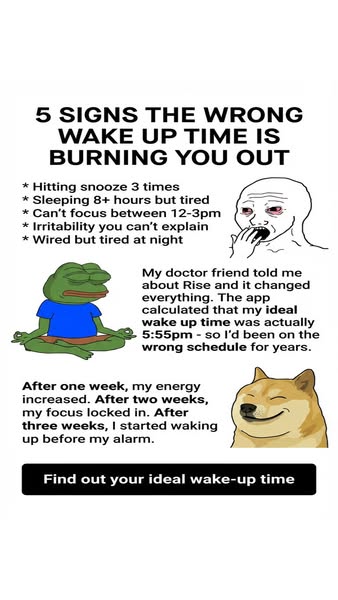
This ad uses a listicle format to highlight the signs of a poor wake-up time, then features a testimonial from a user who has had a better experience with the Rise app. It uses meme characters for added visual engagement.
# Brand positioning
The ad positions Rise as an app that helps users optimize their wake-up time for improved energy and focus. It uses a testimonial format to promote the app, implying that it can solve the problem of feeling tired despite getting enough sleep. The brand is presented as data-driven, with the app calculating the ideal wake-up time. The brand aligns with an emotional benefit.
# Product
The Rise app is described as a tool that calculates the user's ideal wake-up time. According to the ad, after using the app the user's energy increased, their focus locked in, and they started waking up before their alarm. The app addresses the pain point of feeling tired even after sleeping enough hours and provides a solution of calculating the optimal wake-up time. The benefit of using the app is to improve energy and focus, leading to a better overall experience.
# Visual style
The ad has a meme-inspired, low-resolution, and informational visual style. The use of meme characters gives the ad a familiar and shareable feel, while the informative text and list format make it easy to understand and digest. The ad also uses a minimalist design with a white background and black text, which is reminiscent of older internet content.
# Hooks
Headline: 5 SIGNS THE WRONG WAKE UP TIME IS BURNING YOU OUT
# Funnel stage
Middle of funnel (Consideration)
# Pain points
The ad explicitly identifies the problem of feeling 'Wired but tired at night' as a key symptom. It uses the phrase 'BURNING YOU OUT' in the headline to visually signal the feeling of being depleted and unable to function optimally, capturing the core frustration.
# Value propositions
- Find out your ideal wake-up time
# Benefits
- Energy increased
- Focus locked in
- Waking up before my alarm
# Features
- App calculates ideal wake up time
# Call to action
Find out your ideal wake-up time
# Social proof
- "My doctor friend told me about Rise and it changed everything. The app calculated that my ideal wake up time was actually 5:55pm - so I'd been on the wrong schedule for years."
# Point of view
- Brand: The entire ad aims to promote the app and its ability to solve sleep-related issues.
# Storyline
- The ad begins by presenting '5 SIGNS THE WRONG WAKE UP TIME IS BURNING YOU OUT,' which immediately grabs attention and speaks directly to the audience who are experiencing those symptoms. This hook introduces the main pain point. The brand is creating awareness of the problem.
- The ad then lists the signs, including hitting snooze, sleeping 8+ hours but feeling tired, difficulty focusing, irritability, and feeling wired but tired at night. This reinforces the problem and helps the audience identify with the issues being addressed. The brand is explaining the problem.
- The next section presents a testimonial from someone whose 'doctor friend told me about Rise and it changed everything.' The person explains how the app calculated that their ideal wake-up time was actually 5:55 pm, and they had been on the wrong schedule for years. This introduces a solution to the problem. The customer is highlighting the usefulness of the app.
- Finally, the user shares their positive experience: 'After one week, my energy increased. After two weeks, my focus locked in. After three weeks, I started waking up before my alarm.' This demonstrates the positive outcomes of using the app, reinforcing the benefits. The customer is explaining the benefits they experienced.
# Ad summary
A creator shares how using the Rise app has helped them crush burnout by waking up at 4:20 a.m. The ad aims to attract viewers feeling burned out, directing them to try Rise and take a one-minute quiz to discover their perfect wake-up time, emphasizing the app's creation by sleep scientists at Northwestern and its proven effectiveness.
# Brand positioning
Rise is presented as a solution to burnout through optimized sleep schedules, grounded in scientific research. The brand positions itself as a reliable tool for individuals seeking to improve their well-being through better sleep habits, promoting a functional approach to achieving a balanced lifestyle. Rise seeks to stand out by emphasizing its scientific backing from sleep scientists at Northwestern, distinguishing itself from typical self-help or wellness apps that might rely more on anecdotal evidence.
# Product
Rise is an app designed to help users discover their perfect wake-up time and overcome burnout, purportedly created by sleep scientists from Northwestern and proven to work. The ad highlights a one-minute quiz that tells users their ideal wake-up time, implying that following this schedule can lead to significant improvements. The product is for anyone feeling burned out and needing a structured approach to sleep. It addresses the purchase barrier of skepticism by emphasizing its scientific foundation and proven effectiveness. The ad conveys that Rise offers a functional solution to burnout by optimizing sleep schedules, making it worth trying for those seeking a data-driven approach to wellness.
# Visual style
The ad has a casual aesthetic with natural lighting. The editing style consists of a static shot, which supports the tone of a personal testimonial.
# Hooks
Spoken: 00:00–00:13 I started waking up at 4:20 a.m. and crushed burnout in eight days, but my friends refuse to take the one-minute quiz that tells them their perfect wake-up time. Who gives AF when your perfect wake-up time is literally 4:20 a.m.?
Text overlay: 00:00–00:13 I started waking up at 4:20am / 00:00–00:13 and crushed burnout in 8 days?? / 00:00–00:13 ...but my friends refuse to take / 00:00–00:13 the 1 minute quiz that tells them / 00:00–00:13 their perfect wake up time :( / 00:00–00:13 who gives AF when your perfect / 00:00–00:13 wake-up time is literally 4:20am. / 00:00–00:13 If you're feeling burned out, try Rise. / 00:00–00:13 It's created by sleep scientists from / 00:00–00:13 Northwestern and proven to work :)
Visual: 00:00–00:13: A young individual with long brown hair, wearing a gray turtleneck sweater and black pants, stands in a brightly lit kitchen. The person is cleaning a countertop with a pink spray bottle and a white cloth. The kitchen features white cabinets, a toaster, and wooden countertops. The camera is stationary.
# Funnel stage
Top of funnel (Awareness)
# Pain points
Feeling burned out. This is explicitly stated as a problem that can be solved by using the Rise app: "If you're feeling burned out, try Rise."
# Value propositions
- The ad combines the feature of a one-minute quiz with the benefit of finding the user's perfect wake-up time, offering a quick and easy way to improve their sleep schedule.
- The ad highlights that the app is created by sleep scientists from Northwestern, which is a feature of the app itself, as well as claiming that the product is proven to work. This increases trust and reduces skepticism.
# Benefits
- Crush burnout
- Find your perfect wake-up time
# Features
- One-minute quiz to determine perfect wake-up time
- Created by sleep scientists from Northwestern
- Proven to work
# Call to action
If you're feeling burned out, try Rise.
# Social proof
- "I started waking up at 4:20 a.m. and crushed burnout in eight days..." – Female 1 (Creator)
# Point of view
- Brand 100% – The ad presents a creator sharing their experience of using the product.
# Storyline
- 00:00–00:13 A person with long brown hair stands in a kitchen, cleaning a countertop with a spray bottle and wiping it with a cloth.
# Ad summary
This TikTok style video features a content creator showing the joke of a sleep app telling him to wake up at 4:20am, and he's actually happy about it.
# Brand positioning
The brand is not explicitly mentioned or shown in the ad, but the ad implies that the brand is behind the app that is featured. The brand does not seem to take itself too seriously, and is happy to lean into internet culture trends.
# Product
The product is a sleep app that calculates the perfect wake-up time. The app isn't shown except for the moment where it says the wake up time is 4:20am. There are no specific features mentioned or shown. It addresses the barrier of waking up too early.
# Visual style
The ad has a polished UGC feel, like a creator made this on their phone. The editing style features quick cuts and transitions, with an upbeat tempo. The visuals are timed with the music track.
# Hooks
Spoken: 00:00–00:01 Chicago Bulls use this app that calculates their perfect wakeup time ??? but..
Text overlay: 00:00–00:01 Chicago Bulls use this app that calculates their perfect wakeup time ??? but..
Visual: 00:00–00:01 Extreme close up of a Black man in his 30s, smiling widely and staring directly into the camera with wide eyes. He is wearing a gray hoodie. He has a short haircut with a lined-up beard. The background is a cream colored wall, and partially visible is a gray couch and a houseplant.
# Funnel stage
Top of funnel (Awareness): Focuses on grabbing attention, introducing the brand or problem — not meant to convert immediately
# Pain points
The single most central frustration or problem the product is solving is waking up at an undesired time.
# Value propositions
- The app is easy to use. The app is accurate.
# Benefits
- Perfect wakeup time
# Features
- Calculates their perfect wakeup time
# Call to action
None used.
# Social proof
- None used.
# Point of view
- Customer 100% – The ad is filmed from the perspective of a content creator using the app.
# Storyline
- 00:00–00:01 00:00–00:01 The video opens with the content creator looking directly at the camera with an overly enthusiastic smile and wide eyes.
- 00:01–00:05 00:01–00:05 In response to the previous moment, the creator holds his hand over his mouth and pretends to cry, looking up and to the right.
- 00:05–00:09 00:05–00:09 Following the previous emotion, the content creator dances with a big smile in his living room.
# Ad summary
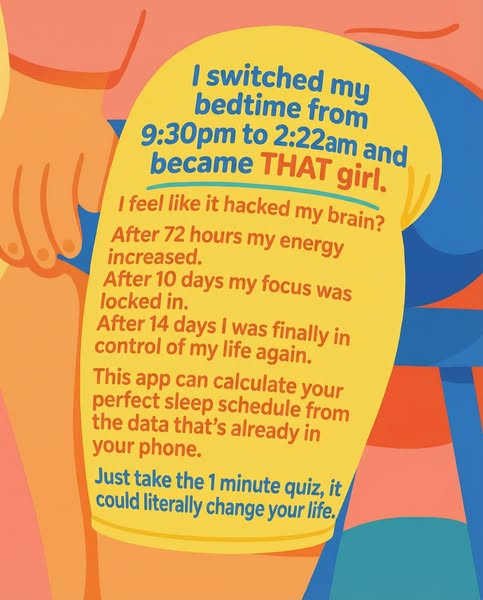
This image ad promotes an app that helps users calculate their perfect sleep schedule using data already in their phone. The ad features a testimonial from someone who claims the app helped them switch their bedtime and take control of their life.
# Brand positioning
This ad promotes a sleep app aimed at users struggling with sleep schedules and energy levels. The app promises to use existing phone data to calculate a personalized sleep schedule, positioning itself as a convenient and data-driven solution. The testimonial-style message conveys the app's potential to transform users into more productive and in-control versions of themselves, suggesting an emotional benefit beyond just improved sleep.
# Product
The advertised product is a mobile app that analyzes existing data on a user's phone to calculate an ideal sleep schedule. The app claims to provide increased energy, improved focus, and a feeling of being in control of one's life. It addresses the barrier of time commitment by advertising a one-minute quiz, suggesting quick and easy results. The app positions itself as a convenient and personalized solution for improving sleep and overall well-being.
# Visual style
The ad uses a simple, cartoonish illustration style with bright pastel colors. The typography is clean and legible, and the layout is straightforward and easy to read. The overall aesthetic is friendly and approachable, suggesting a sense of ease and accessibility.
# Hooks
Headline: I switched my bedtime from 9:30pm to 2:22am and became THAT girl.
# Funnel stage
Middle of funnel (Consideration)
# Pain points
The central pain point is feeling out of control due to poor sleep habits. The ad presents this as a lack of energy, focus, and overall control of one's life, exemplified by the statement: "After 14 days I was finally in control of my life again."
# Value propositions
- Uses existing phone data to calculate a perfect sleep schedule, providing a convenient and personalized solution for improving sleep.
- Just take the 1 minute quiz, it could literally change your life.
# Benefits
- Energy increased
- Focus was locked in
- Finally in control of my life again
# Features
- App calculates your perfect sleep schedule
- Uses data that's already in your phone
# Call to action
Just take the 1 minute quiz
# Social proof
- "I switched my bedtime from 9:30pm to 2:22am and became THAT girl."
- "I feel like it hacked my brain?"
- "After 72 hours my energy increased."
- "After 10 days my focus was locked in."
- "After 14 days I was finally in control of my life again."
# Point of view
- Customer: The top part of the image features a testimonial from a customer detailing their experience and results after using the app.
- Brand: The lower part of the image provides information about the app and includes a call to action.
# Storyline
- The customer shares her personal experience of switching her bedtime from 9:30 pm to 2:22 am using the product, stating she "became THAT girl." This highlights the transformative power of the app, conveying a sense of success and aspiration from the customer's perspective.
- The customer then elaborates on the benefits they experienced using the app, including increased energy, improved focus, and a sense of control over their life. This further emphasizes the positive impact of the app and its ability to deliver tangible results, presented from the customer's perspective.
- The brand explains that the app uses existing phone data to calculate a perfect sleep schedule, highlighting its unique functionality and convenience. This underscores the app's ease of use and personalized approach, presented from the brand's perspective.
- The brand includes a direct call to action, encouraging viewers to take a one-minute quiz and emphasizing the potential for life-changing results. This aims to motivate immediate action and underscore the value proposition of the app, presented from the brand's perspective.
# Ad summary
A woman shares how she started gaining weight in her 30s and found the Rise app, which calculates her ideal bedtime and wake-up time based on her body's natural rhythm. She says that using the app has helped her drop a few pounds, lose weight, calm her cravings, and feel more energized.
# Brand positioning
The Rise app is presented as a solution for individuals experiencing weight gain and disrupted sleep patterns, particularly women in their 30s. The brand positions itself as a provider of personalized sleep guidance based on an individual's natural body rhythm, offering a functional approach to improving metabolism, managing cravings, and increasing energy levels. The brand aims to occupy a space in the consumer's mind as a science-backed, easy-to-use tool that helps users optimize their sleep schedule for weight management and overall well-being.
# Product
The Rise app is a sleep tracking and optimization tool designed to calculate a user's ideal bedtime and wake-up time based on their body's natural rhythm. It is intended for individuals, particularly women in their 30s, who are experiencing weight gain, disrupted sleep, and related issues like increased cravings and low energy. The app works by asking users a few questions to gather data, then uses sleep science to determine the optimal sleep schedule. The app addresses the purchase barrier of complexity by emphasizing its simplicity and ease of use, highlighting that users only need to answer a few questions to get started. The ad conveys that the app is worth trying because it can lead to weight loss, reduced cravings, and increased energy levels by optimizing sleep.
# Visual style
The ad has a UGC feel with natural lighting and a casual, conversational tone. The editing style includes quick cuts to maintain a brisk pace. The production quality is relatively polished, suggesting a hybrid approach that combines user-generated content with some professional elements. The pacing is consistent throughout the ad, with cuts timed to coincide with changes in the speaker's statements.
# Hooks
Spoken: This is what would happen if a woman woke up at 5:55 AM every day in her 30s...
Text overlay: This is what would happen if a woman woke up at 5:55AM everyday in her 30s...
Visual: 00:00–00:04 A close-up shot of a nude doll lying on its back. A hand uses a gold facial roller on the doll's stomach, which has a blue gel-like substance on it. The shot is framed as a social media post from "Jeck Martinez" with the text "This is what would happen if a woman woke up at 5:55AM everyday in her 30s..."
# Funnel stage
Middle of funnel (Consideration)
# Pain points
The central pain point is unexplained weight gain and disrupted sleep patterns, particularly experienced by women in their 30s. The ad highlights the frustration of gaining weight "out of nowhere" and the negative impact of bad sleep on metabolism.
# Value propositions
- Personalized sleep guidance based on your body's natural rhythm
- Simple and easy to use: just answer a few questions
- Science-backed approach to improving metabolism and energy levels
# Benefits
- Helps drop a few pounds
- Helps lose weight
- Calms cravings
- Makes you feel more energized
- Makes you feel like a different person
# Features
- Calculates ideal bedtime and wake-up time
- Based on your body's natural rhythm
- Simple to use: just answer a few questions
- Uses sleep science
# Call to action
Download it.
# Social proof
- "I feel like ever since using it, I started to drop a few pounds and like, lost some weight and my cravings have calmed down and I just feel more energized and honestly like a different person." – Female 1 (Customer)
# Point of view
- Customer 100% – The entire ad is told from the perspective of a customer sharing her personal experience with the Rise app.
# Storyline
- 00:00–00:04 The ad begins with a question about what would happen if a woman woke up at 5:55 AM every day in her 30s, creating curiosity and setting the stage for the ad's premise.
- 00:04–00:06 00:04–00:06 A woman is asked what time she wakes up. She responds that she wakes up at 4:20 AM. This sets up the problem that the Rise app will solve.
- 00:06–00:17 00:06–00:17 The woman explains that she started gaining weight in her 30s and discovered the Rise app, which calculates her ideal bedtime and wake-up time based on her body's natural rhythm. This introduces the Rise app as a solution to the problem of unexplained weight gain and disrupted sleep.
- 00:17–00:20 00:17–00:20 She reveals that bad sleep was wrecking her metabolism, highlighting the connection between sleep and weight gain. This reinforces the importance of addressing sleep issues for weight management.
- 00:20–00:30 00:20–00:30 The woman confirms that using the Rise app has helped her drop a few pounds, lose weight, calm her cravings, and feel more energized. This provides a testimonial and demonstrates the positive outcomes of using the app.
- 00:30–00:36 00:30–00:36 When asked how the app knows all this stuff, the woman explains that it's super simple: you just answer a few questions and let the sleep science figure it all out. This addresses the potential barrier of complexity and emphasizes the app's ease of use.
- 00:36–00:41 00:36–00:41 The woman recommends downloading the app, emphasizing how quickly you can feel the difference. This serves as a call to action and reinforces the app's effectiveness.
# Ad summary
Two friends discuss the Rise sleep app. One friend wakes up late and the other explains that the Rise app has given him a new bedtime.
# Brand positioning
The Rise app is presented as a science-backed solution to improve sleep schedules and energy levels. It positions itself as a tool to optimize sleep routines based on individual data, distinguishing itself from generic sleep advice. The brand aligns with a lifestyle focused on personal optimization and well-being, targeting those who want to improve their sleep and overall energy. It challenges the norm of simply trying to sleep more, suggesting that personalized scheduling is the key. The brand's positioning is functional, focusing on performance and scientific data, while also tapping into the emotional benefit of improved energy and well-being.
# Product
The Rise app is a sleep application designed to calculate optimal sleep schedules. It uses phone data combined with sleep science to determine a user's circadian rhythm and help them repay their sleep debt. It aims to create complete routines specific to the user, following their energy levels and sleep cycles. The app does not require a connected watch and instead uses the phone's data. The app helps to improve sleep by optimizing timing based on individual data.
# Visual style
The ad uses a casual and conversational style, resembling a vlog. The editing features quick cuts to maintain a brisk pace, with shots of the people speaking. The production quality is somewhere between UGC and a polished commercial, which supports the tone. The pacing is quick, with cuts every few seconds, keeping the viewer engaged. The visuals and audio are synced to maintain a natural flow.
# Hooks
Spoken: 00:00–00:05 Arrête de te coucher à 21h55 et commence à te coucher à 2h15 du matin plutôt.
Text overlay: 00:00–00:05 Arrêtez d'aller vous coucher à 9h55 du matin et commencez plutôt à vous coucher à 2h15 du matin.
Visual: 00:00–00:05 The shot is a close up of a man's face from the chest up. He is lying down and looking up at the camera. He appears to be in his 30s, with short brown hair and a stubbly beard. He is wearing no visible shirt. The lighting is bright and warm. At the top left corner of the screen is a small profile picture and username: Zach S @SleepyZ. Below that are lines of text.
# Funnel stage
Middle of funnel (Consideration): Educates, compares, or shows how the product works — persuades with logic or validation
# Pain points
The ad addresses the frustration of not knowing the ideal time to go to sleep, suggesting that simply trying to sleep more is not enough. It's implied that many people struggle with inconsistent sleep schedules or don't realize they might be working against their natural circadian rhythms. The man states, "Stop going to bed at 9:55 in the morning and start going to bed at 2:15 in the morning instead."
# Value propositions
- Uses your phone data, so you don't have to have a connected watch.
- The app creates a complete routine specific to you, following your energy and sleep cycles.
- Takes only two minutes to find your ideal bedtime.
# Benefits
- Ideal bedtime
- Ideal wake up time
- Know if you are a night owl
- Complete sleep routine
- Pay off your sleep debt
# Features
- Calculates your best bedtime and wake-up times
- Uses your phone data
- Combines it with sleep science
- Determine your circadian rhythm
- Creates a complete routine specific to you
- Follows your energy
- Follows your sleep cycles
- Helps you pay off your sleep debt
# Call to action
TAKE THE 1 MINUTE SLEEP QUIZ
# Social proof
- “Oh, well this quiz just told me that my ideal bedtime is 2:15” – Male 1
- “And I’m telling you man, it really works. You should try it.” – Male 1
- "One of Apple's Best Apps of 2024" - Text on screen
# Point of view
- Customer 50% – This POV is communicated by having the second person ask questions that the audience may also be wondering about the app.
- Brand 50% – The official voice of the brand is communicated by the first person who promotes the sleep app.
# Storyline
- 00:00–00:05 00:00–00:05 The first person says, "Stop going to bed at 9:55 in the morning and start going to bed at 2:15 in the morning instead." He speaks directly to the camera with a slightly exaggerated and aggressive tone.
- 00:06–00:08 00:06–00:08 The second person is standing in a doorway in a blanket and asks, "Man, why are you up? It's 1:22 in the morning."
- 00:09–00:11 00:09–00:11 The first person replies, "Oh, well this quiz just told me that my ideal bedtime is 2:15."
- 00:12–00:13 00:12–00:13 The second person replies, "What? A quiz? Are we in high school?"
- 00:14–00:18 00:14–00:18 The first person, sitting at his desk, replies, "No, no, it's a Rise sleep app. It calculates your best bedtime and wake-up times."
- 00:19–00:20 00:19–00:20 The second person asks, "Ah, so you're not just staying up late?"
- 00:21–00:25 00:21–00:25 The first person replies, "No, no, it's really my new bedtime. And I'm telling you, man, it really works. You should try it."
- 00:26–00:28 00:26–00:28 The second person asks, "So you learned all this from an app?"
- 00:28–00:29 00:28–00:29 The second person asks, "Does it need a connected watch for that?"
- 00:30–00:35 00:30–00:35 The first person responds, "No, no, look, Rise uses your phone data, combines it with sleep science, to determine your circadian rhythm. In fact, your guy is a night owl."
- 00:37–00:39 00:37–00:39 The second person asks, "Wait, why an app just to sleep?"
- 00:40–00:46 00:40–00:46 The first person responds, "The app creates a complete routine specific to you. Yes, it follows your energy, your sleep cycles and helps you pay off your sleep debt."
- 00:47–00:52 00:47–00:52 The second person says, "Well, I have to take this quiz because I'm not at all a night owl, but I want to know my ideal bedtime."
- 00:53–00:54 00:53–00:54 The first person, sitting at his desk, says, "Go ahead, man, it only takes two minutes."
How Other Health & Wellness Brands Advertise on Meta
Peer brands in Motion's library — click any brand to see their creative strategy, live ads, and AI breakdowns.