

# Ad summary
This ad showcases the 'We're Not Really Strangers' card game, emphasizing its role in fostering deeper connections and improved communication. The ad features a person interacting with the game in a casual setting, highlighting its potential to enhance relationships.
# Brand positioning
We're Not Really Strangers is presented as a brand focused on fostering meaningful connections and improving communication through its card game. The brand aims to occupy a space in the consumer's mind as a tool for deepening relationships and encouraging vulnerability. The brand aligns with values of emotional intelligence, self-awareness, and authentic communication. It pushes against superficial interactions and promotes deeper, more meaningful conversations. The brand positioning is both functional, in that it provides a structured way to communicate, and emotional, in that it aims to foster deeper connections and understanding between people. The brand identity is consistent across the product line, emphasizing the core mission of fostering genuine connections.
# Product
The product featured is the 'We're Not Really Strangers' card game, designed to facilitate deeper connections and improve communication between individuals. The game consists of a set of cards with questions and prompts intended to encourage vulnerability and self-reflection. The game is for anyone looking to enhance their relationships, whether romantic, platonic, or familial. The ad highlights the game's ability to help people learn to communicate effectively and avoid misunderstandings. The game is presented as a tool for building stronger, more authentic relationships by encouraging open and honest conversations. The ad addresses the purchase barrier of potential awkwardness or discomfort by framing the game as a fun and engaging way to connect with others.
# Visual style
The ad has a casual, UGC feel with natural lighting and a relaxed setting. The editing style is simple, with static shots and minimal transitions. The production quality is low-fi, which supports the intended tone of authenticity and personal connection. The pacing is slow and deliberate, allowing viewers to focus on the product and the message being conveyed.
# Hooks
Spoken: 00:00–00:06: learning to communicate because I don't want it to be someone else
Text overlay: 00:00–00:06: learning to communicate because I don't want it to be someone else
Visual: 00:00–00:06: A person sits on a bed with white sheets. The bed is covered with 'We're Not Really Strangers' card game components, including a red box, several red and white cards, and a pencil. The person, whose race is not visible, is wearing a white shirt and has fair skin. They are picking up a white card and looking at it. The camera is stationary and positioned overhead, providing a clear view of the game components and the person's hands. The lighting is soft and natural, creating a relaxed and intimate atmosphere. The product is prominently displayed, with the red box and cards standing out against the white bedding. The text on the cards is visible but not easily readable.
# Funnel stage
Middle of funnel (Consideration)
# Pain points
The ad implies that a central frustration is the difficulty in communicating effectively in relationships, leading to misunderstandings and superficial connections. "learning to communicate because I don't want it to be someone else"
# Value propositions
- The 'We're Not Really Strangers' card game helps you learn to communicate effectively, leading to deeper and more meaningful relationships.
# Benefits
- Learning to communicate
- Deeper connections
# Features
- Card game with questions and prompts
# Call to action
None used.
# Social proof
- None used.
# Point of view
- Customer 100% – The entire video is shot from the perspective of someone using the product in a casual, personal setting.
# Storyline
- 00:00–00:06 00:00–00:06: A person is shown sitting on a bed, surrounded by 'We're Not Really Strangers' card game components. They pick up a card and read it. This moment conveys the intention of using the game to improve communication and deepen relationships. The perspective is from an observer, showing the person's interaction with the game. The tone is casual and intimate, suggesting a personal and reflective experience. This moment sets the stage for the ad's focus on the game's benefits.

How We're Not Really Strangers Advertises on Meta
Updated Apr 19, 2026 · Refreshes weekly
We're Not Really Strangers runs 19 active ads on Meta, shipping ~3 new creatives per week. Their library leans on Demo29%, POV10%, and Unboxing6%. Recently, Pushing the card game—especially the Couples Edition—as "couples therapy in a box," with messaging anchored in deeper connection, reigniting lost spark, and breaking communication barriers. Secondary editions (parents, kids) and apparel with self-acceptance slogans round out the mix.
Indexed by Motion's Inspo Library.
The 20 Most Recent We're Not Really Strangers Ads on Meta
# Ad summary
A woman shares how the We're Not Really Strangers Couples Edition card game saved her 10-year relationship by improving communication and helping her connect with her partner on a deeper level. She recommends it to all couples, whether they're just starting to date or have been together forever.
# Brand positioning
We're Not Really Strangers is presented as a brand that helps couples improve their communication and connect on a deeper level. The brand positions itself as a tool for couples therapy in a box, offering over 100 questions with three different levels designed to help partners talk about the things that matter. The brand aligns with values of emotional connection, vulnerability, and continuous learning within a relationship. It pushes against the norm of superficial conversation and aims to foster meaningful dialogue between partners. The brand positioning is both functional, providing a tool for communication, and emotional, promoting deeper connection and understanding.
# Product
The We're Not Really Strangers Couples Edition is a card game designed to help couples improve their communication and connect on a deeper level. It contains over 100 questions with three different levels, intended to facilitate meaningful conversations about important topics. The game is presented as a tool for couples therapy in a box, addressing the common issue of communication breakdown in relationships. It is suitable for couples at any stage of their relationship, whether they are just starting to date or have been together for many years. The game aims to help partners talk about the things that matter and connect on a deeper level, even after being together for a long time. The ad suggests that the game is an easy and fun way to reignite the spark in a relationship.
# Visual style
The ad has a UGC feel with a selfie-style camera angle and natural lighting. The editing is simple with static shots and smooth transitions. The production quality is decent, giving it a casual yet informative tone. The pacing is consistent, with a moderate tempo.
# Hooks
Spoken: 00:00–00:02 What's something we used to do at the beginning of our relationship that you miss the most?
Text overlay: 00:00–00:41 This saved my 10 year relationship / 00:00–00:02 WHAT'S SOMETHING WE USED TO DO AT THE BEGINNING OF OUR RELATIONSHIP THAT YOU MISS THE MOST?
Visual: 00:00–00:02 The shot is a close-up of a woman with long, dark hair and light makeup, wearing a black top and a gold necklace. She is holding a white card with pink text that reads, "WHAT'S SOMETHING WE USED TO DO AT THE BEGINNING OF OUR RELATIONSHIP THAT YOU MISS THE MOST?" The background is a blurred living room with a framed picture on the wall. The camera is stationary and selfie-style.
# Funnel stage
Middle of funnel (Consideration)
# Pain points
The number one reason couples break up is because of communication.
# Value propositions
- Couples therapy in a box
- Designed to help you and your partner talk about the things that matter and connect on a deeper level
# Benefits
- Helps you and your partner talk about the things that matter
- Connect on a deeper level
- Easy and fun way to get it back
# Features
- Over 100 questions
- Three different levels
# Call to action
None used.
# Social proof
- "I've been with my boyfriend for over 10 years since high school I still learn things about him when we play this game" – Female 1 (Customer)
- "I recommend this to every couple whether you just started dating or you've been together forever" – Female 1 (Customer)
# Point of view
- Customer 100% – The entire video is told from the perspective of a customer sharing her personal experience and recommendation.
# Storyline
- 00:00–00:06 00:00–00:06 The creator holds up several cards from the game, each featuring a different question. She reads the questions aloud, such as, "What's something we used to do at the beginning of our relationship that you miss the most?" and "What has this relationship taught you about yourself?"
- 00:06–00:12 00:06–00:12 The creator introduces the product as the Couples Edition of We're Not Really Strangers, describing it as "couples therapy in a box."
- 00:12–00:22 00:12–00:22 The creator explains that the number one reason couples break up is because of communication. She highlights that the game includes over 100 questions with three different levels, designed to help partners talk about the things that matter and connect on a deeper level.
- 00:22–00:30 00:22–00:30 The creator shares her personal experience, stating that she has been with her boyfriend for over 10 years since high school and still learns things about him when they play the game. She acknowledges that it might sound crazy.
- 00:30–00:41 00:30–00:41 The creator recommends the game to every couple, whether they just started dating or have been together forever, emphasizing that it's an easy and fun way to get the spark back if they struggle with communication or feel like they've lost it.
# Ad summary
This ad showcases the We're Not Really Strangers card game, focusing on the 'For Parents' edition. The ad features a hand opening the card game box and displaying various question cards designed to encourage deeper conversations between parents and children. The questions are thought-provoking and aim to foster emotional connection and understanding.
# Brand positioning
We're Not Really Strangers is presented as a brand focused on fostering meaningful connections through thoughtful and engaging questions. The brand aims to occupy a space in the consumer's mind as a tool for deepening relationships and encouraging vulnerability. The brand aligns with values of emotional intelligence, empathy, and open communication. It pushes against superficial interactions and promotes deeper, more authentic conversations. The brand positioning is emotional, focusing on creating a sense of connection and understanding.
# Product
The product featured is the 'For Parents' edition of the We're Not Really Strangers card game. It is a set of question cards designed to facilitate deeper conversations between parents and their children. The cards contain thought-provoking questions intended to encourage emotional connection, vulnerability, and understanding. The game is presented as a tool to help parents and children communicate more openly and honestly. The cards are housed in a white box with the brand name written in colorful letters. The USP is its ability to transform everyday interactions into meaningful dialogues, addressing the barrier of superficial communication between parents and children.
# Visual style
The ad has a simple, UGC-style aesthetic with natural lighting and static shots. The production quality is basic, giving it an authentic and relatable feel. The pacing is slow, allowing viewers to read each question card. The visuals are timed to the music.
# Hooks
Text overlay: 00:00–00:12 questions parents don't ask their kids but should
Visual: 00:00–00:01: A hand with light skin and painted nails opens a white rectangular box on a white wrinkled sheet. The box contains stacks of cards. Text overlay: "questions parents don't ask their kids but should".
# Funnel stage
Top of funnel (Awareness)
# Pain points
The ad implies that parents often struggle to have meaningful conversations with their children, leading to superficial relationships and a lack of deep understanding. The text overlay "questions parents don't ask their kids but should" highlights this gap in communication.
# Value propositions
- Transforms everyday interactions into meaningful dialogues
- Helps parents and children communicate more openly and honestly
# Benefits
- Facilitates deeper conversations
- Encourages emotional connection
- Promotes vulnerability
- Enhances understanding
# Features
- Set of question cards
- Designed for parents and children
- Thought-provoking questions
# Call to action
None used.
# Social proof
- None used.
# Point of view
- Customer 100% – The ad is presented from the perspective of a user unboxing and showcasing the product.
# Storyline
- 00:00–00:01 The ad begins with a close-up of a hand opening a white box labeled 'We're Not Really Strangers'.
- 00:01–00:15 The hand then pulls out individual cards from the box, each displaying a different question.
- 00:01–00:15 The questions are shown in a static, close-up view, allowing the viewer to read each one clearly.
- 00:15–00:16 The ad concludes with a final shot of the box, reinforcing the brand name and product.
# Ad summary
This ad presents Third Date card game in a real-world setting. Two participants ask each other relationship questions from the card pack and react to each other's answers in a mix of awkwardness and humor, which makes for a compelling, relatable, and bingeable exchange.
# Brand positioning
The Third Date brand is positioned as a catalyst for deeper conversations and connections, designed to help people move beyond surface-level interactions. The brand presents itself as playful, a little cheeky, and relevant to modern dating norms and challenges. By using relatable questions about relationships and personal values, the brand implies a commitment to fostering authenticity and understanding between people. It occupies a space in the market that pushes against superficial dating experiences by offering a fun, engaging way to explore meaningful topics.
# Product
The product being advertised is Third Date, a card game designed to prompt meaningful conversations between two people. The game consists of a deck of cards, each containing a thought-provoking question related to relationships, values, and personal experiences. It is for anyone seeking to deepen their connection with another person, whether in a dating scenario or an established relationship. The cards encourage users to share their perspectives on dating rules, compromises, and the underrated aspects of being in a relationship. The product aims to address the barrier of superficial conversations by providing structured prompts that make it easier to explore deeper topics, and is positioned as a tool for fostering a fun and revealing exchange.
# Visual style
The ad has a raw, unfiltered aesthetic, giving it a UGC feel. The video is shot indoors, likely in a car, using natural lighting. The editing consists of quick cuts and static shots and the pacing is consistent. The camera is at eye-level, with a clear recording of the subject.
# Hooks
Spoken: Name one thing you won’t compromise in a relationship?
Text overlay: yeah this will def be our last date... ew
Visual: 00:00–00:02 The camera is positioned inside a car, looking up at a woman in the driver's seat and a man in the passenger seat. The woman, who is Asian, in her early 20s, with long dark hair, sits in the driver's seat and reads from a burgundy card. She is wearing a gray sweatshirt. The man looks off to the side. The car interior is light gray. Text overlay on top reads “Yeah this will def be our last date...ew.”
# Funnel stage
Top of funnel (Awareness)
# Pain points
Difficulty initiating deeper conversations on dates and the superficiality of modern dating norms are implied.
# Value propositions
- Breaks the ice and encourages meaningful conversations with thought-provoking questions
# Benefits
- Deeper conversations
- Fun and engaging
# Features
- Card game with thought-provoking questions
# Call to action
None used.
# Social proof
- None used.
# Point of view
- Customer 100% – The entire video is told from the perspective of two participants (presumably customers of the game) having a conversation while playing the game.
# Storyline
- 00:00–00:02 00:00–00:02 A woman sits in a car and reads from a card. She asks, “Name one thing you won’t compromise in a relationship?”
- 00:02–00:05 00:02–00:05 The man considers the question while the woman waits. The message is that the card game promotes thoughtful answers.
- 00:05–00:18 00:05–00:18 The man answers, “I probably wouldn’t compromise gaming with the boys...I need at least 3–4 hours every night.” His tone is casual and confident.
- 00:18–00:20 00:18–00:20 The woman looks shocked and asks, “Three, like video games?” It shows her surprise at his answer.
- 00:21–00:24 00:21–00:24 The man confirms, “Three to four hours playing games with the boys.
- 00:25–00:27 00:25–00:27 The woman reads a new card, “Have you ever felt pressured to follow a dating rule? Explain.
- 00:27–00:36 00:27–00:36 The man replies, “The one I absolutely hate is the whole you gotta pay for every date thing.” His tone is mildly annoyed.
- 00:36–00:43 00:36–00:43 He continues, “It’s 2026. Girls have jobs now. I’ll get the first one, but after that they should really just be splitting it with me.” His tone is assertive.
- 00:44–00:46 00:44–00:46 The woman reads the next card, “What’s the most underrated part of being in a relationship?”
- 00:47–00:54 00:47–00:54 The man says, “The best and most underrated thing about being in a relationship with someone is having them do stuff for you.
- 00:54–01:01 00:54–01:01 The man continues by listing favors his partner can do such as picking up food, helping clean the apartment.
- 01:01–01:02 01:01–01:02 The man concludes with, “That’s just clutch.”
# Ad summary
This ad promotes the We're Not Really Strangers kids version card game. The ad features a creator showing the game and reading some of the questions from the cards.
# Brand positioning
We're Not Really Strangers is presented as a brand that creates card games designed to foster deeper connections between people. The brand aims to occupy a space in the consumer's mind as a tool for meaningful conversations and emotional exploration. The brand aligns with values of vulnerability, empathy, and authentic communication. The brand pushes against superficial interactions and promotes a lifestyle of intentional connection. The brand positioning is emotional, focusing on empowerment and self-discovery through shared experiences.
# Product
The We're Not Really Strangers kids version is a card game designed to help parents, teachers, and anyone connect on a deeper level with children. The game consists of a set of cards with questions intended to spark meaningful conversations. The cards are housed in a white box with the words "WE'RE NOT REALLY STRANGERS" written in colorful marker. The game is presented as a solution for parents struggling to connect with their kids and get them off their iPads. The ad suggests that the game is worth trying because it facilitates deeper connections and encourages open communication.
# Visual style
The ad has a UGC feel, with a casual and authentic aesthetic. The editing style consists of quick cuts and static shots. The production quality is simple and straightforward, supporting the intended tone of a relatable and genuine recommendation. The pacing is consistent, with a moderate number of cuts per minute. The audio-visual sync is natural, with the visuals aligning with the spoken content.
# Hooks
Spoken: Female 1: Why is nobody talking about how we're not really strangers has a kids version?
Text overlay: Reply to Tam's comment (Comment bubble) / They have a kid edition!?!? / Why is nobody talking about how we're not really strangers?
Visual: 00:00–00:02: A red We're Not Really Strangers card game box sits on a white bed sheet. A comment bubble from "Tam" reads, "They have a kid edition!?!?" A hand with white nail polish points at the box. / 00:02–00:03: The hand picks up the red box.
# Funnel stage
Middle of funnel (Consideration)
# Pain points
Struggling to connect with your kid and get them off their iPad.
# Value propositions
- Perfect for parents or teachers trying to connect with their kids on a deeper level
- If you've been struggling to connect with your kid and get them off their iPad, this is 100% for you
# Benefits
- Connect on a deeper level with their kids
- Get them off their iPad
# Features
- Card game with questions
- Kids version
# Call to action
None used.
# Social proof
- "They have a kid edition!?!?" – Tam (Commenter)
# Point of view
- Customer 100% – The entire video is told from the perspective of a customer who is enthusiastic about the product.
# Storyline
- 00:00–00:02 The video opens with a shot of the We're Not Really Strangers card game box on a bed.
- 00:00–00:03 The creator asks why no one is talking about the fact that We're Not Really Strangers has a kids version, conveying surprise and curiosity.
- 00:03–00:09 The creator shows the kids version of the game, emphasizing that it is perfect for parents or teachers trying to connect with their kids on a deeper level, conveying the product's target audience and its intended use.
- 00:09–00:23 The creator pulls out a few question cards, reading them aloud to showcase the types of questions included in the game, conveying the game's content and potential for engaging conversations.
- 00:23–00:29 The creator concludes by stating that if you've been struggling to connect with your kid and get them off their iPad, this game is 100% for you, reinforcing the product's value proposition and target audience.
# Ad summary
This ad shows a person walking with a red balloon. The ad is for the brand "let people love you".
# Brand positioning
The brand "let people love you" is presented as an apparel brand that focuses on positivity and self-love. The brand's name is a statement of encouragement, suggesting a focus on acceptance and kindness towards oneself and others. The brand seems to be targeting a younger demographic, aligning with current trends in streetwear and casual wear. The brand's positioning is emotional, aiming to create a sense of comfort and belonging for its customers.
# Product
The product featured in the ad is a black hoodie with the phrase "let people love you" printed in white on the back. The hoodie appears to be made of a soft, comfortable material, suitable for casual wear. The design is simple and straightforward, with a focus on the message rather than elaborate detailing. The hoodie is likely targeted towards young adults and teenagers who value self-expression and positive messaging in their clothing.
# Visual style
The ad has a lo-fi, UGC feel with a handheld camera and simple setting. The editing is minimal, with a single static shot. The production quality is basic, giving it an authentic, unpolished look. The pacing is slow and steady, matching the relaxed tone of the ad.
# Hooks
Text overlay: 00:00–00:04: make sure this 2026 to
Visual: 00:00–00:04: A person with long dark hair, wearing a black hoodie with the words "let people love you" printed in white on the back, walks away from the camera. They are holding a red, heart-shaped balloon in their left hand. The background is a gray, corrugated metal wall with a "No estacionar" sign visible in the upper right corner. The camera is stationary and slightly shaky, giving a candid, street-style feel. The lighting is dim, with shadows obscuring the person's face. The focus is on the hoodie and the message it conveys.
# Funnel stage
Top of funnel (Awareness)
# Pain points
None used.
# Call to action
None used.
# Point of view
- Brand 100% – The ad showcases the brand's hoodie and message through a simple, observational shot.
# Storyline
- 00:00–00:04 00:00–00:04: A person walks away from the camera, holding a red balloon. The message is to show the brand's hoodie in a casual, everyday setting. The perspective is from an observer, focusing on the back of the person wearing the hoodie. The tone is casual and relaxed.
# Ad summary
This ad features a person wearing a black hoodie with a white text overlay on the back. The text reads, "STOP TRYING TO BE LIKED BY EVERYBODY. YOU DON'T EVEN LIKE EVERYBODY." The person is standing in front of a subway train.
# Brand positioning
The brand is presented as one that values individuality and self-acceptance. It encourages people to be authentic and not to seek validation from others. The brand aligns with a lifestyle of self-confidence and nonconformity. It pushes against the norm of trying to please everyone and promotes the idea that it's okay to be selective about who you associate with. The brand positioning is emotional, focusing on empowerment and self-acceptance.
# Product
The featured product is a black hoodie with white text printed on the back. The text reads, "STOP TRYING TO BE LIKED BY EVERYBODY. YOU DON'T EVEN LIKE EVERYBODY." The hoodie is for anyone who values individuality and self-acceptance. It's a statement piece that encourages people to be authentic and not to seek validation from others. The hoodie is presented as a way to express oneself and to stand out from the crowd. The ad addresses the purchase barrier of feeling like one needs to conform to societal expectations.
# Visual style
The ad has a raw, urban aesthetic. The editing is minimal, with static shots and smooth transitions. The production quality is somewhere between UGC and a polished commercial. The pacing is slow and deliberate. The audio and visual elements are synced to create a sense of rhythm.
# Hooks
Text overlay: 00:00–00:05: STOP TRYING TO BE LIKED BY EVERYBODY (on hoodie) / 00:00–00:05: YOU DON'T EVEN LIKE EVERYBODY (on hoodie)
Visual: 00:00–00:05: A person wearing a black hoodie with white text on the back stands in front of a subway train. The person is wearing a red baseball cap and jeans. The subway train is orange and gray. The lighting is natural. The camera is stationary and focused on the person's back. The text on the hoodie reads, "STOP TRYING TO BE LIKED BY EVERYBODY. YOU DON'T EVEN LIKE EVERYBODY."
# Funnel stage
Top of funnel (Awareness)
# Pain points
The central frustration is the pressure to conform to societal expectations and to seek validation from others. The ad addresses the feeling that one needs to be liked by everyone, which can be exhausting and inauthentic. The text on the hoodie, "STOP TRYING TO BE LIKED BY EVERYBODY. YOU DON'T EVEN LIKE EVERYBODY," signals this frustration.
# Value propositions
- The hoodie is a statement piece that encourages people to be authentic and not to seek validation from others.
# Benefits
- Express individuality
- Promote self-acceptance
- Stand out from the crowd
# Features
- Black hoodie
- White text on the back
- Text reads: "STOP TRYING TO BE LIKED BY EVERYBODY. YOU DON'T EVEN LIKE EVERYBODY."
# Call to action
None used.
# Social proof
- None used.
# Point of view
- Brand 100% – The ad is presented from the brand's perspective, showcasing its values and message through the product.
# Storyline
- 00:00–00:05 00:00–00:05: A person wearing a black hoodie with white text on the back stands in front of a subway train. The text reads, "STOP TRYING TO BE LIKED BY EVERYBODY. YOU DON'T EVEN LIKE EVERYBODY." The message is to encourage individuality and self-acceptance. The perspective is from an observer, showing the person as a representation of the brand's values. The tone is rebellious and empowering. The moment introduces the product and its message.
# Ad summary
This ad uses a simple, encouraging message to promote self-compassion and mental well-being during a potentially stressful time of year. It features a person walking down the street with a message on their sweatshirt, overlaid with text that reinforces the message.
# Brand positioning
The brand is presented as supportive and empathetic, focusing on emotional well-being rather than specific products or services. It aims to occupy a space in the consumer's mind as a source of encouragement and self-compassion, aligning with values of mental health awareness and positive self-talk. The brand pushes against the norms of typical advertising by not directly promoting a product, instead offering a message of support. The brand positioning is primarily emotional, focusing on empowerment and self-acceptance.
# Product
There is no specific product being advertised. The ad focuses on a message of encouragement and self-compassion, suggesting that viewers should remember they are handling things better than they used to, especially during a potentially stressful time of year. The message is conveyed through text overlays and a sweatshirt with the same message printed on the back. The ad addresses the potential purchase barrier of feeling overwhelmed or inadequate by offering a reminder of personal progress and resilience.
# Visual style
The ad has a simple, UGC-style aesthetic with a focus on conveying a message through text and a relatable visual. The editing style is static, with a single shot throughout the ad. The production quality is basic, giving it a raw and authentic feel. The pacing is slow and steady, with no quick cuts or transitions. The audio-visual sync is minimal, as the music plays in the background without any specific synchronization to the visuals.
# Hooks
Text overlay: 00:00–00:05 I know this time of the year is a bit too much but remember that
Visual: 00:00–00:05 The shot shows a person walking away from the camera on a city street at night. The person is wearing a black sweatshirt with white text on the back that reads: "YOU'RE HANDLING THINGS BETTER THAN YOU USED TO". The background includes parked cars, streetlights, and buildings. The lighting is dim, creating a slightly somber mood. The camera is positioned behind the person, following their movement. The framing is medium, focusing on the back of the person and the message on their sweatshirt. The person appears to be of average build, wearing jeans and dark shoes. The street is paved and slightly wet, reflecting the streetlights.
# Funnel stage
Top of funnel (Awareness)
# Pain points
The ad addresses the feeling of being overwhelmed or stressed, particularly during a specific time of year. "I know this time of the year is a bit too much"
# Value propositions
- The ad offers a message of encouragement and self-compassion, reminding viewers that they are handling things better than they used to, especially during a potentially stressful time of year.
# Benefits
- Remember that
# Call to action
None used.
# Point of view
- Brand 100% – The ad conveys the brand's message of encouragement and support through visuals and text overlays.
# Storyline
- 00:00–00:05 00:00–00:05 The video shows a person walking down a city street at night. The person is wearing a black sweatshirt with the message "YOU'RE HANDLING THINGS BETTER THAN YOU USED TO" printed on the back. The message is intended to provide encouragement and reassurance, especially during a potentially stressful time of year. The perspective is from behind the person, creating a sense of anonymity and universality, as if the message is for anyone who needs it. The tone is supportive and uplifting.
# Ad summary
This ad features an unboxing of the We're Not Really Strangers card game. The ad shows different versions of the game, including the couples edition, family edition, and self-love edition.
# Brand positioning
We're Not Really Strangers is presented as a brand focused on fostering deeper connections through meaningful conversations. The brand offers various card games designed to spark engaging discussions among couples, families, and individuals practicing self-love. The brand positions itself as a tool for building stronger relationships and self-discovery, promoting emotional intimacy and vulnerability. The brand seems to ignore the superficiality of typical small talk, instead pushing for more authentic and profound interactions.
# Product
We're Not Really Strangers is a card game designed to deepen connections through meaningful questions and conversations. The ad showcases different editions, including the Couples Edition, Family Edition, Self Love Edition, and Honest Dating Expansion Pack. Each edition is tailored to specific relationships or personal growth, featuring curated questions to spark engaging discussions. The games are presented in sleek, minimalist packaging, emphasizing the brand's focus on simplicity and emotional depth. The ad highlights the game's ability to foster vulnerability and understanding, making it a valuable tool for building stronger relationships and promoting self-reflection.
# Visual style
The ad has a clean and minimalist aesthetic with bright, even lighting and a focus on product visibility. The editing style is simple, with static shots and smooth transitions. The production quality is polished, giving the ad a professional feel. The pacing is moderate, with cuts timed to the music beats. The overall visual style supports the brand's focus on simplicity and emotional depth.
# Hooks
Spoken: 00:00–00:02 Female 1 [singing] What's spinning in twice shy
Visual: 00:00–00:02 Close-up shot of a red square box tied with a red ribbon on a dark gray surface. A hand with red nail polish unties the ribbon. The lighting is bright and even, highlighting the textures of the box and ribbon. The camera is stationary and positioned directly above the box, providing a clear view of the unboxing process.
# Funnel stage
Top of funnel (Awareness)
# Pain points
The ad implies that people often struggle to have meaningful conversations and build deeper connections in their relationships.
# Value propositions
- The We're Not Really Strangers card game offers a unique way to foster deeper connections through meaningful conversations, making it a valuable tool for building stronger relationships and promoting self-reflection.
# Benefits
- Deeper connections
- Meaningful conversations
- Personal growth
- Stronger relationships
- Emotional intimacy
- Vulnerability
# Features
- Couples Edition
- Family Edition
- Self Love Edition
- Honest Dating Expansion Pack
# Call to action
None used.
# Social proof
- None used.
# Point of view
- Brand 100% – The entire video is presented from the brand's perspective, showcasing the product range and brand values.
# Storyline
- 00:00–00:03 00:00–00:03 The video begins with a close-up shot of a red square box tied with a red ribbon. A hand with red nail polish unties the ribbon. The message is to create anticipation and curiosity about the product being revealed. The perspective is from an observer watching the unboxing process. The tone is playful and inviting.
- 00:03–00:04 00:03–00:04 The hand taps the top of the box, revealing the words "SELF LOVE" printed on a light pink box. This highlights the different editions of the game and its focus on personal growth. The perspective is from an observer, and the tone is gentle and encouraging.
- 00:04–00:06 00:04–00:06 The hand taps another red box, revealing the words "FAMILY EDITION." This continues to showcase the variety of editions available. The perspective remains from an observer, and the tone is warm and inclusive.
- 00:06–00:08 00:06–00:08 The hand taps another red box, revealing the words "HONEST DATING EXPANSION PACK." This further emphasizes the range of relationship-focused editions. The perspective is still from an observer, and the tone is straightforward and informative.
- 00:08–00:10 00:08–00:10 The hand reties the ribbon on the original red box. This action provides a sense of closure and prepares the viewer for the final product showcase. The perspective is from an observer, and the tone is calm and deliberate.
- 00:10–00:14 00:10–00:14 The video transitions to a shot of multiple We're Not Really Strangers games arranged with red tinsel. This showcases the full product range and creates a festive, inviting atmosphere. The perspective is from an observer, and the tone is celebratory and inclusive.

# Ad summary
This ad features the We're Not Really Strangers card game, emphasizing its appeal to those who prefer deeper conversations over small talk. The visual arrangement and headline work together to position the game as a means to connect more authentically.
# Brand positioning
We're Not Really Strangers is presented as a brand that values authentic connection and meaningful conversations. The brand positions itself against superficial interactions, offering a product designed to foster deeper relationships. The brand's tone is introspective and intimate, aligning with a lifestyle that prioritizes emotional depth and vulnerability. It pushes against the norms of casual, surface-level communication, appealing to those who seek more profound engagement with others. The brand positioning is primarily emotional, focusing on the feelings of connection and understanding that the product aims to facilitate.
# Product
The product featured is the We're Not Really Strangers card game, designed to facilitate meaningful conversations and deeper connections between people. The game is packaged in a red rectangular box with the brand name printed on the front. The product is for individuals who seek to move beyond small talk and engage in more authentic interactions. The game's USP is its ability to foster vulnerability and understanding through carefully crafted questions and prompts. The ad implies that the game can be used in various social settings to create more profound connections. By focusing on the desire to skip small talk, the ad addresses the purchase barrier of feeling disconnected or unsatisfied with superficial conversations.
# Visual style
The ad has a clean and minimalist visual style, with a focus on the product and its packaging. The use of a limited color palette (red and white) creates a cohesive and visually appealing aesthetic. The high production quality and studio-shot appearance suggest a polished and professional brand image. The flatlay arrangement and simple background contribute to a scannable and easily digestible visual format.
# Hooks
Headline: For the one who rather skip small talk.
# Funnel stage
Top of funnel (Awareness)
# Pain points
The ad addresses the frustration of superficial conversations and the desire for more authentic connections. The headline, "For the one who rather skip small talk," directly signals this frustration.
# Value propositions
- The ad targets individuals who value deeper connections and meaningful conversations, offering a product that facilitates these interactions.
# Call to action
None used.
# Social proof
- None used.
# Point of view
- Brand: The brand is communicating its value proposition and product offering directly to the viewer through the headline and product display.
# Storyline
- The ad opens with the headline, "For the one who rather skip small talk," immediately setting the tone and identifying the target audience. This is the brand speaking directly to the viewer, establishing a shared sentiment against superficial conversation and inviting those who feel the same way to consider the product.
- The central focus is on the We're Not Really Strangers card game box, prominently displayed in the middle of the frame. The brand is presenting its product as the solution for those who want to move beyond small talk and connect on a deeper level.
- The arrangement of the product box surrounded by other gift-wrapped boxes suggests that the game is a thoughtful and meaningful gift option. The brand is visually reinforcing the idea that this game is a way to show someone you care about having deeper connections.
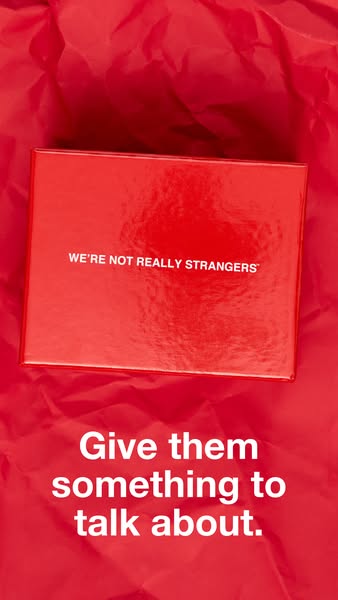
# Ad summary
This ad features the We're Not Really Strangers card game. The ad is a close up of the game box on a red background with the text "Give them something to talk about."
# Brand positioning
We're Not Really Strangers is presented as a brand focused on fostering deeper connections and meaningful conversations. The brand positions itself as a tool to move beyond superficial interactions, encouraging vulnerability and understanding between people. The brand's tone is intimate and thought-provoking, aligning with a lifestyle centered on emotional intelligence and authentic communication. It challenges the norms of surface-level interactions, pushing against the tendency for people to remain guarded or distant. The brand positioning is primarily emotional, aiming to create a sense of connection, empathy, and personal growth.
# Product
The product featured is the We're Not Really Strangers card game, designed to facilitate meaningful conversations and deeper connections between people. The game consists of a set of cards with questions and prompts intended to encourage vulnerability, self-reflection, and empathy. The game is for anyone looking to move beyond superficial interactions and build more authentic relationships. The game is packaged in a red box with the brand name printed on the front. The ad highlights the game as a tool to "give them something to talk about," suggesting it can overcome conversational barriers and spark engaging discussions. The ad addresses the purchase barrier of awkwardness or difficulty in initiating meaningful conversations.
# Visual style
The ad has a studio-shot, highly polished production quality. The visual motif is a monochromatic color scheme, using various shades and textures of red. The image treatment includes background removal, focusing attention on the product. The typography is large and bold, enhancing scannability. The style contrasts with platform-native content, aiming to disrupt the feed with a high-design aesthetic.
# Hooks
Headline: Give them something to talk about.
# Funnel stage
Top of funnel (Awareness)
# Pain points
The ad addresses the pain point of difficulty in initiating and maintaining meaningful conversations, as highlighted by the phrase "Give them something to talk about."
# Value propositions
- Give them something to talk about.
# Benefits
- Give them something to talk about.
# Call to action
None used.
# Social proof
- None used.
# Point of view
- Brand: The brand's point of view is present throughout the image, showcasing the product and its value proposition.
# Storyline
- The ad opens with a close-up shot of the We're Not Really Strangers card game box, immediately introducing the product. This is included to capture attention and establish the visual focus of the ad. The audience experiences this from the brand's perspective, showcasing its product as the central element.
- The ad then presents the text "Give them something to talk about," positioned below the product. This is included to highlight the game's primary benefit: facilitating engaging conversations. The audience experiences this from the brand's perspective, emphasizing the value proposition of the game.
# Ad summary
This ad promotes the We're Not Really Strangers card game. The ad features a person sitting on a bed and pulling cards from the game. The cards feature questions that are meant to help people connect on a deeper level.
# Brand positioning
We're Not Really Strangers is presented as a brand focused on fostering meaningful connections and vulnerability. The brand aims to occupy a space in the consumer's mind as a tool for deepening relationships and encouraging open communication. The brand aligns with values of authenticity, emotional intelligence, and self-reflection. It pushes against superficial interactions and promotes a lifestyle of genuine connection. The brand positioning is emotional, focusing on empowerment and vulnerability.
# Product
The featured product is the We're Not Really Strangers card game, designed to facilitate deeper connections between people. The game consists of three levels of questions, each designed to encourage vulnerability and self-reflection. The game is for anyone who wants to move beyond surface-level interactions and build more meaningful relationships. The cards feature questions like, "What parts of yourself do you see in me?" and "What's the most pain you've ever been in that wasn't physical?" The game addresses the purchase barrier of superficiality and promotes the idea that it's worth trying to foster genuine connections.
# Visual style
The ad has a casual, UGC feel with natural lighting and simple editing. The production quality is polished but not overly produced, which supports the intended tone of authenticity and relatability. The pacing is slow and deliberate, allowing viewers to focus on the questions and reflect on their meaning.
# Hooks
Spoken: 00:02–00:12: forget the rules. what matters is love that sees all of you and stays
Text overlay: 00:02–00:12: forget the rules. what matters is love that sees all of you and stays
Visual: 00:02–00:05: A person is sitting on a bed with a white comforter. In front of them is the We're Not Really Strangers card game. The game includes a red box and three stacks of red cards labeled "Level 1," "Level 2," and "Level 3." / 00:05–00:07: The person picks up a stack of cards and flips through them. / 00:07–00:12: The person holds up individual cards to the camera, revealing questions like, "What parts of yourself do you see in me?" and "What's the most pain you've ever been in that wasn't physical?" and "What is the last thing you lied to your mother about?"
# Funnel stage
Middle of funnel (Consideration)
# Pain points
The ad implies that many relationships are superficial and lack genuine connection. The opening text overlays of "situation-ship" and "love bombing" signal negative relationship experiences that the product aims to address.
# Value propositions
- The game provides a structured way to deepen connections with others.
- The questions are designed to encourage vulnerability and self-reflection, leading to more authentic relationships.
# Benefits
- Helps people move beyond superficial interactions
- Builds more meaningful relationships
- Encourages open communication
# Features
- Card game with three levels of questions
- Questions designed to foster vulnerability and self-reflection
# Call to action
None used.
# Social proof
- None used.
# Point of view
- Customer 100% – The entire video is presented from the perspective of a potential customer discovering and interacting with the product.
# Storyline
- 00:00–00:02 The ad opens with text overlays of terms associated with negative relationship experiences.
- 00:02–00:12 00:02–00:12: The ad transitions to a person sitting on a bed with the We're Not Really Strangers card game. The person pulls cards from the game, revealing questions designed to foster deeper connections. The message conveyed is that the game can help people move beyond superficial interactions and build more meaningful relationships. The perspective is from a potential customer who is discovering the game and its potential benefits. The tone is hopeful and encouraging.
# Ad summary
This ad features a couple on a hike using a deck of cards to ask each other questions and deepen their relationship.
# Brand positioning
We're Not Really Strangers is presented as a brand that aims to foster deeper connections and meaningful conversations between people. The brand positions itself as a tool for self-discovery and improved relationships, encouraging users to move beyond superficial interactions. The brand aligns with values of vulnerability, empathy, and personal growth, pushing against the norms of shallow communication and quick-fix solutions. The brand positioning is emotional, focusing on empowerment and connection.
# Product
We're Not Really Strangers is a card game designed to deepen relationships and encourage meaningful conversations. The game consists of a series of questions and prompts intended to foster vulnerability, empathy, and self-reflection. The product is for anyone seeking to improve their communication skills, strengthen their relationships, or engage in deeper self-discovery. The game addresses the purchase barrier of superficial interactions by providing a structured approach to meaningful conversation. The ad shows the couple using the cards while on a hike.
# Visual style
The ad has a UGC feel, with a handheld camera and natural lighting. The editing is simple, with static shots and smooth transitions. The production quality is casual, supporting the intended tone of authenticity and relatability. The pacing is slow and steady.
# Hooks
Text overlay: 00:00–00:09 Maturing is realizing that a strong, lasting relationship comes from recognizing that you and your partner have different backgrounds, pain, flaws, and perspectives. The goal isn't to run or shut down when it gets hard, but to grow together, learn to communicate, and break the cycle rather than carrying it into a new relationship
Visual: 00:00–00:05 The shot is taken outdoors, with a view of mountains and a lake in the background. In the foreground, a person is sitting on a rock, and a red box is on the rock next to them. The person is wearing a gray shirt and black shorts. The camera is handheld and slightly shaky. Text overlay is present.
# Funnel stage
Top of funnel (Awareness)
# Pain points
The ad implies that superficial interactions and a lack of meaningful communication can hinder the development of strong, lasting relationships. The text overlay states, "Maturing is realizing that a strong, lasting relationship comes from recognizing that you and your partner have different backgrounds, pain, flaws, and perspectives."
# Value propositions
- Structured approach to meaningful conversation
# Benefits
- Deepen relationships
- Encourage meaningful conversations
- Foster vulnerability
- Empathy
- Self-reflection
# Features
- Card game
- Series of questions and prompts
# Call to action
None used.
# Social proof
- None used.
# Point of view
- Customer 100% – The ad is presented from the perspective of a customer using the product in a real-life setting.
# Storyline
- 00:00–00:05 The ad opens with a text overlay about maturing and relationships.
- 00:05–00:09 00:05–00:09 The ad shows a person holding a card from the We're Not Really Strangers game. The message is to show the product being used in a real-life setting.
# Ad summary
This ad features a creator reviewing the We're Not Really Strangers Couples Edition card game. She explains that the game has three levels of questions and is for couples who have been together forever or who have just started dating. She shows some of the cards and explains that there are also fun wild cards throughout the whole game. She recommends the game for couples who are feeling a little bored in their relationship or who feel like their communication could be better.
# Brand positioning
We're Not Really Strangers is presented as a brand focused on fostering deeper connections through meaningful conversations. The brand aims to occupy a space in the consumer's mind as a tool for improving communication and intimacy, particularly in romantic relationships. The brand aligns with values of vulnerability, self-reflection, and emotional intelligence. It pushes against superficial interactions and promotes a lifestyle of intentional connection. The brand positioning is emotional, focusing on empowerment and improved relationships.
# Product
The We're Not Really Strangers Couples Edition is a card game designed to help couples deepen their connection through meaningful conversations. The game features three levels of questions: Perception, Connection, and Reflection, catering to couples at different stages of their relationship, whether they've been together for a long time or are just starting out. The game also includes fun wild cards to add variety and spontaneity. The product aims to address the pain points of boredom and poor communication in relationships, offering a fun and engaging way to dive deeper with your partner.
# Visual style
The ad has a casual, UGC feel with a simple overhead shot of the product on a bed. The editing is minimal, with static shots and no transitions. The production quality is basic, giving it an authentic and relatable tone. The pacing is slow and steady, with cuts only occurring when the creator changes the card being shown.
# Hooks
Spoken: If you feel like you and your man are losing your spark or you just suck at communication overall, this is couples therapy in a box.
Text overlay: This saved my 6 year relationship / Reply to cookiebanana8's comment / Show us some of the cards!!
Visual: 00:00–00:02: A hand places a red box on a white comforter. The box is labeled "COUPLES." A comment bubble is visible at the bottom of the screen. The camera is stationary and positioned overhead. / 00:02–00:05: The hand opens the box to reveal a deck of cards. The camera remains stationary and positioned overhead. / 00:05–00:06: The hand places three smaller red boxes on the comforter, labeled "LEVEL 1 (PERCEPTION)," "LEVEL 2 (CONNECTION)," and "LEVEL 3 (REFLECTION)." The camera remains stationary and positioned overhead.
# Funnel stage
Middle of funnel (Consideration)
# Pain points
Feeling a little bored in your relationship or you feel like your communication could be better.
# Value propositions
- Couples therapy in a box
- A fun and engaging way to improve your relationship
# Benefits
- Helps couples dive deeper with their partner
- Improves communication
- Adds spark to the relationship
# Features
- Three levels of questions: Perception, Connection, and Reflection
- Fun wild cards
# Call to action
None used.
# Social proof
- "This saved my 6 year relationship" – Female 1 (Customer)
# Point of view
- Customer 100% – The entire video is told from the perspective of a customer reviewing the product.
# Storyline
- 00:00–00:05 The creator introduces the product as a solution for couples who are losing their spark or struggling with communication.
- 00:05–00:06 She describes the game as "couples therapy in a box," highlighting its potential to improve relationships.
- 00:06–00:11 She explains that the game has three levels of questions for couples who have been together forever or who have just started dating.
- 00:11–00:15 She lists the three levels of questions: perception, connection, and reflection.
- 00:15–00:36 She shows some of the cards and reads the questions aloud.
- 00:36–00:39 She mentions that there are also fun wild cards throughout the whole game.
- 00:39–00:46 She recommends the game for couples who are feeling a little bored in their relationship or who feel like their communication could be better.
# Ad summary
A woman shares that she and her boyfriend are losing their spark and she doesn't know what to do. She then shares the We're Not Really Strangers card game as a way to reconnect with your partner.
# Brand positioning
We're Not Really Strangers is presented as a card game designed to deepen connections and foster meaningful conversations. The brand aims to occupy a space in the consumer's mind as a tool for building intimacy and understanding in relationships. The brand aligns with values of vulnerability, authenticity, and emotional connection. It pushes against superficial interactions and promotes deeper engagement. The brand positioning is emotional, focusing on empowerment and connection.
# Product
We're Not Really Strangers is a card game designed to deepen connections and foster meaningful conversations. The game is for anyone looking to build intimacy and understanding in their relationships, whether romantic, platonic, or familial. The game consists of a series of thought-provoking questions and prompts designed to encourage vulnerability and self-reflection. The USP is its ability to facilitate meaningful conversations and create deeper connections between people. The ad shows the game being used as a way to reconnect with a partner who is losing their spark. The ad addresses the purchase barrier of not knowing how to reignite the spark in a relationship by offering a tangible tool for connection. The ad tells the viewer that this product is worth trying because it offers a fun and engaging way to build stronger, more meaningful relationships.
# Visual style
The ad has a UGC feel, with natural lighting and a selfie-style camera angle. The editing style is simple, with static shots and smooth transitions. The production quality is casual, supporting the intended tone of a personal recommendation. The pacing is consistent, with a moderate tempo. The audio-visual sync is timed to the woman's speech.
# Hooks
Spoken: 00:00–00:03 Female 1: My bf and I are losing our spark and I don't know what to do.
Text overlay: 00:00–00:07 “my bf and i are losing our spark and idk what to do” (Caption box) / 00:00–00:07 we’re not really strangers (Caption box)
Visual: 00:00–00:03 The shot is a close-up of a woman with long brown hair, wearing a black top, standing in front of a white wall with a plant in the background. The setting appears to be a home interior. The woman is looking directly at the camera with a concerned expression. The camera is stationary and selfie-style, with natural lighting.
# Funnel stage
Top of funnel (Awareness)
# Pain points
Losing the spark in a relationship: “my bf and i are losing our spark and idk what to do”
# Value propositions
- A fun and engaging way to build stronger, more meaningful relationships
- A tangible tool for connection
# Benefits
- Deepens connections
- Fosters meaningful conversations
- Encourages vulnerability
- Encourages self-reflection
# Features
- Card game
- Thought-provoking questions and prompts
# Call to action
None used.
# Social proof
- None used.
# Point of view
- Customer 100% – The entire video is told from the perspective of a customer sharing her personal experience and solution.
# Storyline
- 00:00–00:03 00:00–00:03 A woman is looking directly at the camera and states that she and her boyfriend are losing their spark and she doesn't know what to do. The message is to convey a common relationship problem and to create a sense of relatability with the audience. The perspective is from the woman sharing her personal experience, conveyed through her direct address and casual tone. The tone is concerned and seeking help, which progresses the narrative by setting up the problem that the product will solve.
- 00:03–00:07 00:03–00:07 The woman holds up a red box with the words "We're Not Really Strangers" on it. The message is to introduce the product as a solution to the problem stated in the previous beat. The perspective is from the woman showcasing the product, conveyed through her enthusiastic tone and visual presentation. The tone is hopeful and excited, which progresses the narrative by presenting the product as a potential solution.
# Ad summary
A woman shares three questions to ask your partner to deepen your relationship. She recommends the card game "We're Not Really Strangers: Couples Edition" to help couples dig a little deeper.
# Brand positioning
We're Not Really Strangers is presented as a card game designed to deepen relationships through meaningful conversations. The brand aims to occupy a space of emotional intimacy and connection, promoting values of vulnerability, understanding, and open communication. It pushes against superficial interactions, encouraging users to explore deeper aspects of their relationships. The brand positioning is emotional, focusing on fostering intimacy and connection between partners.
# Product
The featured product is the "We're Not Really Strangers: Couples Edition" card game, designed to help couples deepen their relationship. It is filled with questions intended to spark meaningful conversations, whether the couple has just made it official or has been together forever. The game aims to open eyes to things that may not have been seen before and is presented as a tool for every couple to play and dig a little deeper. The USP is its ability to facilitate conversations that might not otherwise occur, leading to a deeper understanding and connection between partners. The ad addresses the purchase barrier of potential awkwardness or difficulty in initiating deep conversations by providing a structured and engaging way to do so.
# Visual style
The ad has a casual, UGC feel with natural lighting and static shots. The production quality is simple, resembling a typical social media video. The editing style consists of static shots with smooth transitions. The pacing is consistent throughout the ad.
# Hooks
Spoken: Female 1: If you're in a relationship, I'm begging you to ask your partner these three questions.
Text overlay: 3 KINDA SPICY QUESTIONS / TO ASK YOUR PARTNER
Visual: 00:00–00:03 The shot is a close-up of a woman with long, dark hair, fair skin, and light makeup. She is wearing a dark tank top. The background is a bedroom with a white wall, a framed picture, and a ceiling fan.
# Funnel stage
Middle of funnel (Consideration)
# Pain points
The ad implies that couples may struggle to have meaningful conversations or may not know how to initiate deeper discussions about their relationship. "I've had some of the best conversations with my partner playing this that I feel like we never would have had otherwise."
# Value propositions
- The card game is filled with questions to help deepen your relationship, whether you just made it official or have been together forever.
- The card game helps you dig a little deeper.
# Benefits
- Helps deepen your relationship
- Helps you dig a little deeper
# Features
- Card game filled with questions
# Call to action
None used.
# Social proof
- "I've had some of the best conversations with my partner playing this that I feel like we never would have had otherwise" – Female 1 (Customer)
# Point of view
- Customer 100% – The entire video is told from the perspective of a customer sharing her personal experience and recommendations.
# Storyline
- 00:00–00:03 The creator introduces the topic of the video.
- 00:03–00:16 The creator shares the first question to ask your partner: "How do you define cheating?"
- 00:16–00:32 The creator shares the second question to ask your partner: "What do you think I struggle to open up about in our relationship?"
- 00:32–00:44 The creator shares the third question to ask your partner: "What can we laugh about now that once felt so daunting in our relationship?"
- 00:44–00:57 The creator reveals that the questions are from the card game "We're Not Really Strangers: Couples Edition."
- 00:57–01:07 The creator shares her personal experience with the card game.
# Ad summary
This ad promotes the We're Not Really Strangers card game, emphasizing its ability to foster deeper connections through thought-provoking questions. The ad features a creator unboxing and describing the game, highlighting its three levels of questions designed to bring people closer together.
# Brand positioning
We're Not Really Strangers is presented as a brand focused on fostering deeper connections and meaningful conversations. The brand positions itself as a tool for self-discovery and understanding others, even those you've known for a long time. It encourages vulnerability and open communication, pushing against superficial interactions. The brand's tone is earnest and introspective, aligning with a lifestyle of self-improvement and emotional intelligence. It occupies a space in the market that values authentic relationships over small talk, appealing to those seeking genuine connections.
# Product
The We're Not Really Strangers card game is a tool designed to foster deeper connections through meaningful conversations. It consists of 150 questions divided into three levels: Perception, Connection, and Reflection. The game is intended for anyone who wants to learn more about themselves and others, regardless of how long they've known each other. The questions range from light to deep, addressing potential purchase barriers by suggesting that even tough conversations can be beneficial. The game's USP is its ability to uncover things you never knew before, promoting the idea that it can enhance any relationship.
# Visual style
The ad has a casual, UGC feel with a top-down perspective and minimal editing. The production quality is simple, focusing on clear visuals of the product and text. The pacing is consistent, with static shots and natural transitions. The red and white color scheme of the product is visually prominent.
# Hooks
Spoken: 00:00–00:01 If you're scared of this game, keep watching.
Text overlay: 00:00–00:01 WE'RE NOT REALLY STRANGERS
Visual: 00:00–00:01: A red box with the words "WE'RE NOT REALLY STRANGERS" in white text is dropped onto a white sheet. The camera is positioned directly above, providing a top-down view.
# Funnel stage
Middle of funnel (Consideration)
# Pain points
The ad addresses the fear or hesitation some may have about engaging in deep or vulnerable conversations: "If you're scared of this game, keep watching."
# Value propositions
- The game's three levels offer a structured approach to deepening connections.
- The game helps you find out what you didn't even know you wanted to ask.
# Benefits
- Designed to bring you closer
- Helps you find out what you didn't even know you wanted to ask
# Features
- 150 questions
- Three different levels: Perception, Connection, and Reflection
# Call to action
None used.
# Point of view
- Customer 100% – The entire video is presented from the perspective of a customer sharing their experience with the product.
# Storyline
- 00:00–00:01 The ad begins with a red box labeled "We're Not Really Strangers" being dropped onto a white sheet.
- 00:00–00:01 The creator speaks directly to the camera, warning viewers that if they're scared of the game, they should keep watching.
- 00:01–00:07 The creator opens the box to reveal the cards inside, then shows examples of questions from the deck.
- 00:07–00:09 The creator explains that despite what some may think, there is nothing to be afraid of in this game.
- 00:09–00:17 The creator states that you learn things you never knew before when playing We're Not Really Strangers, even if you've known someone your whole life.
- 00:17–00:24 The creator describes the game's features, including its 150 questions and three different levels, emphasizing that they are all designed to bring you closer.
- 00:24–00:28 The creator suggests that if a tough conversation comes up, it might be the one that needed to happen anyway.
- 00:28–00:31 The creator concludes by stating that the game helps you find out what you didn't even know you wanted to ask.
# Ad summary
A woman reviews the We're Not Really Strangers Couples Edition card game, explaining that it is designed to help couples communicate and connect on a deeper level. She recommends it to all couples, whether they've been together forever or just started dating.
# Brand positioning
We're Not Really Strangers is presented as a brand that aims to foster deeper connections and meaningful conversations, particularly within romantic relationships. The brand positions itself as a tool for couples to improve communication and address potential relationship challenges. The brand aligns with values of emotional intimacy, vulnerability, and personal growth. It pushes against the norm of superficial interactions, offering a structured way to delve into more profound topics. The brand positioning is both functional, by providing a tool for communication, and emotional, by promising deeper connection and understanding.
# Product
The We're Not Really Strangers Couples Edition is a card game designed to facilitate deeper conversations and improve communication between partners. It consists of 100 questions divided into three levels, intended to help couples talk about important topics and connect on a deeper level. The game is presented as a tool to address the number one reason couples break up: communication issues. It is marketed towards couples who may be struggling with communication or feel they have lost their spark, offering an easy and fun way to reconnect. The product is framed as "couples therapy in a box," suggesting it provides a structured approach to addressing relationship challenges.
# Visual style
The ad has a natural, unfiltered aesthetic, resembling user-generated content. The editing style consists of static shots with minimal transitions. The production quality is simple, with a focus on clear visuals and audio. The pacing is moderate, with cuts timed to natural pauses in speech. The overall feel is authentic and relatable, aligning with the tone of a personal recommendation.
# Hooks
Spoken: 00:00–00:03 What's something we used to do at the beginning of our relationship that you miss the most?
Text overlay: 00:00–00:04 WHAT'S SOMETHING WE USED TO DO AT THE BEGINNING OF OUR RELATIONSHIP THAT YOU MISS THE MOST?
Visual: 00:00–00:03 The shot is a close-up of a young woman with long, dark hair, wearing a black top and a gold necklace. She is holding a white card with pink text that reads, "WHAT'S SOMETHING WE USED TO DO AT THE BEGINNING OF OUR RELATIONSHIP THAT YOU MISS THE MOST?" She is indoors, with a white wall and a window in the background. The camera is stationary and at eye level.
# Funnel stage
Consideration
# Pain points
The ad addresses the pain point of communication struggles in relationships. "If you and your partner struggle with communication or you feel like you've lost that spark..."
# Value propositions
- Couples therapy in a box: The product is presented as a convenient and accessible way to address relationship issues.
- Designed to help you and your partner talk about the things that matter and connect on a deeper level: The product is designed to facilitate meaningful conversations and strengthen the bond between partners.
# Benefits
- Helps you and your partner talk about the things that matter
- Connect on a deeper level
- Easy and fun way to get the spark back
# Features
- 100 questions
- Three different levels
# Call to action
None used.
# Social proof
- "I have been with my boyfriend for over 10 years, yes since high school, and I still learn things about him when we play this game" – Female 1 (Customer)
# Point of view
- Customer 100% – The entire video is told from the perspective of a customer who is sharing her personal experience with the product.
# Storyline
- 00:00–00:08 00:00–00:08 The creator holds up several cards, each with a question printed on it, such as, "What's something we used to do at the beginning of our relationship that you miss the most?" The intention is to showcase the types of questions included in the game and pique the viewer's curiosity. The audience experiences the ad from the creator's perspective, as she directly addresses the camera. The tone is inquisitive and thoughtful.
- 00:08–00:16 00:08–00:16 The creator holds up the red box of the Couples Edition card game and states, "These are questions from the couples edition of We're Not Really Strangers. It's basically like couples therapy in a box. The number one reason couples break up is because of communication." The intention is to introduce the product and highlight its purpose in addressing communication issues in relationships. The audience experiences the ad from the creator's perspective, as she directly addresses the camera. The tone is informative and slightly serious.
- 00:16–00:25 00:16–00:25 The creator holds up the box again, showing the cards inside, and says, "So this is a hundred questions with three different levels and it's designed to help you and your partner talk about the things that matter and connect on a deeper level." The intention is to detail the product's features and benefits, emphasizing its ability to foster meaningful conversations. The audience experiences the ad from the creator's perspective, as she directly addresses the camera. The tone is informative and encouraging.
- 00:26–00:33 00:26–00:33 The creator holds up the box and states, "I have been with my boyfriend for over 10 years, yes since high school, and I still learn things about him when we play this game. I know that sounds crazy." The intention is to provide a personal testimonial, building credibility by sharing her own experience with the product. The audience experiences the ad from the creator's perspective, as she directly addresses the camera. The tone is casual and relatable.
- 00:33–00:45 00:33–00:45 The creator holds up the box and concludes, "So if you and your partner struggle with communication or you feel like you've lost that spark, this is such an easy and fun way to get it back. I recommend this to every couple whether they've been together forever or just started dating." The intention is to offer a solution to a common relationship problem and encourage viewers to try the product. The audience experiences the ad from the creator's perspective, as she directly addresses the camera. The tone is encouraging and supportive.
# Ad summary
This ad shows the We're Not Really Strangers card game. The ad shows the box and the different levels of questions in the game.
# Brand positioning
We're Not Really Strangers is presented as a brand that aims to foster deeper connections between people. The brand aligns with values of vulnerability, self-reflection, and meaningful conversation. It pushes against superficial interactions and small talk, instead promoting authenticity and emotional exploration. The brand positioning is primarily emotional, focusing on the desire for genuine connection and understanding. The product aims to help people move beyond surface-level interactions and engage in more meaningful conversations.
# Product
The product is the We're Not Really Strangers card game, designed to facilitate deeper connections between people. The game consists of three levels of questions: Perception, Connection, and Reflection. The cards contain thought-provoking questions intended to encourage vulnerability and self-disclosure. The game also includes a pencil and notepads for players to write messages to each other. The ad highlights the game's ability to help people who crave deeper connections, suggesting that it addresses the barrier of superficial interactions and provides a structured way to engage in more meaningful conversations.
# Visual style
The ad has a simple, clean aesthetic with a focus on the product. The editing is straightforward with static shots and smooth transitions. The production quality is polished, giving it a commercial feel. The pacing is consistent, with a moderate tempo. The cuts are timed to the music beats.
# Hooks
Text overlay: 00:00–00:03 pov: u got this because you crave deeper connections / 00:00–00:03 Reply to ashleyinsavannah's comment (Comment) / 00:00–00:03 Can you show us some of the questions? (Comment)
Visual: 00:00–00:02 A hand with light pink nail polish holds a red box with the words "WE'RE NOT REALLY STRANGERS" in white letters. The box is on a white bed sheet. A comment bubble is visible in the upper left corner. The camera is stationary and focuses on the box.
# Funnel stage
Middle of funnel (Consideration)
# Pain points
The ad implies that people often struggle with superficial interactions and crave more meaningful connections.
# Value propositions
- Craving deeper connections? This game is for you.
# Benefits
- Facilitates deeper connections between people
- Encourages vulnerability and self-disclosure
- Provides a structured way to engage in meaningful conversations
# Features
- Three levels of questions: Perception, Connection, and Reflection
- Cards with thought-provoking questions
- Includes a pencil and notepads
# Call to action
None used.
# Social proof
- None used.
# Point of view
- Customer 100% – The video is shot from the perspective of a customer showing the product and its features.
# Storyline
- 00:00–00:02 The video begins with a close-up of the We're Not Really Strangers card game box on a white bed sheet.
- 00:02–00:04 The box is opened to reveal the cards inside, which are divided into three levels: Level 1 (Perception), Level 2 (Connection), and Level 3 (Reflection).
- 00:04–00:06 The hand holds up a card from Level 1, which asks, "Do I look kind? Explain."
- 00:07–00:10 The hand holds up a card from Level 2, which asks, "What's the most pain you've ever been in that wasn't physical?"
- 00:10–00:13 The hand holds up another card from Level 1, which asks, "What is the last thing you lied to your mother about?"
- 00:13–00:16 The hand holds up a card with instructions: "Each player write a message to the other. Fold and exchange. Open only once you two have parted."
- 00:16–00:19 The video ends with a view of the box and the cards.
# Ad summary
This ad features a woman reviewing the We're Not Really Strangers card game. She emphasizes its ability to foster deep connections and facilitate meaningful conversations, highlighting its potential to strengthen relationships and even spark new ones. She describes the game's structure, mentioning its multiple levels and different ways to play, and shares her personal experiences of creating cherished memories while playing.
# Brand positioning
We're Not Really Strangers is presented as a brand that facilitates deep connections and meaningful conversations. The brand aims to occupy a space in the consumer's mind as a tool for fostering relationships, healing family dynamics, and even sparking romance. The brand aligns with values of vulnerability, authenticity, and emotional growth. It pushes against superficial interactions and promotes deeper understanding between people. The brand positioning is primarily emotional, focusing on the potential for connection, healing, and personal growth.
# Product
The We're Not Really Strangers card game is a tool designed to foster deep connections and meaningful conversations between people. It consists of 150 questions across multiple levels, offering two ways to play: "play it safe" or "play to grow." The game is intended for anyone who craves deep connections and is designed to facilitate the start of relationships, the formation of friendships, and the healing of family dynamics. The game addresses the barrier of superficial interactions by providing structured prompts for deeper conversations. The ad emphasizes the game's potential to create cherished memories and facilitate personal growth.
# Visual style
The ad has a casual, UGC feel with natural lighting and a simple background. The editing style is straightforward with static shots and minimal transitions. The production quality is clean but not overly polished, supporting the authentic and relatable tone. The pacing is moderate, with cuts timed to the speaker's pauses.
# Hooks
Spoken: 00:00–00:02: What is in this game?
Text overlay: 00:00–00:02: WE'RE NOT REALLY STRANGERS
Visual: 00:00–00:02: A hand holds and rotates a red box with the words "WE'RE NOT REALLY STRANGERS" printed in white on the top. The background is a white bed sheet.
# Funnel stage
Middle of funnel (Consideration)
# Pain points
The ad implies that people struggle with superficial interactions and crave deeper connections.
# Value propositions
- Facilitates deep connections
- Creates meaningful conversations
- Helps start relationships
- Helps form friendships
- Helps heal family dynamics
- Creates favorite memories
# Benefits
- Relationships start
- Friendships form
- Family start to heal
- Proposals
# Features
- 150 questions
- Multiple levels
- Two ways to play: play it safe or play to grow
# Call to action
None used.
# Social proof
- "I have seen so many relationships start from this game, friendships form, family start to heal. I've even seen proposals from this game."
# Point of view
- Customer 100% – The entire ad is told from the perspective of a customer sharing her personal experience and recommendation of the product.
# Storyline
- 00:00–00:02 The ad begins with a woman holding a red box with the words "WE'RE NOT REALLY STRANGERS" printed on it.
- 00:02–00:08 She expresses her belief that the game should come with a warning label, implying it's more than just a typical card game.
- 00:08–00:17 She shares her observations of relationships starting, friendships forming, and families healing through the game, even mentioning proposals.
- 00:17–00:24 She details the game's features, including 150 questions, multiple levels, and two ways to play: "play it safe" or "play to grow."
- 00:24–00:27 She shares that some of her favorite memories have been made playing this game.
- 00:27–00:31 She concludes by recommending the game to those who crave deep connections.
How Other Lifestyle Brands Advertise on Meta
Peer brands in Motion's library — click any brand to see their creative strategy, live ads, and AI breakdowns.