

# Ad summary
This video ad features a female expert in a lab coat explaining why many people struggle with sleep despite taking magnesium. She highlights that magnesium alone is insufficient for anxiety-related insomnia and introduces saffron as the missing psychological component. The ad then details the 'Naali Magnésium +' product, emphasizing its blend of four highly assimilable magnesium forms, clinical-dose saffron, taurine, and vitamin B6. It explains the scientific mechanism of these ingredients in regulating neurotransmitters and reducing cerebral hyperactivity, promising faster sleep onset, improved sleep quality, and a less exhausted appearance within weeks. The ad targets individuals whose sleep issues stem from mental overactivity and stress, positioning the product as a comprehensive, science-backed solution.
# Brand positioning
Naali is presented as a science-backed supplement brand that offers a comprehensive and effective solution for sleep and stress issues, going beyond conventional single-ingredient remedies. The brand aims to occupy a space in the consumer's mind as a trustworthy authority on sleep science, providing a 'complete formula' for those who have tried other solutions without success. It aligns with values of scientific rigor, efficacy, and holistic well-being. The brand pushes against the norm of simplistic solutions (like magnesium alone) by emphasizing a multi-faceted, biochemically informed approach. Its positioning is primarily functional, focusing on the proven performance of its ingredients, but also touches on emotional outcomes like reduced anxiety and improved emotional well-being.
# Product
The featured product is 'Naali Magnésium +,' a dietary supplement designed to address sleep difficulties, particularly those linked to mental overactivity and anxiety. It is for individuals who struggle to fall asleep, ruminate on thoughts at night, make endless to-do lists in the early hours, or feel anxious about not being able to sleep, even if their body is exhausted. The product's core features include: four forms of highly assimilable magnesium (citrate for immediate calming, bisglycinate for nervous system support, glycerophosphate for prolonged release, and marine Aquamin for optimal cellular absorption), 100% pure Afghan red saffron at a clinical dose of 30mg, taurine to improve magnesium absorption, and vitamin B6 to facilitate the conversion of tryptophan into serotonin. The ad emphasizes that it's not just magnesium, but this 'complete formula' that acts on both physical tension and the dysregulation of stress hormones. The unique selling proposition is its dual action on both physical and psychological aspects of sleep, particularly its inclusion of saffron, which is clinically proven to improve emotional well-being and reduce sleep-disrupting symptoms by regulating dopamine and serotonin circuits. The ad suggests use occasions are nightly, leading to falling asleep in 20 minutes within two weeks and sleeping through the night after a month. It addresses the purchase barrier of previous failed attempts with magnesium alone by explaining the scientific rationale behind its comprehensive formula.
# Visual style
The visual style is a hybrid of polished commercial and educational content, with elements of UGC. The overall aesthetic is clean and modern, with bright lighting in the expert segments and more subdued, realistic lighting in the problem/solution scenarios. Editing is fast-paced with quick cuts, especially during the problem-setting and ingredient explanation segments, maintaining engagement. Production quality is high, with clear visuals and professional camera work, but the use of split screens and direct address to the camera gives it a relatable, social media-native feel. Visual motifs include the consistent presence of the expert in a lab coat, scientific overlays (chemical structures, research papers), and contrasting visuals of restless vs. peaceful sleep. Pacing is generally quick, with cuts occurring every 1-3 seconds, especially during explanations, and slowing slightly during the more serene 'solution' visuals. Audio-visual sync is strong, with text overlays and visual changes perfectly timed to the voiceover, enhancing the educational aspect.
# Hooks
Spoken: Pourquoi votre partenaire s'endort en 5 minutes alors que vous il vous faut 1h
Text overlay: Pourquoi votre partenaire s'endort en 5 minutes alors que vous il vous faut / 1h
Visual: The screen is split vertically. The top half shows a light-skinned man with short brown hair, lying on his back in bed, covered by a striped duvet, with his hands behind his head, sleeping and snoring. The bottom half shows a light-skinned woman with reddish-brown hair, wearing a white lab coat over a leopard print top, looking directly at the camera with a neutral expression. The background behind her is a plain light wall. TikTok UI elements are visible on the right side and top of the screen. / The screen is split vertically. The top half shows a light-skinned woman with dark hair, lying on her back in bed, covered by a striped duvet, with her hands behind her head, yawning and rubbing her eyes. The bottom half shows the same light-skinned woman with reddish-brown hair in a lab coat, looking directly at the camera with a neutral expression. TikTok UI elements are visible. / The screen is split vertically. The top half shows the light-skinned woman from the previous shot, still in bed, looking frustrated and rubbing her eyes. The bottom half shows the same light-skinned woman with reddish-brown hair in a lab coat, looking directly at the camera with a neutral expression. TikTok UI elements are visible. / The screen shows a medium close-up of the light-skinned woman with reddish-brown hair, wearing a white lab coat over a leopard print top, looking directly at the camera. She has a serious, slightly questioning expression and gestures with her hands. The background is a plain light wall. The camera is stationary and at eye level. / The shot remains the same: medium close-up of the woman in a lab coat, looking directly at the camera with a serious expression, gesturing with her hands. The background is a plain light wall. / The shot remains the same: medium close-up of the woman in a lab coat, looking directly at the camera with a serious expression, gesturing with her hands. The background is a plain light wall.
# Funnel stage
Consideration
# Pain points
The central pain point is the inability to fall asleep due to mental overactivity and anxiety, even when the body is exhausted. This is highlighted by scenarios like: "à minuit se repasse les discussions en boucle", "à 2h du matin fait des listes de choses à faire interminables", and being "anxieux à l'idée de ne pas arriver à s'endormir."
# Value propositions
- Ce n'est pas seulement une carence en magnésium, c'est ceci
- le magnésium seul ne suffira pas
- La pièce manquante? S'attaquer à l'aspect psychologique
- le safran a fait l'objet de nombreuses études sur ses effets sur l'humeur et l'anxiété
- 30mg par jour d'extrait de safran avaient un réel impact
- on agit sur les 2 aspects de l'équation du sommeil
- C'est précisément ce que fait Naali Magnésium +
- c'est la formule complète qui explique pourquoi une personne comme vous qui a tout essayé, dont le corps est épuisé mais dont l'esprit refuse de se reposer reste encore éveillé la nuit
- la différence est rapide en quelques jours seulement
- votre esprit a besoin d'un soutien, pas seulement vos muscles
# Benefits
- aide votre corps à se détendre physiquement
- améliore les scores de bien-être émotionnel
- réduit les symptômes qui perturbent le sommeil
- agit sur les circuits de la dopamine et de la sérotonine
- contribue à réguler nos neurotransmetteurs
- réduit l'hyperactivité cérébrale
- agit sur la tension physique
- agit sur les dérèglements des hormones du stress
- le flot incessant de pensées s'apaise
- s'endormir en 20 minutes (en 2 semaines)
- dormir d'une traite (après un mois d'utilisation)
- ne plus avoir l'air épuisé
# Features
- 4 formes de magnésium
- citrate pour un effet calmant immédiat
- bisglycinate pour soutenir le système nerveux
- glycérophosphate pour une libération prolongée
- magnésium marin Aquamin pour une absorption cellulaire optimale
- safran rouge afghan pur à 100%
- dose clinique de 30mg (safran)
- taurine qui améliore l'absorption du magnésium
- vitamine B6 pour favoriser la conversion du tryptophane en sérotonine
# Call to action
None used
# Social proof
- Les recherches confirment ces résultats, une méta-analyse publiée dans PubMed Central a révélé que même si le magnésium aidait les populations carencées à mieux dormir, les résultats étaient par contre incohérents chez les personnes qui souffrent d'insomnie liées à l'anxiété. – Female 1 (Expert)
- Plusieurs essais contrôlés randomisés ont montré que 30mg par jour d'extrait de safran avaient un réel impact. – Female 1 (Expert)
- dont l'efficacité a été prouvée lors d'essai clinique. – Female 1 (Expert)
# Point of view
- Expert 80% – The main speaker, dressed in a lab coat, provides scientific explanations and product details, establishing authority.
- Customer 20% – Visuals depict relatable scenarios of people struggling with sleep, using the product, and experiencing its benefits, representing the user's perspective.
# Storyline
- 00:00–00:07 The video opens with a split screen, showing a man sleeping soundly and snoring on the top half, while a woman lies awake, looking frustrated, on the bottom half. This immediately establishes a relatable problem: one partner sleeps easily, while the other struggles, setting a tone of shared experience and frustration.
- 00:07–00:13 The expert, dressed in a lab coat, appears on screen and poses a direct question to the viewer: 'Pourquoi votre partenaire s'endort en 5 minutes alors que vous il vous faut 1h' (Why does your partner fall asleep in 5 minutes while you need 1 hour?). This directly addresses the viewer's potential pain point and establishes the expert's role in providing an answer, shifting the perspective to an authoritative, educational one.
- 00:13–00:15 The expert states, 'Ce n'est pas seulement une carence en magnésium, c'est ceci:' (It's not just a magnesium deficiency, it's this:). This immediately challenges a common assumption and builds curiosity, signaling that a deeper, more complex explanation is coming from an informed perspective.
- 00:15–00:18 The expert continues, 'Je vais vous expliquer ce qui cloche' (I'm going to explain what's wrong). This reinforces her role as a problem-solver and expert, promising to reveal the underlying issue.
- 00:18–00:26 The expert explains that magnesium acts on muscles and stress hormone levels, with visuals of a woman stretching her back and then molecular structures. This provides a scientific basis for magnesium's role, but the expert's tone implies it's not the full picture.
- 00:26–00:33 The expert confirms that magnesium supplementation can help the body relax physically, with a visual of a woman stretching on a couch. This acknowledges a known benefit but sets up the subsequent argument that it's not enough for all sleep issues.
- 00:33–00:46 The expert then introduces the core problem: mental overactivity and anxiety. She describes scenarios like replaying discussions at midnight, making endless to-do lists at 2 AM, or being anxious about not falling asleep, accompanied by visuals of people looking restless and worried in bed. This directly addresses the psychological pain points of the target audience, creating strong relatability and empathy.
- 00:46–01:05 The expert states that magnesium alone will not suffice for these anxiety-related sleep issues. She supports this by showing a scientific paper and mentioning a meta-analysis published in PubMed Central, which revealed that while magnesium helped deficient populations sleep better, results were inconsistent for those with anxiety-related insomnia. This builds credibility through scientific evidence and reinforces the inadequacy of a single-ingredient solution.
- 01:05–01:09 The expert asks, 'La pièce manquante?' (The missing piece?), then answers, 'S'attaquer à l'aspect psychologique' (Addressing the psychological aspect). This creates a clear problem-solution framework and introduces the key differentiator of the product.
- 01:09–01:16 The expert introduces saffron, holding a handful of saffron threads, and preempts skepticism by saying, 'avant que vous ne pensiez 'le safran n'est qu'une épice', comprenez ceci' (before you think 'saffron is just a spice', understand this). This directly addresses a potential objection and prepares the viewer for scientific evidence.
- 01:16–01:22 The expert explains that saffron has been the subject of numerous studies on its effects on mood and anxiety, showing more scientific text. This further builds scientific credibility for saffron as a key ingredient.
- 01:22–01:37 The expert states that randomized controlled trials have shown that 30mg of saffron extract per day had a real impact, improving emotional well-being scores and reducing sleep-disrupting symptoms, with a visual of a woman meditating peacefully. This highlights the specific dosage and benefits, connecting scientific findings to desired emotional outcomes.
- 01:37–01:49 The expert then explains the mechanism: saffron acts on dopamine and serotonin circuits, regulating neurotransmitters responsible for cerebral hyperactivity, with visuals of chemical structures and glowing neural networks. This provides a clear, scientific explanation for how saffron addresses the psychological aspect of sleep.
- 01:49–02:05 The expert summarizes that by combining highly assimilable magnesium forms with clinical-dose saffron, the product acts on both physical tension and stress hormone dysregulation, with a visual of hands sifting saffron. This reinforces the comprehensive nature of the product's formula.
- 02:05–02:08 The expert introduces the product, 'Naali Magnésium +,' holding up the product container. This is the direct product reveal, linking all the scientific explanations to the specific solution.
- 02:08–02:13 The expert details the four forms of magnesium in the product, explaining their alternating action throughout the night, with a visual of a woman unboxing the product. This highlights the advanced formulation and sustained benefit.
- 02:13–02:28 The expert explains the specific benefits of each magnesium form: citrate for immediate calming, bisglycinate for nervous system support, glycerophosphate for prolonged release, and marine Aquamin for optimal cellular absorption, with visuals of the woman preparing the drink and animated cell graphics. This provides detailed functional benefits for each component.
- 02:28–02:35 The expert then highlights the 100% pure Afghan red saffron at a clinical dose of 30mg, showing a close-up of saffron threads being poured. This reiterates the quality and proven efficacy of the saffron component.
- 02:35–02:38 The expert emphasizes that the efficacy of these ingredients has been proven in clinical trials, with a visual of two women in lab coats looking at a tablet and a clipboard, and a green checkmark appearing. This provides strong social proof and scientific validation.
- 02:38–02:50 The expert adds that taurine and vitamin B6 are also included to improve magnesium absorption and convert tryptophan to serotonin, with a visual of a small bottle of taurine and a serotonin chemical structure. This further explains the synergistic effects of the complete formula.
- 02:50–03:03 The expert concludes this section by stating it's not just magnesium, but the 'complete formula' that explains why someone who has tried everything, whose body is exhausted but whose mind refuses to rest, remains awake at night, with a visual of a woman looking tired and rubbing her temples. This directly addresses the target audience's experience and reinforces the product's unique value.
- 03:03–03:12 The expert promises that the difference is rapid, with the incessant flow of thoughts subsiding in just a few days, accompanied by a visual of a man sleeping peacefully with a thought bubble showing calm lines. This offers a quick and tangible benefit, addressing the immediate relief desired by insomniacs.
- 03:12–03:22 The expert details the long-term benefits: falling asleep in 20 minutes (instead of 45+ minutes) within two weeks, and sleeping through the night after a month, with visuals of the woman drinking the product and then a woman sleeping soundly. This provides clear, measurable outcomes and builds anticipation for sustained results.
- 03:22–03:27 The expert adds a social benefit: colleagues will stop worrying because the user no longer looks exhausted, with a visual of two colleagues smiling and interacting positively. This highlights the positive impact on daily life and social perception.
- 03:27–03:37 The expert reiterates that if magnesium only slightly helped without solving the problem, the viewer now knows why: their mind needs support, not just their muscles, with a visual of the woman drinking the product. This circles back to the initial problem, reinforcing the product's unique, comprehensive solution.

How Naali Advertises on Meta
Updated Apr 19, 2026 · Refreshes weekly
Naali runs 169 active ads on Meta, shipping ~42 new creatives per week. Their library leans on Testimonial13%, Listicle11%, and Demo11%. Recently, Naali is pushing its saffron-based stress and sleep supplements — primarily Magnesium+ and anti-stress gummies — on the core argument that magnesium alone isn't enough, and that saffron is the missing psychological fix for anxiety-driven insomnia and chronic stress. The through-line is science-backed legitimacy paired with personal transformation: calm mind, better sleep, visible results within two weeks.
Indexed by Motion's Inspo Library.
The 20 Most Recent Naali Ads on Meta
# Ad summary
A woman shares her daily supplement routine to combat stress, improve sleep, and promote hair and skin health. She highlights the Naali brand, known for its safranotherapy approach, and showcases various products including magnesium, anti-stress gummies, and collagen.
# Brand positioning
Naali is presented as a wellness brand focused on natural solutions for stress, sleep, and beauty. The brand emphasizes the use of safranotherapy, positioning itself as a provider of products that leverage saffron for its health benefits. Naali aims to occupy a space in the consumer's mind as a holistic wellness provider, aligning with a lifestyle that values natural ingredients and comprehensive self-care. The brand's packaging and product presentation suggest a modern, health-conscious approach, pushing against the norms of traditional supplement brands with its focus on saffron and appealing gummy formats. The brand positioning is both functional (addressing specific health concerns) and emotional (promoting well-being and self-care).
# Product
The ad features several Naali products designed to address stress, sleep, and overall well-being. The products include: Magnesium, described as a base supplement for anti-stress and muscle relaxation, taken nightly. Anti-Stress Gummies, highlighted for their anti-stress relaxation and positive mood benefits, with a delicious taste and texture. Hair Supplements, containing selenium, zinc, and biotin, aimed at promoting voluminous hair. Marine Collagen, designed to improve skin, hair, and nail health. The products are presented as part of a daily routine to combat the effects of stress on hair, skin, and sleep. The ad addresses the purchase barrier of skepticism by noting that the results of the cure take three months to appear.
# Visual style
The ad has a UGC feel, with a natural lighting and a casual, conversational tone. The editing style is simple, with static shots and minimal transitions. The production quality is polished but maintains a relatable, authentic vibe. The pacing is consistent, with a moderate tempo that matches the speaker's delivery. The visuals are timed to support the voiceover, with product close-ups and gestures emphasizing key points.
# Hooks
Spoken: 00:00–00:03: Alors pour celles qui me connaissent, vous savez que je suis stressée, je suis une fille stressée, voilà.
Text overlay: 00:00–00:03: Gifting / 00:00–00:03: ✅ chaque soit Magnésium antistress / nervosité musculaire et mélatonine pour mon sommeil / 00:00–00:03: ✅ 15 jours que je fais une cure @naali.fr Marque haut de gamme qui utilise la safranothérapie ! Leurs produits son magnifiques délicieux pour les résultats j'attends les 3 mois pour vous en parler !!! / 00:00–00:03: ✅ je fais la cure ✅ cheveux pousse et force je les ai ai perdus comme never ces derniers mois ! / 00:00–00:03: ✅ anti stress relaxation et humeur positive ! Leurs gummies sont dingues autant la texture que le goût ! ✅ Collagène main pour le rebondi de ma peau du visage surtout : mobilité articulaire, beauté de mes ongles et de mes cheveux ! Cette boisson est délicieuse / 00:00–00:03: GOÛT citron et menthe et NON sucrée hyper rafraîchissante J'ADORE ❤️
Visual: 00:00–00:03: A woman with curly hair, wearing a gray sweater, stands in front of a staircase and speaks directly to the camera. She gestures with her hands as she talks about stress affecting her hair, skin, and sleep. The background includes a staircase and a glimpse of a room with various items on the wall.
# Funnel stage
Middle of funnel (Consideration)
# Pain points
The ad addresses the pain point of stress and its negative effects on hair, skin, and sleep. The creator explicitly states, "vous savez que je suis stressée, je suis une fille stressée, voilà" and explains how stress affects her hair, skin, and sleep.
# Value propositions
- Magnésium antistress / nervosité musculaire et mélatonine pour mon sommeil
- Marque haut de gamme qui utilise la safranothérapie !
- Leurs produits son magnifiques délicieux pour les résultats j'attends les 3 mois pour vous en parler !!!
- anti stress relaxation et humeur positive ! Leurs gummies sont dingues autant la texture que le goût !
- Collagène main pour le rebondi de ma peau du visage surtout : mobilité articulaire, beauté de mes ongles et de mes cheveux ! Cette boisson est délicieuse
- GOÛT citron et menthe et NON sucrée hyper rafraîchissante J'ADORE ❤️
# Benefits
- Pour mon sommeil
- Cheveux pousse et force je les ai ai perdus comme never ces derniers mois !
- Leurs gummies sont dingues autant la texture que le goût !
- Collagène main pour le rebondi de ma peau du visage surtout
- Cette boisson est délicieuse
- J'ADORE ❤️
# Features
- Magnesium antistress
- Nervosité musculaire
- Mélatonine
- Safranothérapie
- Anti stress relaxation
- Humeur positive
- Collagène marin
- Mobilité articulaire
- Beauté de mes ongles et de mes cheveux
- Goût citron et menthe
- NON sucrée hyper rafraîchissante
# Call to action
None used.
# Social proof
- "Leurs produits son magnifiques délicieux pour les résultats j'attends les 3 mois pour vous en parler !!!" – Female 1 (Customer)
- "je fais la cure ✅ cheveux pousse et force je les ai ai perdus comme never ces derniers mois !" – Female 1 (Customer)
- "Leurs gummies sont dingues autant la texture que le goût !" – Female 1 (Customer)
- "Collagène main pour le rebondi de ma peau du visage surtout : mobilité articulaire, beauté de mes ongles et de mes cheveux ! Cette boisson est délicieuse" – Female 1 (Customer)
- "GOÛT citron et menthe et NON sucrée hyper rafraîchissante J'ADORE ❤️" – Female 1 (Customer)
# Point of view
- Customer 100% – The entire video is presented from the perspective of a customer sharing her personal experience and routine with the brand's products.
# Storyline
- 00:00–00:11 The creator introduces herself as someone who is stressed and explains how stress affects her hair, skin, and sleep.
- 00:11–00:16 She emphasizes the importance of supplementation to counteract these effects.
- 00:16–00:26 She highlights magnesium as a base supplement for anti-stress and muscle relaxation.
- 00:26–00:29 She mentions taking magnesium every night.
- 00:29–00:32 She introduces Naali products, starting with those for sleep.
- 00:32–00:45 She presents Naali's anti-stress gummies, emphasizing the brand's use of safranotherapy and the gummies' delicious taste.
- 00:45–00:50 She showcases Naali's hair supplements, containing selenium, zinc, and biotin for voluminous hair.
- 00:50–00:54 She notes she has been using the products for only 15 days and will provide more updates after three months.
- 00:54–00:59 She concludes by highlighting Naali's marine collagen for skin, hair, and nail health, noting its delicious taste.
# Ad summary
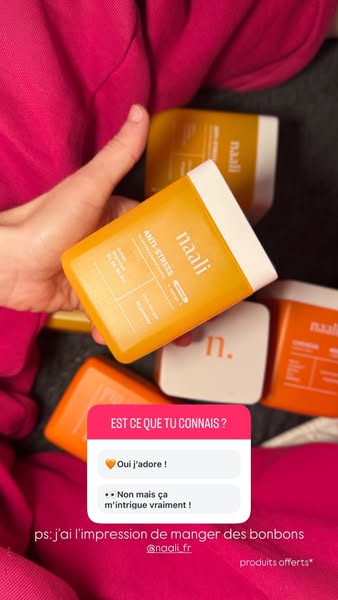
This ad features Naali anti-stress supplements. The ad is presented as an interactive poll asking viewers if they are familiar with the product, with options to answer "Yes, I love it!" or "No, but it really intrigues me!". The ad copy suggests the supplements taste like candy.
# Brand positioning
Naali is presented as a brand offering health supplements that are enjoyable to consume. The brand seems to be positioning itself against the norm of traditional, less palatable supplements by emphasizing the appealing taste of its products. The brand aims to occupy a space in the consumer's mind where health and enjoyment coexist, making wellness routines more accessible and less of a chore. The brand's tone is playful and inviting, suggesting that taking care of one's health can be a delightful experience.
# Product
The ad features Naali anti-stress supplements, presented in a rectangular container with a white lid. The supplements are designed to help reduce stress. The ad copy suggests that the supplements taste like candy, making them an enjoyable way to manage stress. The product is for individuals seeking a convenient and tasty method to incorporate stress relief into their daily routine. The ad addresses the purchase barrier of unpleasant-tasting supplements by highlighting the appealing flavor of Naali supplements.
# Visual style
The ad has a UGC (user-generated content) style, with a slightly cluttered and casual arrangement of products. The image treatment includes soft lighting and natural colors, giving it an authentic feel. The visual motifs include a product-focused flatlay with an interactive poll layered on top, mimicking a platform-native story format. The typography is simple and legible, integrated seamlessly into the poll design. The overall style contrasts with highly polished ads, aiming for a more relatable and scannable in-feed experience.
# Hooks
Headline: EST CE QUE TU CONNAIS?
# Funnel stage
Middle of funnel (Consideration)
# Pain points
The ad addresses the pain point of unpleasant-tasting supplements. "ps: j'ai l'impression de manger des bonbons"
# Value propositions
- The supplements taste like candy, making them an enjoyable way to manage stress.
# Benefits
- Enjoyable way to manage stress
- Tastes like candy
# Features
- ANTI-STRESS
# Call to action
None used.
# Point of view
- Customer: The ad copy states that the supplements taste like candy, sharing their positive experience.
- Brand: An interactive poll is presented, asking viewers if they are familiar with the product.
# Storyline
- The ad begins with a hand holding a container of Naali anti-stress supplements, surrounded by other Naali products. This is intended to showcase the product and its packaging. The story is being told from the perspective of someone familiar with the product, introducing it to the audience.
- An interactive poll is presented, asking viewers if they are familiar with the product. This is intended to engage the audience and gauge their awareness of the brand. The story is being told from the brand's perspective, seeking to understand and interact with potential customers.
- The ad copy states that the supplements taste like candy, aiming to entice viewers with the promise of a delicious and enjoyable health supplement. This is being told from the perspective of a customer who has tried the product, sharing their positive experience.
# Ad summary
string
# Brand positioning
Naali is presented as a brand focused on natural solutions for stress and emotional balance. The brand aligns with values of holistic wellness, emphasizing the interconnectedness of physical, mental, and emotional health. It promotes a lifestyle that prioritizes self-care and gentle, sustainable methods for managing stress, rather than quick fixes or harsh interventions. Naali positions itself as a provider of solutions that respect the body's natural rhythms, offering a more compassionate approach to well-being. The brand's gummies are presented as a simple, well-thought-out, and easy-to-integrate solution for daily stress management.
# Product
Naali Anti-Stress Gummies are presented as a natural supplement designed to regulate the nervous system and promote emotional balance. These gummies combine the most active part of saffron with B vitamins, which support the nervous system and help reduce mental fatigue. The product is for individuals who constantly feel under tension and function in survival mode. The gummies are designed to help the body remember how to calm down, offering a gentle and respectful approach to managing stress. The gummies are easy to integrate into daily routines, providing a simple and convenient way to support overall well-being.
# Visual style
The ad has a polished, commercial aesthetic with a blend of studio-lit shots and natural lighting. The editing style includes quick cuts and smooth transitions, creating a dynamic yet cohesive feel. The production quality is high, lending credibility to the brand. Visual motifs include close-ups of the product, saffron threads, and the speaker, all center-framed. The pacing is consistent, with cuts timed to the voiceover lines, enhancing the audio-visual sync.
# Hooks
Spoken: 00:00–00:03: Si vos journées sont rythmées par le stress prenez juste quelques secondes pour écouter ça.
Visual: 00:00–00:03: A medium close-up shot of a woman with long, wavy brown hair and glasses, wearing a white shirt. She is centered in the frame, speaking directly to the camera. Behind her is a gray wall and a large green plant. The lighting is soft and natural.
# Funnel stage
Middle of funnel (Consideration)
# Pain points
The central pain point is chronic stress that leads to a dysregulated nervous system, resulting in constant fatigue, irritability, sleep disturbances, and a feeling of being in survival mode. "À force votre corps reste en mode panique 24h/24h" (Your body stays in panic mode 24/7).
# Value propositions
- Natural ingredients: Saffron and B vitamins
- Convenient form: Easy-to-take gummies
- Holistic approach: Addresses physical, mental, and emotional aspects
- Gentle solution: Respects the body's natural rhythms
# Benefits
- Regulates the nervous system
- Helps the body regain emotional balance
- Supports the nervous system
- Helps reduce mental fatigue
- Easy to integrate into daily life
# Features
- Contains saffron
- Contains B vitamins
- Gummy form
# Call to action
None used.
# Point of view
- Expert 80% – The majority of the video is told from the perspective of a naturopath, who shares her expertise and insights on stress and its management.
- Customer 20% – The video includes brief shots of customers interacting with the product, showing its ease of use and integration into daily life.
# Storyline
- 00:00–00:03 The video begins with the speaker addressing viewers who experience stress in their daily lives, inviting them to listen for a few seconds. This sets the stage for a discussion about stress and its impact, creating an immediate connection with the audience by acknowledging a common problem.
- 00:04–00:10 The speaker introduces herself as a naturopath and mentions that she often sees the same problems in consultations, such as constant fatigue, irritability, sleep disturbances, and stress. This establishes her credibility and expertise, positioning her as a knowledgeable authority on the topic.
- 00:11–00:25 She describes people who hold on despite their nervous systems being exhausted, highlighting the chronic stress they experience due to constant stimulation and a body that never rests. This deepens the audience's understanding of the problem and its effects on the body.
- 00:26–00:41 The speaker explains that chronic stress prevents the nervous system from regulating itself, leading to poor sleep, irritability, digestive issues, muscle tension, headaches, and fatigue, which impacts relationships. This emphasizes the wide-ranging consequences of unmanaged stress.
- 00:42–00:52 She introduces the concept of naturopathy, explaining that it involves a holistic approach to the body, addressing physical, mental, and emotional aspects through natural means such as diet, lifestyle, and natural resources. This provides context for the solution she is about to present.
- 00:52–00:57 The speaker shares her interest in saffron, also known as the spice of happiness, and introduces Naali gummies as a solution. This transitions the narrative from problem to solution, presenting a specific product to address the identified issues.
- 00:58–01:04 She explains that Naali gummies act as a regulator for the nervous system, helping the body regain emotional balance in a stable and gentle way. This highlights the product's benefits and its gentle approach.
- 01:05–01:16 The speaker introduces the formula of Naali gummies, which combines the most active part of saffron with B vitamins to support the nervous system and reduce mental fatigue. This provides specific details about the product's ingredients and their benefits.
- 01:17–01:21 She emphasizes that the gummies work on a foundational level, combining the right ingredients in the right proportions. This reinforces the product's effectiveness and thoughtful formulation.
- 01:22–01:28 The speaker notes that the gummies are interesting because they not only work on the body in depth but also help the body to calm down rather than forcing it to be quiet. This highlights the product's unique approach to stress management.
- 01:29–01:35 She points out that the gummies are also appealing because they come in gummy form, making them a simple, well-thought-out, and easy-to-integrate solution for daily life. This emphasizes the product's convenience and ease of use.
- 01:35–01:47 The speaker concludes by stating that if viewers constantly feel under tension and function in survival mode, there are solutions like Naali gummies that are more respectful of their rhythm and gentler. This reinforces the product's benefits and encourages viewers to consider it as a solution.
# Ad summary
This ad features a female creator who shares her personal struggle with chronic stress, fatigue, and anxiety, which she attributes to a demanding work-life balance and magnesium deficiency. She explains the science behind stress and magnesium depletion, highlighting how other methods like therapy, meditation, and caffeine reduction failed to alleviate her physical symptoms. The creator then introduces Naali Magnesium+ as her ultimate solution, detailing its unique composition of four highly assimilable magnesium forms and pure saffron extract. She differentiates it from generic magnesium products and provides a personal testimonial about her improved well-being within two weeks of use. The ad concludes with a call to action to try the product.
# Brand positioning
Naali is presented as a premium, scientifically-backed brand specializing in high-quality nutritional supplements, specifically for stress management. It aims to occupy a space in the consumer's mind as a trusted, effective solution for chronic stress symptoms, distinguishing itself from generic, less effective alternatives. The brand aligns with values of well-being, scientific rigor, and efficacy, promoting a lifestyle of calm and presence. It pushes against the norm of low-quality, poorly absorbed supplements found in pharmacies, emphasizing its superior formulation. The brand positioning is primarily functional, focusing on the performance and specific benefits of its magnesium and saffron blend, but also touches on emotional outcomes like feeling calm and present.
# Product
The product featured is Naali Magnesium+, a dietary supplement designed to combat stress, fatigue, and anxiety. It works by providing the body with specific nutrients, particularly magnesium, which is depleted by stress. The product is for individuals experiencing chronic stress, jaw clenching, migraines, irritability, mood swings, fatigue, and sleep disturbances. Key features include its unique 'French formula' that combines four highly assimilable forms of magnesium: bisglycinate, citrate, glycerophosphate, and marine magnesium. These forms are specifically chosen because each targets different tissues and absorption pathways, ensuring maximum efficacy. Additionally, it contains pure, 100% red saffron extract, which is clinically shown to reduce anxiety, stress, depressive feelings, and improve mood. The product is a powder, making it easy to consume as a 'simple daily ritual' mixed with water, unlike 'enormous pills.' It contains no sugar and has no bad aftertaste, making it pleasant to take. The ad emphasizes that it's 'the only product that worked' for the creator, addressing the purchase barrier of ineffective previous solutions.
# Visual style
The ad features a hybrid visual style, blending a raw, authentic UGC feel with elements of educational content. The editing rhythm is dynamic, with quick cuts between the creator speaking and illustrative text overlays or graphics, maintaining engagement. The production quality leans towards a polished UGC aesthetic, using natural lighting and a home-like setting (white walls, whiteboard) to create a relatable and trustworthy atmosphere. Visual motifs include direct address to the camera, close-ups of the creator's expressive face, and clear, bold text overlays for key information. The pacing is relatively fast, with frequent cuts (approximately 1 cut every 2-3 seconds) that keep the viewer's attention. Audio-visual sync is prominent, with text overlays and graphic animations appearing precisely as the creator speaks about the corresponding information, enhancing clarity and impact.
# Hooks
Spoken: Notre corps n'est pas fait pour des semaines de travail de 60 heures et des notifications Slack incessantes.
Text overlay: We said goodnight 5 minutes ago 😂
Visual: The shot is a vertical, slightly high-angle view of a bedroom. A light-skinned man with short brown hair is lying in bed, covered by a striped beige and white duvet, with his hands behind his head, looking up and to the right, seemingly awake and restless. In the bottom right corner, a light-skinned woman with long brown hair and glasses, wearing a dark long-sleeved top, is superimposed, pointing towards the man with a slight smile and raised eyebrows. The background is a plain white wall. The camera is stationary, third-person POV.
# Funnel stage
Middle of funnel (Consideration)
# Pain points
The central pain point is chronic stress and its debilitating physical and emotional symptoms, exacerbated by modern work demands and digital overload, leading to magnesium deficiency. "Notre corps n'est pas fait pour des semaines de travail de 60 heures et des notifications Slack incessantes." (00:00-00:04), "Le manque de magnésium finit par modifier la façon dont votre corps gère le stress" (00:06-00:09), "Vous devenez irritable." (00:13-00:14), "Serrer les mâchoires après une journée de travail chargée est plus fréquent qu'on ne le pense. Les migraines ou les accès de colère envers ses proches en sont également des exemples." (00:15-00:23), "J'étais trop excitée par la caféine et je n'arrivais pas à rester tranquille. Mais en utilisant des applications de méditation et réduire ma consommation de caféine n'a fait qu'accroître ma fatigue et mon anxiété." (00:29-00:39)
# Value propositions
- Notre corps n'est pas fait pour des semaines de travail de 60 heures et des notifications Slack incessantes.
- Le manque de magnésium finit par modifier la façon dont votre corps gère le stress parce qu'il épuise ce minéral qui aide votre système nerveux à rester équilibré.
- Chaque forme cible différents tissus et voies d'absorption.
- Rien à voir avec le magnésium bon marché qu'on trouve en pharmacie et qui vous cause des problèmes digestifs et qui est à peine absorbé.
- C'est le seul produit qui a fonctionné pour moi.
- Des données cliniques montrent qu'il réduit significativement l'anxiété, le stress et les sentiments dépressifs et améliore l'humeur.
- C'est devenu mon petit rituel du soir, contrairement aux énormes comprimés que je dois avaler à chaque fois.
- Une dose et c'est réglé.
- Il ne contient pas de sucre, pas de mauvais arrière-goût, il reste agréable à prendre, ce qui honnêtement change tout.
# Benefits
- aide votre système nerveux à rester équilibré
- réduit significativement l'anxiété, le stress et les sentiments dépressifs
- améliore l'humeur
- atténue les symptômes physiques du stress comme la tension, la fatigue et les troubles du sommeil
- agit sur les aspects émotionnels tels que l'irritabilité, les sautes d'humeur et le sentiment d'être constamment à cran
- ne serrai plus les mâchoires en permanence
- ne me réveille plus à 3h du matin à penser au travail
- se sentir calme
- plus présente
- profiter à nouveau de ma tête
# Features
- 4 formes de magnésium hautement assimilables
- bisglycinate
- citrate
- glycérophosphate
- magnésium marin
- extrait de safran pur 100% rouge
- ne contient pas de sucre
- pas de mauvais arrière-goût
- agréable à prendre
# Call to action
LIEN JUSTE EN DESSOUS (02:15-02:21), Offrez à votre système nerveux ce qui lui manque. (02:18-02:21)
# Social proof
- Notre corps n'est pas fait pour des semaines de travail de 60 heures et des notifications Slack incessantes.
# Point of view
- Customer 80% – The main speaker shares her personal experience, struggles, and success with the product, using 'I' statements and a relatable, empathetic tone.
- Brand 20% – Product features, scientific explanations, and differentiation from competitors are presented by the speaker, acting as an informed advocate for the brand.
# Storyline
- 00:00–00:04 The ad opens with a relatable scenario of modern-day stress, showing a man lying in bed, seemingly unable to sleep, while a woman points at him with a slightly exasperated but understanding expression. This immediately establishes a common problem many viewers face: the inability to truly disconnect and relax, even after a long day.
- 00:04–00:13 The creator, speaking directly to the camera, explains that the body is not designed for constant stress from long work weeks and incessant notifications. She introduces the core problem: stress not only causes fatigue but also depletes magnesium, which is crucial for a balanced nervous system. This sets up the scientific basis for the product's solution.
- 00:14–00:22 The creator lists common physical manifestations of stress, such as irritability, jaw clenching, migraines, and anger outbursts towards loved ones. She speaks with an empathetic and knowing tone, suggesting she understands these struggles firsthand, making the problem more tangible and relatable to the audience.
- 00:22–00:38 She shares her personal journey, revealing that she experienced these symptoms for two years. She tried therapy, which helped her understand her stress, but didn't resolve the physical symptoms. She also mentions that caffeine made her too excited and unable to relax, and meditation apps or reducing caffeine only worsened her fatigue and anxiety. This builds credibility and empathy, showing she's tried conventional methods that failed.
- 00:38–00:59 The creator then explains what she learned: the body needs specific nutrients to manage stress, and chronic stress consumes magnesium faster than it can be replenished. She describes this as a 'vicious cycle' where stress depletes magnesium, leading to increased reactivity to stress, which further depletes magnesium. This provides a clear, scientific explanation for the problem.
- 00:59–01:16 Having established the problem and its root cause, the creator transitions to her solution. She states she embarked on an endless quest, trying everything, including a specific 'French formula' that combines four highly assimilable forms of magnesium. This positions the product as a well-researched, effective discovery after extensive personal effort.
- 01:16–01:21 She explicitly differentiates this product from 'cheap pharmacy magnesium' that causes digestive issues and is poorly absorbed. This addresses a common consumer concern and positions her chosen product as a superior, high-quality alternative, reinforcing its value proposition.
- 01:21–01:35 The product, Naali Magnesium+, is then revealed as 'the only product that worked' for her. She highlights the addition of pure saffron extract, initially admitting skepticism but then citing clinical data that proves its effectiveness in reducing anxiety, stress, and depressive feelings, and improving mood. This combines personal endorsement with scientific validation.
- 01:35–01:48 She summarizes the dual action of the product: magnesium alleviates physical stress symptoms like tension, fatigue, and sleep issues, while saffron addresses emotional aspects such as irritability, mood swings, and feeling constantly on edge. This clearly outlines the comprehensive benefits.
- 01:48–02:00 The creator provides a powerful personal testimonial, stating that within two weeks of starting the treatment, she no longer clenches her jaw, wakes up at 3 AM, feels calm, more present, and can enjoy her life again. This emotional appeal reinforces the product's effectiveness and the desired outcome.
- 02:00–02:15 She demonstrates how easy it is to take the product, mixing the powder into a drink, emphasizing that it's a 'simple daily ritual' unlike 'enormous pills.' She also highlights its pleasant taste, no sugar, and no bad aftertaste, removing potential barriers to consistent use.
- 02:15–02:21 The ad concludes with a direct call to action, encouraging viewers who are tired of being stressed or whose stress affects their relationships to try the product. She provides a link and urges them to 'give your nervous system what it needs.' This directly prompts engagement and purchase.
# Ad summary
This ad features a woman explaining the 'stress/sleep paradox' and how magnesium deficiency contributes to stress, fatigue, and irritability. She shares her personal struggle with these issues and how traditional methods like therapy, meditation, and diet changes didn't fully resolve them. She then introduces Naali Magnesium+, highlighting its unique formula with four highly absorbable forms of magnesium and pure saffron extract. She explains how magnesium addresses physical symptoms of stress, while saffron targets emotional aspects. She provides a personal testimonial about the product's effectiveness within two weeks, emphasizing its pleasant taste and ease of use compared to pills. The ad concludes with a call to action to try the product.
# Brand positioning
Naali is presented as a solution-oriented brand in the health and wellness market, specifically targeting stress and magnesium deficiency. It aims to occupy a space as a premium, scientifically-backed, and user-friendly supplement provider. The brand pushes against the norm of 'cheap magnesium' found in pharmacies that cause digestive issues and are poorly absorbed, positioning itself as a superior alternative. Naali aligns with values of efficacy, well-being, and ease of use, promoting a lifestyle where individuals can regain calm and presence. Its positioning is both functional, by offering a highly absorbable and targeted magnesium formula, and emotional, by promising relief from stress-related physical and emotional symptoms.
# Product
The product advertised is 'Naali Magnesium+', a magnesium supplement designed to combat stress, fatigue, and irritability. It is for individuals experiencing chronic stress, sleep disturbances, and related physical and emotional symptoms who have found other solutions ineffective. The ad highlights its unique selling proposition: a French formula combining four highly assimilable forms of magnesium (bisglycinate, citrate, glycerophosphate, and marine magnesium) specifically chosen to target different tissues and absorption pathways. Additionally, it contains 100% pure red saffron extract, which is clinically shown to reduce anxiety and improve mood. The product is presented as a pleasant-tasting powder, easily mixed into a drink, addressing the purchase barrier of large, hard-to-swallow pills and avoiding the digestive issues associated with cheaper magnesium. It is intended for daily use as a simple ritual to restore balance and well-being, with noticeable effects within two weeks.
# Visual style
The visual style is a hybrid of polished UGC and educational content. It features a clean, bright aesthetic with natural lighting, primarily shot indoors against a white background. The editing rhythm is moderately paced, with cuts occurring every few seconds to transition between the speaker, animated graphics, and product demonstrations. The production quality feels professional yet authentic, leveraging the direct-to-camera address and whiteboard explanations common in educational content, combined with slick animated text overlays. There are no strong visual motifs beyond the consistent use of the whiteboard and the speaker's direct address. Pacing is consistent throughout, maintaining an informative yet engaging flow. Audio-visual sync is well-executed, with text overlays and graphic animations appearing precisely when the speaker mentions the corresponding concepts.
# Hooks
Spoken: Vous n'êtes pas en panne. / Vous êtes tout simplement prise dans le cycle stress/sommeil dont la plupart des femmes ignorent son existence.
Text overlay: LE PARADOXE / trop fatigué pour fonctionner / Trop / stressé pour dormir / Ce qu'ils ne disent pas: / le STRESS / vous prive de / MAGNESIUM
Visual: Close-up shot of Female 1, a woman with medium brown hair and glasses, speaking directly to the camera. She is wearing a black long-sleeved top. Behind her is a white whiteboard with 'LE PARADOXE' written at the top, followed by 'trop fatigué pour fonctionner / Trop' and 'stressé pour dormir'. Below the text, there are two small wooden cylindrical objects on a white surface. The camera is stationary, tripod-mounted, at eye level. / Close-up shot of Female 1, speaking directly to the camera. The whiteboard behind her now reads 'Ce qu'ils ne disent pas: le STRESS vous prive de MAGNESIUM'. The word 'MAGNESIUM' is underlined. She holds a white pen in her right hand and gestures with both hands. The camera is stationary, tripod-mounted, at eye level.
# Funnel stage
Consideration
# Pain points
The central pain point is the 'stress/sleep paradox' and the chronic physical and emotional symptoms stemming from magnesium deficiency. The ad highlights: 'trop fatigué pour fonctionner / Trop stressé pour dormir' (too tired to function / too stressed to sleep), 'le STRESS vous prive de MAGNESIUM' (stress deprives you of magnesium), 'Ça ne vous rend pas seulement fatigués' (It doesn't just make you tired), 'Vous devenez irritable' (You become irritable), 'Serrage de mâchoires + migraines + Aigreur' (Jaw clenching + migraines + bitterness/acidity), 'J'étais trop excitée par la caféine et je n'arrivais pas à rester tranquille' (I was too excited by caffeine and couldn't stay calm), 'n'a fait qu'accroître ma fatigue et mon anxiété' (only increased my fatigue and anxiety), 'le magnésium bon marché qu'on trouve en pharmacie et qui vous cause des problèmes digestifs et qui est à peine absorbé' (cheap magnesium found in pharmacies that causes digestive problems and is barely absorbed), 'je ne serrais plus les mâchoires en permanence' (I no longer constantly clenched my jaw), 'Je me réveille plus à 3h du matin à penser au travail' (I no longer wake up at 3 AM thinking about work).
# Value propositions
- Le manque de magnésium finit par modifier la façon dont votre corps gère le stress parce qu'il épuise ce minéral qui aide votre système nerveux à rester équilibré.
- Notre corps a besoin de nutriments spécifiques pour bien gérer le stress.
- Le stress épuise les réserves de magnésium et un faible taux de magnésium vous rend plus réactif au stress, ce qui épuise encore plus de magnésium.
- Cette formule française combine quatre formes de magnésium hautement assimilable.
- Chaque forme cible différents tissus et voies d'absorption.
- Des données cliniques montrent qu'il réduit significativement l'anxiété et améliore l'humeur.
- Le magnésium atténue les symptômes physiques du stress comme la tension, la fatigue et les troubles du sommeil.
- Le safran, quant à lui, agit sur les aspects émotionnels tels que l'irritabilité, les sautes d'humeur et le sentiment d'être constamment à cran.
- C'est le seul produit qui a fonctionné pour moi.
- Il ne contient pas de sucre, pas de mauvais arrière-goût, il reste agréable à prendre, ce qui honnêtement change tout.
# Benefits
- aide votre système nerveux à rester équilibré
- réduit significativement l'anxiété
- améliore l'humeur
- atténue les symptômes physiques du stress comme la tension, la fatigue et les troubles du sommeil
- agit sur les aspects émotionnels tels que l'irritabilité, les sautes d'humeur et le sentiment d'être constamment à cran
- disparition des tensions physiques
- retour de la clarté mentale
- se sentir calme, plus présente
- pouvoir profiter à nouveau de ma trentaine
# Features
- 4 formes de magnésium hautement assimilable
- bisglycinate
- citrate
- glycérophosphate
- magnésium marin
- extrait de safran pur 100% rouge
- ne contient pas de sucre
- pas de mauvais arrière-goût
- agréable à prendre
# Call to action
LIEN JUSTE EN DESSOUS (yellow banner)
# Social proof
- Des recherches montrent que le stress déclenche une perte de magnésium au niveau cellulaire, créant un cercle vicieux. (Research shows that stress triggers cellular magnesium loss, creating a vicious cycle.)
- Au début, j'étais sceptique jusqu'à ce que je découvre des données cliniques montrent qu'il réduit significativement l'anxiété et améliore l'humeur. (At first, I was skeptical until I discovered clinical data showing it significantly reduces anxiety and improves mood.) – Female 1 (Creator)
- Le magnésium plus de Naali et c'est le seul produit qui a fonctionné pour moi. (Naali Magnesium+ and it's the only product that worked for me.) – Female 1 (Creator)
- Deux semaines après avoir commencé la cure, je ne serrais plus les mâchoires en permanence. Je me réveille plus à 3h du matin à penser au travail. Je me sens calme, plus présente et j'ai l'impression de pouvoir profiter à nouveau de ma trentaine. (Two weeks after starting the treatment, I no longer constantly clenched my jaw. I no longer wake up at 3 AM thinking about work. I feel calm, more present, and I feel like I can enjoy my thirties again.) – Female 1 (Creator)
# Point of view
- Customer 80% – The speaker shares her personal struggles and journey to finding a solution, using 'I' statements and relatable experiences.
- Brand 20% – The speaker presents product features, scientific explanations, and benefits in a clear, informative manner, acting as an informed advocate for the brand.
# Storyline
- 00:00–00:05 The ad opens with Female 1 directly addressing the viewer, explaining the 'paradox' of being too tired to function but too stressed to sleep. She uses a whiteboard with 'LE PARADOXE' written on it to visually support her point.
- 00:05–00:15 She then reveals that the core issue isn't just fatigue but a stress/sleep cycle where magnesium deficiency plays a crucial, often ignored, role. She points to the whiteboard which now displays 'Ce qu'ils ne disent pas: le STRESS vous prive de MAGNESIUM'. This establishes the problem and introduces the key ingredient.
- 00:15–00:24 Female 1 describes the physical and emotional manifestations of this deficiency, such as irritability, jaw clenching, migraines, and anger towards loved ones. This connects the abstract concept of magnesium deficiency to relatable, everyday struggles, making the problem tangible for the audience.
- 00:24–00:31 She shares her personal experience, stating she lived with these symptoms for two years and that therapy helped her understand the stress but didn't alleviate the physical symptoms. This builds empathy and positions her as a credible, relatable figure who has tried other solutions.
- 00:31–00:40 She further elaborates on her past attempts to manage stress, including reducing caffeine and using meditation apps, which only worsened her fatigue and anxiety. This reinforces the idea that common solutions are insufficient and sets the stage for a more effective alternative.
- 00:40–01:01 Female 1 then explains what she 'finally learned': the body needs specific nutrients to manage stress, and chronic stress depletes magnesium faster than it can be replenished, creating a vicious cycle. This provides an educational, scientific explanation for the problem, empowering the viewer with knowledge.
- 01:01–01:23 She introduces her solution, a French formula combining four highly absorbable forms of magnesium and saffron extract, emphasizing its superiority over 'cheap magnesium' that causes digestive issues. This transitions to the product, highlighting its unique formulation and differentiating it from competitors.
- 01:23–01:37 Female 1 unboxes and presents the Naali Magnesium+ product, stating it's the only one that worked for her. She then details the specific ingredients: pure red saffron extract, backed by clinical data showing significant reduction in anxiety and improved mood. This provides a tangible product demonstration and scientific validation.
- 01:37–01:50 She explains the 'double action' of the formula: magnesium for physical symptoms (tension, fatigue, sleep issues) and saffron for emotional aspects (irritability, mood swings, feeling on edge). This clearly articulates the comprehensive benefits of the product.
- 01:50–02:01 Female 1 shares her personal results after two weeks of using the product: no more jaw clenching, no more waking up at 3 AM, feeling calmer, more present, and enjoying her thirties again. This serves as a powerful personal testimonial, demonstrating the desired outcomes.
- 02:01–02:12 She demonstrates mixing the powder into a drink, highlighting its pleasant taste and ease of use compared to pills, and reiterates that it contains no sugar or bad aftertaste. This addresses practical concerns and reinforces the product's user-friendliness.
- 02:12–02:23 She concludes by urging viewers who are tired of being stressed or whose relationships are affected by stress to try Naali Magnesium+, providing a clear call to action and emphasizing the product's value. She points downwards, indicating where to find the link.
# Ad summary
This video ad addresses the common problem of sleep difficulties, particularly when the mind is overactive despite the body being tired. It features an expert in a lab coat who explains the science behind sleep and magnesium, then introduces saffron as a key ingredient to address the psychological aspect of sleep. The ad promotes 'Naali Magnésium +' as a comprehensive solution, detailing its unique blend of four magnesium forms, saffron, taurine, and vitamin B6, all backed by clinical studies. It highlights the benefits of improved emotional well-being, reduced anxiety, faster sleep onset, and sustained sleep, promising noticeable results within weeks.
# Brand positioning
Naali is presented as a science-backed, expert-driven brand in the sleep and wellness market. It aims to occupy a space in the consumer's mind as a sophisticated, effective solution for complex sleep issues, moving beyond simple remedies. The brand aligns with values of scientific rigor, holistic well-being, and efficacy, promoting a lifestyle of restful sleep and mental clarity. It pushes against the norm of single-ingredient solutions by offering a comprehensive, multi-faceted approach. The brand positioning is primarily functional, emphasizing the specific ingredients, dosages, and scientific evidence, but also emotional by promising relief from anxiety and improved quality of life.
# Product
The featured product is 'Naali Magnésium +,' a dietary supplement designed to improve sleep by addressing both physical and psychological factors. It is for individuals who struggle to fall asleep, experience restless nights, or have an overactive mind that prevents them from resting, even if their magnesium levels are normal. The product contains four highly assimilable forms of magnesium that act in alternation throughout the night: citrate for immediate calming, bisglycinate to support the nervous system, glycerophosphate for prolonged release, and marine magnesium Aquamin for optimal cellular absorption. Additionally, it includes a 100% pure Afghan red saffron extract at a clinical dose of 30mg, which has been shown to improve emotional well-being and reduce sleep-disturbing symptoms by acting on dopamine and serotonin circuits. Taurine is added to enhance magnesium absorption, and vitamin B6 is included to facilitate the conversion of tryptophan into serotonin. The ad emphasizes that it's not just magnesium, but a 'complete formula' that tackles both physical tension and the dysregulation of stress hormones, offering a comprehensive solution for those whose bodies are exhausted but whose minds refuse to rest.
# Visual style
The ad features a hybrid visual style, blending polished, studio-quality shots of the presenter with stock footage illustrating problems and solutions, and some UGC-style shots for product interaction. The overall aesthetic is clean, informative, and trustworthy, with bright, even lighting for the presenter and varied lighting for the illustrative clips. Editing is moderately paced with smooth cuts, primarily driven by the voiceover. Visual motifs include split screens to juxtapose the presenter with illustrative content, and animated text overlays to highlight key information. The audio-visual sync is precise, with text and visual changes often timed to the speaker's emphasis.
# Hooks
Spoken: Votre corps est prêt à dormir, votre taux de magnésium est normal, alors pourquoi votre cerveau se met à faire des listes de choses à faire à 2h du matin?
Text overlay: votre corps est prêt à dormir / votre taux de magnésium est normal / votre cerveau / se met / à faire des listes / de choses à faire / à 2h du matin?
Visual: Close-up shot of the woman in the lab coat, from the chest up, looking directly at the camera. Her expression is serious and informative. She gestures with her hands as she speaks. The background is a plain light gray wall. The camera is stationary, tripod-mounted, third-person POV. / Animated 3D rendering of a human brain, glowing blue, rotating slowly against a textured blue background. Text overlays appear and disappear around it. The camera is stationary, third-person POV.
# Funnel stage
Consideration
# Pain points
The central pain point is the inability to fall asleep or stay asleep due to an overactive mind and anxiety, even when the body is physically tired or after trying basic magnesium supplements. This is signaled by: "When you can't fall asleep, so you have to do this" (00:00-00:04), "votre cerveau se met à faire des listes de choses à faire à 2h du matin?" (00:09-00:14), "à minuit se repasse les discussions en boucle, à 2h du matin fait des listes de choses à faire interminables, ou encore est anxieux à l'idée de ne pas arriver à s'endormir" (00:33-00:43), and "dont le corps est épuisé mais dont l'esprit refuse de se reposer, reste encore éveillé la nuit" (02:56-03:02).
# Value propositions
- C'est un phénomène biochimique
- une supplémentation peut vraiment aider votre corps à se détendre physiquement
- le magnésium seul ne suffira pas
- Les recherches confirment ces résultats
- une méta-analyse publiée dans PubMed Central a révélé que même si le magnésium aidait les populations carencées à mieux dormir, les résultats étaient par contre incohérents chez les personnes qui souffrent d'insomnie liées à l'anxiété
- S'attaquer à l'aspect PSYCHOLOGIQUE
- le safran a fait l'objet de nombreuses études sur ses effets sur l'humeur et l'anxiété
- Plusieurs essais contrôlés randomisés ont montré que 30mg par jour d'extrait de safran avaient un réel impact
- le safran agit sur les circuits de la dopamine et de la sérotonine
- Il contribue à réguler nos neurotransmetteurs qui sont responsables de cette hyperactivité cérébrale
- en combinant des formes de magnésium hautement assimilables avec du safran à dose clinique, on agit sur les deux aspects de l'équation du sommeil
- C'est la formule complète qui explique pourquoi une personne comme vous, qui a tout essayé, dont le corps est épuisé mais dont l'esprit refuse de se reposer, reste encore éveillé la nuit
- La différence est rapide. En quelques jours seulement, le flot incessant de pensées s'apaise.
# Benefits
- effet calmant immédiat
- soutenir le système nerveux
- libération prolongée
- absorption cellulaire optimale
- améliore les scores de bien-être émotionnel
- réduit les symptômes qui perturbent le sommeil
- s'endormirez en 20 minutes au lieu de 45 minutes, voire plus
- dormir d'une traite
- n'avez plus l'air épuisé
# Features
- 4 formes de magnésium
- citrate
- bisglycinate
- glycérophosphate
- magnésium marin Aquamin
- safran rouge afghan pur à 100%
- dose clinique de 30mg
- taurine
- vitamine B6
# Call to action
None used
# Social proof
- Les recherches confirment ces résultats. Une méta-analyse publiée dans PubMed Central a révélé que même si le magnésium aidait les populations carencées à mieux dormir, les résultats étaient par contre incohérents chez les personnes qui souffrent d'insomnie liées à l'anxiété.
# Point of view
- Brand 80% – The majority of the video features a woman in a lab coat explaining scientific concepts and product benefits directly to the camera, representing the official voice and expertise of the brand.
- Customer 20% – Several short clips depict individuals struggling with sleep or experiencing the benefits of restful sleep, illustrating the problem and desired outcome from a user's perspective.
# Storyline
- 00:00–00:04 The ad opens with a split screen showing a woman tossing and turning in bed, unable to sleep, while a woman in a lab coat looks on. This immediately establishes a relatable problem of insomnia and introduces an expert figure, setting a problem-solution narrative.
- 00:05–00:14 The expert, speaking directly to the camera, poses a question about why the brain stays active at 2 AM even when the body is ready to sleep and magnesium levels are normal. This creates curiosity and frames the problem as a deeper, more complex issue than just magnesium deficiency, inviting the viewer to seek a more advanced solution.
- 00:15–00:45 The expert explains that magnesium acts on muscles and stress hormone levels, but then transitions to explain that for those with anxiety-related insomnia, magnesium alone is not enough. This builds on the initial problem, reframing it as a common misconception and setting up the need for a more comprehensive solution.
- 00:46–1:35 The expert introduces saffron as the 'missing piece' and presents scientific evidence (meta-analysis, clinical trials) supporting its efficacy in improving mood and reducing anxiety, which are linked to sleep disturbances. This establishes credibility and introduces the unique selling proposition of saffron in the product, shifting the narrative towards a novel solution.
- 1:36–1:48 The expert details the mechanism of saffron, explaining its action on dopamine and serotonin circuits to regulate neurotransmitters responsible for cerebral hyperactivity. This provides a scientific explanation for the product's effectiveness, appealing to viewers who seek understanding and evidence-based solutions.
- 1:49–2:03 The expert then explains how combining highly assimilable forms of magnesium with clinical-dose saffron addresses both physical tension and stress hormone dysregulation, which are the 'two aspects of the sleep equation.' This summarizes the product's holistic approach and reinforces its comprehensive nature.
- 2:04–2:06 The product 'Naali Magnésium +' is explicitly introduced, with the expert holding the product packaging. This is the direct product reveal, connecting all the previous scientific explanations to the specific solution being offered.
- 2:07–2:25 The expert, now in a picture-in-picture overlay, details the four forms of magnesium and their specific benefits, while a woman prepares the supplement. This provides concrete product features and demonstrates ease of use, reinforcing the product's advanced formulation.
- 2:26–2:36 The expert highlights the 100% pure Afghan red saffron at a clinical dose, again emphasizing its proven efficacy. This reiterates the premium quality and scientific backing of a key ingredient.
- 2:37–2:50 The expert further explains the inclusion of taurine and vitamin B6, detailing their roles in magnesium absorption and serotonin conversion. This completes the explanation of the 'complete formula,' showcasing the thoughtful design of the product.
- 2:51–3:02 The expert summarizes that it's the 'complete formula' that explains why someone who has tried everything still struggles to sleep, because their mind refuses to rest. This directly addresses the target audience's frustration and validates their experience, positioning the product as the ultimate solution.
- 3:03–3:25 The expert promises rapid results: falling asleep in 20 minutes instead of 45+ within two weeks, and sleeping through the night after a month. Visuals show people sleeping peacefully and looking refreshed. This provides clear, tangible benefits and a timeline for improvement, creating a strong call to action based on desired outcomes.
- 3:26–3:36 The ad concludes with the expert stating that if magnesium alone only slightly helped, the viewer now knows why their mind needs support, not just their muscles. This reinforces the core message of the product's unique, comprehensive approach and leaves the viewer with a clear understanding of its value.
# Ad summary
This ad features a woman discussing the effects of stress on the body and how it can lead to a magnesium deficiency. She then introduces a magnesium supplement from the brand Naali, which she says has helped her manage her stress and improve her overall well-being. She highlights the unique formula of the supplement, which contains four different forms of magnesium and saffron extract.
# Brand positioning
Naali is presented as a brand that offers a magnesium supplement designed to combat the physical and emotional symptoms of stress. The brand emphasizes the unique formulation of its product, which combines four highly absorbable forms of magnesium with saffron extract. This combination is positioned as a comprehensive solution that addresses both the physical and emotional aspects of stress, setting it apart from other magnesium supplements on the market. The brand aligns with a lifestyle of self-care and holistic wellness, promoting the idea that managing stress is essential for overall well-being.
# Product
The featured product is Naali Magnesium +, a magnesium supplement designed to alleviate the physical and emotional symptoms of stress. It contains a unique blend of four highly absorbable forms of magnesium: bisglycinate, citrate, glycerophosphate, and marine magnesium. These forms are specifically chosen to target different tissues and absorption pathways in the body. The supplement also includes pure red saffron extract, which is clinically shown to reduce anxiety and improve mood. The product is presented as a convenient and enjoyable way to incorporate magnesium into one's daily routine, with a pleasant taste and no added sugar or artificial ingredients. It is positioned as a superior alternative to traditional magnesium supplements that may cause digestive issues or have poor absorption.
# Visual style
The ad has a UGC feel with a mix of static shots and quick cuts. The production quality is relatively polished, with clear lighting and crisp visuals. The editing rhythm is moderate, with cuts timed to voiceover lines and text overlays. The overall aesthetic is clean and modern, with a focus on conveying information in a straightforward and accessible manner.
# Hooks
Spoken: 00:00–00:03 Ne pas réussir à s'endormir est en réalité la pire chose qui puisse arriver.
Text overlay: 00:00–00:03 Ne pas réussir
Visual: 00:00–00:03 A woman with medium brown hair, wearing glasses and a black top, stands in front of a whiteboard. The whiteboard has the words "L'EFFET CASCADE" written on it. She is holding a blue marker and gesturing with her hands as she speaks.
# Funnel stage
Middle of funnel (Consideration)
# Pain points
The central pain point is the inability to manage stress effectively, leading to physical and emotional symptoms that negatively impact daily life. "Not being able to fall asleep is actually the worst thing that can happen."
# Value propositions
- Comprehensive stress relief: Addresses both physical and emotional symptoms of stress with a unique combination of magnesium and saffron.
- Superior absorption: Contains four highly absorbable forms of magnesium for maximum effectiveness.
- Enjoyable experience: Pleasant taste and easy to incorporate into daily routine, unlike traditional supplements.
# Benefits
- Alleviates physical symptoms of stress (tension, fatigue, sleep disturbances)
- Acts on emotional aspects of stress (irritability, mood swings, feeling constantly on edge)
- Reduces anxiety
- Improves mood
- Promotes calmness and presence
- Easy to incorporate into daily routine
# Features
- Contains four highly absorbable forms of magnesium: bisglycinate, citrate, glycerophosphate, and marine magnesium
- Includes pure red saffron extract
- Pleasant taste
- No added sugar
- No bad aftertaste
# Call to action
Offer your nervous system what it lacks.
# Social proof
- "Naali Magnesium + is the only product that has worked for me" – Female 1 (Customer)
- "Clinical data showing that it significantly reduces anxiety and improves mood" – Female 1 (Customer)
# Point of view
- Customer 100% – The entire video is told from the perspective of a customer sharing her personal experience with stress and how the product has helped her.
# Storyline
- 00:00–00:03 00:00–00:03 Not being able to fall asleep is actually the worst thing that can happen.
- 00:03–00:12 00:03–00:12 What they don't say is that stress deprives you of magnesium. Magnesium deficiency ends up changing the way your body handles stress because it depletes this mineral that helps your nervous system stay balanced.
- 00:13–00:21 00:13–00:21 You become irritable. Clenching your jaws after a busy day at work is more common than you think. Migraines or outbursts of anger towards loved ones are also examples.
- 00:21–00:27 00:21–00:27 I experienced this for two years. Therapy helped me understand why I was stressed, but it didn't make the physical symptoms disappear.
- 00:27–00:37 00:27–00:37 I was too excited by caffeine, and I couldn't stay calm. Even using meditation apps and reducing my coffee consumption only increased my fatigue and anxiety.
- 00:38–00:42 00:38–00:42 Here's what I ended up learning: our body needs specific nutrients to properly manage stress.
- 00:42–00:46 00:42–00:46 And in case of chronic stress, we consume magnesium faster than we can replenish it.
- 00:46–00:51 00:46–00:51 Research shows that stress triggers a loss of magnesium at the cellular level, creating a vicious cycle.
- 00:52–00:58 00:52–00:58 Stress depletes magnesium reserves, and a low magnesium level makes you more reactive to stress, which depletes even more magnesium.
- 00:59–01:06 00:59–01:06 I embarked on an endless quest trying everything that exists, including this French formula that combines four highly absorbable forms of magnesium.
- 01:06–01:15 01:06–01:15 Bisglycinate, citrate, glycerophosphate, and marine magnesium, specifically chosen because each form targets different tissues and absorption pathways.
- 01:15–01:21 01:15–01:21 It has nothing to do with the magnesium on the market that you find in pharmacies and that causes you digestive problems and is barely absorbed.
- 01:21–01:25 01:21–01:25 Naali Magnesium + is the only product that has worked for me.
- 01:25–01:35 01:25–01:35 They've added pure 100% red saffron extract. At first, I was skeptical until I discovered clinical data showing that it significantly reduces anxiety and improves mood.
- 01:35–01:47 01:35–01:47 Magnesium alleviates the physical symptoms of stress, like tension, fatigue, and sleep disturbances. Saffron, on the other hand, acts on the emotional aspects, such as irritability, mood swings, and the feeling of being constantly on edge.
- 01:48–01:58 01:48–01:58 Two weeks after starting the cure, I no longer clench my jaws permanently, I no longer wake up at 3 a.m. to think about work. I feel calm, more present, and I have the impression of being able to enjoy my thirties again.
- 01:59–02:04 01:59–02:04 It has become my little evening ritual, unlike the enormous pills that I have to swallow every time.
- 02:04–02:08 02:04–02:08 One dose and it's settled. It contains no sugar, no bad aftertaste, it remains pleasant to take, which honestly changes everything.
- 02:09–02:19 02:09–02:19 If you're tired of being the stressed person or if stress affects your relationships, it's worth a try. I've put the link just below. Offer your nervous system what it lacks.
# Ad summary
This video ad addresses common sleep issues, particularly those related to an overactive mind and anxiety, by introducing a magnesium and saffron supplement. It starts with a relatable user struggling to sleep, then transitions to an expert (wearing a lab coat) who explains why traditional magnesium alone might not be enough. She introduces Naali Magnésium +, highlighting its unique combination of four magnesium forms, saffron, taurine, and vitamin B6, all backed by scientific research. The ad demonstrates the product's use and showcases the benefits of improved sleep and reduced mental hyperactivity, concluding with a call to action to try the product.
# Brand positioning
The brand, Naali, positions itself as a science-backed solution provider for sleep and mental well-being. It aims to occupy a space in the consumer's mind as a trustworthy, effective, and innovative brand that understands the complexities of sleep beyond simple magnesium supplementation. The brand aligns with values of scientific rigor, efficacy, and holistic well-being, promoting a lifestyle of restful sleep and mental calm. It pushes against the norm of single-ingredient solutions by offering a 'complete formula' that addresses both physical tension and psychological aspects of sleep. The brand positioning is primarily functional, emphasizing the scientific formulation and proven impact, but also touches on emotional outcomes like reduced anxiety and improved emotional well-being.
# Product
The product advertised is 'Naali Magnésium +,' a supplement designed to improve sleep by addressing both physical tension and psychological factors. It is for individuals who struggle with sleep due to an overactive mind, anxiety, or difficulty relaxing, even after trying other magnesium supplements. The ad highlights several key features: it contains four highly assimilable forms of magnesium that act alternately throughout the night, including citrate (for immediate calming effect), bisglycinate (for nervous system support), glycerophosphate (for prolonged release), and Aquamin marine magnesium (for optimal cellular absorption). Additionally, it includes 100% pure Afghan red saffron at a clinical dose of 30mg, which has proven efficacy in improving emotional well-being and reducing sleep-disturbing symptoms by acting on dopamine and serotonin circuits. The formula is further enhanced with taurine to improve magnesium absorption and vitamin B6 to facilitate the conversion of tryptophan into serotonin. The ad emphasizes that it's not just magnesium, but a 'complete formula' that helps those whose bodies are exhausted but whose minds refuse to rest. It promises faster sleep onset (20 minutes instead of 45) within two weeks and uninterrupted sleep after one month of use, addressing the barrier of ineffective single-ingredient solutions.
# Visual style
The visual style is a hybrid, blending scrappy, relatable UGC-style content with polished, informative expert-led segments and stock footage. The editing rhythm is dynamic, with quick cuts between different scenes and a consistent pace. The production quality shifts from lo-fi (initial selfie-style clip) to more professional (expert segments, stock footage), supporting a narrative that moves from a personal problem to a scientifically backed solution. Visual motifs include the consistent use of the expert in a lab coat, scientific animations, and text overlays to highlight key information. The pacing is generally fast, with cuts occurring every few seconds, maintaining engagement. Audio-visual sync is strong, with text overlays and visual changes precisely timed to the expert's spoken lines.
# Hooks
Text overlay: my brain as soon as a i pop my magnesium before bed
Visual: Split screen: Top half shows a young blonde woman (Female 2) in a dark room, looking tired and frustrated. She is holding a white bottle, shaking it, then covers her mouth with her hand, looking up, and finally takes a sip from a pink mug. Her expression is one of exasperation. The camera is handheld, selfie-style, close-up on her face. Bottom half shows a woman (Female 1) with reddish-brown hair, wearing a white lab coat over a leopard print top, looking directly at the camera with a thoughtful expression, touching her chin. The background is a plain light wall. This is a picture-in-picture (PIP) overlay. Text overlay: 'my brain as soon as a i pop my magnesium before bed'.
# Funnel stage
Consideration
# Pain points
The central pain point is the inability to achieve restful sleep due to an overactive mind and anxiety, even when trying common remedies like magnesium. This is signaled by: "à minuit se repasse les discussions en boucle", "à 2h du matin fait des listes de choses à faire interminables", "est anxieux à l'idée de ne pas arriver à s'endormir", and "dont le corps est épuisé mais dont l'esprit refuse de se reposer, reste encore éveillé la nuit."
# Value propositions
- C'est un phénomène biochimique (explaining why magnesium works)
- Voici ce qui apaise réellement votre esprit (promising a true solution)
- le safran a fait l'objet de nombreuses études sur ses effets sur l'humeur et l'anxiété (scientific backing for saffron)
- 30mg par jour d'extrait de safran avaient un réel impact (proven efficacy of saffron dosage)
- on agit sur les deux aspects de l'équation du sommeil (comprehensive solution)
- c'est la formule complète (superior to single-ingredient solutions)
- la différence est rapide en quelques jours seulement (fast results)
# Benefits
- aide votre corps à se détendre physiquement
- apaise réellement votre esprit
- améliore les scores de bien-être émotionnel
- réduit les symptômes qui perturbent le sommeil
- agit sur les deux aspects de l'équation du sommeil (tension physique et dérèglement des hormones du stress)
- le flot incessant de pensées s'apaise
- fini de repasser votre journée en boucle
- fini d'imaginer le pire pour le lendemain
- vous vous endormirez en 20 minutes au lieu de 45 minutes, voire plus (en deux semaines)
- vous allez dormir d'une traite (après un mois d'utilisation)
- vos collègues vont cesser de s'inquiéter pour vous
- vous n'avez plus l'air épuisé
# Features
- 4 formes de magnésium
- citrate pour un effet calmant immédiat
- bisglycinate pour soutenir le système nerveux
- glycérophosphate pour une libération prolongée
- magnésium marin Aquamin pour une absorption cellulaire optimale
- safran rouge afghan pur à 100%
- dose clinique de 30mg de safran
- taurine qui améliore l'absorption du magnésium
- vitamine B6 pour favoriser la conversion du tryptophane en sérotonine
# Call to action
None used.
# Social proof
- Les recherches confirment ces résultats, une méta-analyse publiée dans PubMed Central a révélé que même si le magnésium aidait les populations carencées à mieux dormir, les résultats étaient par contre incohérents chez les personnes qui souffrent d'insomnie liées à l'anxiété (Expert)
- le safran a fait l'objet de nombreuses études sur ses effets sur l'humeur et l'anxiété (Expert)
- Plusieurs essais contrôlés randomisés ont montré que 30mg par jour d'extrait de safran avaient un réel impact (Expert)
- dont l'efficacité a été prouvée lors d'essais cliniques (Expert)
# Point of view
- Customer 10% – The initial segment shows a user's relatable struggle with sleep, presented in a casual, selfie-style format.
- Expert 80% – The majority of the video features a woman in a lab coat explaining scientific concepts and product benefits, providing authoritative information.
- Brand 10% – Product shots and explicit mentions of 'Naali Magnésium +' directly communicate the brand's offering.
# Storyline
- 00:00–00:04 The video opens with a split screen, showing a young woman struggling to sleep in a UGC-style clip while a woman in a lab coat (the expert) appears in a picture-in-picture overlay. The text overlay 'my brain as soon as a i pop my magnesium before bed' humorously sets up the common problem of magnesium not being enough for mental hyperactivity before sleep. The expert's presence immediately signals a shift to a more authoritative, problem-solving perspective.
- 00:04–00:12 The expert, now full screen, explains that magnesium helps the body relax but doesn't stop thoughts from preventing sleep. This directly addresses the pain point introduced in the opening, validating the viewer's experience and setting up the need for a more comprehensive solution. Her tone is informative and empathetic.
- 00:12–00:15 She then introduces the core problem: 'Voici ce qui apaise réellement votre esprit' (Here's what really soothes your mind). This creates anticipation and positions the upcoming information as the true solution, shifting the narrative from problem validation to solution introduction. Her tone is confident and promising.
- 00:15–00:47 The expert explains the biochemical phenomenon of magnesium acting on muscles and stress hormone levels, but clarifies that for those with persistent sleep issues due to overthinking or anxiety, magnesium alone is insufficient. This segment uses scientific explanation to deepen the understanding of the problem and why common solutions fail, reinforcing the need for a specialized product. Visuals of a woman stretching and molecular structures support the scientific explanation.
- 00:47–01:05 The expert presents scientific evidence, citing a meta-analysis published in PubMed Central, to show that while magnesium helps deficient populations sleep better, its results are inconsistent for those with anxiety-related insomnia. This builds credibility and further justifies the need for a more advanced solution, directly addressing potential skepticism about magnesium's limitations. The visual of scientific text reinforces the research-backed claim.
- 01:05–01:09 She poses the question, 'La pièce manquante?' (The missing piece?), and answers that it's about tackling the 'aspect PSYCHOLOGIQUE' (psychological aspect). This clearly defines the gap in current solutions and introduces the unique selling proposition of the product. The puzzle piece emoji visually emphasizes the 'missing piece' concept.
- 01:09–01:22 The expert introduces saffron as the key ingredient for the psychological aspect, preempting skepticism by stating that saffron is not 'just a spice' and has been the subject of numerous studies on its effects on mood and anxiety. This builds saffron's credibility and prepares the viewer for its role in the product. Visuals of saffron threads and scientific text support the claims.
- 01:22–01:37 She further elaborates on saffron's efficacy, stating that 30mg per day has a real impact, improving emotional well-being scores and reducing sleep-disturbing symptoms. This provides concrete benefits and dosage information, reinforcing the product's effectiveness. A visual of a woman meditating illustrates emotional well-being.
- 01:37–01:49 The expert explains saffron's mechanism of action: it affects dopamine and serotonin circuits, regulating neurotransmitters responsible for cerebral hyperactivity. This provides a scientific explanation for how the product addresses the psychological pain point. Visuals of molecular structures and a glowing brain illustrate the internal processes.
- 01:49–02:08 The expert then introduces the product, Naali Magnésium +, explaining that by combining highly assimilable magnesium forms with clinical-dose saffron, it acts on both physical tension and stress hormone dysregulation. This is the direct product reveal and explanation of its comprehensive approach. A visual of the product packaging is shown.
- 02:08–02:28 She details the four forms of magnesium and their specific benefits (citrate for immediate calming, bisglycinate for nervous system, glycerophosphate for prolonged release, Aquamin for optimal absorption). This provides detailed feature information, demonstrating the product's advanced formulation. A user is shown preparing the drink, and animated cells illustrate absorption.
- 02:28–02:38 The expert reiterates the inclusion of 100% pure Afghan red saffron at a clinical dose, proven effective in clinical trials. This reinforces the quality and scientific backing of the saffron component. A visual of saffron threads and scientists in a lab setting support the claim.
- 02:38–02:50 She adds that taurine and vitamin B6 are also included to enhance magnesium absorption and serotonin conversion. This highlights additional ingredients that contribute to the product's overall efficacy. Molecular structures are shown to illustrate the chemical processes.
- 02:50–03:03 The expert emphasizes that it's a 'complete formula' that explains why someone who has tried everything and whose body is exhausted but mind refuses to rest, still stays awake. This directly addresses the target audience's frustration and positions the product as the ultimate solution. A woman looking stressed and holding her head illustrates the pain point.
- 03:03–03:22 She promises rapid results: falling asleep in 20 minutes instead of 45 within two weeks, and sleeping through the night after one month. This provides clear, measurable benefits and a timeline for expected outcomes. A man sleeping peacefully and a woman drinking the product illustrate the desired state.
- 03:22–03:40 The expert concludes by stating that colleagues will stop worrying because the user will no longer look exhausted. This highlights a social benefit and reinforces the overall positive transformation. A scene of happy colleagues interacting supports this. She then reiterates that if magnesium alone didn't solve the problem, now the viewer knows why, emphasizing the product's unique approach to mental support. The woman drinks the product, reinforcing its ease of use.
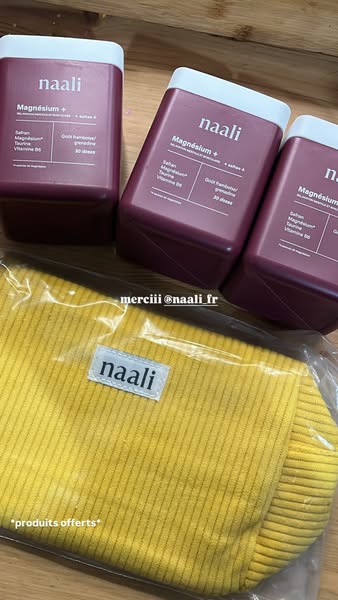
# Ad summary
This ad features three containers of Naali Magnesium+ supplement and a yellow Naali pouch. The ad is likely targeted towards individuals interested in health supplements and the Naali brand.
# Brand positioning
Naali is presented as a brand focused on health supplements, specifically highlighting its Magnesium+ product. The brand is positioned as a provider of supplements with a focus on ingredients like Saffron, Magnesium, Taurine, and Vitamin B6. The brand's aesthetic is clean and modern, with a minimalist design on its packaging. The brand seems to be targeting health-conscious consumers looking for supplements with specific ingredients.
# Product
The featured product is Naali Magnésium +, a dietary supplement. Each container includes 30 doses. The supplement contains Saffron, Magnesium, Taurine, and Vitamin B6. The product is raspberry/grenadine flavored. The packaging is a rectangular container with a white lid and a label that lists the ingredients and flavor. The ad highlights the specific ingredients and the number of doses per container, suggesting that the product is designed to provide a convenient and effective way to supplement these nutrients.
# Visual style
The ad has a clean and minimalist visual style, with a focus on showcasing the product and its packaging. The lighting is soft and natural, creating a warm and inviting feel. The composition is simple and uncluttered, with the products arranged in an aesthetically pleasing manner. The overall style suggests a focus on health and wellness, with a touch of luxury.
# Hooks
Headline: None used
# Funnel stage
Middle of funnel
# Pain points
None used.
# Value propositions
- None used
# Benefits
- None used
# Features
- Sahan
- Magnésium
- Taurine
- Vitamine B6
- Goût framboise/grenadine
- 30 doses
# Call to action
None used.
# Social proof
- merciii @naali_fr
# Point of view
- Brand: The image showcases the product and its packaging, highlighting the brand's aesthetic and product features.
- Customer: The text "merciii @naali_fr" suggests a customer or influencer expressing gratitude for receiving the product.
- Brand: The text "*produits offerts*" indicates that the products were gifted, providing transparency about the nature of the post.
# Storyline
- The image shows three containers of Naali Magnésium + supplement and a yellow Naali pouch. This is intended to showcase the product and its packaging, giving the audience a clear view of what they are purchasing. The perspective is from the brand, highlighting the product's features and presentation.
- The text "merciii @naali_fr" is included, which suggests that the image is a thank you post from an influencer or customer who received the product. This adds a layer of social proof and endorsement to the product. The perspective is from a customer or influencer, showing their appreciation for the brand.
- The text "*produits offerts*" is included, which indicates that the products were gifted. This provides transparency to the audience, letting them know that the post is part of a collaboration or gifting arrangement. The perspective is from the brand or influencer, disclosing the nature of the product placement.
# Ad summary
The ad features the founder of Naali, a saffron-based wellness brand, showcasing the packing of a customer's order. He highlights the brand's success since appearing on a TV show, emphasizing thousands of orders. The video then details the benefits of Naali's anti-stress gummies and collagen, both containing saffron, through product demonstrations and visuals of people experiencing the benefits. It concludes with the founder packing the order, including a free gift of pure saffron, and thanking the customer.
# Brand positioning
Naali positions itself as a modern, natural wellness brand specializing in 'safranothérapie' (saffron therapy). It aims to occupy a space in the consumer's mind as a trusted source for natural, effective solutions to common well-being and beauty concerns. The brand aligns with values of natural health, self-care, and efficacy, promoting a lifestyle of balanced well-being. It pushes against the norm of synthetic solutions by emphasizing 100% natural saffron. The brand positioning is both functional, offering tangible benefits like stress reduction and improved skin, and emotional, by fostering a sense of care and natural harmony. The ad implies a direct-to-consumer model with a focus on customer appreciation and transparency, showcasing the founder and the packing process.
# Product
The ad features two primary products: Naali Anti-Stress Gummies and Naali Collagen. The Anti-Stress Gummies are chewable supplements designed to reduce stress and anxiety and promote better sleep. They are highlighted as containing 100% red saffron, being natural, and having no habit-forming properties or side effects. They are for individuals experiencing stress, anxiety, or sleep difficulties. The Collagen is a supplement, likely in powder form, also containing saffron. It is presented as a comprehensive solution for skin and hair health, offering benefits such as firmer and more radiant skin, reduced wrinkles, improved skin elasticity, strengthened hair, and a decrease in muscle pain. It is for those looking to improve their skin's appearance, hair strength, and alleviate muscle discomfort. Both products are positioned as natural, effective solutions for holistic well-being, with the saffron content being a key unique selling proposition. The ad also showcases a 1g jar of pure saffron as a gift, reinforcing the brand's core ingredient.
# Visual style
The ad features a hybrid visual style, blending polished commercial aesthetics with a UGC-like, authentic feel. The production quality is high, with clear lighting and crisp visuals, but the handheld camera work and direct address by the founder give it a personal, relatable touch. Editing is fast-paced with quick cuts, especially during the product benefit explanations, keeping the viewer engaged. There are smooth transitions between the founder's direct address, product shots, and lifestyle snippets. Visual motifs include close-ups of products and people interacting with them, often with a bright, clean aesthetic. The pacing is generally quick, with cuts occurring every 1-2 seconds, maintaining a dynamic rhythm. Audio-visual sync is strong, with cuts and text overlays precisely timed to the voiceover, enhancing clarity and impact.
# Hooks
Spoken: Cette commande-là c'est grâce à vous.
Text overlay: cette commande / grâce à vous
Visual: A medium shot of a male (Male 1) standing behind a light wooden packing table, holding a brown cardboard box with 'naali SAFRANOTHERAPIE' logo. The background is a white wall with light wooden shelves holding more cardboard boxes and packing materials. A black computer monitor and a barcode scanner are on the left. The camera is stationary, eye-level, and slightly zoomed out. / The same shot, but Male 1 lowers the box onto the table. A small video inset appears in the lower center, showing two males (Male 1 and Male 2) walking into a brightly lit, modern office space, both wearing backpacks. The camera remains stationary.
# Funnel stage
Consideration
# Pain points
The ad addresses the pain points of stress and anxiety, as shown by Female 2's stressed expression (00:19-00:20). It also targets issues like poor sleep (implied by Female 3 reading in bed, 00:20-00:22), skin aging (wrinkles, loss of firmness), weak hair, and muscle pain (Female 7 exercising, 00:43-00:44).
# Value propositions
- safranothérapie (saffron therapy)
- cure complète (complete cure)
- prendre soin de sa peau, c'est aussi gérer le stress de l'intérieur (taking care of your skin is also managing stress from within)
- une meilleure assimilation (better assimilation)
# Benefits
- réduisent le stress et l'anxiété
- favorise un meilleur sommeil
- une peau plus ferme et éclatante
- moins de ridules
- une meilleure élasticité cutanée
- des cheveux renforcés
- une diminution des douleurs musculaires
# Features
- 100% rouge (saffron)
- naturelle
- sans accoutumance
- ni effets secondaires
# Call to action
None used
# Social proof
- Depuis notre passage sur 'Qui veut être mon associé', on en bal sans arrêt. On a reçu des milliers de commandes en moins de 48h.
# Point of view
- Brand 70% – The founder directly addresses the audience, explains product details, and showcases the brand's success and values.
- Customer 30% – Various individuals are shown using the products and experiencing their benefits, implying a user perspective and desired outcomes.
# Storyline
- 00:00–00:01 The founder of Naali stands behind a packing table, holding a branded box, and addresses the camera directly, expressing gratitude to customers for their support.
- 00:01–00:04 The founder continues to speak, and a small video inset appears showing a clip of him and another person from the TV show 'Qui veut être mon associé' (the French version of Shark Tank/Dragon's Den). This establishes credibility and highlights the brand's growth.
- 00:04–00:07 The founder, now without the inset, emphasizes the high volume of orders received since the TV appearance, stating they've received 'thousands of orders in less than 48 hours.' This conveys rapid growth and popularity, building social proof.
- 00:07–00:09 The founder announces that he will be packing a specific customer's order, 'Nadia's order,' and a screenshot of an online shopping cart with Naali products appears over him. This personalizes the experience and shows transparency in the fulfillment process.
- 00:09–00:12 The camera shifts to a first-person view looking down into the open Naali box. The founder's hands begin placing three boxes of 'Anti-Stress' gummies into the larger shipping box. An image of the gummies and their packaging is overlaid, detailing the quantity.
- 00:12–00:15 The founder explains that Naali created 'safranothérapie' (saffron therapy) and that the gummies contain 100% red saffron. This introduces the core ingredient and brand philosophy.
- 00:15–00:16 A visually appealing shot of various Naali products (gummies, collagen) arranged aesthetically on white pedestals appears, reinforcing the brand's product range and premium feel.
- 00:16–00:19 A close-up shot shows a hand holding a pile of orange anti-stress gummies, emphasizing their appealing texture and color. The founder asks why these gummies are a 'revolution,' setting up the explanation of their benefits.
- 00:19–00:20 A young woman is shown sitting on a couch, reading a book with a slightly stressed expression. The voiceover explains the gummies reduce stress and anxiety. This visually demonstrates the problem the product solves.
- 00:20–00:22 Another young woman is shown comfortably reading in bed, covered by a blanket. The voiceover states the gummies promote better sleep. This shows another key benefit and desired outcome.
- 00:22–00:24 A young woman smiles while typing on a laptop, with a Naali product visible on the desk. The voiceover highlights the natural aspect of the product, without habituation or side effects. This reinforces the product's safety and natural appeal.
- 00:24–00:25 The same young woman from the previous shot is now on a balcony, smiling and shielding her eyes from the sun, looking happy and relaxed. This visual reinforces the positive, natural lifestyle associated with the product's benefits.
- 00:25–00:29 The camera returns to the first-person view of the packing process. The founder's hands place three bags of Naali Collagen into the box. An image of the collagen packaging is overlaid, detailing the quantity.
- 00:29–00:30 The founder mentions that the collagen is 'perfect for a complete cure' and also contains saffron. This connects the collagen to the brand's core ingredient and suggests a holistic approach.
- 00:30–00:31 A product shot of the collagen bag and saffron-related elements (saffron threads, flowers) appears, with small video insets showing saffron being harvested and handled. This visually reinforces the natural origin and quality of the saffron.
- 00:31–00:33 A young woman touches her face and smiles at the camera. The voiceover explains that taking care of one's skin also means managing stress from within. This links the collagen to internal well-being and stress management, connecting it to the gummies' benefits.
- 00:33–00:34 A woman with curly hair smiles at her reflection in a mirror, touching her hair. The voiceover mentions 'better assimilation' for the collagen. This implies the product's effectiveness and absorption.
- 00:34–00:35 A close-up shows hands scooping collagen powder into a glass of water. The voiceover continues to discuss the benefits of collagen. This demonstrates product preparation and usage.
- 00:35–00:36 A woman in a car smiles while drinking a yellow liquid from a glass with a straw. The voiceover asks about the benefits of Naali collagen. This shows convenient on-the-go consumption and prompts the upcoming list of benefits.
- 00:36–00:37 A woman works on a laptop, sipping the yellow liquid. The voiceover lists benefits: 'firmer and more radiant skin.' This shows integration into a daily routine and highlights a key skin benefit.
- 00:37–00:38 Two women are seen talking and laughing in a bright, modern bathroom, one touching her face. The voiceover continues: 'fewer wrinkles.' This shows social interaction and another skin benefit.
- 00:38–00:39 A close-up of a woman's face as she touches her cheek, smiling. The voiceover adds: 'better skin elasticity.' This emphasizes a specific skin health improvement.
- 00:39–00:41 A woman sits on a chair, holding a Naali collagen bag, smiling and looking happy. The voiceover mentions 'stronger hair.' This shows a satisfied customer and a hair benefit.
- 00:41–00:43 The woman with curly hair from earlier runs her hands through her hair, smiling broadly. The voiceover continues: 'and a decrease in muscle pain.' This visually confirms the hair benefit and introduces a new physical benefit.
- 00:43–00:44 A woman performs squats with a barbell in a gym. The voiceover reinforces the benefit of reduced muscle pain. This visually demonstrates the physical activity where this benefit would be relevant.
- 00:44–00:45 The camera returns to the first-person view of the packing process. The founder's hands place a small hexagonal jar labeled 'naali SAFRAN 100% ROUGE' into the box. The voiceover announces a 'small gift.'
- 00:45–00:47 The founder holds up the small jar of saffron, showing it to the camera, then gives a thumbs-up. The voiceover specifies it's '1g of pure saffron' and explains it's 'because we love to pamper our clients.' This highlights customer appreciation and adds value.
- 00:47–00:49 The founder's hands place a small card into the box, then close the box. The voiceover addresses Nadia directly, saying her package is on its way. This completes the personalized packing narrative.
- 00:49–00:50 The founder's hands tape the box shut with packing tape. The voiceover thanks Nadia for her order. This finalizes the fulfillment process and reinforces customer gratitude.
# Ad summary
A female creator showcases a variety of products she received as a micro-influencer. She explains how she was contacted by each brand and shows the products she received.
# Brand positioning
The ad features multiple brands, each presented as desirable and worth trying. The brands are positioned as accessible to micro-influencers, suggesting that they are open to collaborations and partnerships. The ad promotes a lifestyle of receiving free products and sharing them with an audience, aligning with the values of transparency and authenticity often associated with influencer culture. The brands are functional, offering beauty and wellness products, but also emotional, as the creator expresses excitement and satisfaction with the products she receives.
# Product
The ad features a variety of products from different brands. Atolea is a jewelry brand that offers waterproof jewelry, including a gold ring with small stones and a gold bracelet that is adjustable. Fresh Skin sends the creator their Glow Me+ and Detox Me product lines. Luxeol sends their anti-hair loss line, including shampoo, spray, and supplements. Nudumun sends a variety of skincare products, including a vitamin C mask and a rose collagen overnight mask. Illan sends anti-stress and hair supplements, as well as marine collagen. Paula's Choice sends their Iconic Trio Kit, which includes an exfoliant, a collagen gloss, and an SPF 50 anti-aging cream, as well as an exfoliant for the body. The ad highlights the products' features and benefits, such as being waterproof, anti-aging, or collagen-infused, and emphasizes the creator's excitement to try them.
# Visual style
The ad has a casual, UGC feel, with a static camera and minimal editing. The production quality is simple, with natural lighting and a focus on the products being showcased. The pacing is consistent, with a moderate number of cuts per minute. The audio-visual sync is loose, with the cuts generally following the speaker's rhythm but not timed to music beats.
# Hooks
Spoken: que j'ai reçu cette semaine en tant que mini influenceuse et je vous explique à chaque fois comment j'ai fait pour les avoir.
Text overlay: mes colis de la semaine version colis baby influenceuse
Visual: 00:00–00:03 The shot is a medium shot of a young woman with long, wavy brown hair, wearing a brown sweater, standing in a room with white walls and a light-colored floor. She is holding a stack of boxes in her arms. Behind her is a desk, a floor lamp, and a radiator. The camera is stationary and at eye level.
# Funnel stage
Top of funnel (Awareness)
# Pain points
None used.
# Value propositions
- Atolea jewelry is waterproof
- Atolea bracelet is adjustable
- Luxeol products are anti-hair loss
- Nudumun mask is overnight collagen
- Illan products are anti-stress and for hair
- Illan products are for radiance, complexion, and hydration
- Paula's Choice Iconic Trio Kit includes an exfoliant, a collagen gloss, and an SPF 50 anti-aging cream
# Benefits
- Atolea jewelry is waterproof
- Atolea bracelet is adjustable
- Luxeol products are anti-hair loss
- Nudumun mask is overnight collagen
- Illan products are anti-stress and for hair
- Illan products are for radiance, complexion, and hydration
- Paula's Choice Iconic Trio Kit includes an exfoliant, a collagen gloss, and an SPF 50 anti-aging cream
# Features
- Atolea jewelry is waterproof
- Atolea bracelet is adjustable
- Luxeol products are anti-hair loss
- Nudumun mask is overnight collagen
- Illan products are anti-stress and for hair
- Illan products are for radiance, complexion, and hydration
- Paula's Choice Iconic Trio Kit includes an exfoliant, a collagen gloss, and an SPF 50 anti-aging cream
# Call to action
Abonne-toi pour ne rien rater.
# Social proof
- "Écoutez, je les ai littéralement adoptés" – Female 1 (Creator)
- "Je vous avoue, je les porte tous les jours depuis que je les ai reçus" – Female 1 (Creator)
# Point of view
- Customer 100% – The entire video is told from the perspective of a customer who is also a micro-influencer.
# Storyline
- 00:00–00:03 The creator introduces herself and the topic of the video, which is to show the packages she received as a micro-influencer and explain how she got them.
- 00:03–00:09 00:03–00:09 The creator shows a small box from Atolea, a jewelry brand that contacted her on TikTok and makes waterproof jewelry.
- 00:09–00:13 00:09–00:13 She shows a gold ring she received from Atolea, saying she has "literally adopted" it.
- 00:13–00:21 00:13–00:21 She shows a gold bracelet she also received from Atolea, noting that it is adjustable.
- 00:21–00:25 00:21–00:25 She shows a colorful necklace she received from Atolea, saying it will look great on tanned skin.
- 00:25–00:29 00:25–00:29 The creator expresses her satisfaction with the Atolea products and says she wears them every day.
- 00:29–00:30 00:29–00:30 The creator introduces the next package from Fresh Skin.
- 00:30–00:45 00:30–00:45 She opens the Fresh Skin package and shows the Glow Me+ and Detox Me product lines, noting that she contacted them by email for their advent calendar, but they sent her products to test instead.
- 00:45–00:48 00:45–00:48 The creator introduces the next package from Luxeol, which contacted her on TikTok.
- 00:48–00:56 00:48–00:56 She shows the anti-hair loss line from Luxeol, including shampoo, spray, and supplements.
- 00:56–01:01 00:56–01:01 The creator introduces the next package from Nudumun, which contacted her directly by email.
- 01:01–01:27 01:01–01:27 She opens the Nudumun package and shows a variety of skincare products, including a vitamin C mask and a rose collagen overnight mask, which she is excited to try.
- 01:27–01:34 01:27–01:34 The creator introduces the next products from Illan, which she contacted by email for their advent calendar, but they sent her products instead.
- 01:34–01:45 01:34–01:45 She shows the anti-stress and hair supplements from Illan.
- 01:45–01:49 01:45–01:49 She shows the Illan supplements for radiance, complexion, and hydration, saying they will be great for winter.
- 01:49–02:03 01:49–02:03 She shows the marine collagen from Illan, saying she has never taken collagen before but knows she should.
- 02:03–02:10 02:03–02:10 She explains that collagen is good for the skin, hair, and nails.
- 02:10–02:15 02:10–02:15 The creator struggles to open the last box.
- 02:15–02:29 02:15–02:29 The creator introduces the last brand, Paula's Choice, which she has wanted to try for a long time. She explains that she received these products by applying to their ambassador program.
- 02:29–02:44 02:29–02:44 She shows the Paula's Choice Iconic Trio Kit, which includes an exfoliant, a collagen gloss, and an SPF 50 anti-aging cream.
- 02:44–02:49 02:44–02:49 She shows the Paula's Choice exfoliant for the body.
- 02:49–02:57 02:49–02:57 The creator announces that the advent calendar by Sidonie B is not over and that there will be more contests. She tells viewers to subscribe so they don't miss anything.
# Ad summary
This ad promotes Naali anti-stress saffron gummies. The ad features a woman showing the product and talking about how it helps her mental well-being. She also mentions that by purchasing the brand's products, they support the education of young Afghan girls.
# Brand positioning
Naali is presented as a brand focused on mental well-being through natural supplements. The brand aligns with values of natural health and social responsibility, as it supports the education of young Afghan girls. The brand positioning is both functional, offering anti-stress benefits, and emotional, promoting mental well-being.
# Product
Naali anti-stress saffron gummies are designed to improve mental well-being. The gummies contain saffron, vitamins B6, B9, and B12. The product is for anyone who needs a little boost to pass the cap naturally. The gummies come in orange containers with the brand name and product details clearly displayed.
# Visual style
The ad has a natural and authentic aesthetic, resembling user-generated content. The editing style includes quick cuts and close-up shots to maintain viewer engagement. The production quality is simple, with natural lighting and minimal effects, which supports the tone of authenticity and approachability. The pacing is moderate, with cuts timed to key moments in the voiceover.
# Hooks
Spoken: 00:02–00:09: Je vais donc tester les gommes au safran. Saveur pour le bien-être mental et je pense que je ne suis pas la seule par ici à ressentir le besoin d'un petit coup de pouce naturel pour passer le cap.
Text overlay: 00:02–00:09 Je vais donc tester les gommes au safran @naali_fr saveur ✨ pour le bien-être mental. Et je pense que je ne suis pas la seule par ici à ressentir le besoin d'un petit coup de pouce naturel pour passer le cap (en + en achetant les produits de la marque, on soutient L'éducation des jeunes filles afghanes)
Visual: 00:02–00:09: The camera focuses on a woman with light skin and brown hair, wearing a black top. She is in a room with a plant and a framed picture in the background. She is speaking directly to the camera.
# Funnel stage
Consideration
# Pain points
The ad addresses the need for a natural boost to improve mental well-being. The woman mentions that she feels the need for a little natural boost to pass the cap, implying that others may feel the same way.
# Value propositions
- Natural boost for mental well-being: The gummies provide a natural way to improve mental well-being, appealing to those seeking natural health solutions.
- Socially responsible purchase: Buying the product supports the education of young Afghan girls, adding a layer of ethical consumerism.
# Benefits
- Bien-être mental (mental well-being)
- Petit coup de pouce naturel pour passer le cap (a little natural boost to pass the cap)
# Features
- Saffron
- Vitamins B6, B9, B12
# Call to action
None used.
# Point of view
- Customer 100% – The entire video is told from the perspective of a customer reviewing the product.
# Storyline
- 00:00–00:02 The video begins with a shot of Naali anti-stress saffron gummies on a wooden surface, along with a yellow pouch with the brand name. The text overlay introduces the product and its benefits.
- 00:02–00:09 The woman begins to speak, introducing herself and stating that she will test the saffron gummies. She mentions that they are good for mental well-being and that she feels the need for a little natural boost.
- 00:09–00:12 She highlights that by purchasing the brand's products, they support the education of young Afghan girls, reinforcing the brand's social mission.
- 00:12–00:17 The woman opens the container and shows the gummies. She takes one and eats it, expressing her satisfaction with the taste.
- 00:17–00:20 She reiterates that the gummies are a great natural boost and encourages viewers to try them.
# Ad summary
This ad features a personal testimonial about a product that helps the user manage their emotions. The ad is designed to look like a spontaneous social media post.
# Brand positioning
The brand is presented as a supportive aid for emotional regulation, offering a 'calm candy' that helps manage emotions. It positions itself as a solution for those feeling overwhelmed, insecure, and paralyzed by daily stressors and emotional challenges. The brand aligns with values of self-care and emotional well-being, contrasting against the norm of ignoring or suppressing difficult emotions. The brand positioning is primarily emotional, focusing on providing comfort and support during challenging times.
# Product
The product is described as a 'calm candy' designed to help manage emotions. It is presented as a small, orange, cube-shaped edible. The product is for individuals who are feeling overwhelmed, insecure, and emotionally paralyzed, particularly during times of stress or emotional difficulty. The ad addresses the purchase barrier of feeling helpless or unable to cope with emotional challenges by offering a tangible aid for emotional regulation. The ad suggests that the product is worth trying or buying because it provides a sense of calm and support during challenging times.
# Visual style
The ad has a UGC production quality, resembling a spontaneous social media post. The visual motif is a close-up shot with soft lighting, creating a personal and intimate feel. The image treatment includes a slight blur and desaturation, enhancing the casual, unfiltered aesthetic. The typography is integrated as caption-style text, mimicking a platform-native look. The style contrasts with highly polished ads, aiming for authenticity and relatability to increase scannability and stop power in the feed.
# Hooks
Headline: Mon petit bonbon calm (comme dirait Elon) @naali_fr qui m'aide à gérer mes émotions.
# Funnel stage
Middle of funnel (Consideration)
# Pain points
The ad addresses the pain point of feeling overwhelmed, insecure, and emotionally paralyzed by daily stressors and life events. "Aujourd'hui, je me sens totalement dépassée. La montagne me paraît infranchissable. Le SPM commence, ce qui n'aide pas. Ces dernières semaines, plusieurs événements m'ont fait me sentir en insécurité. J'ai peur, souvent. L'injustice m'écrase, les conflits me brisent."
# Value propositions
- The 'calm candy' provides emotional regulation, offering a tangible aid for those feeling overwhelmed and insecure.
# Benefits
- qui m'aide à gérer mes émotions
# Features
- calm candy
# Call to action
None used.
# Social proof
- The ad includes a mention of '@naali_fr,' suggesting an endorsement or collaboration with another user, which can build trust and credibility.
# Point of view
- Customer: The entire image is presented from the customer's point of view, as they share their personal experience and feelings about using the product.
# Storyline
- The ad begins with the user introducing the product as their 'petit bonbon calm,' which helps them manage their emotions. This is included to immediately establish the product's purpose and benefit from the user's perspective.
- The user shares their current emotional state, expressing feelings of being overwhelmed, insecure, and paralyzed by various life events. This is included to create a relatable context and highlight the need for the product from the user's perspective.
- The user acknowledges that good things are happening, but they still feel guilty for feeling paralyzed. This is included to add depth to the user's emotional experience and reinforce the product's role in helping them navigate complex emotions from the user's perspective.
# Ad summary
This ad showcases Naali Saffron, emphasizing its quality and versatility. The video features close-up shots of the saffron threads and their use in making tea, highlighting the product's rich color and aroma. The ad aims to convey the luxurious and authentic experience of using high-quality saffron.
# Brand positioning
Naali Saffron is presented as a purveyor of high-quality, authentic saffron. The brand emphasizes the purity and richness of its saffron threads, positioning itself in the premium segment of the spice market. The brand aligns with values of luxury, authenticity, and a refined lifestyle, appealing to consumers who appreciate gourmet ingredients and traditional culinary practices. Naali Saffron differentiates itself by focusing on the superior quality of its saffron, avoiding direct comparisons but implying a higher standard than mass-market spices. The brand positioning is both functional (high-quality spice) and emotional (luxury, authenticity).
# Product
Naali Saffron is advertised as 100% pure saffron threads, packaged in a small, clear jar with a black lid. The product is intended for culinary use, specifically to enhance the flavor and color of dishes and beverages. The ad highlights the rich, deep red color of the saffron threads, suggesting a high concentration of flavor and aroma. The unique selling proposition (USP) is the product's purity and quality, as indicated by the label and visual presentation. The ad shows the saffron being used to make tea, implying a use occasion for relaxation and enjoyment. The ad addresses the purchase barrier of perceived high cost by emphasizing the value and authenticity of the product.
# Visual style
The ad has a UGC feel with a focus on close-up shots and natural lighting. The editing style is simple with static shots and smooth transitions. The production quality is decent, giving it a polished yet authentic look. The pacing is slow and deliberate, emphasizing the luxurious and refined nature of the product.
# Hooks
Text overlay: SAFRAN (on product label) / naali (on product label)
Visual: 00:00–00:01: A hand holds a small, clear jar of Naali Saffron. The jar has a black lid and a white label with red text. The saffron threads inside are a deep red color. The background is blurred and dimly lit. / 00:01–00:02: A plate with several orange candies is shown on a blue surface. The candies are a mix of round and square shapes. The lighting is dim, with a slight blue tint.
# Funnel stage
Top of funnel (Awareness)
# Pain points
None used.
# Value propositions
- High-quality, authentic saffron for a luxurious culinary experience
# Benefits
- Enhances the flavor and color of dishes and beverages
# Features
- 100% pure saffron threads
# Call to action
None used.
# Social proof
- None used.
# Point of view
- Customer 100% – The ad is presented from the perspective of someone using and showcasing the product in a casual, user-generated content style.
# Storyline
- 00:00–00:01 A hand holds a small jar of Naali Saffron, focusing on the label and the vibrant red threads inside.
- 00:01–00:02 The camera pans over a plate of orange candies, creating a visual contrast with the saffron.
- 00:02–00:05 A hand drops saffron threads into a glass of tea, stirring it with a spoon.
- 00:05–00:08 The camera focuses on the jar of Naali Saffron, emphasizing the product's color and texture.
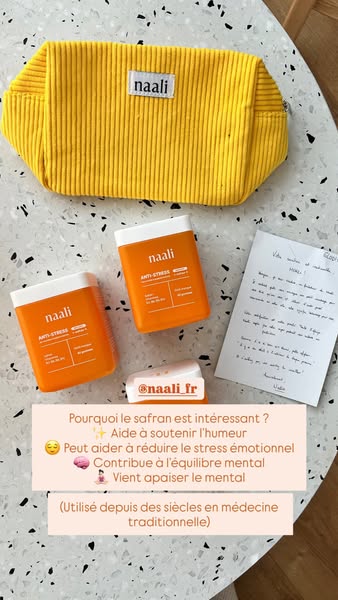
# Ad summary
This ad promotes Naali anti-stress supplements, highlighting their benefits for mood, stress reduction, mental balance, and relaxation. The ad uses a flatlay visual style with the product, a handwritten note, and text overlays to convey the benefits and traditional use of saffron in medicine.
# Brand positioning
Naali is presented as a brand focused on natural remedies for stress and mood enhancement. The brand aligns with a lifestyle that values mental well-being and traditional medicine. The brand positions itself in the health and wellness category, emphasizing the use of saffron, a natural ingredient, to support emotional and mental health. The brand's positioning is both functional, highlighting the benefits of saffron, and emotional, appealing to those seeking stress relief and mental balance.
# Product
The featured product is Naali Anti-Stress, a supplement designed to support mood, reduce emotional stress, contribute to mental balance, and promote relaxation. The product is presented in orange and white rectangular containers. The supplement is for individuals seeking natural ways to manage stress and enhance their mental well-being. The ad highlights the use of saffron, noting that it has been used for centuries in traditional medicine. The ad addresses the purchase barrier of skepticism towards natural remedies by emphasizing the historical use of saffron.
# Visual style
The ad features a clean, minimalist aesthetic with a flatlay arrangement. The production quality appears to be high, with well-lit and sharp images. The visual motifs include a grid-like layout with the products and handwritten note arranged in a balanced composition. The image treatment includes color grading to enhance the warmth and vibrancy of the colors. The typography is integrated with clear and legible fonts. The overall style is modern and approachable, designed to be easily scannable in a social media feed.
# Hooks
Headline: Pourquoi le safran est intéressant?
# Funnel stage
Middle of funnel (Consideration)
# Pain points
The ad addresses the pain point of emotional stress and the desire for mental balance.
# Value propositions
- Saffron and Vitamin B6 to support mood and reduce stress
- Used for centuries in traditional medicine
# Benefits
- Aide à soutenir l'humeur
- Peut aider à réduire le stress émotionnel
- Contribue à l'équilibre mental
- Vient apaiser le mental
# Features
- SAFRAN + VITAMINE B6
# Call to action
None used.
# Social proof
- The handwritten note suggests a personal testimonial, implying that others have had positive experiences with the product.
# Point of view
- Brand: The brand is communicating the benefits of its product and the historical use of saffron to build trust and credibility.
# Storyline
- The ad begins by posing the question, "Pourquoi le safran est intéressant?" (Why is saffron interesting?), immediately capturing the viewer's attention and setting the stage for the product's benefits. The brand is telling the audience why they should care about saffron.
- The ad then lists the benefits of saffron, including "Aide à soutenir l'humeur" (Helps support mood), "Peut aider à réduire le stress émotionnel" (Can help reduce emotional stress), "Contribue à l'équilibre mental" (Contributes to mental balance), and "Vient apaiser le mental" (Helps soothe the mind). The brand is highlighting the key advantages of using the product.
- The ad concludes by stating, "(Utilisé depuis des siècles en médecine traditionnelle)" ((Used for centuries in traditional medicine)), reinforcing the credibility and historical use of saffron. The brand is providing reassurance and validation of the product's efficacy.
# Ad summary
This ad features a woman sharing her personal struggle with chronic fatigue despite getting enough sleep. She explains the biological reason behind this phenomenon, comparing it to trying to charge a phone without plugging it in. She then introduces Naali Anti-Stress gummies, highlighting their key ingredients (saffron and B vitamins) and how they help the body naturally transition from 'alert mode' to 'rest mode' without being a sedative. The ad showcases her positive results after two weeks, emphasizing feeling rested and calm. It concludes with social proof (Trustpilot rating) and a risk-free 90-day trial offer.
# Brand positioning
The brand, Naali, is presented as a natural and effective solution for chronic fatigue and stress, specifically targeting women who experience persistent tiredness despite adequate sleep. It aims to occupy a space in the consumer's mind as a science-backed, non-sedative alternative to traditional sleep aids, focusing on restoring the body's natural rhythm. The brand aligns with values of natural well-being, scientific understanding of the body, and a holistic approach to health. It pushes against the norm of simply masking symptoms with sedatives, instead offering a solution that supports the body's inherent processes. The brand positioning is both functional, emphasizing specific ingredients like saffron and B vitamins, and emotional, promising relief from exhaustion and a return to feeling rested and calm.
# Product
The featured product is Naali Anti-Stress gummies. These gummies are designed for women who sleep enough hours but still wake up feeling tired and exhausted, experiencing chronic fatigue, irritability, and broken sleep due to their body being in a constant 'alert mode.' The product works by helping the body transition from this alert mode to a rest mode naturally, rather than acting as a sedative. Key ingredients include 100% red saffron, which is highlighted for its ability to help regulate this shift, and a complex of B vitamins, which support the nervous system. The gummies are mango-flavored, making them pleasant to consume, and are presented as an easy-to-integrate daily routine, requiring just two gummies per day, offering a convenient alternative to pills. The unique selling proposition (USP) is their natural approach to stress and sleep, supporting the body's natural rhythm and nervous system without causing drowsiness. The ad implies use occasions are daily, as part of a routine to combat chronic fatigue and stress. A purchase barrier addressed is the concern about sedatives, as the ad explicitly states it's 'not by knocking you out like a sleeping pill.'
# Visual style
The ad features a hybrid visual style, blending a polished UGC aesthetic with clear, informative elements. The production quality feels authentic and relatable, akin to a well-produced social media video from an influencer. The editing style uses quick cuts between different scenes and camera angles, maintaining a dynamic pace. There are no obvious visual motifs beyond the consistent use of the main speaker in various settings. The pacing is generally fast, with cuts occurring every 1-3 seconds, keeping the viewer engaged. The audio-visual sync is strong, with text overlays appearing precisely when the corresponding spoken words are uttered, and visual demonstrations aligning with the narrative.
# Hooks
Spoken: 73% des femmes dorment assez d'heures mais se réveillent plus fatiguées qu'en se couchant.
Text overlay: 73% / des femmes / assez d'heures / mais se réveillent / +FATIGUÉES
Visual: 00:00–00:03: A medium shot shows a woman with dark curly hair lying in a bed with light gray bedding. She is on her side, facing away from the camera, with her head on a gray pillow, covered by a light gray duvet and a textured gray blanket. Her arm is bent, and her hand is near her head. The room is minimalist with white walls and a white bedside table with a lamp and a small rainbow decoration. The camera is stationary, capturing the scene from a slightly elevated angle. / 00:03–00:05: A close-up, slightly angled shot from above shows a black smartphone screen displaying a digital alarm clock set to '07:46 Réveil'. A hand with light skin and short, neat nails reaches into the frame from the left, tapping the 'Arrêter' (Stop) button on the screen. The phone is on a white bedside table, with a charging cable visible. The background is dark and out of focus. The camera is stationary.
# Funnel stage
Middle of funnel (Consideration)
# Pain points
The central pain point is chronic fatigue despite getting enough sleep, stemming from the body being in a constant 'alert mode.' This leads to a cycle of stress, fatigue, irritability, and broken nights. The ad highlights this with: '73% des femmes dorment assez d'heures mais se réveillent plus fatiguées qu'en se couchant.' (00:00-00:05) and 'Je dormais 8h par nuit et je me réveillais déjà ÉPUISÉE.' (00:11-00:14)
# Value propositions
- not by knocking you out like a sleeping pill
- helps your body transition from alert mode to rest mode
- restores natural rhythm
- no need for pills
- super simple to integrate
# Benefits
- body recovers naturally
- deep sleep
- no more waking up at 3 AM
- wake up rested
- stay calm (even in the rush)
- body can breathe (recover)
- supports the nervous system
- helps body relax naturally
# Features
- 100% red saffron
- complex of B vitamins
- mango flavor
- gummies
- just 2 gummies per day
# Call to action
None used
# Social proof
- "En 2 semaines, j'ai vu la différence. J'ai un sommeil profond, plus de réveil à 3h. Je me réveille reposée et même dans le rush, je reste calme." – Female 1 (Customer)
- "Ils ont 4,7 sur 5 sur Trustpilot avec des milliers d'avis. C'est ce qui m'a donné confiance." – Female 1 (Customer)
# Point of view
- Customer 80% – The main speaker shares her personal experience, struggles, and positive outcomes with the product, speaking directly to the camera and demonstrating product use.
- Brand 20% – Animated visuals and product demonstrations, along with the speaker explaining the scientific basis and product features, convey information from the brand's perspective.
# Storyline
- 00:00–00:03 00:00–00:03: A woman is shown lying in bed, seemingly asleep but looking uncomfortable. The scene sets up the core problem: many women sleep enough but still wake up tired, immediately establishing relatability and a common pain point for the target audience. The perspective is third-person, observing the woman's struggle.
- 00:03–00:06 00:03–00:06: The camera focuses on a smartphone alarm clock displaying 07:46, and a hand reaches out to hit 'stop' on the alarm. This visual reinforces the idea of waking up, but the previous shot implies it's not a refreshing awakening, continuing the problem-setting narrative. The perspective is close-up, focusing on the action.
- 00:06–00:10 00:06–00:10: The woman from the first shot is now speaking directly to the camera, sharing her personal experience of thinking her constant fatigue was 'normal' for years. This shifts to a first-person testimonial, building empathy and trust by personalizing the problem. Her tone is reflective and slightly resigned, conveying a shared struggle.
- 00:10–00:14 00:10–00:14: The scene returns to the woman in bed, now sitting up with a tired expression, as she explains she slept 8 hours but still woke up exhausted. This visually reiterates her spoken problem, making it tangible and relatable. The perspective is third-person, observing her continued struggle.
- 00:14–00:17 00:14–00:17: Back to the woman speaking to the camera, she questions, 'Isn't that just life?' This rhetorical question directly addresses the audience's potential resignation to fatigue, further building relatability and setting up the idea that there might be an alternative. Her tone is questioning and slightly frustrated.
- 00:17–00:18 00:17–00:18: The woman, still speaking to the camera, states, 'Until the day I understood something.' This acts as a narrative turning point, signaling a shift from problem identification to the discovery of a solution. Her tone becomes more insightful and hopeful.
- 00:18–00:23 00:18–00:23: An animated visual of a human body with glowing red and blue electrical signals illustrates the biological explanation: when the body is in 'alert mode' for too long, it produces more stress hormones than rest hormones. This provides a scientific, educational explanation for the previously described fatigue, validating the problem with biological context. The perspective is an objective, animated demonstration.
- 00:23–00:26 00:23–00:26: The woman returns, explaining that even if you sleep, your body doesn't recover. This connects the scientific explanation back to the personal experience of fatigue, making the biological concept understandable and relevant. Her tone is explanatory and empathetic.
- 00:26–00:29 00:26–00:29: She is shown trying to charge her phone by holding the cable near the outlet without plugging it in, then looking confused. This visual analogy humorously and effectively illustrates the concept of trying to rest without truly recovering, making the problem more tangible. The perspective is third-person, observing her action.
- 00:29–00:31 00:29–00:31: The woman, now holding a mug, explains that the longer this goes on, the more exhausted the body becomes. This emphasizes the chronic nature and worsening effects of the problem, building urgency for a solution. Her tone is serious and concerned.
- 00:31–00:36 00:31–00:36: A hand writes a cycle diagram on paper: 'Stress -> Chronic fatigue -> Irritability -> Broken nights -> Stress.' This visualizes the vicious cycle of fatigue and stress, clearly outlining the interconnected pain points. The perspective is a top-down shot of the writing process.
- 00:36–00:42 00:36–00:42: The woman, still holding her mug, discusses common solutions like herbal teas, meditation, or cutting coffee, acknowledging they might alleviate pressure but don't solve the root problem. This dismisses ineffective alternatives, positioning the upcoming solution as superior. Her tone is informative but dismissive of these partial solutions.
- 00:42–00:47 00:42–00:47: The woman, with a hopeful expression, declares that fortunately, 'all of this is not irreversible,' and through her research, she discovered something. This builds anticipation for the product and offers hope, transitioning from problem to solution. Her tone is optimistic and revealing.
- 00:47–00:49 00:47–00:49: A close-up shot shows saffron threads being carefully picked up with tweezers. This visually introduces the key ingredient, saffron, in a precise and almost scientific manner. The perspective is a close-up product shot.
- 00:49–00:50 00:49–00:50: A woman's hand holds a small pile of saffron threads, bringing it closer to the camera. This personalizes the ingredient, showing it being handled by a person, connecting it to the user experience. The perspective is a close-up of the hand and saffron.
- 00:50–00:55 00:50–00:55: The main speaker explains that saffron can help regulate the body's shift from alert to rest mode, 'not by knocking you out like a sleeping pill.' This clarifies the mechanism of action and differentiates the product from sedatives, addressing a potential concern. Her tone is informative and reassuring.
- 00:55–01:01 00:55–01:01: She continues, explaining that when saffron is combined with a B vitamin complex that supports the nervous system, the body regains its 'natural rhythm.' This introduces the full product formulation and its comprehensive benefits. Her tone is enthusiastic and knowledgeable.
- 01:01–01:04 01:01–01:04: The woman is in a kitchen setting, stating, 'And that's exactly what I found in Naali Anti-Stress gummies.' This is the product reveal, directly linking the solution to the brand. Her tone is excited and confident.
- 01:04–01:08 01:04–01:08: She demonstrates the product, showing the orange gummies and listing the ingredients: '100% red saffron, a complex of B vitamins.' This provides a clear product demonstration and highlights key features. The perspective is a medium shot of her interacting with the product.
- 01:08–01:10 01:08–01:10: Holding a gummy, she explains it helps the body 'relax naturally.' This reiterates the core benefit and natural approach. Her tone is gentle and reassuring.
- 01:10–01:14 01:10–01:14: She holds up two gummies, mentioning 'just 2 gummies per day,' 'mango flavor,' and 'super simple to integrate.' This highlights ease of use and pleasant experience, addressing practical considerations. Her tone is friendly and encouraging.
- 01:14–01:19 01:14–01:19: The woman is back in bed, wearing a bathrobe, sharing her personal testimonial: 'In 2 weeks, I saw the difference. I have deep sleep, no more waking up at 3 AM.' This provides powerful social proof and a clear before-and-after narrative. Her tone is sincere and relieved.
- 01:19–01:21 01:19–01:21: She is shown making her bed, looking refreshed, with the text 'I wake up rested.' This visually confirms the benefit of waking up feeling rested. The perspective is third-person, showing her morning routine.
- 01:21–01:24 01:21–01:24: She is shown washing her face in the mirror, smiling, with the text 'and even in the rush, I stay calm.' This demonstrates another key benefit – maintaining calmness even during busy times. The perspective is a mirror shot, showing her reflection.
- 01:24–01:29 01:24–01:29: Back in bed, she clarifies, 'It's not magic, it's just that my body could breathe.' This manages expectations, grounding the benefits in natural bodily processes rather than a miraculous cure. Her tone is honest and reflective.
- 01:29–01:31 01:29–01:31: She expresses regret, 'And honestly, I would have loved to have tested this sooner.' This creates a sense of urgency and FOMO, implying others should try it now. Her tone is slightly wistful.
- 01:31–01:36 01:31–01:36: She mentions the product's 4.7/5 rating on Trustpilot with thousands of reviews, stating, 'That's what gave me confidence.' This provides strong external social proof, leveraging third-party validation to build trust. Her tone is confident and reassuring.
- 01:36–01:42 01:36–01:42: Outdoors, she directly addresses the viewer: 'If you also wake up tired even though you sleep enough, maybe your body is trying to tell you something.' This re-engages the audience with the initial pain point and suggests a call to action. Her tone is direct and empathetic.
- 01:42–01:45 01:42–01:45: She is shown eating a gummy, with the text 'You can try Naali for 90 days risk-free.' This visualizes product consumption and introduces the main offer. The perspective is a medium shot of her eating the gummy.
- 01:45–01:47 01:45–01:47: She is looking at a tablet displaying an article about saffron, with the text 'If it changes nothing, you're reimbursed.' This reinforces the risk-free offer and money-back guarantee. The perspective is an over-the-shoulder shot of her using the tablet.
- 01:47–01:50 01:47–01:50: The woman, back outdoors, asks, 'Frankly, what do you risk?' This final rhetorical question challenges the viewer to consider the minimal risk and potential reward, driving conversion. Her tone is persuasive and confident.
# Ad summary
The ad features a woman sharing her personal struggle with stress-induced physical symptoms like a puffy face, dark circles, and fatigue, which made her avoid mirrors. After trying various ineffective remedies and almost resorting to Botox, her pharmacist friend explained the link between stress (cortisol) and these symptoms. She then discovered Naali Anti-Stress gummies, which contain 100% red saffron and vitamin B. She highlights the product's benefits, ease of use, and her positive results within two weeks, including better sleep and a decongested face. The ad concludes with her endorsing the product, mentioning a 90-day money-back guarantee and high Trustpilot ratings, encouraging viewers to try it.
# Brand positioning
Naali is presented as a brand offering a natural, effective solution for stress-related physical and emotional well-being. It aims to occupy a space in the consumer's mind as a trustworthy alternative to conventional or invasive beauty treatments, focusing on internal balance rather than superficial fixes. The brand aligns with values of natural health, self-care, and holistic beauty, promoting a lifestyle where inner calm translates to outer radiance. It pushes against the norm of solely treating symptoms by addressing the root cause (stress) and offers a simple, pleasant way to integrate wellness into daily life. The brand positioning is both functional, by providing specific ingredients like saffron and vitamin B for stress reduction, and emotional, by promising a return to feeling good about oneself and regaining confidence.
# Product
The product featured is Naali Anti-Stress gummies. These are described as sugar-free gummies containing 100% red saffron, which is highlighted as the 'rarest' and possessing 'numerous virtues,' along with a complex of B vitamins (B3, B6, B9, B12). The product is for individuals experiencing stress-related physical symptoms such as puffy faces, dark circles, permanent fatigue, and lack of sleep, who are looking for a natural and easy-to-integrate solution. The gummies work by helping the nervous system regulate itself (due to saffron) and providing a 'gentle energy without crash' (due to vitamin B). They are mango-flavored, making them 'good' and 'super easy to integrate into the routine.' The ad implies that the product addresses the purchase barrier of skepticism towards traditional remedies by offering a natural, science-backed alternative with a money-back guarantee.
# Visual style
The ad features a UGC-style aesthetic, characterized by its authentic, unpolished feel. The production quality is a hybrid, combining raw, handheld selfie-style shots with more stable, well-lit indoor shots, giving it a relatable and trustworthy vibe. The editing rhythm is relatively quick, with frequent cuts between the woman speaking directly to the camera in different settings and close-ups of product interaction or visual demonstrations of symptoms. The pacing is consistent, maintaining an engaging flow. The audio-visual sync is strong, with text overlays and visual actions perfectly timed to the speaker's voiceover, enhancing clarity and impact.
# Hooks
Spoken: Je peux de nouveau me regarder avec le sourire et me sentir bien dans ma peau, je t'explique comment.
Text overlay: Je peux de nouveau / me regarder avec le sourire / et me sentir bien dans ma peau / je t'explique comment
Visual: The screen is split vertically into two main sections, with a smaller, rectangular inset at the bottom center. The left section shows a medium close-up of a woman with light skin, dark hair pulled back, wearing a red and white plaid shirt, looking directly at the camera with a tired, slightly sad expression, holding her face with both hands. Her eyes are slightly red-rimmed, and there are visible dark circles under her eyes. A silver ring is visible on her left ring finger. The right section shows a medium close-up of the same woman, also with dark hair pulled back, wearing a dark brown knitted sweater, looking directly at the camera with a more radiant, slightly smiling expression. Her skin appears smoother, and her eyes are brighter with less visible dark circles. The bottom inset shows the same woman from the right section, speaking directly to the camera, framed from the chest up, wearing the same brown sweater. The camera is stationary, capturing a direct address. The lighting is bright and even, suggesting natural light.
# Funnel stage
Consideration
# Pain points
The central pain point is the negative impact of stress on physical appearance and self-perception. The ad highlights this through: "je ne reconnaissais plus mon reflet et je préférais éviter les miroirs" and visual demonstrations of "visages gonflés, cernes, fatigues permanentes" and "un manque de sommeil permanent."
# Value propositions
- Je peux de nouveau me regarder avec le sourire et me sentir bien dans ma peau
- le plus rare pour ses nombreuses vertus (saffron)
- hyper facile à intégrer dans la routine
- en 2 semaines, j'ai vu la différence
- garantie 90 jours: tu testes, t'aimes ou t'es remboursé
# Benefits
- se sentir bien dans ma peau
- dormais mieux
- visage s'est décongestionné
- ça fait naturel
- je me sentais enfin moi
- calme intérieur
- le safran aide ton système nerveux à se réguler
- la vitamine B redonne une énergie douce sans crash
# Features
- gummies sans sucre
- safran 100% rouge
- complexe de vitamine B
- goût mangue
# Call to action
None used
# Social proof
- Une amie pharmacienne m'expliquait que le problème ce n'était pas ma peau, c'était mon stress. (Female 1, Customer/Creator)
- Mon amie pharmacienne m'a confirmé et m'a parlé de la marque Naali. (Female 1, Customer/Creator)
- Ils ont une note de 4.7/5 sur Trustpilot avec plein d'avis. (Female 1, Customer/Creator)
# Point of view
- Customer 90% – The majority of the video is told from the perspective of a female user sharing her personal struggle, discovery, and positive experience with the product.
- Brand 10% – Product shots and explicit mentions of ingredients and their functions represent the brand's voice and claims.
# Storyline
- 00:00–00:04 The video opens with a split screen showing the woman looking tired and sad on the left, and radiant and happy on the right, while a smaller inset of her speaking appears at the bottom. She expresses her renewed ability to look at herself with a smile and feel good in her skin, promising to explain how. This sets up a clear before-and-after transformation and immediately hooks the viewer with a personal, positive outcome, creating curiosity.
- 00:04–00:08 The woman, now speaking directly to the camera in a casual outdoor setting, recounts her past struggle, stating that a few months ago, she 'no longer recognized her reflection' and 'preferred to avoid mirrors.' This establishes the problem from a personal, relatable customer perspective, using a slightly melancholic but determined tone to convey her past frustration.
- 00:08–00:10 Visuals transition back to the woman in a home setting, demonstrating the physical symptoms she experienced: 'puffy faces,' 'dark circles,' and 'permanent fatigue.' This visually reinforces the problem she described, making it tangible and relatable to viewers who might share similar experiences, enhancing the emotional connection.
- 00:10–00:14 Returning to the outdoor setting, she elaborates on her state, saying she was in a 'not great phase' with 'permanent lack of sleep.' This deepens the understanding of her pain point, connecting the physical symptoms to a broader sense of malaise and exhaustion, maintaining a relatable customer perspective.
- 00:14–00:19 She then describes her attempts to solve the problem, stating she 'tried everything: creams, massages, completely overpriced' products, but 'nothing changed.' This highlights the common frustration of trying various solutions without success, building empathy and setting the stage for a truly effective solution.
- 00:19–00:21 She reveals she was 'two steps away from cracking for Botox,' emphasizing the severity of her desperation and the extent to which she considered extreme measures. This further underscores the depth of her problem and positions the upcoming solution as a much-needed, less invasive alternative.
- 00:21–00:33 She explains that a 'pharmacist friend' clarified that the problem wasn't her skin, but her 'stress.' She then provides a scientific explanation: when stress lasts too long, the body goes into 'survival mode' and produces 'cortisol,' which negatively impacts appearance. This introduces an expert perspective to validate the problem's root cause, shifting the narrative from personal struggle to scientific understanding.
- 00:33–00:37 The visual returns to the woman in the home setting, touching her face, as she continues to explain the effects of cortisol: 'your hair falls out,' 'your face swells,' and 'your dark circles deepen.' This visual demonstration, combined with the scientific explanation, makes the connection between stress and physical symptoms even clearer and more impactful.
- 00:37–00:42 Back in the outdoor setting, she describes how she 'searched on Google how to reduce cortisol' and found 'many studies' on the benefits of 'red saffron.' This shows her proactive search for a solution and introduces the key ingredient, building anticipation for the product.
- 00:41–00:42 The screen displays a Google search results page and an article about saffron, visually confirming her research. This external validation reinforces the credibility of saffron as a solution.
- 00:42–00:46 She then reveals that her 'pharmacist friend confirmed' the benefits of saffron and 'told her about the Naali brand.' This brings the expert endorsement full circle, directly linking the scientific solution to the specific product.
- 00:46–00:51 She holds up a Naali product container, then the video shows a close-up of three Naali 'Anti-Stress' gummy containers. She describes them as 'sugar-free gummies with 100% red saffron,' emphasizing its rarity and 'numerous virtues.' This is the product reveal, highlighting key features and benefits from the brand's perspective.
- 00:51–00:59 A close-up shot shows a hand taking a gummy from the container and placing it in the woman's mouth. She explains that 'saffron helps your nervous system regulate' and 'vitamin B gives you gentle energy without a crash.' This demonstrates product usage and clearly articulates the functional benefits of the ingredients.
- 00:59–01:02 Back in the outdoor setting, she describes the gummies as 'mango flavored,' 'good,' and 'super easy to integrate into the routine.' This addresses practical aspects of product use, making it appealing and convenient for daily life.
- 01:02–01:12 She shares her personal results, stating that 'in 2 weeks,' she 'saw the difference,' 'slept better,' her 'face decongested,' and she 'felt natural' and 'finally herself.' She concludes that 'inner calm shows on the outside.' This is the powerful testimonial phase, demonstrating the product's effectiveness through her personal experience and emotional transformation.
- 01:12–01:19 She addresses potential skepticism, saying she 'was skeptical like you at first,' but highlights the '90-day guarantee: you test, you like it, or you get refunded. Simple.' This directly tackles a common purchase barrier and offers risk reversal, building trust with the audience.
- 01:19–01:27 Finally, she mentions the brand's '4.7/5 rating on Trustpilot with many reviews,' which 'gave her confidence,' and now she's 'part of it,' having 'physically found herself again.' This provides strong social proof and reinforces her personal endorsement, encouraging viewers to join her in experiencing the benefits.
# Ad summary
A woman shares her experience with Naali anti-stress gummies, which she says have helped her reduce cortisol levels and improve her overall well-being. She explains that she was initially skeptical, but after trying them for two weeks, she noticed a significant difference in her sleep, face congestion, and overall mood. She emphasizes that the gummies are sugar-free, taste like mango, and are easy to incorporate into a daily routine. She also mentions that the product has a 90-day guarantee and a high rating on Trustpilot, which gave her confidence to try them.
# Brand positioning
Naali is presented as a brand that offers a solution to combat stress and its negative effects on the body. The brand positions itself as a provider of sugar-free gummies with saffron and vitamin B, which help regulate the nervous system and provide a gentle energy boost. The brand aligns with a lifestyle focused on inner calm and outer well-being, suggesting that addressing internal stress can lead to visible improvements in appearance. Naali pushes against the norm of relying solely on skincare products to address skin issues, instead focusing on the root cause of stress and its hormonal impact on the body. The brand positioning is both functional, offering specific ingredients and benefits, and emotional, promising a sense of calm and feeling like oneself again.
# Product
Naali anti-stress gummies are sugar-free gummies containing 100% red saffron and a complex of vitamin B. The product is designed for individuals experiencing stress, lack of sleep, and related symptoms such as facial puffiness and dark circles. The gummies aim to regulate the nervous system with saffron and provide a gentle energy boost with vitamin B. The USPs include the use of rare red saffron known for its numerous virtues, the sugar-free formulation, and the mango flavor, making it easy to integrate into a daily routine. The gummies address the purchase barrier of skepticism by offering a 90-day guarantee, allowing customers to test the product and receive a refund if not satisfied. The ad emphasizes that the gummies are a natural solution to combat stress and its impact on appearance, promoting a sense of inner calm and outer well-being.
# Visual style
The ad has a hybrid aesthetic, combining a UGC feel with polished commercial elements. The editing style includes quick cuts and static shots, with smooth transitions between scenes. The production quality is a mix of casual, selfie-style footage and more professionally lit and framed shots. The pacing is consistent throughout the ad, with cuts timed to the voiceover lines. The visual motifs include recurring shots of the woman speaking directly to the camera, interspersed with product shots and screen recordings.
# Hooks
Spoken: C'est trop gentil, mais vous abusez un peu. [Friendly tone]
Text overlay: Dis-nous ton secret, tu as rajeunie de 10 ans ! ✨🤩 (Comment bubble)
Visual: 00:00–00:06: A woman with long brown hair and a brown coat stands outside, addressing the camera in a selfie-style shot. A comment bubble is overlaid at the top of the frame. A white van is parked in the background.
# Funnel stage
Middle of funnel (Consideration)
# Pain points
The central pain point is the frustration of dealing with stress and its visible effects on appearance, such as facial puffiness, dark circles, and fatigue. "Visage gonflé, cernes, fatigues permanentes, j'étais dans une phase pas top."
# Value propositions
- Sugar-free gummies with saffron and vitamin B for regulating the nervous system and providing gentle energy.
- 100% red saffron, the rarest type, known for its numerous virtues.
# Benefits
- Helps regulate the nervous system
- Provides gentle energy without a crash
- Easy to integrate into a routine
- Tastes like mango
# Features
- Sugar-free gummies
- 100% red saffron
- Complex of vitamin B
# Call to action
None used.
# Social proof
- "Ils ont une note de 4,7/5 sur Trustpilot avec plein d'avis" – Female 1 (Customer)
# Point of view
- Customer 100% – The entire ad is told from the perspective of a customer sharing her personal experience with the product.
# Storyline
- 00:00–00:06 The creator responds to a comment asking for her secret to looking younger.
- 00:06–00:11 She states that she won't talk about day creams or miracle treatments, but instead shares her secret.
- 00:11–00:14 She explains that a few months ago, she didn't recognize her reflection and avoided mirrors.
- 00:14–00:17 She describes her face as puffy, with dark circles and constant fatigue, indicating she was in a bad phase.
- 00:17–00:22 She mentions trying everything, including creams and massages, but nothing changed.
- 00:22–00:28 She was close to getting Botox when a pharmacist friend explained that the problem wasn't her skin, but her stress.
- 00:28–00:35 The pharmacist explained that prolonged stress puts the body in survival mode, producing cortisol, which affects appearance.
- 00:35–00:40 She lists the effects of stress on appearance, such as hair loss, puffy face, and dark circles.
- 00:40–00:46 She searched on Google for ways to reduce cortisol and found studies on the benefits of red saffron.
- 00:46–00:49 Her pharmacist friend confirmed this and introduced her to Naali gummies.
- 00:49–00:57 She describes Naali gummies as sugar-free with 100% red saffron, the rarest type, and vitamin B.
- 00:57–01:02 She explains that saffron helps regulate the nervous system, and vitamin B provides gentle energy without a crash.
- 01:02–01:05 She notes that the gummies taste like mango, making them easy to integrate into a routine.
- 01:05–01:12 She shares that in two weeks, she saw a difference, slept better, and her face decongested.
- 01:12–01:15 She concludes that inner calm reflects on the outside.
- 01:15–01:22 She admits she was skeptical but was reassured by the 90-day guarantee.
- 01:22–01:27 She highlights the product's high rating on Trustpilot with many reviews.
- 01:27–01:30 She concludes that she is now part of it and has physically found herself.
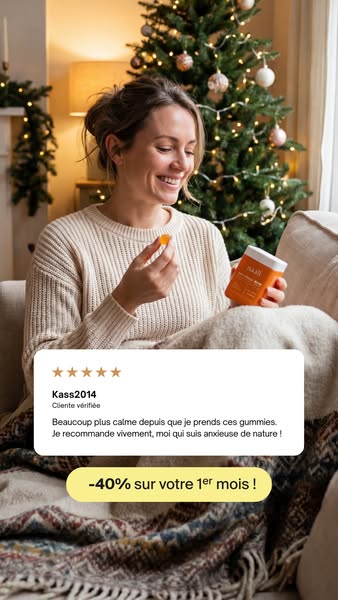
# Ad summary
This ad features a woman holding a container of gummies and a single gummy. She is smiling in front of a Christmas tree. A testimonial is overlaid on the image, along with a discount offer.
# Brand positioning
The brand is positioned as a provider of gummies that promote calmness and reduce anxiety. The ad features a customer testimonial that highlights the product's effectiveness in helping with anxiety. The brand aligns with a lifestyle of self-care and well-being, particularly for individuals who experience anxiety. The brand is presented as a solution for those seeking a natural way to manage their anxiety.
# Product
The product is a container of gummies designed to promote calmness and reduce anxiety. The gummies are presented as a convenient and enjoyable way to manage anxiety. The ad features a customer testimonial that highlights the product's effectiveness in helping with anxiety. The gummies are for people who are looking for a natural way to manage their anxiety. The ad addresses the purchase barrier of skepticism by featuring a customer testimonial that highlights the product's effectiveness.
# Visual style
The ad has a warm and inviting visual style, with a focus on creating a relatable and authentic scene. The production quality is high, with a well-lit and composed shot. The image treatment includes a subtle color grading that enhances the warmth of the scene. The typography is clean and legible, with a focus on readability. The overall style is designed to be visually appealing and engaging, while also conveying a sense of trust and credibility.
# Hooks
Headline: Beaucoup plus calme depuis que je prends ces gummies. Je recommande vivement, moi qui suis anxieuse de nature!
# Funnel stage
Middle of funnel (Consideration)
# Pain points
The ad addresses the pain point of anxiety, as expressed in the quote: "Je recommande vivement, moi qui suis anxieuse de nature!"
# Value propositions
- Calmness through gummies
# Benefits
- Beaucoup plus calme depuis que je prends ces gummies.
# Features
- Gummies
# Call to action
None used.
# Social proof
- "Beaucoup plus calme depuis que je prends ces gummies. Je recommande vivement, moi qui suis anxieuse de nature!" - Kass2014
# Point of view
- Customer: The woman holding the product and smiling conveys a sense of satisfaction and enjoyment.
- Customer: The testimonial provides a firsthand account of the product's effectiveness in helping with anxiety.
- Brand: The discount offer is a direct incentive from the brand to encourage purchase.
# Storyline
- The ad opens with a woman holding a container of gummies and a single gummy, smiling in front of a Christmas tree. This is intended to create a relatable and inviting scene, suggesting that the product can be used in everyday life. The audience experiences this from the customer's perspective.
- The ad then presents a customer testimonial that highlights the product's effectiveness in helping with anxiety. This is intended to build trust and credibility by showing that others have had positive experiences with the product. The audience experiences this from the customer's perspective.
- The ad concludes with a discount offer, encouraging viewers to try the product. This is intended to incentivize immediate purchase by reducing the financial risk. The audience experiences this from the brand's perspective.
How Other Health & Wellness Brands Advertise on Meta
Peer brands in Motion's library — click any brand to see their creative strategy, live ads, and AI breakdowns.