

# Ad summary
This ad promotes the Finch app, framing it as a tool to reduce phone addiction through daily goal setting and productive activities. Two podcast hosts discuss the app, presenting it as a surprising solution to excessive screen time.
# Brand positioning
The Finch app is presented as a quirky and effective tool for reducing screen time and promoting productivity. The brand's tone is lighthearted and playful, with a focus on self-improvement through gamification and habit tracking. It appeals to users looking for a fun and engaging way to manage their digital habits, contrasting with more rigid or clinical approaches to productivity.
# Product
The Finch app is a mobile application designed to help users reduce screen time and increase productivity through daily goal setting. The app allows users to set daily goals and track productive activities. The app features a virtual pet, “Minty Dear”, that evolves as the user achieves their goals, creating a sense of accomplishment and motivation. The app addresses the purchase barrier of skepticism towards the effectiveness of simple apps in combating phone addiction, presenting it as a surprisingly effective solution.
# Visual style
The ad uses a split-screen format to show two podcast hosts in separate locations. The production quality is simple and straightforward, resembling a casual podcast recording. The editing is paced to follow the conversation, with cuts timed to the speakers' lines. The visual style is clean and modern, with natural lighting and minimal distractions. The inclusion of app interface visuals provides a direct view of the product in use.
# Hooks
Spoken: 00:00–00:03 Female 1: If you had to show your therapist your screen time right now, would you be embarrassed?
Text overlay: 00:00–00:03 if you had to show your therapist your screen time right now be embarrassed?
Visual: 00:00–00:03: A split screen shows a woman and a man sitting in front of microphones in separate rooms. Both are speaking into the microphones. The woman is on top. She is sitting in a black chair in front of a blue wall. The man is below her, sitting at a desk in front of a bookcase with books and plants.
# Funnel stage
Consideration
# Pain points
The central pain point is phone addiction. The male podcaster admits, “I didn’t think a silly little app would help me with my phone addiction” and expresses surprised relief that the Finch app has helped.
# Value propositions
- Reduce screen time through daily goal setting and productive activities.
# Benefits
- Screen time is down
- 30-day streak
# Features
- Set daily goals
- Limit screen time
- Do productive stuff
# Call to action
None used.
# Social proof
- "My screen time is actually down, like consistently down" – Male 1 (Podcaster)
- "See, I told you. That little bird really does work" – Female 1 (Podcaster)
- "I didn’t think a silly little app would help me with my phone addiction" – Male 1 (Podcaster)
# Point of view
- Customer 90% – The ad is framed from the perspective of two podcast hosts who are casually discussing and using the product.
- Brand 10% – The brand's presence is evident through the app's name being mentioned and the visuals of the app interface.
# Storyline
- 00:00–00:03 A female podcaster asks a male podcaster if he would be embarrassed to show his therapist his screen time.
- 00:04–00:07 The male podcaster responds that his screen time is consistently down.
- 00:07–00:08 The female podcaster asks him what has changed.
- 00:08–00:17 The male podcaster says he downloaded the Finch app, set daily goals to limit himself and do productive things, and now has a 30-day streak. He states his screen time has never been lower.
- 00:17–00:19 The female podcaster responds that she told him the app really does work.
- 00:19–00:24 The male podcaster states that he didn’t think a silly little app would help with his phone addiction, but that it did.

How Finch Advertises on Meta
Updated Apr 19, 2026 · Refreshes weekly
Finch runs 532 active ads on Meta, shipping ~56 new creatives per week. Their library leans on Screen Recording30%, Demo11%, and Montage8%. Recently, Finch leans hard on the "self-care Tamagotchi" hook — positioning the app as a free, gamified way to break out of bedrotting and doom scrolling and accidentally become a functional adult. Transformation testimonials and structured challenges (13-day declutter, reading, daily walks) carry the through-line.
Indexed by Motion's Inspo Library.
The 20 Most Recent Finch Ads on Meta
# Ad summary
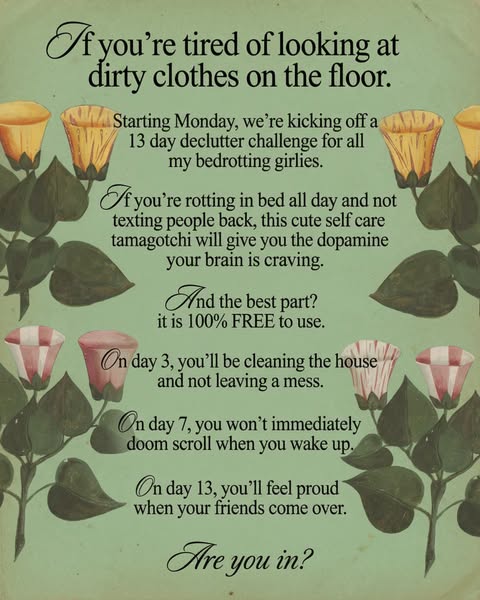
This ad promotes a 13-day declutter challenge for people who spend a lot of time in bed. It highlights the benefits of the challenge, such as cleaning the house, avoiding doom scrolling, and feeling proud when friends come over.
# Brand positioning
The brand is presented as a supportive and understanding companion for individuals who identify as "bedrotting girlies." It acknowledges the challenges of spending excessive time in bed and offers a self-care solution in the form of a 13-day declutter challenge. The brand aims to occupy a space in the consumer's mind as a relatable and non-judgmental resource for improving mental well-being and productivity. It aligns with values of self-care, dopamine-seeking, and achieving small victories. The brand pushes against the norm of constant productivity and instead offers a gentle approach to decluttering and self-improvement. The brand positioning is emotional, focusing on providing dopamine and a sense of accomplishment.
# Product
The product is a 13-day declutter challenge designed for individuals who spend a lot of time in bed, referred to as "bedrotting girlies." The challenge aims to provide a structured approach to decluttering and self-care, offering a sense of accomplishment and improved mental well-being. The ad highlights specific benefits associated with completing the challenge, such as cleaning the house without leaving a mess, avoiding doom scrolling, and feeling proud when friends come over. The challenge is presented as a "cute self care tamagotchi" that provides dopamine, addressing the purchase barrier of lack of motivation or energy. The challenge is 100% FREE to use.
# Visual style
The ad has a vintage, hand-crafted aesthetic with a light green background and watercolor-style illustrations of morning glory flowers. The typography is elegant and slightly whimsical, contributing to the overall charming and approachable feel. The visual style is designed to be calming and inviting, contrasting with the potential stress associated with decluttering.
# Hooks
Headline: If you're tired of looking at dirty clothes on the floor.
# Funnel stage
Middle of funnel (Consideration)
# Pain points
The central pain point is the frustration of living in a cluttered space, specifically "dirty clothes on the floor," which can contribute to feelings of overwhelm and lack of motivation. The ad also implies the pain point of "rotting in bed all day and not texting people back."
# Value propositions
- 13 day declutter challenge for all my bedrotting girlies
- This cute self care tamagotchi will give you the dopamine your brain is craving.
- 100% FREE to use.
# Benefits
- Cleaning the house and not leaving a mess
- Avoiding doom scrolling
- Feeling proud when your friends come over
- This cute self care tamagotchi will give you the dopamine your brain is craving.
# Features
- 13 day declutter challenge
- 100% FREE to use
# Call to action
Are you in?
# Social proof
- None used.
# Point of view
- Brand: The entire ad is presented from the brand's perspective, as it promotes the 13-day declutter challenge and highlights its benefits.
# Storyline
- The ad starts by addressing the viewer's potential frustration with "dirty clothes on the floor," aiming to capture their attention and establish a relatable problem. This is told from the brand's perspective.
- The ad introduces a "13 day declutter challenge for all my bedrotting girlies," presenting a solution to the problem and targeting a specific audience. This is told from the brand's perspective.
- The ad explains that the challenge is a "cute self care tamagotchi" that will give the viewer the dopamine their brain is craving, highlighting the emotional benefits of participating. This is told from the brand's perspective.
- The ad emphasizes that the challenge is "100% FREE to use," removing a potential barrier to entry. This is told from the brand's perspective.
- The ad outlines specific benefits of participating in the challenge, such as cleaning the house and not leaving a mess, avoiding doom scrolling, and feeling proud when friends come over, showcasing the positive outcomes of completing the challenge. This is told from the brand's perspective.
- The ad ends with a question, "Are you in?", inviting the viewer to participate and take action. This is told from the brand's perspective.
# Ad summary
This ad uses a Minecraft-style interface to showcase a brand's clothing and accessories. The ad features a cartoon character being assembled with different items, set to a catchy tune.
# Brand positioning
The brand is presented as fun, quirky, and trendy, with a focus on unique and playful designs. The brand aligns with a youthful, creative lifestyle, pushing against the norms of traditional fashion by embracing a cartoonish aesthetic. The brand positioning is emotional, aiming to evoke feelings of joy and self-expression through its whimsical products.
# Product
The ad features a range of clothing and accessories, including a hat, pants, shoes, and a boba tea cup. The products are designed with a playful, cartoonish aesthetic, featuring bright colors and whimsical designs. The products are for individuals who enjoy expressing their personality through unique and eye-catching fashion choices. The ad highlights the fun and creative aspect of the products, suggesting they are worth trying for those who want to stand out and embrace their individuality.
# Visual style
The ad has a playful and cartoonish aesthetic, with bright colors and whimsical designs. The editing style is simple and straightforward, with quick cuts between scenes. The production quality is polished, giving the ad a professional feel. The pacing is upbeat and energetic, matching the tone of the music.
# Hooks
Spoken: 00:00–00:02: [Singing] With the time and I heard that I was ugly.
Text overlay: 00:00–00:02: Inventory
Visual: 00:00–00:02: A Minecraft-style inventory screen is displayed. The screen is gray with white grid lines, and the word "Inventory" is written in black text at the top. The inventory slots are filled with cartoonish images of a hat, pants, shoes, and a boba tea cup.
# Funnel stage
Top of funnel (Awareness)
# Pain points
The ad implies a frustration with feeling plain or uninspired by traditional fashion options.
# Value propositions
- Fun and creative fashion choices
# Benefits
- Unique and playful designs
- Express personality through fashion
- Stand out from the crowd
# Features
- Hat
- Pants
- Shoes
- Boba tea cup
# Call to action
None used.
# Social proof
- None used.
# Point of view
- Brand 100% – The ad is presented from the brand's perspective, showcasing its products and aesthetic.
# Storyline
- 00:00–00:02 The ad opens with a Minecraft-style inventory screen.
- 00:00–00:02 Items such as a hat, pants, shoes, and a boba tea cup appear in the inventory.
- 00:02–00:05 The items are then moved to a crafting table, where they are combined to create a cartoon character.
- 00:05–00:12 The cartoon character is then shown dancing and interacting with the environment.
# Ad summary
This ad promotes a self-care game that motivates users to exercise and clean their homes. The ad features a person cleaning various parts of their house while text overlays describe how the game has positively impacted their life.
# Brand positioning
The brand is presented as a self-care game that helps users become more functional adults by gamifying exercise and cleaning. It positions itself as a solution for those who are out of shape, bored, and prone to doomscrolling. The brand promotes a lifestyle of productivity and well-being, suggesting that users can improve their physical health and maintain a clean home while having fun. The brand pushes against the norm of tedious chores by framing them as part of an engaging game, making self-care more accessible and enjoyable. The brand positioning is both functional (exercise and cleaning) and emotional (happiness and self-improvement).
# Product
The product is a self-care game designed to motivate users to exercise and clean their homes. It is for individuals who are out of shape, bored, and spend too much time doomscrolling. The game encourages users to do 30 minutes of exercise every day and keep their houses clean. A key selling point is that the game is free to use without ever paying. The ad emphasizes that the game has changed the user's life, making them 245% happier. The product addresses the purchase barrier of cost by highlighting its free availability, making it an accessible option for anyone looking to improve their self-care routine.
# Visual style
The ad has a UGC feel with simple, static shots and minimal editing. The production quality is basic, resembling content created by an individual user. The pacing is slow and consistent, with each shot held for several seconds. The audio-visual sync is loose, with the music playing continuously in the background without specific synchronization to the visuals.
# Hooks
Text overlay: 00:00–00:22 Accidentally became a functional adult because of a game like tamagotchi but for self care. / 00:00–00:22 Last year I was so out of shape, bored 24/7 and always doomscrolling. / 00:00–00:22 Then I saw an ad for this self care game and it changed my life.
Visual: 00:00–00:02 A young, light-skinned man wearing a light gray hoodie and jeans is mopping a kitchen floor. He is wearing blue disposable shoe covers. The kitchen has dark brown cabinets, a stainless steel refrigerator, and a light-colored granite countertop. The floor is tiled with light brown and beige tiles. The camera is stationary and positioned at eye level. The lighting is bright and natural. A yellow bucket is visible near the mop.
# Funnel stage
Top of funnel (Awareness)
# Pain points
The ad addresses the pain point of being out of shape, bored, and prone to doomscrolling. "Last year I was so out of shape, bored 24/7 and always doomscrolling."
# Value propositions
- Gamified self-care: Makes exercise and cleaning enjoyable and engaging.
- Free access: Eliminates cost as a barrier to entry.
- Comprehensive improvement: Addresses physical health, mental well-being, and home environment.
# Benefits
- Become a functional adult
- Improved physical shape
- Reduced boredom
- Clean house
- Increased happiness (245% happier)
# Features
- Self-care game
- Motivates exercise
- Motivates cleaning
- Free to use without ever paying
# Call to action
None used.
# Social proof
- None used.
# Point of view
- Brand 100% – The entire video is presented from the brand's perspective, showcasing the benefits of the self-care game through visuals and text overlays.
# Storyline
- 00:00–00:02 00:00–00:02 The video shows a person wearing blue shoe covers and mopping a kitchen floor. The message is that the game helps users keep their house clean. The perspective is from the brand, showcasing the game's benefits through a user's actions. The tone is casual and relatable, suggesting that cleaning can be a fun activity.
- 00:02–00:04 00:02–00:04 The video transitions to a shot of a neatly made bed in a bedroom. The message is that the game promotes a clean and organized living space. The perspective is from the brand, highlighting the positive outcomes of using the game. The tone is calm and inviting, emphasizing the comfort of a clean home.
- 00:04–00:06 00:04–00:06 The video shows a person cleaning a stove top. The message is that the game encourages users to maintain a clean kitchen. The perspective is from the brand, demonstrating the game's practical benefits. The tone is straightforward and efficient, suggesting that cleaning can be a quick and easy task.
- 00:06–00:08 00:06–00:08 The video shows a person cleaning a kitchen sink. The message is that the game helps users keep their kitchen clean and hygienic. The perspective is from the brand, showcasing the game's impact on cleanliness. The tone is practical and encouraging, suggesting that maintaining a clean sink is achievable.
- 00:08–00:10 00:08–00:10 The video shows a person cleaning a bathroom sink. The message is that the game promotes cleanliness in all areas of the house. The perspective is from the brand, highlighting the game's comprehensive approach to cleaning. The tone is casual and relatable, suggesting that even bathroom cleaning can be part of a fun routine.
- 00:10–00:13 00:10–00:13 The video shows a person cleaning the inside of a refrigerator. The message is that the game encourages users to maintain a clean and organized fridge. The perspective is from the brand, demonstrating the game's focus on detailed cleaning. The tone is practical and motivating, suggesting that a clean fridge is an achievable goal.
- 00:13–00:15 00:13–00:15 The video shows a person cleaning a toilet. The message is that the game helps users tackle even the less pleasant cleaning tasks. The perspective is from the brand, showcasing the game's ability to make all cleaning tasks manageable. The tone is humorous and relatable, suggesting that even toilet cleaning can be part of a fun game.
- 00:16–00:18 00:16–00:18 The video shows a person cleaning a shower. The message is that the game promotes a clean and hygienic bathroom. The perspective is from the brand, highlighting the game's focus on thorough cleaning. The tone is practical and encouraging, suggesting that maintaining a clean shower is an achievable goal.
- 00:18–00:22 00:18–00:22 The video shows a person cleaning a dirty air vent. The message is that the game encourages users to clean even the hidden and often overlooked areas of their home. The perspective is from the brand, demonstrating the game's comprehensive approach to cleaning. The tone is thorough and motivating, suggesting that no cleaning task is too difficult with the game.
# Ad summary
This ad features a woman in her home who is holding a whiteboard with a long to-do list. She then introduces the Finch app, which organizes your to-dos and breaks everything down so it actually feels possible. She describes it as a self-care Tamagotchi. When you complete a task, your little birb gets happy, and you get that dopamine hit. She says that she has stayed consistent with her goals for the last 14 days, which is so rare for her. She encourages viewers to download Finch and hatch their new virtual BFF right now.
# Brand positioning
Finch is presented as a self-care app that helps users organize their to-do lists and achieve their goals. The brand aims to occupy a space in the consumer's mind as a fun and engaging way to manage daily tasks and promote mental well-being. The brand aligns with values of self-care, gamification, and emotional support, positioning itself as a virtual BFF. Finch pushes against the norm of overwhelming to-do lists by breaking tasks down into manageable steps and rewarding users with positive reinforcement. The brand positioning is both functional (organizing tasks) and emotional (providing a sense of accomplishment and joy).
# Product
Finch is a free app designed to help users organize their to-do lists and achieve their goals. The app breaks down tasks into smaller, more manageable steps, making them feel more achievable. It is described as a self-care Tamagotchi, where completing tasks makes your virtual bird (birb) happy, providing a dopamine hit. The app helps users stay consistent with their goals, as demonstrated by the creator's 14-day streak. The app addresses the purchase barrier by being literally free, making it accessible to anyone who wants to try it. The app is presented as a virtual BFF, offering emotional support and encouragement as users work towards their goals.
# Visual style
The ad has a polished UGC feel, with bright, natural lighting and a clean background. The editing style is a mix of static shots and quick cuts to showcase the app interface. The production quality is high, giving the ad a professional yet relatable tone. The pacing is consistent, with cuts timed to emphasize key points in the voiceover. The visual motifs include close-ups of the app interface and direct address to the camera.
# Hooks
Spoken: When was somebody going to tell me I didn't need to be doing this and I could have been doing this instead?
Text overlay: To Do Today: / • Empty Dishwasher / • Mop & Sweep / • Client Emails / • Wash Car / • Taxes / • Book Doctor / • Grocery / • Kernel / • DOWNLOAD FINCH / • Milk / • Almond / • Bread
Visual: 00:00–00:02: The creator stands in a well-lit room with white walls, holding a whiteboard with a to-do list written in blue marker. The background includes a window with a green plant, decorative vases, and framed mirrors. The creator is a young woman with dark hair, wearing a black top and a silver necklace. She looks directly at the camera with a slightly exasperated expression. / 00:02–00:04: The creator holds up her iPhone, displaying the Finch app interface. The app features a colorful, cartoonish design with a virtual bird character. The background remains the same as in the previous shot. The creator points to the phone screen while speaking.
# Funnel stage
Middle of funnel (Consideration)
# Pain points
The ad addresses the pain point of feeling overwhelmed by a long to-do list. The creator holds up a whiteboard filled with tasks and asks, "When was somebody going to tell me I didn't need to be doing this?"
# Value propositions
- Free app
- Virtual BFF
# Benefits
- Makes tasks feel possible
- Helps you stay consistent with your goals
- Provides a dopamine hit
# Features
- Organizes your to-dos
- Breaks everything down
# Call to action
Download Finch
# Social proof
- "Like I have stayed consistent with my goals for the last 14 days which is so rare for me." – Female 1 (Customer)
# Point of view
- Customer 100% – The entire ad is told from the perspective of a customer who is sharing her experience with the app.
# Storyline
- 00:00–00:02 The creator holds up a whiteboard with a long to-do list, expressing frustration.
- 00:02–00:04 The creator introduces the Finch app as an alternative to the overwhelming to-do list.
- 00:05–00:09 The creator explains that the app organizes to-dos and breaks everything down to make it feel possible.
- 00:09–00:16 The creator describes the app as a self-care Tamagotchi, where completing tasks makes your virtual bird happy, providing a dopamine hit.
- 00:18–00:23 The creator shares her personal experience of staying consistent with her goals for the last 14 days using the app.
- 00:23–00:29 The creator encourages viewers to download the free Finch app and hatch their new virtual BFF.
# Ad summary
A woman shares how she uses the Finch app to stay on top of her goals. She describes it as a free app that organizes your to-dos and breaks everything down so it feels possible. She also describes it as a self-care Tamagotchi, where your little birb gets happy when you complete a task, giving you a dopamine hit. She says she has stayed consistent with her goals for the last 14 days, which is rare for her.
# Brand positioning
Finch is presented as a free, accessible, and fun self-care app designed to help users organize their to-do lists and achieve their goals. The brand aims to occupy a space in the consumer's mind as a supportive and engaging tool that makes self-improvement feel less daunting and more rewarding. It aligns with values of personal growth, mental wellness, and gamified productivity, promoting a lifestyle where self-care is integrated into daily routines. Finch pushes against the norms of traditional, often overwhelming, task management apps by offering a playful and visually appealing interface. The brand positioning is both functional, providing organizational tools, and emotional, fostering a sense of accomplishment and well-being through its interactive features.
# Product
Finch is a free mobile app designed to help users organize their to-do lists and achieve their goals. The app is described as a "self-care Tamagotchi," where users complete tasks to make their virtual "birb" happy, providing a sense of accomplishment and a "dopamine hit." The app breaks down tasks to make them feel more manageable and less overwhelming. It is designed for individuals looking for a fun and engaging way to stay consistent with their goals and integrate self-care into their daily routines. The app addresses the common purchase barrier of cost by being "literally free," making it accessible to a wide audience. The ad highlights the app's ability to help users stay consistent with their goals, as demonstrated by the presenter's personal experience of maintaining a 14-day streak, which is described as "so rare" for her.
# Visual style
The ad has a casual, UGC-style aesthetic with a bright and airy feel. The editing style is simple, with static shots and occasional close-ups to highlight the app's features. The production quality is polished but not overly produced, giving it a relatable and authentic feel. The pacing is consistent, with a moderate number of cuts per minute. The visuals are synced with the voiceover, emphasizing key points and features of the app.
# Hooks
Spoken: 00:00–00:06 I am always looking for new ways to stay on top of my goals, and I think I may have found my new favorite way with Finch!
Text overlay: 00:00–00:01 I am always / 00:01–00:02 looking for / 00:02–00:03 to stay on top / 00:03–00:04 and I think I / 00:04–00:05 may have found / 00:05–00:06 my new favorite way / 00:06–00:06 with Finch!
Visual: 00:00–00:06 A woman with long, dark hair, wearing a black top and a silver necklace, stands in front of a white wall with decorative vases and a plant. She holds a whiteboard with a to-do list written on it. She looks directly at the camera and speaks. She then holds up a phone displaying the Finch app.
# Funnel stage
Consideration
# Pain points
The ad implies that the viewer struggles to stay on top of their goals. The presenter states, "I am always looking for new ways to stay on top of my goals."
# Value propositions
- Free app organizes your to-dos and breaks everything down so it actually feels possible
- Self-care Tamagotchi
- When you complete a task, your little birb gets happy, and so you get that dopamine hit
# Benefits
- Feels possible
- Dopamine hit
- Stay consistent with my goals
# Features
- Organizes your to-dos
- Breaks everything down
# Call to action
Download Finch
# Social proof
- "Like I have stayed consistent with my goals for the last 14 days, which is so rare for me." – Female 1 (Customer)
# Point of view
- Customer 100% – The entire video is told from the perspective of a customer sharing their experience with the Finch app.
# Storyline
- 00:00–00:06 00:00–00:06 The presenter introduces herself and states that she is always looking for new ways to stay on top of her goals. She then introduces Finch as her new favorite way to do so. This moment is from the presenter's perspective, conveyed through her direct address to the camera and enthusiastic tone. The intention is to grab the viewer's attention by presenting a relatable problem (struggling to stay on top of goals) and offering a potential solution.
- 00:06–00:13 00:06–00:13 The presenter shows the Finch app on her phone and explains that it organizes your to-dos and breaks everything down so it actually feels possible. She describes it as a self-care Tamagotchi. This moment is from the presenter's perspective, conveyed through her direct address to the camera and demonstration of the app's features. The intention is to explain the app's functionality and unique selling proposition.
- 00:13–00:17 00:13–00:17 The presenter explains that when you complete a task, your little birb gets happy, and so you get that dopamine hit. This moment is from the presenter's perspective, conveyed through her direct address to the camera and explanation of the app's reward system. The intention is to highlight the emotional benefits of using the app and how it motivates users to complete tasks.
- 00:17–00:24 00:17–00:24 The presenter acknowledges that it sounds silly, but it actually works. She shares that she has stayed consistent with her goals for the last 14 days, which is so rare for her. This moment is from the presenter's perspective, conveyed through her direct address to the camera and personal testimonial. The intention is to build credibility and social proof by sharing her own positive experience with the app.
- 00:24–00:30 00:24–00:30 The presenter encourages viewers to try the app, stating that it's literally free. She instructs viewers to download Finch and hatch their new virtual BFF right now. This moment is from the presenter's perspective, conveyed through her direct address to the camera and call to action. The intention is to drive downloads by highlighting the app's accessibility and offering a clear next step.
# Ad summary
This ad promotes Finch, a free app that organizes your to-do list and breaks everything down so it feels possible. It’s a self-care Tamagotchi; when you complete a task, your little burb gets happy, and so you get that dopamine hit. It sounds silly, but it works to help you stay consistent.
# Brand positioning
Finch is positioned as a free, accessible, and friendly app designed to make task management feel achievable and rewarding. It aligns with a lifestyle of self-care and personal well-being, framing productivity in a positive and gentle way. It differentiates itself from traditional task management apps by incorporating elements of gamification and emotional support.
# Product
The Finch app is presented as a free tool designed to organize to-do lists. It operates by breaking down tasks into manageable steps, making them feel less daunting and more achievable. The app includes a virtual pet, or "burb," that responds positively when tasks are completed, providing users with a sense of accomplishment. The ad emphasizes the app's ability to foster consistency in achieving goals and create a rewarding experience through gamification.
# Visual style
The ad uses a simple, selfie-style aesthetic that gives it a personal and authentic feel. The background is a typical home setting, which helps to create a relatable environment. The editing is straightforward with consistent cuts, maintaining a casual and approachable vibe. The pacing is moderate, following the speaker's rhythm, and the overall production quality suggests a UGC feel, making it seem less like a polished commercial and more like a friend sharing a helpful tip.
# Hooks
Spoken: Female 1: I have tried so many things to stay organized but Finch has actually worked every day for the last 14 days.
Visual: 00:00–00:01: The camera is selfie-style. Female 1 stands in front of a counter, holding up a sheet of paper with a blue marker scribbled on it. Behind her is a window. On the counter are various vases and a green leaf. / 00:01–00:03: The camera is selfie-style. Female 1 stands in front of a counter, holding up a whiteboard with to-do items written on it in blue marker. Above the whiteboard is the Finch app icon. / 00:03–00:05: The camera is selfie-style. Female 1 stands in front of a counter, holding up an iPhone that displays the Finch app screen. Above the iPhone is the Finch app icon.
# Funnel stage
Consideration
# Pain points
The ad addresses the struggle of staying organized and managing to-do lists effectively. The pain point is signaled through the line: "I have tried so many things to stay organized" and by showing a sheet of paper scribbled with many tasks, indicating that other methods have been unsuccessful.
# Value propositions
- It's literally free.
- Hatch your new virtual bff right now.
# Benefits
- Feels possible
- Get that dopamine hit
# Features
- Organizes your to-dos
- Breaks everything down
# Call to action
Download Finch.
# Social proof
- “Finch has actually worked every day for the last 14 days” – Female 1 (Customer)
- “I have stayed consistent with my goals for the last 14 days” – Female 1 (Customer)
# Point of view
- Customer 100% – The entire ad is told from the POV of a customer who is talking about her experience with the app.
# Storyline
- 00:00–00:01 The creator begins by showing the viewer a sheet of paper with tasks scribbled on it, implying it's an unsuccessful way to stay organized.
- 00:01–00:02 The creator then explains that she’s tried so many things to stay organized.
- 00:02–00:05 The creator introduces the Finch app, implying it works for her.
- 00:05–00:10 The creator explains that this free app organizes your to-do's and it breaks everything down so it feels possible.
- 00:11–00:17 The creator says it’s kind of like a self-care Tamagotchi and that when you complete a task your little burb gets happy and so you get that dopamine hit.
- 00:17–00:20 The creator says it sounds so silly but it actually works.
- 00:20–00:24 The creator shares that she’s stayed consistent with her goals for the last 14 days, which is rare for her.
- 00:24–00:27 The creator encourages the viewer to try it because it’s literally free.
- 00:27–00:30 The creator tells the viewer to download Finch and then you can hatch your new virtual bff right now.
# Ad summary
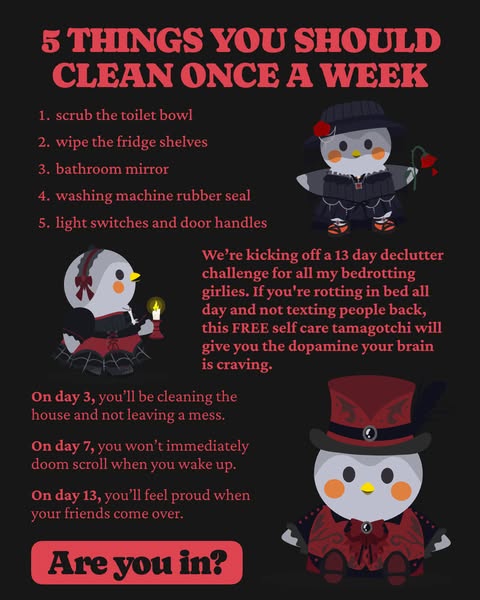
This ad presents a decluttering challenge targeted towards bedrotting girlies. It features a list of cleaning tasks to be done once a week along with a motivational message that addresses the problem of doom scrolling and lack of motivation. The ad promotes a feeling of accomplishment and pride upon completion of the challenge.
# Brand positioning
This ad does not explicitly promote a specific brand. Instead, it focuses on the concept of a "FREE self care tamagotchi," which appears to be a digital or virtual product designed to provide dopamine and encourage users to engage in decluttering and cleaning tasks. The brand positions itself as a solution for individuals struggling with motivation, particularly those who identify as "bedrotting girlies," targeting a specific niche within the self-care market.
# Product
The product being advertised is a "FREE self care tamagotchi," which seems to be a virtual or digital self-care aid. It is explicitly targeted toward "bedrotting girlies" and addresses the problem of being unmotivated and doom scrolling. The ad promises that this "tamagotchi" will provide the dopamine the user's brain is craving, implying it's designed to make self-care and decluttering more engaging and rewarding. The primary benefit seems to be an increase in motivation and a sense of accomplishment, as indicated by the promise that users will feel proud when their friends come over on day 13 after completing the challenge.
# Visual style
The ad adopts a flat, vector-based illustration style with cartoon birds dressed in gothic attire. The color palette is dark, with a background that resembles dark burgundy with red undertones. The overall aesthetic is playful, with the characters adding a sense of whimsy to the topic of cleaning. The typography is simple and legible, making the text easy to read. The layout is straightforward, with clearly defined sections and a direct call to action, making it easy to scan and understand the message.
# Hooks
Headline: 5 THINGS YOU SHOULD CLEAN ONCE A WEEK
# Funnel stage
Middle of funnel (Consideration)
# Pain points
The ad addresses the problem of being unmotivated and stuck in a cycle of inactivity. The ad explicitly mentions, "If you're rotting in bed all day and not texting people back," indicating a frustration with feeling unproductive and disengaged.
# Value propositions
- The FREE self care tamagotchi will give you the dopamine your brain is craving.
- On day 3, you'll be cleaning the house and not leaving a mess.
- On day 7, you won't immediately doom scroll when you wake up.
- On day 13, you'll feel proud when your friends come over.
# Benefits
- Gives you the dopamine your brain is craving
- Cleaning the house and not leaving a mess
- You won't immediately doom scroll when you wake up
- You'll feel proud when your friends come over
# Features
- 13 day declutter challenge
- FREE self care tamagotchi
# Call to action
Are you in?
# Social proof
- None used.
# Point of view
- Brand: The brand's point of view is reflected in the initial listing of tasks, introduction of the declutter challenge, offering of the "FREE self care tamagotchi," and the final CTA. These elements serve to promote the challenge and encourage participation.
- Customer: The customer's perspective is seen in the references to "bedrotting girlies" and the problem of "rotting in bed all day and not texting people back." These acknowledgements are designed to resonate with the viewer's feelings and experiences.
- Customer: The benefits of the challenge on days 3, 7, and 13 is presented from a future-oriented POV showing results the user can expect after getting involved.
# Storyline
- The ad starts with a list of five cleaning tasks to be completed once a week. This immediately establishes the core theme of cleaning and provides actionable steps for the viewer from a brand POV.
- The ad then shifts to an invitation to join a "13 day declutter challenge," specifically targeting "bedrotting girlies." This framing presents the ad's goal and product from the perspective of a brand seeking to involve potential customers.
- The ad addresses the viewer's potential reluctance by referencing a specific negative behavior, "rotting in bed all day and not texting people back." This relatable moment is meant to resonate with a consumer POV who may be facing that exact problem.
- The ad introduces a "FREE self care tamagotchi" as the solution to this reluctance, promising it will "give you the dopamine your brain is craving." This provides value and positions the product as a motivator from the brand's POV.
- The ad forecasts positive outcomes on specific days of the challenge: "On day 3, you'll be cleaning the house and not leaving a mess;" "On day 7, you won't immediately doom scroll when you wake up;" and "On day 13, you'll feel proud when your friends come over." This reinforces the benefit of joining the challenge from a future-oriented customer POV.
- The ad ends with a direct call to action, "Are you in?" This prompts the viewer to engage with the challenge and positions the value being offered from the brand's POV.
# Ad summary
This ad features a purple puppet with a towel wrapped around its head like hair. On-screen text reads 'omg you look just like your therapist' as someone off-screen says 'Oh my god you look just like your dad. You guys are twins.'
# Brand positioning
This ad does not explicitly describe a brand. Because the puppet's appearance is presented with humor, the brand can be perceived as playful and lighthearted. The ad is designed to be funny and draw attention, rather than highlight any functional value.
# Product
This ad does not explicitly describe any products but the puppet is wearing a green sweatshirt that could be identified as one.
# Visual style
The visual style of the ad has a UGC feel. The editing style is quick cuts. The production quality appears scrappy.
# Hooks
Spoken: 00:00–00:03: Oh my god you look just like your dad. You guys are twins.
Text overlay: 00:00–00:03: "omg you look just like your therapist"
Visual: 00:00–00:03: The shot shows a person in front of a bathroom mirror wrapping a white towel around their head. They are wearing a green sweatshirt. Reflected in the mirror, there is a phone attached to the mirror to record the video. The background includes beige tiling and a wooden cabinet.
# Funnel stage
Top of funnel (Awareness)
# Pain points
None used.
# Value propositions
- None used
# Benefits
- None used
# Features
- None used
# Call to action
None used.
# Social proof
- None used.
# Point of view
- Customer 100% – The ad is presented from a UGC perspective, showing an individual in front of a mirror.
# Storyline
- 00:00–00:03 The video opens with a person in front of a mirror with a towel wrapped around their head. There is text on the screen that says 'omg you look just like your therapist'.
- 00:03–00:06 The video cuts to a purple puppet in front of a mirror with a towel around its head and wearing a green sweatshirt.
# Ad summary
This ad promotes the Finch self-care app. The ad shows a man who used to be messy and unmotivated. He hears about the Finch app, which he describes as a self-care Tamagotchi, and it helps him become a functional adult. The ad shows him using the app to complete tasks like cleaning his room, reading, and getting some gainzzz.
# Brand positioning
The Finch app is presented as a fun and engaging self-care tool that helps users build healthy habits and improve their mental well-being. The brand uses a playful and lighthearted tone, incorporating cute cartoon characters and a gamified approach to self-care. It positions itself as a supportive companion that makes self-improvement feel less like a chore and more like a game. The brand aims to occupy a space in the consumer's mind as an accessible and enjoyable way to prioritize mental health and daily routines, pushing against the often serious and clinical nature of traditional self-care apps.
# Product
The Finch app is a self-care and habit-tracking app designed to help users manage their daily routines and mental well-being. It functions as a virtual pet that grows and thrives as the user completes tasks and engages in self-care activities. The app allows users to set goals, track their progress, and earn rewards, all while interacting with an adorable cartoon bird. It is designed for anyone who wants to improve their daily habits, prioritize self-care, and add a bit of fun to their routine. The app addresses the purchase barrier of feeling overwhelmed by self-care by gamifying the process and making it more approachable and enjoyable.
# Visual style
The ad has a UGC feel, with simple editing and natural lighting. The production quality is decent, but it doesn't feel overly polished. The editing style includes quick cuts to transition between scenes. The pacing is moderate, with cuts timed to the music beats. The overall aesthetic is casual and relatable, aiming to connect with viewers on a personal level.
# Hooks
Spoken: 00:00–00:02: Me last year: Always messy. Never motivated.
Text overlay: 00:00–00:02: Me last year: / 00:00–00:02: Always messy. Never motivated.
Visual: 00:00–00:02: A man with curly brown hair, wearing a black t-shirt and gray pants, is bent over a messy bed in a bedroom. The bed is covered in clothes and blankets. The room has light beige walls, framed pictures, a desk with a computer, and a white wardrobe. The camera is stationary and at eye level. The lighting is bright and even. The man is rummaging through the clothes on the bed.
# Funnel stage
Middle of funnel (Consideration)
# Pain points
The pain point is a lack of motivation and a disorganized lifestyle, as expressed by the line "Always messy. Never motivated."
# Value propositions
- The Finch app makes self-care fun and engaging by gamifying the process with a virtual pet.
- The app helps users build healthy habits and improve their mental well-being through goal setting and rewards.
- The app transforms users into functional adults by providing a supportive companion for daily routines.
# Benefits
- Improved daily routines
- Better mental well-being
- Increased motivation
- Fun and engaging self-care
- Organized lifestyle
# Features
- Self-care app
- Habit tracker
- Virtual pet
- Goal setting
- Rewards system
# Call to action
None used.
# Point of view
- Customer 100% – The entire video is told from the perspective of a customer sharing their personal experience with the app.
# Storyline
- 00:00–00:02 00:00–00:02: The ad opens with a man in a messy room, surrounded by clothes and clutter. The text overlay reads, "Me last year: Always messy. Never motivated." This sets up the problem the ad will address: a lack of motivation and a disorganized lifestyle. The perspective is from the man himself, reflecting on his past state.
- 00:02–00:03 00:02–00:03: The scene transitions to a hand holding a phone, displaying the Finch app in the app store. The text overlay reads, "**hears about this app**." This introduces the solution to the problem presented in the previous scene. The perspective shifts to an external view, showing the app's listing.
- 00:05–00:14 00:05–00:14: The man is now shown cleaning his room, making his bed, and putting away clothes. The text overlay reads, "a self care tamagotchi that turned me into a fagunctional adult." This demonstrates the positive impact of the Finch app on the man's life. The perspective returns to the man, showcasing his transformation and newfound motivation.
- 00:14–00:18 00:14–00:18: The ad shows the Finch app interface on a phone, with tasks like "Clean room," "Read," and "Get some gainzzz" being completed. This highlights the app's features and how it helps users achieve their goals. The perspective shifts back to an external view, focusing on the app's functionality and user experience.
# Ad summary
This ad is set to music while various animated characters show up on screen with overlaid text that says, "Testify." The animated characters are seen doing various activities.
# Brand positioning
Testify is presented as a fun, colorful brand that encourages users to express their personality and individuality through animated characters. The brand seems to occupy a space of creativity and self-expression, aligning with values of joy, humor, and uniqueness. It pushes against the norm of serious or overly polished branding in favor of a playful and whimsical approach. The brand positioning is primarily emotional, focusing on the joy and entertainment that users can derive from their products.
# Product
The ad promotes customizable animated characters, which are visually represented in various forms throughout the video. The characters can be tailored to different activities, wearing outfits, and placed in different scenes or settings. The ad emphasizes the fun and creativity involved in customizing the characters. The overall focus of the ad is to showcase the playful and unique aspects of the customizable characters and how they can be used to express the user's personality.
# Visual style
The ad has a polished and cartoonish aesthetic, resembling a playful hybrid commercial. It uses quick cuts to showcase a variety of characters. The pacing is very fast to the music with consistent shifts across the ad. Audio and visual sync is utilized by cutting to the music and the lyrics.
# Hooks
Spoken: 00:00–00:03 I think I died in an accident cause this must be heaven.
Text overlay: 00:00–00:03 THINK / 00:00–00:03 ACCIDENT / 00:00–00:03 MUST / 00:00–00:03 HEAVEN
Visual: 00:00–00:03 The screen is black with the words, "THINK", "ACCIDENT", "MUST", and "HEAVEN" being written in pink with an animated character inside of the text.
# Funnel stage
Top of funnel (Awareness)
# Pain points
None used.
# Call to action
None used.
# Point of view
- Brand 100% – The ad presents the brand's official message through a visual showcase of animated characters and a catchy song.
# Storyline
- 00:00–00:03 00:00–00:03 The ad opens with the words "THINK ACCIDENT MUST HEAVEN" appearing on screen. This serves as an initial attention-grabbing hook, hinting at a potentially unexpected or surprising experience related to the product.
- 00:04–00:06 00:04–00:06 The screen zooms in from a white frame on two animated characters, one orange and one pink. The characters look happy.
- 00:07–00:08 00:07–00:08 Then the screen displays a penguin-animated character and the word "TESTIFY" is overlaid on the screen. The character is then seen in the water.
- 00:09–00:11 00:09–00:11 Various animated characters are displayed on screen and the word "FLY" is overlaid.
- 00:12–00:15 00:12–00:15 More animated characters are displayed on screen with the overlaid text, "I'MMA TESTIFY SKY".
# Ad summary
This animated ad features a blue penguin character who is an artist. The penguin sings about wanting to dance and go out to eat with blobby characters. The penguin is shown dancing in a club with the blobby characters.
# Brand positioning
The brand is presented as fun and playful. The brand aligns with a lifestyle of creativity, fun, and friendship. The brand pushes against the norm of serious or sophisticated brands in the art space, opting for a more lighthearted and accessible approach. The brand positioning is emotional, focusing on joy and connection.
# Product
The product is a series of animated characters called "blobbies." The blobbies are cute, colorful, and have different shapes and expressions. The ad shows the penguin character wanting to dance and go out to eat with the blobbies, implying that they are companions or friends. The ad suggests that the blobbies are worth trying or buying because they bring joy and companionship.
# Visual style
The ad has a bright and colorful aesthetic with simple, cartoon-like animation. The editing style is quick cuts, and the production quality is polished. The pacing is upbeat and consistent with the music. The cuts and text are timed to the music beats.
# Hooks
Spoken: 00:01–00:02 [Singing] Yeahhhhhhh
Visual: 00:00–00:03 A cartoon penguin with blue skin, a yellow beak, and a red beret stands in front of a blank canvas on a wooden easel. The penguin wears a green shirt, a white apron with colorful paint splatters, and red shoes. A small, yellow blobby character with a smiling face stands to the left of the penguin. The background is plain white.
# Funnel stage
Top of funnel (Awareness)
# Pain points
None used.
# Benefits
- Companionship
- Fun
- Love
# Call to action
None used.
# Social proof
- None used.
# Point of view
- Brand 100% – The entire video is presented from the brand's perspective, showcasing its characters and message through animation and music.
# Storyline
- 00:00–00:03 00:00–00:03 The ad begins with a blue penguin character standing in front of a blank canvas, dressed as an artist. The penguin is accompanied by a small, yellow blobby character. This moment introduces the main character and sets the scene for a creative and playful narrative.
- 00:03–00:11 00:03–00:11 The scene transitions to a nightclub setting with purple lighting and speakers. The penguin, still dressed as an artist, dances with the yellow blobby character. The song lyrics "I wanna dance with some blobbies, I wanna go out to eat with some blobbies" play. This moment establishes the desire for fun and companionship as the central theme.
- 00:11–00:12 00:11–00:12 The penguin hugs the yellow blobby character. This moment emphasizes the close relationship between the penguin and the blobbies.
- 00:12–00:20 00:12–00:20 The scene widens to show the penguin dancing with multiple blobbies of different colors and shapes under a disco ball. The lyrics "I wanna dance with some blobbies, with blobbies who love me" play. This moment reinforces the theme of friendship and love, suggesting that the blobbies provide companionship and affection.
# Ad summary
This ad promotes the Woohoo! app, which encourages users to complete daily goals by rewarding them with virtual pets. The ad features a woman pushing her children in a stroller while using the app to track her walk.
# Brand positioning
The Woohoo! app is presented as a fun and engaging way to achieve daily goals and build healthy habits. The brand aims to occupy a space in the consumer's mind as a virtual self-care companion that makes achieving goals enjoyable and rewarding. The brand aligns with values of health, wellness, and family, promoting a lifestyle that balances personal well-being with parental responsibilities. The brand pushes against the norm of traditional, often tedious, goal-setting apps by gamifying the experience and offering virtual rewards. The brand positioning is both functional, by providing a platform to track and achieve goals, and emotional, by fostering a sense of accomplishment and joy through virtual pet interactions.
# Product
The Woohoo! app is a virtual self-care companion designed to help users achieve daily goals and build healthy habits. The app allows users to set and track goals, rewarding them with virtual pets and other incentives upon completion. The app is for anyone looking to gamify their self-care routine and make achieving goals more enjoyable. The app features a user-friendly interface with options to add and track various goals, such as walking. The app's USP is its ability to turn mundane tasks into fun adventures by incorporating virtual pets and rewards. The ad shows the app being used during a daily walk, suggesting it can be integrated into everyday routines. The app addresses the purchase barrier of lack of motivation by providing a fun and rewarding experience.
# Visual style
The ad has a UGC feel with handheld camera work and natural lighting. The editing is simple with smooth transitions. The production quality is casual, aligning with the intended tone of a relatable user experience. The pacing is consistent, with cuts timed to the music.
# Hooks
Spoken: 00:00–00:07: Female 1: 1st thing on my 2026 list? Going on daily walks to make my kids and my virtual self care bird happy.
Text overlay: 00:00–00:07: 1st thing on my 2026 list? / 00:00–00:07: going on daily walks to make my kids & my virtual self care bird happy 😊
Visual: 00:00–00:01: A young woman with long braids walks along a path, pushing a stroller. She is wearing a white top and has a neutral expression. The background shows trees and a cloudy sky. The camera is handheld, creating a selfie-style view. / 00:01–00:04: The camera angle shifts to show the stroller from behind, revealing two young children inside. The woman's hands are visible on the stroller handle. The background shows a sidewalk, grass, and a white fence. The camera moves along with the stroller. / 00:04–00:07: A screen recording of the Woohoo! app is shown. The app interface features a green background with cartoon trees and a sun. A pink character with a "Bear Hug" shirt is in the center. Text on the screen reads "Start Adventure!" and "Last goal of the day!" A checkmark appears next to the "Walk" goal. Confetti and celebratory graphics appear as the goal is completed.
# Funnel stage
Top of funnel (Awareness)
# Pain points
Lack of motivation: The ad implies that users may struggle with the motivation to achieve their daily goals. "1st thing on my 2026 list? going on daily walks to make my kids & my virtual self care bird happy 😊"
# Value propositions
- Gamified self-care: Turns mundane tasks into fun adventures with virtual pets and rewards.
- Easy integration: Can be used during daily routines like walking.
# Benefits
- Makes achieving goals enjoyable
- Builds healthy habits
- Provides a virtual self-care companion
# Features
- Goal tracking
- Virtual pets
- User-friendly interface
# Call to action
None used.
# Point of view
- Customer 100% – The entire video is shot from the perspective of a customer using the product in their daily life.
# Storyline
- 00:00–00:01 The ad opens with a woman walking outside, pushing a stroller.
- 00:01–00:04 The perspective shifts to show the woman pushing the stroller with her children inside.
- 00:04–00:07 The ad transitions to a screen recording of the Woohoo! app, showing the user interface and the completion of a daily goal.
# Ad summary
This ad promotes the app Finch, a self-care pet simulation game. The ad features a person who claims they accidentally became a functional adult because of the app. The ad shows the app's interface and how it helps the user complete tasks such as exercise and cleaning.
# Brand positioning
Finch is presented as a self-care app that gamifies daily tasks and routines. The brand aims to occupy a space in the consumer's mind as a fun and engaging way to improve mental health and productivity. The brand aligns with values of self-improvement, mindfulness, and playful engagement. It pushes against the norms of traditional self-care apps that can feel clinical or overly serious, instead opting for a lighthearted and whimsical approach. The brand positioning is both functional, by providing tools for task management and habit formation, and emotional, by fostering a sense of accomplishment and well-being.
# Product
Finch is a self-care app designed to help users manage daily tasks and routines through a gamified pet simulation. The app is for anyone who wants to improve their mental health, productivity, and self-care habits. It features a virtual pet bird that users care for by completing tasks such as anxiety breathing exercises, journaling, doing a 15-second plank, and picking up dirty clothes. The app provides positive reinforcement and a sense of accomplishment as users complete tasks and progress in the game. The app addresses the purchase barrier of cost by offering a free version, allowing users to experience its benefits without paying.
# Visual style
The ad has a UGC feel, with casual, unpolished visuals. The editing style is quick cuts, with frequent transitions between shots. The production quality is low-fi, which supports the intended tone of authenticity and relatability. The pacing is fast, with cuts every 1-2 seconds, which keeps the viewer engaged. The audio-visual sync is loose, with the visuals not always perfectly timed to the music or voiceover.
# Hooks
Spoken: 00:11–00:15: I accidentally became a functional adult because of a game like Tamagotchi, but for self-care.
Text overlay: 00:11–00:15 I ACCIDENTALLY BECAME A FUNCTIONAL ADULT / 00:12–00:15 BECAUSE OF A GAME LIKE TAMAGOTCHI / 00:14–00:15 BUT FOR SELF CARE
Visual: 00:11–00:12: A medium shot of a young, light-skinned man with short brown hair cleaning a spill on a tiled kitchen floor. He is wearing a gray hoodie, blue jeans, and blue shoe covers. The background is a kitchen with dark brown cabinets, a stainless steel refrigerator, and a granite countertop. The camera is stationary. / 00:12–00:15: A wide shot of a bedroom with a gray bed, white nightstands, and a purple rug. The bed is neatly made with white linens and purple pillows. The nightstands have purple lamps. The camera is stationary.
# Funnel stage
Middle of funnel (Consideration)
# Pain points
The ad implies that the target audience struggles with being out of shape, bored, and addicted to doom scrolling. The man states that last year he was out of shape, bored 24/7 and always doom scrolling.
# Value propositions
- Gamified self-care: Makes self-care fun and engaging
- Free to use: Accessible to everyone
- Comprehensive: Covers a wide range of self-care activities
# Benefits
- Become a functional adult
- Improved mental health
- Increased productivity
- More exercise
- Cleaner house
- Improved happiness
# Features
- Self-care app
- Gamified tasks
- Virtual pet bird
- Tasks: Anxiety breathing, Journal, Do a 15 second plank, Pick dirty clothes off floor
- Free to use
# Call to action
None used.
# Social proof
- "Then I saw an ad for this self care game and it changed my life. Now I do 30 minutes of exercise every day. My house is always clean and I'm 245% happier." – Male 1 (Customer)
# Point of view
- Customer 100% – The entire video is told from the perspective of a customer sharing their personal experience with the app.
# Storyline
- 00:00–00:01 The ad opens with a man doing push-ups, suggesting a focus on physical activity and fitness.
- 00:01–00:03 The scene transitions to a screen recording of the Finch app, showing a list of tasks including "Anxiety breathing," "Journal," "Do a 15 second plank," and "Pick dirty clothes off floor." This highlights the app's features and the types of activities it promotes.
- 00:03–00:05 The ad returns to the man doing push-ups, reinforcing the connection between the app and physical activity.
- 00:05–00:07 The scene transitions back to the Finch app, showing a notification that says, "Nicely done! 3rd completed goal in a row with Pushups." This emphasizes the app's gamified approach and positive reinforcement.
- 00:07–00:08 The ad shows a person walking, suggesting another type of activity that the app promotes.
- 00:08–00:10 The scene transitions to the Finch app, showing a notification that says, "You did it! 4th completed goal in a row with Walking." This reinforces the app's gamified approach and positive reinforcement.
- 00:10–00:12 The ad shows a man cleaning a spill, suggesting that the app also promotes household tasks and responsibilities.
- 00:11–00:15 The man states that he accidentally became a functional adult because of a game like Tamagotchi, but for self-care. This introduces the app's concept and its benefits.
- 00:15–00:20 The man states that last year he was out of shape, bored, and doom scrolling. This highlights the problems that the app solves.
- 00:20–00:23 The man states that he saw an ad for the self-care game and it changed his life. This introduces the app as a solution to his problems.
- 00:23–00:31 The man states that he now does 30 minutes of exercise every day, his house is always clean, and he's 245% happier. This highlights the positive outcomes of using the app.
- 00:31–00:33 The man states that you can use it for free without ever paying. This emphasizes the app's accessibility and affordability.
# Ad summary
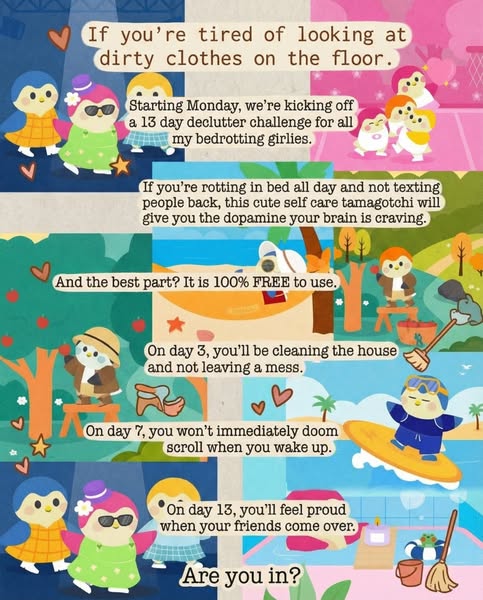
This ad promotes a 13-day declutter challenge for people who are tired of looking at dirty clothes and rotting in bed all day. The ad uses cute cartoon penguins to illustrate the benefits of the challenge, such as cleaning the house, avoiding doom scrolling, and feeling proud when friends come over.
# Brand positioning
The brand is presented as a supportive and understanding companion for individuals struggling with clutter and lack of motivation. It positions itself as a provider of gentle, gamified solutions for self-care and productivity, specifically targeting those who identify as 'bedrotting girlies.' The brand's tone is lighthearted and encouraging, contrasting with the often-serious or demanding nature of traditional productivity advice. It aims to occupy a space of accessible and enjoyable self-improvement, focusing on small, achievable steps rather than drastic lifestyle changes. The brand aligns with values of self-compassion and community, promoting a sense of belonging and shared experience among its target audience.
# Product
The product is a 13-day declutter challenge designed for individuals who struggle with motivation and maintaining a tidy living space. It is presented as a 'cute self care tamagotchi' that provides dopamine and encourages small, achievable tasks each day. The challenge addresses the pain points of being 'tired of looking at dirty clothes on the floor' and 'rotting in bed all day and not texting people back.' It promises benefits such as 'cleaning the house and not leaving a mess,' avoiding 'doom scroll when you wake up,' and feeling 'proud when your friends come over.' The challenge is positioned as 100% free to use, removing a significant purchase barrier and making it accessible to a wide audience. The product is designed to be a gamified and enjoyable approach to self-care and productivity, offering a gentle alternative to traditional methods.
# Visual style
The ad has a playful and cartoonish visual style, reminiscent of a children's book or a mobile game. The production quality appears to be digitally illustrated, with clean lines and bright, saturated colors. The visual motifs include horizontal panels, cartoon characters, and simple background elements. The image treatment involves flat colors, minimal shading, and a slight blurring effect. The typography is integrated in a caption-style, with text placed directly on top of the illustrations. The overall style is designed to be eye-catching and engaging, contrasting with the typical polished or realistic visuals often seen in ads.
# Hooks
Headline: If you're tired of looking at dirty clothes on the floor.
# Funnel stage
Top of funnel (Awareness)
# Pain points
The ad addresses the pain point of being overwhelmed by clutter and lacking motivation to clean, as expressed in the line: 'If you're tired of looking at dirty clothes on the floor.'
# Value propositions
- 13 day declutter challenge: Provides a structured and achievable plan for decluttering.
- cute self care tamagotchi: Offers a fun and engaging approach to self-care.
- 100% FREE to use: Removes a financial barrier and makes the challenge accessible to everyone.
# Benefits
- give you the dopamine your brain is craving
- cleaning the house and not leaving a mess
- you won't immediately doom scroll when you wake up
- you'll feel proud when your friends come over
# Features
- 13 day declutter challenge
- cute self care tamagotchi
- 100% FREE to use
# Call to action
Are you in?
# Social proof
- None used.
# Point of view
- Customer: The opening line, 'If you're tired of looking at dirty clothes on the floor,' speaks directly to the viewer's potential frustration and establishes a relatable problem.
- Brand: The rest of the ad is from the brand's perspective, introducing the challenge, highlighting its benefits, and inviting participation.
# Storyline
- The ad opens by addressing the viewer's frustration with 'dirty clothes on the floor,' immediately establishing a relatable problem. This is told from the customer's perspective, drawing them in by acknowledging their current struggle.
- The ad introduces a '13 day declutter challenge' starting Monday, framing it as a solution for 'bedrotting girlies.' This is told from the brand's perspective, offering a specific program tailored to a particular audience.
- The ad acknowledges the viewer's potential habit of 'rotting in bed all day and not texting people back,' then presents the challenge as a 'cute self care tamagotchi' that will 'give you the dopamine your brain is craving.' This is told from the brand's perspective, highlighting the challenge's ability to address a common issue with a fun and engaging solution.
- The ad emphasizes that the challenge is '100% FREE to use,' removing a potential barrier to entry. This is told from the brand's perspective, highlighting the accessibility of the challenge.
- The ad previews the benefits of participating in the challenge, stating that 'On day 3, you'll be cleaning the house and not leaving a mess.' This is told from the brand's perspective, showcasing the tangible results of the challenge.
- The ad continues to preview the benefits, stating that 'On day 7, you won't immediately doom scroll when you wake up.' This is told from the brand's perspective, highlighting the positive impact on the viewer's mental well-being.
- The ad concludes by stating that 'On day 13, you'll feel proud when your friends come over,' emphasizing the emotional reward of completing the challenge. This is told from the brand's perspective, reinforcing the positive outcome of the challenge.
- The ad ends with a direct question, 'Are you in?,' inviting the viewer to participate. This is told from the brand's perspective, prompting immediate action.
# Ad summary
This ad features a woman cooking breakfast in her kitchen while discussing the Finch app. The creator of the ad states that the app is helping her make healthier meals, get up earlier, and sleep more.
# Brand positioning
The ad presents Finch as a self-care tool. The ad equates the app to a Tamagotchi for self-care, which implies that the user must consistently care for a virtual pet which motivates them to care for themselves. The brand positions itself against norms where self-care apps may be seen as complicated or difficult to maintain. Finch positions itself as a simple and accessible tool for individuals looking to improve their well-being through consistent daily habits.
# Product
Finch is a self-care app that is being advertised as a “Tamagotchi for self-care.” When the user downloads the app, they hatch a little bird that they take care of. In order to take care of the bird, the user must take care of themself. The ad emphasizes that the app is life-changing. Using the app helps the user make healthier meals, get up earlier, and sleep more.
# Visual style
The ad is shot in a simple, natural style with no apparent editing. It is shot in a selfie-style that gives it an authentic UGC feel. The pacing is casual, with longer takes that allow the speaker to fully express their thoughts. The audio and visual are synced to the speaker, with no music or sound effects to distract from the message.
# Hooks
Spoken: 00:00–00:04 Female 1: Listen, last year I was bed rotting. Last year, I wasn’t taking care of myself.
Text overlay: 00:00–00:04 Listen, last year I was bed rotting. / 00:01–00:03 Last year, I wasn’t taking care of myself.
Visual: 00:00–00:04 The shot is selfie-style and the camera is stationary. A woman stands in a kitchen. She appears to be in her 20s. She is wearing a black long-sleeved crop top, and light green leggings. She is holding a pan with two fried eggs in it and a spatula. In the background, there is a light-colored wall, a light fixture, a table, and a kitchen sink.
# Funnel stage
Consideration
# Pain points
The pain point is not taking care of yourself which leads to "bed rotting."
# Value propositions
- Level up in 2026 with Finch
# Benefits
- Makes healthier meals
- Getting up earlier
- Sleeping more
# Features
- Self-care app
# Call to action
None used.
# Social proof
- “This app is changing my life.” – Female 1 (Customer)
# Point of view
- Customer 100% – The entire ad is told from the perspective of a customer, communicating her experience with the app.
# Storyline
- 00:00–00:05 The creator introduces herself and the app.
- 00:05–00:05 The creator equates the app to a Tamagotchi for self-care.
- 00:08–00:12 The creator describes how the app works, saying that the user hatches a little bird that they take care of, and the way to take care of it is by taking care of yourself.
- 00:13–00:15 The creator expresses the importance of the app by saying she cannot emphasize it enough, and that the app is changing her life.
- 00:15–00:18 The creator lists ways that the app has helped her, saying that she is making healthier meals, getting up earlier, and sleeping more.
- 00:18–00:21 The creator urges the viewer to download the app if they want to “level up” in 2026.
# Ad summary
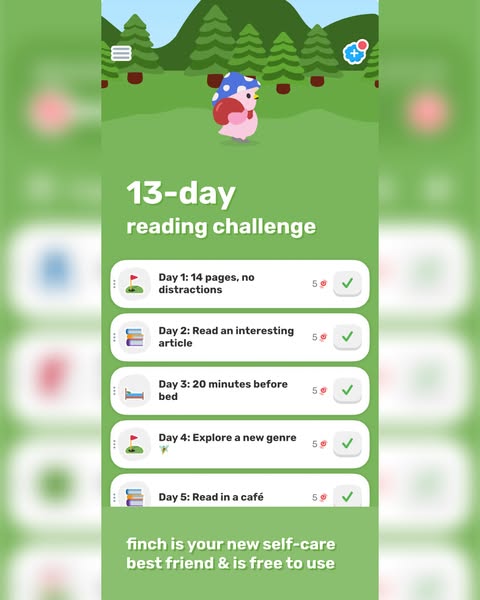
This ad promotes the Finch app by showcasing a 13-day reading challenge. The ad uses a screenshot of the app interface, highlighting daily reading goals and a friendly, supportive tone.
# Brand positioning
Finch is presented as a self-care companion designed to support users in their daily routines and personal growth. The brand aims to occupy a space in the consumer's mind as a friendly and accessible tool for mental wellness, promoting values of self-improvement and emotional support. Finch positions itself against the often sterile or clinical approach of traditional self-care apps by adopting a playful, approachable tone and gamified elements. The brand's positioning is primarily emotional, focusing on providing comfort, encouragement, and a sense of accomplishment to its users.
# Product
The Finch app is a self-care application designed to help users build healthy habits and manage their mental well-being. The ad showcases a 13-day reading challenge within the app, which includes daily reading goals such as '14 pages, no distractions,' 'Read an interesting article,' '20 minutes before bed,' 'Explore a new genre,' and 'Read in a café.' The app is presented as a 'self-care best friend' and is free to use, addressing potential purchase barriers by emphasizing its accessibility and supportive nature. The product is for anyone looking to incorporate reading into their daily routine as a form of self-care.
# Visual style
The ad has a clean, minimalist visual style with a focus on the app's user interface. The production quality is high, resembling a polished screenshot from a mobile app. The visual motifs include rounded rectangles, simple icons, and a consistent color palette of greens and whites. The image treatment is bright and cheerful, with no filters or heavy color grading. The typography is clean and legible, and the overall style is platform-native, resembling a typical mobile app interface. This style enhances scannability and stop power in feed by presenting a familiar and trustworthy interface.
# Hooks
Headline: 13-day reading challenge
# Funnel stage
Middle of funnel (Consideration)
# Pain points
The ad addresses the pain point of difficulty in establishing and maintaining a consistent reading habit. The ad offers a structured, gamified approach to make reading more accessible and enjoyable.
# Value propositions
- Finch is your new self-care best friend & is free to use
# Benefits
- Self-care
- Habit-building
- Mental well-being
# Features
- 13-day reading challenge
- Daily reading goals
- Free to use
# Call to action
None used.
# Social proof
- None used.
# Point of view
- Brand: The brand's POV is present in the headline '13-day reading challenge' and the concluding statement 'finch is your new self-care best friend & is free to use,' which directly promote the app and its benefits.
- Customer: The customer's POV is reflected in the list of daily reading goals, which show the user what they can expect to accomplish each day.
# Storyline
- The ad opens with a view of the Finch app interface, immediately establishing the context of a digital self-care tool. This is from the brand's perspective, setting the stage for the challenge being presented.
- The ad highlights a '13-day reading challenge,' which is intended to grab the viewer's attention and frame the app's features as an engaging activity. This is from the brand's perspective, showcasing a specific program within the app.
- The ad lists five daily reading goals, each with a small icon and a checkmark, demonstrating the app's structured approach to habit-building. This is from the customer's perspective, showing the user what they can expect to accomplish each day.
- The ad concludes by stating that 'finch is your new self-care best friend & is free to use,' reinforcing the app's supportive role and addressing potential cost concerns. This is from the brand's perspective, summarizing the app's key benefits and value proposition.
# Ad summary
The ad is a first-person video testimonial about the impact of a free self-care game on the user's life. It is presented in a UGC style with text overlays highlighting the key benefits and features. The video shows how the game has motivated the user to become more active, clean their house, and generally improve their well-being.
# Brand positioning
The brand promotes self-care through gamification. The brand aims to occupy the space of accessible mental and physical well-being by integrating simple habits into a user's daily routine. It aims to feel fun and rewarding, just like a game, instead of a chore. The brand presents a functional approach to self-care, breaking away from the category norm of 'luxury' self-care and making it inclusive through the use of a free game. The brand values simplicity, fun, and personal growth.
# Product
The product is a free self-care game designed to help users become functional adults. It uses gamification to motivate users to develop positive habits, such as cleaning, exercising, and socializing. The game is designed for anyone who wants to improve their daily routine and overall well-being. The ad emphasizes that users can access all of these benefits without paying anything, positioning the product as accessible and risk-free. The game promises to make users feel 245% happier by making self-care fun and engaging.
# Visual style
The ad uses a scrappy, UGC-style aesthetic. The editing consists of quick cuts between various scenes. The production quality aligns with the casual tone of user-generated content. The pacing is quick, with a new shot every 1-2 seconds. The visuals loosely sync with the music.
# Hooks
Spoken: 00:00-00:12: I'm not kidding... I accidentally became a functional adult because of a game like tamagotchi but for self care.
Text overlay: 00:00-00:14: I'm not kidding...I accidentally became a functional adult because of a game like tamagotchi but for self care. / 00:00-00:14: It's crazy how different I feel. / 00:00-00:14: Within 72 hours, I went from rotting in bed to cleaning my entire house. / 00:00-00:14: 10 days later I was doing 30 mins exercise every day, going for walks and meeting friends. / 00:00-00:14: I feel 245% happier. / 00:00-00:14: You can use it for FREE without ever paying.
Visual: 00:00–00:02: The camera is positioned looking upwards at a young, light-skinned male with messy brown hair wearing a white T-shirt. He is indoors with light from the window shining on his face. / 00:02–00:04: The camera angle is low to the ground, looking up at the same male, now wearing a backwards black baseball cap and doing pushups in the same room as before. / 00:04–00:05: The camera angle is positioned looking at an outdoor street. There is a sidewalk next to the street. There are buildings and trees in the background. The sky is visible, and it's sunny. / 00:05–00:06: The camera is angled looking inside of a garbage can while the same male is throwing away trash. The trash can is inside. / 00:06–00:07: The camera is angled looking inside of a bathroom mirror while the same male is splashing water on his face. The bathroom is bright white. / 00:07–00:09: The camera is angled looking inside of a garbage can while the same male is throwing away trash. The trash can is inside. / 00:09–00:11: The camera angle is on the same hand that was throwing away the trash. The background is a white surface. / 00:11–00:12: The camera is angled looking up at the same male in the same T-shirt in the same room.
# Funnel stage
Top of funnel (Awareness)
# Pain points
The ad addresses the pain point of struggling to maintain a healthy routine and feeling unmotivated to engage in self-care activities. The creator describes going from 'rotting in bed' to actively cleaning, exercising, and socializing, indicating a transformation from a state of stagnation to productivity and well-being. The quote highlights the initial struggle and the subsequent improvement, which is a clear attempt to showcase that the customer was not motivated or able to follow self-care habits and was able to do so through the game.
# Value propositions
- The game helps you go from 'rotting in bed' to 'cleaning my entire house' within 72 hours.
- The game helps you go from 'rotting in bed' to 'doing 30 mins exercise every day, going for walks and meeting friends' within 10 days.
- The game helps you feel 245% happier.
# Benefits
- Helps you become a functional adult
- Increases happiness
# Features
- A free self-care game.
# Call to action
None used.
# Point of view
- Customer 100% – The entire video is shot from the customer's perspective, showing their personal experience and transformation using the self-care game, which is communicated through selfie-style shots, casual language, and direct claims about their improvement.
# Storyline
- 00:00–00:02 The creator states they 'accidentally became a functional adult' because of a self-care game.
- 00:02–00:05 They claim to feel '245% happier' after playing the game.
- 00:05–00:12 The creator highlights the accessibility by stating that the game can be used for FREE without ever paying.
# Ad summary
This ad promotes the Finch app's Spellbound Stories event for January 2026. The ad features animated characters in a library setting, highlighting the app's storytelling and character design.
# Brand positioning
Finch is presented as a whimsical and comforting app that focuses on self-care and mental well-being through the use of cute, animated characters and engaging storytelling. The brand aims to occupy a space in the consumer's mind as a supportive and gentle companion, promoting values of self-improvement, mindfulness, and emotional support. It pushes against the norms of more aggressive or demanding self-help apps by offering a playful and non-intimidating approach. The brand positioning is primarily emotional, focusing on creating a sense of joy, comfort, and personal connection.
# Product
The Finch app is a self-care application designed to promote mental well-being through interactive storytelling and adorable characters. The app is for anyone seeking a gentle and engaging way to manage their mental health. The ad highlights the Spellbound Stories event for January 2026, featuring new stories and character designs within a library setting. The app addresses the purchase barrier of overwhelming or intimidating self-care routines by offering a playful and accessible approach. The ad conveys that the Finch app is worth trying because it provides a fun and supportive environment for personal growth and emotional well-being.
# Visual style
The ad has a polished, animated aesthetic with a warm color palette. The editing style features smooth transitions and static shots, creating a calming and inviting atmosphere. The production quality is high-end, supporting the intended tone of whimsy and comfort. The pacing is consistent, with a gentle rhythm that matches the app's focus on self-care.
# Hooks
Text overlay: 00:00–00:03: None used
Visual: 00:00–00:01: A dark forest path with tall trees framing an arched doorway. The doorway has a glowing lantern above it and a red door. A book floats in the air above the archway. The lighting is dim, with a spotlight on the doorway, creating a magical atmosphere. The camera is stationary, providing a clear view of the scene. / 00:01–00:03: A dimly lit library filled with shelves of books. The shelves are packed with books of various sizes and colors. The lighting is warm, with a soft glow emanating from the shelves. The camera moves forward through the shelves, creating a sense of exploration.
# Funnel stage
Top of funnel (Awareness)
# Pain points
The ad implies that traditional self-care routines can be overwhelming or intimidating, which can deter people from seeking help for their mental well-being. The ad addresses this by offering a playful and accessible approach to self-care.
# Value propositions
- Engaging storytelling for mental well-being
- Cute characters for emotional support
- Playful approach to self-care
# Benefits
- Promotes mental well-being
- Provides a gentle and engaging way to manage mental health
- Offers a fun and supportive environment for personal growth
- Creates a sense of joy and comfort
# Features
- Animated characters
- Interactive storytelling
- Library setting
- Spellbound Stories event for January 2026
# Call to action
None used.
# Social proof
- None used.
# Point of view
- Brand 100% – The entire video is presented from the brand's perspective, showcasing the app's features and characters in a promotional manner.
# Storyline
- 00:00–00:01 00:00–00:01: The video opens with a view of a dark forest path leading to an arched doorway with a glowing lantern above it. A book floats in the air above the doorway. This sets a magical and inviting tone, suggesting a journey into a world of stories and imagination. The perspective is from an observer entering the forest, creating a sense of anticipation.
- 00:01–00:03 00:01–00:03: The scene transitions to a dimly lit library filled with shelves of books. The camera moves through the shelves, creating a sense of exploration and discovery. This continues the magical tone, emphasizing the theme of stories and knowledge. The perspective is from someone moving through the library, searching for something.
- 00:03–00:04 00:03–00:04: A small, animated penguin character wearing a green beret and coat is shown sitting at a desk, reading and writing in a book with a quill. This introduces one of the app's characters in a studious and whimsical setting. The perspective is from an observer, highlighting the character's charm and the app's creative design.
- 00:04–00:07 00:04–00:07: Another animated character, a pink bird with glasses and a yellow coat, walks through the library aisles, looking around with curiosity. This introduces another character and reinforces the theme of exploration and discovery. The perspective is from an observer, showcasing the character's design and the library environment.
- 00:07–00:11 00:07–00:11: A blue penguin character in a formal outfit stands on a platform in the library and jumps with excitement, holding a book. This conveys a sense of joy and enthusiasm for reading and stories. The perspective is from an observer, emphasizing the character's energy and the app's positive message.
- 00:11–00:16 00:11–00:16: The camera moves back through the library shelves, revealing a white dog character with glasses peeking out from behind the books. This introduces another character and adds to the whimsical atmosphere. The perspective is from someone moving through the library, discovering the characters.
- 00:16–00:20 00:16–00:20: All four characters are shown together in front of the library backdrop, with the Finch logo and the text "Spellbound Stories Jan 2026 Seasonal Event" appearing on screen. This summarizes the ad by showcasing the characters and promoting the app's event. The perspective is from an observer, providing a clear view of the characters and the event details.
# Ad summary
This ad features a woman who shares that she stopped 'bedrotting' after a friend told her about Finch, a self-care app. The ad shows a cartoon penguin character in different outfits.
# Brand positioning
Finch is presented as a self-care app that helps users improve their mental health and daily routines. The brand aims to occupy a space in the consumer's mind as a fun and engaging way to practice self-care. The brand aligns with values of personal growth, mental wellness, and playful engagement, pushing against the often serious or clinical tone of mental health apps by using a cute, cartoon-like character. The brand positioning is both functional, offering tools for self-improvement, and emotional, fostering a sense of joy and accomplishment.
# Product
Finch is a self-care app designed to help users improve their mental health and daily routines. The app features a cartoon penguin character that users can customize with different outfits and accessories. The app is implied to be for individuals who struggle with self-care and are looking for a fun and engaging way to build positive habits. The ad highlights the app's ability to help users stop 'bedrotting,' suggesting it addresses the barrier of inertia or lack of motivation. The app is presented as a playful and customizable tool for self-improvement.
# Visual style
The ad has a UGC feel with a mix of live-action and animated elements. The editing style includes quick cuts and zooms, especially during the animated portion. The production quality is a hybrid of casual and polished, with the live-action segment having a natural, unfiltered look and the animated segment being clean and colorful. The pacing is fast, with cuts timed to the music beat. The overall aesthetic is playful and engaging, designed to appeal to a younger audience.
# Hooks
Spoken: 00:00–00:03: my married friend told me about this self-care tamagotchi and I finally stopped bedrotting ??
Text overlay: 00:00–00:03: my married friend told me about this self-care tamagotchi and I finally stopped bedrotting ??
Visual: 00:00–00:03: A woman with curly brown hair, wearing a brown sweatshirt and gold chain, looks at the camera with a slightly confused expression. She is sitting in front of a beige wall with a yellow pillow behind her. The camera is selfie-style, slightly shaky. Text overlay appears on the screen.
# Funnel stage
Top of funnel (Awareness)
# Pain points
The central pain point is struggling with self-care and feeling unmotivated or stuck in a rut, described as 'bedrotting.' The woman's statement, 'I finally stopped bedrotting ??' signals this frustration.
# Value propositions
- Fun and engaging way to practice self-care
- Playful and customizable tool for self-improvement
# Benefits
- Helps improve mental health
- Helps improve daily routines
- Stops 'bedrotting'
# Features
- Self-care app
- Cartoon penguin character
- Customizable outfits and accessories
# Call to action
None used.
# Social proof
- "my married friend told me about this self-care tamagotchi and I finally stopped bedrotting ??" – Female 1 (Customer)
# Point of view
- Customer 100% – The ad is told from the perspective of a customer sharing their experience with the product.
# Storyline
- 00:00–00:03 A woman shares that she stopped 'bedrotting' after a friend told her about Finch, a self-care app.
- 00:03–00:21 The ad transitions to show a cartoon penguin character in different outfits.
How Other Health & Wellness Brands Advertise on Meta
Peer brands in Motion's library — click any brand to see their creative strategy, live ads, and AI breakdowns.