

# Ad summary
This ad for Impulse brain training features a game where the user must complete a drawing. The ad claims that only people with an IQ over 130 can solve the puzzle.
# Brand positioning
Impulse is presented as a brain training app that challenges users with puzzles and games designed to improve cognitive skills. The brand positions itself as a tool for enhancing intelligence and problem-solving abilities, appealing to individuals who want to test and improve their mental acuity. The brand uses a playful and challenging tone, suggesting that its app is both fun and intellectually stimulating. By claiming that only those with an IQ over 130 can solve the puzzles, Impulse creates an exclusive and aspirational image, encouraging users to prove their intelligence and join an elite group.
# Product
Impulse is a brain training app that challenges users with puzzles and games designed to improve cognitive skills. The app features a game where the user must complete a drawing by swiping on the screen. The ad claims that only people with an IQ over 130 can solve the puzzle. The app is designed to be challenging and intellectually stimulating, appealing to individuals who want to test and improve their mental acuity.
# Visual style
The ad has a playful and engaging aesthetic, combining live-action footage with animated elements. The editing is quick and dynamic, with cuts timed to the music beats. The production quality is polished, with clear visuals and professional graphics. The overall feel is modern and appealing, designed to capture the attention of a younger audience.
# Hooks
Spoken: 00:00–00:04: Sadece 130'un üstü IQ'ya sahip kişiler çözebilir. Kendiniz denemelisiniz.
Text overlay: 00:00–00:04: Bunu ancak IQ'su > 130 olanlar çözebilir! / 00:00–00:04: AKILLI DAHI PSIKOPAT
Visual: 00:00–00:04: A man and a woman stand in front of a large screen. The screen displays a game where they must complete a drawing of a boat with a flag. The background is a simple, modern space with visible chairs. The camera is stationary and captures the full scene. The lighting is bright and even. The text overlay claims that only people with an IQ over 130 can solve the puzzle.
# Funnel stage
Top of funnel (Awareness)
# Pain points
The ad implies that the viewer may be unsure of their own intelligence or cognitive abilities. The ad states, "Bunu ancak IQ'su > 130 olanlar çözebilir!" which translates to "Only those with an IQ > 130 can solve this!"
# Value propositions
- Test your intelligence with challenging puzzles
- Improve your cognitive skills with brain training games
# Benefits
- Test your intelligence
- Improve cognitive skills
- Challenge yourself with puzzles and games
# Features
- Brain training app
- Puzzles and games
- Challenges cognitive skills
# Call to action
SIRADA SIZDE
# Point of view
- Customer 100% – The ad shows a person playing the game on their phone, providing a first-person perspective of the user experience.
# Storyline
- 00:00–00:04 00:00–00:04: A man and a woman stand in front of a large screen, moving their arms to complete a drawing of a boat with a flag. The text overlay claims that only people with an IQ over 130 can solve the puzzle, challenging viewers to test their intelligence.
- 00:04–00:07 00:04–00:07: The woman fails to complete the drawing, indicated by a red X and confetti effect. This moment emphasizes the difficulty of the puzzle and the potential for failure.
- 00:07–00:10 00:07–00:10: Three women sit in chairs, holding up signs with numbers, suggesting they are judging the performance. This adds a competitive element and implies that the puzzle is a test of intelligence.
- 00:10–00:17 00:10–00:17: A hand is shown playing the game on a smartphone, successfully completing the drawing. This demonstrates the app's functionality and provides a sense of accomplishment.
- 00:17–00:19 00:17–00:19: The screen displays a red button with the text "SIRADA SIZDE," which translates to "YOUR TURN," prompting viewers to try the game themselves. This serves as a direct call to action, encouraging viewers to download and play the app.

How Impulse - Brain Training Advertises on Meta
Updated Apr 19, 2026 · Refreshes weekly
Impulse - Brain Training runs 4K active ads on Meta, shipping ~380 new creatives per week. Their library leans on Quiz25%, Infographic20%, and Screen Recording13%. Recently, Impulse leans hard on exclusivity-bait puzzles — "only people with IQ 130+," ADHD, INTJ, or childhood trauma can solve this — to trigger curiosity and self-identification. The through-line is psychological hook-first: use a personality/diagnosis angle to make viewers prove something about themselves, then funnel into the app.
Indexed by Motion's Inspo Library.
The 20 Most Recent Impulse - Brain Training Ads on Meta
# Ad summary
This ad promotes an intelligence test by Impulse Brain Training. The ad presents a series of ambiguous images and asks viewers what they see first, implying that their initial perception reveals their intelligence level. The ad concludes by directing viewers to download the app to take the full test and discover their results.
# Brand positioning
Impulse Brain Training is presented as a tool for self-discovery and cognitive assessment. The brand positions itself as a provider of insights into one's intelligence level through interactive tests. The brand aligns with values of curiosity, self-improvement, and intellectual exploration. The brand's positioning is functional, offering a way to measure and understand cognitive abilities, while also tapping into the emotional desire for self-awareness and validation.
# Product
The featured product is an intelligence test designed to reveal insights into the user's cognitive abilities. The test presents a series of ambiguous images and asks the user to identify what they see first. The ad implies that the user's initial perception of these images can reveal their intelligence level. The test is presented as a fun and engaging way to learn more about oneself. The ad addresses the purchase barrier of uncertainty by offering a glimpse into the test's format and promising personalized results.
# Visual style
The ad has a clean and modern aesthetic with a focus on simplicity and clarity. The editing style is smooth with static shots and minimal transitions. The production quality is polished, giving it a professional feel. The pacing is consistent, maintaining a steady rhythm throughout the video.
# Hooks
Spoken: 00:00–00:11 Ehrlich gesagt, es ist ein bisschen unheimlich, aber was Sie zuerst auf dem Bild bemerken, kann Ihr Intelligenzniveau enthüllen.
Text overlay: 00:00–00:11 Jacob Mill (Twitter handle) / 00:00–00:11 Ehrlich gesagt ist es ein bisschen gruselig, aber was Ihnen auf dem Bild zuerst auffällt, kann Ihren Intelligenzgrad verraten und es ist erschreckend, wie genau das ist.
Visual: 00:00–00:11 The shot shows a screen displaying a Twitter post from Jacob Mill. The post features an image with four different ambiguous images: an elephant, a pair of hands, an apple, and a face. Below each image is a label with two options. In the background, a man is standing on a stage giving a presentation to an audience. The setting is a conference or seminar. The lighting is bright and professional. The camera is stationary and captures the entire scene from a medium distance.
# Funnel stage
Middle of funnel (Consideration)
# Pain points
The ad implies a lack of self-awareness or understanding of one's own cognitive abilities. "Ehrlich gesagt ist es ein bisschen unheimlich, aber was Sie zuerst auf dem Bild bemerken, kann Ihr Intelligenzniveau enthüllen."
# Value propositions
- Discover your intelligence level through an interactive test
- Gain insights about yourself by identifying what you see first in ambiguous images
# Benefits
- Reveal your intelligence level
- Discover insights about yourself
# Features
- Ambiguous images
- Interactive test format
- Personalized results
# Call to action
EINEN TEST SCHREIBEN
# Point of view
- Brand 100% – The entire video is presented from the brand's perspective, showcasing the intelligence test and encouraging viewers to participate.
# Storyline
- 00:00–00:11 00:00–00:11 A man is shown on a screen giving a presentation about an image that can reveal your intelligence level. The message is that what you see first in the image can reveal your intelligence level, and it's scary how accurate it is. The perspective is from the audience watching the presentation, conveyed through the camera angle and setting. The tone is intriguing and slightly ominous, creating curiosity about the test.
- 00:11–00:12 00:11–00:12 The scene transitions to a screen recording of the intelligence test interface. This is a continuation of the previous moment, shifting from a presentation to a direct view of the test itself. The message is to introduce the test and its format. The perspective is from a user interacting with the test, conveyed through the screen recording style. The tone is engaging and interactive, inviting the viewer to participate.
- 00:12–00:25 00:12–00:25 The screen recording shows a hand tapping on different image options in the test. The message is to demonstrate how the test works and to show the types of images and choices involved. The perspective is from a user taking the test, conveyed through the first-person view of the screen recording. The tone is playful and intriguing, encouraging the viewer to try the test themselves.
- 00:25–00:27 00:25–00:27 The screen displays a funnel graphic showing different levels of intelligence and a description of the test results. The message is to show the potential outcomes of the test and to encourage viewers to download the app to get their own results. The perspective is from the brand, presenting the test as a valuable tool for self-discovery. The tone is informative and encouraging, highlighting the benefits of taking the test.
# Ad summary
This ad for Impulse Brain Training features a man on a stage presenting a brain teaser to an audience. The brain teaser is a drawing of a wine glass, and the presenter states that only people with an IQ over 130 can solve it. The ad then cuts to a woman on a stage in front of the same drawing, and she traces the drawing with her finger. The ad then cuts to a woman using the app on her phone to trace the drawing. The ad ends with a call to action to try the app.
# Brand positioning
Impulse Brain Training is presented as a tool for improving cognitive skills and challenging one's intellect. The brand positions itself as a provider of brain-training exercises designed to test and enhance IQ. The brand aims to occupy a space in the consumer's mind as a resource for intellectual stimulation and self-improvement. The brand aligns with values of intelligence, challenge, and personal growth. The brand pushes against the norm of passive entertainment by offering interactive brain-training exercises. The brand positioning is functional, focusing on performance and simplicity, as well as emotional, appealing to the desire for intellectual empowerment and fun.
# Product
Impulse Brain Training is a mobile application designed to challenge and improve cognitive skills. The app presents users with brain-training exercises, such as the featured wine glass puzzle, which requires users to trace a drawing on their phone screen. The app is for individuals interested in testing and enhancing their IQ. The ad highlights the app's ability to challenge users with puzzles that only people with an IQ over 130 can solve. The app is used during moments of leisure, such as while enjoying a coffee. The ad addresses the purchase barrier of perceived difficulty by presenting the app as a fun and engaging way to challenge one's intellect. The ad tells the viewer that this product is worth trying because it offers a unique and stimulating way to test and improve cognitive skills.
# Visual style
The ad has a polished aesthetic with bright lighting and smooth textures. The editing style is quick cuts, which keeps the ad engaging. The production quality is high, which supports the intended tone of intelligence and challenge. The pacing is consistent throughout the ad. The cuts and product actions are timed to the music beats.
# Hooks
Spoken: 00:00–00:05 Ich möchte Ihnen keine Angst machen, aber nur Menschen mit einem IQ über 130 können es lösen. Sie müssen es selbst versuchen.
Text overlay: 00:00–00:05 Jacob Mill (Twitter handle) / 00:00–00:05 Ich möchte Ihnen keine Angst machen, aber nur Menschen mit einem IQ über 130 können es lösen. Sie müssen es selbst versuchen.
Visual: 00:00–00:05 The shot shows a man on a stage presenting to an audience. The background is a screen with a drawing of a wine glass. The man is wearing a suit and is standing in front of the screen. The audience is sitting in chairs and watching the presentation. The camera is stationary and is focused on the man. The lighting is bright and the textures are smooth. The product is visible on the screen in the background.
# Funnel stage
Middle of funnel (Consideration)
# Pain points
The ad implies that people may feel insecure about their intelligence or cognitive abilities. The ad states, "Ich möchte Ihnen keine Angst machen, aber nur Menschen mit einem IQ über 130 können es lösen," which suggests that some people may be afraid of not being smart enough.
# Value propositions
- Test and enhance IQ with brain-training exercises
- Engaging and fun way to challenge intellect
# Benefits
- Improve cognitive skills
- Challenge intellect
# Features
- Brain-training exercises
- Mobile application
# Call to action
SIE SIND DRAN
# Point of view
- Customer 25% – The customer POV is communicated through a woman using the app on her phone in a casual setting.
- Brand 75% – The brand POV is communicated through a man on a stage presenting a brain teaser to an audience.
# Storyline
- 00:00–00:05 00:00–00:05 The ad begins with a man on a stage presenting a brain teaser to an audience. The brain teaser is a drawing of a wine glass. The man states that only people with an IQ over 130 can solve it. This is intended to challenge the viewer and pique their interest. The perspective is from the brand, as the man is presenting the brain teaser as part of a presentation. The tone is confident and challenging.
- 00:05–00:16 00:05–00:16 The ad then cuts to a woman on a stage in front of the same drawing. She traces the drawing with her finger. This is intended to demonstrate how the brain teaser works. The perspective is from the brand, as the woman is demonstrating the brain teaser. The tone is playful and engaging.
- 00:16–00:22 00:16–00:22 The ad then cuts to a woman using the app on her phone to trace the drawing. This is intended to show how the app can be used in everyday life. The perspective is from the customer, as the woman is using the app in a casual setting. The tone is relaxed and inviting.
- 00:22–00:25 00:22–00:25 The ad ends with a call to action to try the app. This is intended to encourage the viewer to download the app. The perspective is from the brand, as the call to action is promoting the app. The tone is urgent and encouraging.
# Ad summary
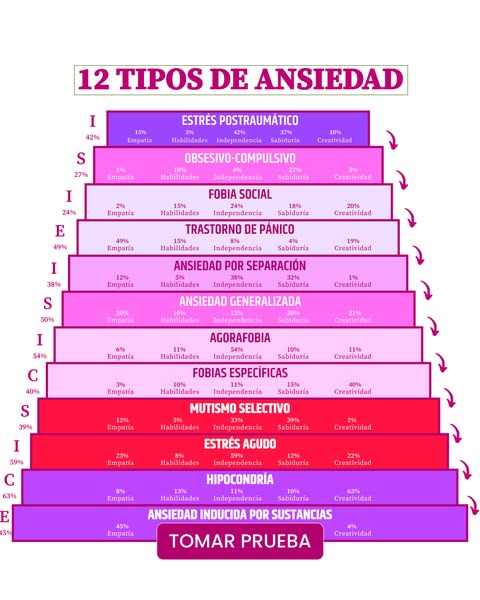
The ad is a graphic that lists 12 types of anxiety. Each type of anxiety is listed on a different colored bar, with the percentage of people who experience that type of anxiety. The ad also includes a button that says "TOMAR PRUEBA", which means "Take the test" in Spanish.
# Brand positioning
This ad does not explicitly promote a brand. Instead, it focuses on providing information about different types of anxiety. The ad aims to position itself as an educational resource for individuals seeking to understand anxiety better. By offering a breakdown of various anxiety types and a call to action to "Take the test," the ad subtly implies a deeper understanding and potential solutions related to anxiety, without directly promoting a specific brand or product.
# Product
This ad does not explicitly feature a product. Instead, it presents a list of 12 types of anxiety, each accompanied by percentage values and associated skills such as "Empatia", "Habilidades", "Independencia", and "Sabiduria". The ad serves as an informational resource, categorizing and quantifying different anxiety types to raise awareness and potentially guide viewers toward further assessment or solutions. The call to action, "TOMAR PRUEBA" (Take the test), suggests an opportunity for viewers to assess their own anxiety levels or types, implying a service or tool for self-diagnosis.
# Visual style
The ad features a clean, infographic-style layout with a focus on readability and organization. The production quality appears to be digitally created with flat design elements. The visual motifs include a stepped, layered design with color-coded bars representing different types of anxiety. The image treatment involves background removal and clear, legible typography. The overall style is informative and straightforward, aiming for easy scannability in a feed.
# Hooks
Headline: 12 TIPOS DE ANSIEDAD
# Funnel stage
Top of funnel (Awareness)
# Pain points
The ad addresses the pain point of not understanding the different types of anxiety. The ad lists "12 TIPOS DE ANSIEDAD" to signal this frustration.
# Value propositions
- Provides a list of 12 types of anxiety, helping viewers understand the different forms anxiety can take.
- Offers a call to action to "TOMAR PRUEBA" (Take the test), suggesting a way to assess one's own anxiety levels.
# Benefits
- Provides information about different types of anxiety
- Offers a way to assess your own anxiety levels
# Call to action
TOMAR PRUEBA
# Point of view
- Brand: The entire image presents information from the perspective of a brand or organization aiming to educate viewers about different types of anxiety.
# Storyline
- The ad begins by introducing the topic: "12 TIPOS DE ANSIEDAD" (12 Types of Anxiety). This is intended to immediately inform the viewer about the content of the ad, told from the brand's perspective to set the stage for an informational presentation.
- The ad then lists each type of anxiety with associated percentages and skills. This is intended to provide specific details about each anxiety type, told from the brand's perspective to educate the viewer.
- The ad concludes with a call to action: "TOMAR PRUEBA" (Take the test). This is intended to encourage the viewer to engage further, told from the brand's perspective to prompt action.
# Ad summary
This ad promotes the Impulse brain training app. It presents a visual puzzle where the user must draw a picture in one line without overlapping. The ad suggests that only people with an INTJ personality can solve it, and encourages viewers to try the puzzle themselves.
# Brand positioning
Impulse is presented as a brain training app designed to improve cognitive skills through engaging puzzles and challenges. The brand aims to occupy a space in the consumer's mind as a fun and effective way to enhance mental abilities. The brand aligns with a lifestyle of continuous self-improvement and intellectual curiosity. The brand positioning is functional, focusing on performance and simplicity, offering a way to sharpen the mind through accessible mobile gaming.
# Product
Impulse is a brain training app that offers a variety of puzzles and challenges designed to improve cognitive skills. The app is for anyone looking to enhance their mental abilities through engaging and accessible mobile gaming. The ad features a specific puzzle where the user must draw a picture in one line without overlapping lines. The app addresses the purchase barrier of perceived difficulty by presenting the puzzle as a fun and engaging challenge. The ad conveys that the app is worth trying because it offers a unique and stimulating way to sharpen the mind.
# Visual style
The ad has a clean and modern aesthetic with bright lighting and simple graphics. The editing style includes quick cuts and smooth transitions. The production quality is polished, giving it a commercial feel. The pacing is consistent, maintaining a steady rhythm throughout the ad.
# Hooks
Spoken: 00:00–00:06: Female 1: Only people with an INTJ personality can draw the picture in one line without overlapping lines. You've got to try it.
Text overlay: 00:00–00:06: Only people with an INTJ personality can solve it!
Visual: 00:00–00:06: A woman stands on a stage in front of a large screen displaying a simple line drawing of a boat with a flag. The background is a light blue color. The woman is wearing a white blazer and black pants. She is gesturing towards the screen and speaking to an audience. A man in the audience stands up and walks towards the stage. The camera is stationary and captures the scene from a medium distance.
# Funnel stage
Top of funnel (Awareness)
# Pain points
The ad implies that people may feel their cognitive skills are lacking or that they are not challenging their minds enough. This is signaled by the puzzle challenge and the suggestion that only certain personality types can solve it.
# Value propositions
- Challenge your mind with engaging puzzles
- Improve your cognitive skills through mobile gaming
- Discover if you have the INTJ personality type
# Benefits
- Engaging puzzles
- Improve cognitive skills
- Fun and effective way to enhance mental abilities
# Features
- Brain training app
- Puzzles and challenges
- Mobile gaming
# Call to action
YOUR TURN
# Point of view
- Brand 100% – The entire video is presented from the brand's perspective, showcasing its product and encouraging engagement.
# Storyline
- 00:00–00:06 00:00–00:06: A woman on stage presents a puzzle to a live audience, stating that only people with an INTJ personality can draw the picture in one line without overlapping lines. This is intended to pique the viewer's curiosity and challenge them to see if they can solve it. The perspective is from the audience watching the presentation, creating a sense of anticipation and intrigue. The tone is playful and challenging.
- 00:06–00:16 00:06–00:16: A man attempts to solve the puzzle on a large screen, with a graphic indicating whether he is 'Smart,' 'Genius,' or 'Psychopath.' He successfully solves the puzzle, triggering a confetti effect. This is intended to create a sense of accomplishment and excitement, demonstrating the app's ability to provide a rewarding experience. The perspective is from the audience watching the man solve the puzzle, creating a sense of vicarious achievement. The tone is celebratory and encouraging.
- 00:16–00:23 00:16–00:23: A hand interacts with the app on a smartphone, attempting to solve the same puzzle. The attempt fails, indicated by a red 'X' and confetti effect. This is intended to show the challenge and potential for failure, making the puzzle more engaging. The perspective is from the user's point of view, creating a sense of immersion and personal challenge. The tone is motivating and encouraging.
- 00:23–00:25 00:23–00:25: A 'YOUR TURN' graphic appears, prompting the viewer to try the puzzle themselves. This is intended to drive engagement and encourage viewers to download the app. The perspective is from the brand, directly addressing the viewer. The tone is inviting and action-oriented.
# Ad summary
This ad for Impulse brain training app presents a brain teaser puzzle that the presenter claims only people with an IQ over 130 can solve. The ad shows a woman solving the puzzle on a large screen, then shows a hand failing to solve the puzzle on a phone screen, and ends with a call to action to try it yourself.
# Brand positioning
Impulse is presented as a brain training app designed to improve cognitive skills through engaging puzzles and challenges. The brand positions itself as a tool for enhancing intelligence and problem-solving abilities, appealing to individuals who enjoy mental stimulation and seek to improve their cognitive functions. The brand uses a playful and challenging tone, suggesting that its app is not only beneficial but also fun and engaging. Impulse differentiates itself by offering a gamified approach to brain training, making it more accessible and enjoyable than traditional methods.
# Product
Impulse is a brain training app that offers a variety of puzzles and challenges designed to improve cognitive skills. The app is presented as a fun and engaging way to enhance intelligence and problem-solving abilities. The ad features a specific puzzle where users must complete a drawing without lifting their finger. The app is designed for individuals who enjoy mental stimulation and seek to improve their cognitive functions. The ad addresses the purchase barrier of perceived difficulty by presenting the puzzle as a challenge that only people with an IQ over 130 can solve, creating a sense of exclusivity and intrigue.
# Visual style
The ad has a clean and modern aesthetic, with a polished commercial feel. The editing style is a mix of static shots and quick cuts, maintaining a consistent pace throughout the video. The production quality is high, with clear visuals and professional lighting. The visual motifs include the use of bright colors, simple graphics, and close-up shots of the product in use. The audio-visual sync is well-executed, with sound effects and music timed to match the visual actions and transitions.
# Hooks
Spoken: 00:00–00:07: Male 1: I don't want to scare you, but only people with an IQ over 130 can solve it. You've got to try it yourself.
Text overlay: I don't want to scare you, but only people with an IQ over 130 can solve it. You've got to try it yourself.
Visual: 00:00–00:05: A man stands on a stage in front of a large screen displaying a simple line drawing of a boat with a flag. The background is a light blue color. The man is wearing a black blazer, white t-shirt, black pants, and white sneakers. He is gesturing towards the screen and speaking. The camera is stationary and captures the scene from a medium distance. The lighting is bright and even.
# Funnel stage
Top of funnel (Awareness)
# Pain points
The ad implies that the viewer may be concerned about their cognitive abilities or intelligence. The presenter states, "I don't want to scare you, but only people with an IQ over 130 can solve it."
# Value propositions
- Test your intelligence with a challenging puzzle
- Improve your cognitive skills through engaging challenges
- Join a community of intelligent individuals
# Benefits
- Improve cognitive skills
- Enhance intelligence
- Improve problem-solving abilities
# Features
- Brain training app
- Puzzles and challenges
- Cognitive skill improvement
# Call to action
YOUR TURN
# Social proof
- None used.
# Point of view
- Brand 95% – The ad is primarily told from the brand's perspective, showcasing the app's features and benefits through demonstrations and challenges.
- Customer 5% – The ad briefly shows a hand interacting with the app on a phone, providing a glimpse of the user experience.
# Storyline
- 00:00–00:05 00:00–00:05: A man on stage presents a brain teaser puzzle, claiming that only people with an IQ over 130 can solve it. This is intended to intrigue the audience and challenge them to test their intelligence. The perspective is from the brand, using a confident and engaging tone to draw viewers in.
- 00:05–00:15 00:05–00:15: A woman on stage attempts to solve the puzzle on a large screen, successfully completing the drawing. This demonstrates the puzzle's mechanics and provides a visual example of how the app works. The perspective is from an observer, showcasing the puzzle's solution in a clear and concise manner.
- 00:15–00:22 00:15–00:22: A hand interacts with the app on a phone screen, attempting to solve the same puzzle but failing. This highlights the challenge and encourages viewers to try it themselves. The perspective shifts to a user experience, emphasizing the app's difficulty and the need for cognitive skills.
- 00:22–00:25 00:22–00:25: A "YOUR TURN" call to action appears, prompting viewers to download the app and try the puzzle. This is a direct invitation to engage with the product and test their intelligence. The perspective is from the brand, urging viewers to take the next step and experience the app firsthand.
# Ad summary
This ad for Impulse Brain Training features a man on a screen presenting a brain teaser to an audience. The brain teaser is a drawing of an upside down wine glass, and the man says that only people with an IQ over 130 can solve it. The ad then cuts to a woman on a screen who is trying to solve the brain teaser by drawing lines on the screen. The ad then cuts to a hand holding a phone with the brain teaser on the screen. The person draws a line on the screen and solves the brain teaser. The ad ends with the text "SIE SIND DRAN" which translates to "It's your turn".
# Brand positioning
Impulse Brain Training is presented as a tool for improving cognitive function and challenging one's intellect. The brand positions itself as a provider of brain-training exercises designed to test and enhance IQ. The brand aims to occupy a space in the consumer's mind as a fun and engaging way to improve mental acuity. The brand aligns with values of intelligence, self-improvement, and mental challenge. The brand pushes against the norm of passive entertainment by offering interactive brain-training exercises. The brand positioning is functional, focusing on performance and simplicity.
# Product
Impulse Brain Training is a mobile app designed to challenge and improve cognitive function. The app presents users with brain-training exercises, such as the featured upside-down wine glass puzzle, which requires users to draw lines to solve it. The product is for individuals interested in testing and enhancing their IQ. The app is presented as a fun and engaging way to improve mental acuity. The ad addresses the purchase barrier of skepticism by presenting the app as a challenge that only people with high IQs can solve, thus piquing the viewer's curiosity and desire to prove their intelligence. The ad tells the viewer that this product is worth trying because it offers a unique and stimulating way to test and improve their cognitive abilities.
# Visual style
The ad has a polished and professional aesthetic. The editing style is quick cuts. The production quality is high-end commercial. The pacing is consistent. The cuts are timed to the music beats.
# Hooks
Spoken: 00:00–00:05 Ich möchte Ihnen keine Angst machen, aber nur Menschen mit einem IQ über 130 können es lösen. [Normal]
Text overlay: 00:00–00:05 Ich möchte Ihnen keine Angst machen, aber nur Menschen mit einem IQ über 130 können es lösen. Sie müssen es selbst versuchen. (Tweet) / 00:00–00:05 Ich möchte Ihnen keine Angst machen, aber nur Menschen mit einem IQ über 130 können es lösen. Sie müssen es selbst versuchen. (Tweet)
Visual: 00:00–00:05 A man in a suit is standing on a stage in front of a screen. The screen shows a drawing of an upside down wine glass. The man is holding a remote control in his hand. The background is a light purple color. There are people sitting in the audience watching the presentation. The camera is stationary and the framing is medium.
# Funnel stage
Top of funnel (Awareness)
# Pain points
The ad implies that the viewer may not be as intelligent as they think they are. The man says that only people with an IQ over 130 can solve the brain teaser.
# Value propositions
- Test and enhance your IQ with brain-training exercises
- Improve mental acuity with a fun and engaging app
# Benefits
- Challenge and improve cognitive function
- Fun and engaging way to improve mental acuity
# Features
- Brain-training exercises
- Upside-down wine glass puzzle
# Call to action
None used.
# Point of view
- Brand 50% – The brand POV is communicated through the presentation of the brain teaser and the call to action at the end of the ad.
- Customer 50% – The customer POV is communicated through the woman on the screen who is trying to solve the brain teaser and the hand holding the phone with the brain teaser on the screen.
# Storyline
- 00:00–00:05 00:00–00:05 The ad begins with a man on a screen presenting a brain teaser to an audience. The brain teaser is a drawing of an upside down wine glass, and the man says that only people with an IQ over 130 can solve it. This is intended to challenge the viewer and make them want to try to solve the brain teaser. The perspective is from the audience watching the presentation. The tone is confident and challenging.
- 00:05–00:16 00:05–00:16 The ad then cuts to a woman on a screen who is trying to solve the brain teaser by drawing lines on the screen. This is intended to show the viewer how the brain teaser works and how to solve it. The perspective is from the viewer watching the woman solve the brain teaser. The tone is playful and engaging.
- 00:16–00:22 00:16–00:22 The ad then cuts to a hand holding a phone with the brain teaser on the screen. The person draws a line on the screen and solves the brain teaser. This is intended to show the viewer how easy it is to use the app and solve the brain teaser. The perspective is from the viewer watching the person solve the brain teaser. The tone is simple and straightforward.
- 00:22–00:25 00:22–00:25 The ad ends with the text "SIE SIND DRAN" which translates to "It's your turn". This is intended to encourage the viewer to download the app and try it for themselves. The perspective is from the brand. The tone is inviting and encouraging.
# Ad summary
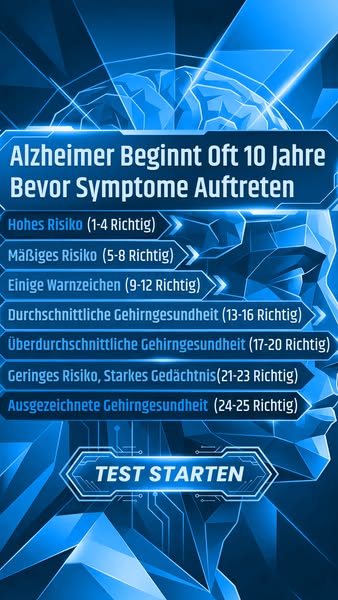
This ad promotes a test to determine the risk of Alzheimer's disease. It highlights that Alzheimer's can begin 10 years before symptoms appear and presents a range of risk levels based on test results.
# Brand positioning
The brand is not explicitly mentioned in the ad. The ad focuses on raising awareness about Alzheimer's disease and encouraging users to take a test to assess their risk. The brand positions itself as a provider of information and tools related to brain health, emphasizing the importance of early detection and proactive measures.
# Product
The product being advertised is a test designed to assess an individual's risk of developing Alzheimer's disease. The ad highlights that Alzheimer's can begin 10 years before symptoms appear, emphasizing the importance of early detection. The test results categorize individuals into different risk levels, ranging from "Hohes Risiko (1-4 Richtig)" to "Ausgezeichnete Gehirngesundheit (24-25 Richtig)". The ad encourages users to take the test to understand their brain health and potential risk factors.
# Visual style
The ad has a modern, technological aesthetic with a blue color scheme and geometric patterns. The image is clean and well-organized, with clear text and distinct visual elements. The overall style is professional and informative, designed to convey a sense of medical authority and encourage engagement.
# Hooks
Headline: Alzheimer Beginnt Oft 10 Jahre Bevor Symptome Auftreten
# Funnel stage
Top of funnel (Awareness)
# Pain points
The ad addresses the pain point of uncertainty and fear surrounding Alzheimer's disease, highlighting that the disease can begin 10 years before symptoms appear. "Alzheimer Beginnt Oft 10 Jahre Bevor Symptome Auftreten"
# Value propositions
- Assess your risk of Alzheimer's disease with a simple test.
- Understand your brain health and take proactive measures.
# Benefits
- Early detection of Alzheimer's risk
- Understanding of brain health
- Proactive measures for brain health
# Features
- Test to assess risk of Alzheimer's disease
- Categorization of risk levels based on test results
# Call to action
TEST STARTEN
# Social proof
- None used.
# Point of view
- Brand: The entire ad is presented from the brand's perspective, providing information about Alzheimer's risk and promoting a test to assess individual risk levels.
# Storyline
- The ad starts by stating that Alzheimer's begins 10 years before symptoms appear, aiming to grab the viewer's attention and highlight the importance of early detection. This is told from the brand's perspective to emphasize the need for proactive measures regarding brain health.
- The ad then presents a range of risk levels based on test results, from "Hohes Risiko (1-4 Richtig)" to "Ausgezeichnete Gehirngesundheit (24-25 Richtig)". This is told from the brand's perspective to inform the viewer about the potential outcomes of taking the test and how their results will be categorized.
- Finally, the ad includes a call to action, "TEST STARTEN", encouraging viewers to take the test. This is told from the brand's perspective to prompt immediate engagement and drive traffic to the test.
# Ad summary
The ad presents a brain training exercise from Impulse. It starts with a woman presenting a drawing on a whiteboard, stating that only people with an IQ over 130 can solve it. The ad then shows a person trying to solve the puzzle on a transparent board, failing, and then shows a person solving the puzzle on their phone using the Impulse app. The ad ends with a call to action to try it yourself.
# Brand positioning
Impulse is presented as a brain training app that offers exercises and puzzles designed to improve cognitive skills and challenge users' intelligence. The brand positions itself as a tool for enhancing mental abilities, suggesting that its exercises are so challenging that only individuals with a high IQ can solve them. The brand aims to occupy a space in the consumer's mind as a provider of intellectually stimulating and exclusive content, aligning with values of intelligence, challenge, and self-improvement. The brand pushes against the norm of easy entertainment, instead offering a product that requires mental effort and promises cognitive benefits. The brand positioning is both functional, offering brain training exercises, and emotional, appealing to the user's desire to test and improve their intelligence.
# Product
The Impulse app is a brain training application designed to challenge and improve cognitive skills. The ad features a specific puzzle that involves identifying a hidden image within a drawing. The app is presented as a tool for individuals who want to test and enhance their intelligence, with the ad suggesting that only people with an IQ over 130 can solve the puzzles offered. The app addresses the purchase barrier of perceived difficulty by framing the challenge as an exclusive opportunity for intelligent individuals. The ad highlights the app's ability to provide intellectually stimulating exercises that can be accessed and solved on a mobile device.
# Visual style
The ad has a mixed aesthetic, combining a polished presentation with a more casual, UGC-style demonstration. The editing style includes quick cuts and static shots. The production quality is a hybrid, with elements of both a commercial and a user-generated video. The pacing is consistent, with cuts timed to the music. The audio-visual sync is noticeable, with sound effects timed to visual actions.
# Hooks
Spoken: 00:00–00:05: Não quero te assustar, mas apenas pessoas com um QI acima de 130 conseguem resolver isso. (I don't want to scare you, but only people with an IQ above 130 can solve this.)
Text overlay: 00:05–00:05: Somente pessoas com QI > 130 podem resolvê-lo!
Visual: 00:00–00:05: A woman stands on a stage in front of a whiteboard. She is wearing a black blazer and light-colored pants. The whiteboard has a drawing of an upside-down wine glass. A phone is recording her from the side. The background is a white screen.
# Funnel stage
Middle of funnel (Consideration)
# Pain points
The ad implies that people may feel insecure about their intelligence or cognitive abilities. The ad states, "I don't want to scare you, but only people with an IQ above 130 can solve this."
# Value propositions
- Exclusive challenge for intelligent individuals
- Intellectually stimulating exercises accessible on a mobile device
# Benefits
- Improve cognitive skills
- Test and enhance intelligence
- Access intellectually stimulating exercises
# Features
- Brain training exercises
- Puzzles designed to challenge cognitive skills
- Mobile app accessibility
# Call to action
SUA VEZ (Your Turn)
# Point of view
- Brand 70% – The brand POV is communicated through the presenter, text overlays, and product demonstrations.
- Customer 30% – The customer POV is communicated through the visual of someone trying and failing to solve the puzzle.
# Storyline
- 00:00–00:05 A woman presents a drawing on a whiteboard and states that only people with an IQ over 130 can solve it. This is intended to challenge the viewer and pique their curiosity, positioning the puzzle as an exclusive test of intelligence. The perspective is from the brand, conveyed through the presenter's authoritative tone and the visual setup of a presentation.
- 00:05–00:15 A person attempts to solve the puzzle on a transparent board but fails. This is intended to show the difficulty of the puzzle and create a sense of challenge for the viewer. The perspective is from an observer, showing the person's struggle and the puzzle's complexity. The tone is slightly humorous, with confetti falling after the failed attempt.
- 00:15–00:22 A person solves the puzzle on their phone using the Impulse app. This is intended to demonstrate the app's ability to provide solutions and make the puzzle accessible. The perspective is from the brand, showcasing the app's functionality and ease of use. The tone is satisfying, showing the successful completion of the puzzle.
- 00:22–00:24 The ad ends with a call to action to try it yourself. This is intended to encourage the viewer to download the app and engage with the puzzle. The perspective is from the brand, directly addressing the viewer and prompting them to take action. The tone is inviting, encouraging the viewer to test their intelligence.
# Ad summary
This ad promotes a childhood trauma test by Impulse Brain Training. The ad opens with a woman presenting a diagram, followed by a screen displaying the text "KINDERTRAUMATEST WAT ZIE JE ALS EERSTE?" (Childhood Trauma Test What Do You See First?). The ad then shows a series of images with two options each, inviting the viewer to select what they see first. The ad concludes with a screen displaying "UW TESTRESULTAAT" (Your Test Result) and a funnel diagram illustrating different types of trauma, along with a brief description and calls to action to download the app or take the test.
# Brand positioning
Impulse Brain Training is presented as a provider of a childhood trauma test. The brand aims to occupy a space in the consumer's mind as a resource for understanding and addressing childhood trauma through an accessible test. The brand aligns with values of self-discovery, mental health awareness, and personal growth. The brand positioning is functional, offering a tool for self-assessment, and emotional, addressing deep-seated personal issues.
# Product
The product is a childhood trauma test designed to reveal the type of trauma a person experienced in childhood based on what they first notice in a series of images. The test presents a series of ambiguous images, each with two possible interpretations. The user selects the interpretation that comes to mind first. The test results categorize potential traumas, such as physical, sexual, and emotional trauma, and offer a brief description of the user's tendencies based on the test results. The test is available via an app.
# Visual style
The ad has a polished yet slightly unsettling aesthetic. The editing style is smooth, with static shots and simple transitions. The production quality is high, giving it a commercial feel. The visual motif is the use of ambiguous images and branching diagrams. The pacing is consistent, with a slow, deliberate rhythm that matches the serious tone of the subject matter. The cuts are timed to the music beats and voiceover lines.
# Hooks
Spoken: Eerlijk gezegd is het een beetje griezelig, maar wat je als eerste op de afbeelding opvalt, kan jouw type jeugdtrauma onthullen en het is eng hoe accuraat het is.
Text overlay: Sami Wolivar / @sami.wolivar / Eerlijk gezegd is het een beetje griezelig, maar wat je als eerste op de foto opmerkt, kan het type trauma uit je kindertijd onthullen en het is eng hoe accuraat het is. / IMPULSE / BRAIN TRAINING
Visual: 00:00-00:07: A woman with long brown hair, wearing a dark blouse and pants, stands in front of a large screen. The screen displays a diagram with images of an elephant, a face, and other abstract shapes, connected by lines and labels. The woman gestures with her hands as she speaks. The setting appears to be a conference or presentation stage, with soft lighting and a blurred background. The camera is stationary and captures a medium shot of the woman. The text "Sami Wolivar" and "@sami.wolivar" appear in the upper left corner, styled like a tweet.
# Funnel stage
Middle of funnel (Consideration)
# Pain points
The ad implies that the central frustration or problem is a lack of understanding of one's childhood trauma and its impact on current tendencies. "Wat je als eerste op de foto opmerkt, kan het type trauma uit je kindertijd onthullen en het is eng hoe accuraat het is." (What you first notice in the image can reveal your type of childhood trauma and that it is scarily accurate.)
# Value propositions
- The test can reveal your type of childhood trauma based on what you first notice in a series of images.
- The test results categorize potential traumas, such as physical, sexual, and emotional trauma, and offer a brief description of the user's tendencies based on the test results.
# Benefits
- The test can reveal your type of childhood trauma.
# Features
- Childhood trauma test
- Series of ambiguous images with two possible interpretations
- Test results categorize potential traumas
# Call to action
TEST DOEN
# Point of view
- Brand 95% – The ad is primarily told from the brand's perspective, presenting the test and its potential benefits.
- Expert 5% – The ad opens with a woman presenting a diagram, suggesting an expert perspective.
# Storyline
- 00:00–00:07 00:00–00:07: A woman introduces the concept of the test, stating that what you first notice in the image can reveal your type of childhood trauma and that it is scarily accurate. This is presented from the perspective of an expert, setting the stage for the test. The tone is intriguing and slightly ominous.
- 00:07–00:08 00:07–00:08: The screen displays the text "KINDERTRAUMATEST WAT ZIE JE ALS EERSTE?" (Childhood Trauma Test What Do You See First?) above a silhouetted figure. This introduces the test and its central question, inviting the viewer to participate. The perspective shifts to the brand, presenting the test as a challenge.
- 00:08–00:21 00:08–00:21: The ad shows a series of images with two options each, inviting the viewer to select what they see first. A hand with red nail polish interacts with the test options on the screen. This demonstrates how the test works and engages the viewer. The perspective is that of a potential user, showing the interactive nature of the test.
- 00:21–00:24 00:21–00:24: The screen displays "UW TESTRESULTAAT" (Your Test Result) and a funnel diagram illustrating different types of trauma, along with a brief description and calls to action to download the app or take the test. This reveals the outcome of the test and encourages the viewer to take action. The perspective is that of the brand, offering a solution and a call to action.
# Ad summary
This ad promotes a test that helps women discover their female archetype. It uses a clip from a podcast to introduce the topic and then transitions to a screen recording of the test itself. The ad emphasizes that the test is easy to take and will help women align with their strengths and potential.
# Brand positioning
This ad does not explicitly mention a brand name, but it promotes a test designed to help women discover their female archetype. The brand positions itself as a tool for self-discovery and personal growth, emphasizing the importance of aligning with one's strengths and potential. The brand aims to occupy a space in the consumer's mind as a resource for understanding oneself and achieving success. The values promoted are self-awareness, empowerment, and personal development. The brand pushes against the norm of superficial self-assessment by offering a deeper, archetype-based approach. The brand positioning is both functional (providing a test) and emotional (offering self-discovery and empowerment).
# Product
The product being advertised is a test designed to help women discover their female archetype. The test is presented as a tool for self-discovery and personal growth, helping women align with their strengths and potential. The ad shows a graphic with "12 FEMALE ARCHETYPES according to your trauma response" including The Queen, The Mother, The Mystic, The Maiden, The Creator, The Sage, The Lover, The Huntress, The Healer, The Sage, The Dame, and The Heroine. The test is for women who are interested in understanding themselves better and achieving success. The ad emphasizes that the test is easy to take and will show you where you operate at your best, when you are truly thriving. The ad addresses the purchase barrier of complexity by highlighting that it's really easy and super simple to figure it out. All you got to do is tap on the screen and take this quick test.
# Visual style
The ad has a hybrid aesthetic, combining a polished podcast clip with a screen recording that has a slightly more UGC feel. The editing style is a mix of static shots and quick cuts to transition between scenes. The production quality is decent, with clear audio and visuals. The pacing is consistent throughout the ad. The cuts are timed to coincide with changes in speakers and key points in the message.
# Hooks
Spoken: 00:00–00:04 Have you seen that video on the difference between a queen and a people pleaser?
Text overlay: 00:00–00:04 HAVE YOU SEEN THAT VIDEO / 00:01–00:04 ON THE DIFFERENCE / 00:02–00:04 AND A PEOPLE PLEASER?
Visual: 00:00–00:04 Close-up shot of a blonde woman with fair skin, wearing a white blazer and pearl necklace, sitting in front of a microphone. She is in a podcast studio with a red curtain in the background. The camera is stationary and focused on her face as she listens and responds.
# Funnel stage
Middle of funnel (Consideration)
# Pain points
The ad implies that women may not have a clear understanding of their strengths and potential, leading to a lack of fulfillment and success. "A lot of you might call yourself a Queen, which is not realistic for human females."
# Value propositions
- Discover your female archetype to align with your strengths and potential.
- Take a quick and easy test to find out where you operate at your best.
# Benefits
- Align with your strengths and potential
- Operate at your best
- Be as successful as possible
# Features
- 12 female archetypes
- Test to discover your archetype
# Call to action
All you got to do is tap on the screen and take this quick test.
# Social proof
- The ad uses a clip from a podcast as social proof, suggesting that the topic of female archetypes is interesting and relevant to a wider audience.
# Point of view
- Brand 80% – The majority of the video is told from the brand's perspective, with a man describing the test and its benefits.
- External source 20% – The ad begins with a clip from a podcast, providing an external source of validation and interest.
# Storyline
- 00:00–00:04 00:00–00:04 The ad begins with a clip from a podcast featuring a woman being asked if she has seen a video on the difference between a queen and a people pleaser. The intention is to pique the viewer's curiosity and introduce the topic of female archetypes. The perspective is from the podcast hosts, creating a conversational and engaging tone.
- 00:04–00:05 00:04–00:05 The woman responds that she has not seen the video yet. This continues the conversational tone and sets up the transition to the test. The perspective remains from the podcast hosts.
- 00:06–00:07 00:06–00:07 The man tells her to pull it up on the screen. This serves as a transition to the next segment of the ad. The perspective remains from the podcast hosts.
- 00:09–00:12 00:09–00:12 The ad transitions to a screen recording of a man talking about the test. He states that a lot of you might call yourself a Queen, which is not realistic for human females. The intention is to challenge the viewer's self-perception and introduce the idea that the test can reveal unexpected insights. The perspective shifts to the man in the screen recording, creating a more direct and informative tone.
- 00:12–00:50 00:12–00:50 The man continues to describe the test, explaining that it identifies 12 female archetypes and helps you align with the archetype reflecting your strengths and potential. The intention is to highlight the benefits of taking the test and encourage viewers to discover their own archetype. The perspective remains from the man in the screen recording, maintaining an informative tone.
- 00:50–00:56 00:50–00:56 The man concludes by emphasizing that the test is easy and simple to figure out. All you got to do is tap on the screen and take this quick test. The intention is to provide a clear call to action and remove any perceived barriers to taking the test. The perspective remains from the man in the screen recording, ending with an encouraging and actionable tone.
# Ad summary
This ad for Impulse brain training features a presenter showing a puzzle on a screen to an audience. The puzzle is then solved by a second presenter, and the ad cuts to a hand solving the same puzzle on a phone. The ad ends with a call to action to play the game.
# Brand positioning
Impulse brain training is presented as a tool to improve cognitive function and intelligence. The ad positions the brand as a provider of brain-training games and puzzles designed to challenge and enhance users' IQ. The brand aims to occupy a space in the consumer's mind as a fun and engaging way to boost intelligence and problem-solving skills. The brand aligns with values of self-improvement, mental agility, and intellectual curiosity. The brand pushes against the norm of passive entertainment by offering interactive and mentally stimulating content. The brand positioning is functional, focusing on performance and simplicity, as well as emotional, appealing to the desire for self-improvement and intellectual satisfaction.
# Product
Impulse brain training is a mobile application designed to improve cognitive function through a series of brain-training games and puzzles. The product is for individuals interested in enhancing their IQ, problem-solving skills, and overall mental agility. The ad features a specific puzzle where users must draw lines to complete a shape. The USP is that only people with an IQ of 130 or higher can solve it. The ad shows the product being used on a smartphone, highlighting its accessibility and convenience. The ad addresses the purchase barrier of doubting one's intelligence by framing the product as a challenge to prove one's IQ.
# Visual style
The ad has a polished, commercial aesthetic with bright lighting and clear visuals. The editing style includes quick cuts to maintain viewer engagement. The production quality is high, giving the ad a professional feel. The pacing is consistent, with cuts timed to the music beats.
# Hooks
Spoken: 00:00–00:04: Je ne veux pas vous faire peur, mais seuls ceux avec un QI de plus de 130 peuvent le résoudre.
Text overlay: 00:00–00:04: C'est à votre tour de prouver que votre QI est supérieur à 130! / 00:03–00:04: Seules les personnes dont le QI est supérieur à 130 peuvent le résoudre! / 00:03–00:04: INTELLIGENT / 00:03–00:04: GÉNIE / 00:03–00:04: PSYCHOPATHE
Visual: 00:00–00:03: A man stands in front of a screen with a puzzle on it. He is wearing a white shirt and addressing an audience. The background is a bright, modern office space.
# Funnel stage
Middle of funnel (Consideration)
# Pain points
The ad implies that the viewer may doubt their intelligence or problem-solving abilities. The presenter states, "Je ne veux pas vous faire peur, mais seuls ceux avec un QI de plus de 130 peuvent le résoudre" (I don't want to scare you, but only those with an IQ of over 130 can solve it), suggesting that the puzzle is difficult and may be beyond the viewer's capabilities.
# Value propositions
- Challenge to prove one's IQ
- Fun and engaging way to boost intelligence
- Accessible and convenient brain training on a smartphone
# Benefits
- Improve cognitive function
- Enhance IQ
- Boost problem-solving skills
- Increase mental agility
# Features
- Brain-training games and puzzles
- Mobile application
- Specific puzzle where users must draw lines to complete a shape
# Call to action
À VOUS DE JOUER
# Point of view
- Brand 100% – The ad is presented from the brand's perspective, showcasing the product and its features.
# Storyline
- 00:00–00:03 A presenter stands in front of an audience and a screen displaying a puzzle.
- 00:00–00:04 The presenter states that only those with an IQ of 130 or higher can solve the puzzle, creating a challenge for the audience.
- 00:04–00:11 A second presenter solves the puzzle on the screen by drawing lines to complete the shape.
- 00:12–00:18 The ad cuts to a hand solving the same puzzle on a smartphone, demonstrating the app's interface and user experience.
- 00:19–00:20 The ad ends with a call to action, encouraging viewers to play the game.
# Ad summary
This ad promotes Impulse, a brain training app, by presenting a challenge that supposedly only people with childhood trauma can solve. The ad features a man presenting the challenge on a stage, followed by a demonstration of the game on a mobile phone.
# Brand positioning
Impulse is presented as a brain training app designed to challenge and improve cognitive functions. The brand uses a playful and slightly provocative approach, suggesting that certain cognitive abilities are linked to personal experiences like childhood trauma. This positioning aims to create curiosity and engagement by framing brain training as more than just a functional exercise, but as a reflection of one's personal history and intelligence. The brand seems to ignore category norms by using a slightly controversial hook to draw attention.
# Product
Impulse is a brain training app that challenges users to complete drawings in a single line without overlapping. The app is designed to test and potentially improve cognitive skills. The ad highlights a specific challenge within the app, framing it as a test of intelligence and linking it to personal experiences. The app is presented as a fun and engaging way to assess one's cognitive abilities, with a playful tone that encourages users to try the challenge and see how they perform.
# Visual style
The ad has a clean and modern aesthetic, with a mix of live-action and digital elements. The editing is quick and engaging, with smooth transitions between scenes. The production quality is polished, giving it a professional feel. The visual motifs include the use of bright colors and simple graphics, which align with the playful tone of the ad. The pacing is consistent, with cuts timed to the music beats.
# Hooks
Spoken: 00:00–00:07: Sólo las personas con trauma infantil pueden dibujar la imagen en una línea sin superponer líneas. Tienes que intentarlo.
Text overlay: Sólo las personas con traumas infantiles pueden hacer el dibujo en una sola línea sin superponer líneas. Tienes que intentarlo. / ¡Sólo las personas con traumas infantiles pueden resolverlo! / INTELIGENTE / GENIO / PSICÓPATA
Visual: 00:00–00:06: A man stands on a stage in front of a light blue screen with a drawing of a boat and flag on it. The man is wearing a black jacket, black pants, and white sneakers. He gestures towards the screen as he speaks. The camera is stationary and the framing is medium shot. Text overlays appear at the top of the screen, mimicking a social media post.
# Funnel stage
Top of funnel (Awareness)
# Pain points
The ad implies a frustration with traditional brain training methods that may be seen as boring or ineffective. The ad offers a more engaging and playful approach to cognitive challenges.
# Value propositions
- Engaging brain training: The app offers a fun and interactive way to improve cognitive skills.
- Unique challenge: The drawing challenge is presented as a test of intelligence and personal history, making it more intriguing than typical brain training exercises.
# Benefits
- Engaging brain training
- Fun cognitive challenge
# Features
- Brain training app
- Drawing challenge
- Single-line drawing without overlapping
# Call to action
TU TURNO
# Social proof
- None used.
# Point of view
- Brand 100% – The ad is presented from the brand's perspective, showcasing its product and its unique approach to brain training.
# Storyline
- 00:00–00:06 00:00–00:06: A man on a stage presents a challenge, stating that only people with childhood trauma can draw a specific image in one line without overlapping. This is intended to pique the viewer's curiosity and challenge their self-perception. The perspective is from the audience watching the presentation, creating a sense of intrigue and competition. The tone is provocative and playful, designed to grab attention.
- 00:06–00:16 00:06–00:16: A young boy steps forward and successfully completes the drawing challenge on the screen. This reinforces the initial claim and adds a visual element of success and achievement. The perspective shifts to a wider shot of the stage, showing both the presenter and the boy. The tone is celebratory, with a confetti effect indicating success.
- 00:16–00:22 00:16–00:22: The ad transitions to a close-up of a hand using the Impulse app on a mobile phone to attempt the same drawing challenge. This demonstrates the app's functionality and invites the viewer to try it themselves. The perspective is from a first-person view of someone using the app. The tone is interactive and engaging, encouraging the viewer to participate.
- 00:22–00:25 00:22–00:25: A 'TU TURNO' (Your Turn) button appears, prompting the viewer to download and try the app. This serves as a direct call to action, encouraging immediate engagement. The perspective remains on the mobile phone screen. The tone is direct and action-oriented, aiming to convert viewers into users.
# Ad summary
This ad for Impulse brain training features a man presenting a brain teaser to a live audience. The audience is challenged to solve the puzzle, and the ad shows how the puzzle is solved both in real life and on the Impulse app. The ad ends with a call to action to try it yourself.
# Brand positioning
Impulse is presented as a brain training app that helps users improve their cognitive skills through a variety of puzzles and games. The brand aims to occupy a space in the consumer's mind as a fun and engaging way to boost intelligence and problem-solving abilities. The brand aligns with a lifestyle of continuous learning and self-improvement. The brand pushes against the norm of passive entertainment by offering interactive and mentally stimulating content. The brand positioning is functional, focusing on performance and simplicity.
# Product
Impulse is a brain training app designed to improve cognitive skills through puzzles and games. The app is for anyone who wants to boost their intelligence and problem-solving abilities. The ad features a specific puzzle where users must complete a drawing without lifting their finger. The USP is that it challenges users to think creatively and strategically. The ad shows the puzzle being solved both in real life and on the app, demonstrating its accessibility and ease of use. The ad addresses the purchase barrier of doubting one's intelligence by framing the puzzle as a challenge only those with a high IQ can solve, thus enticing viewers to prove themselves.
# Visual style
The ad has a polished commercial aesthetic with bright lighting and clear visuals. The editing style is quick cuts, keeping the pace engaging. The production quality is high, with professional-looking graphics and smooth transitions. The pacing is consistent throughout the ad, maintaining a sense of urgency and excitement. The cuts and product actions are timed to the music beats, creating a cohesive audio-visual experience.
# Hooks
Spoken: No quiero asustarte, pero solo gente con un CI superior a 130 puede resolverlo.
Text overlay: ¿Listo? ¡Te toca demostrar que tu CI supera los 130! (Tweet) / Sólo las personas con un coeficiente intelectual superior a 130 pueden resolverlo! / INTELIGENTE / GENIUS / PSICÓPATA
Visual: 00:00–00:03: A man stands in front of a screen presenting a brain teaser to a live audience. The screen displays a drawing of a boat with a flag. The man is wearing a white t-shirt and holding a microphone. The audience is seated and facing the screen. The setting is a modern office space with glass walls and bright lighting.
# Funnel stage
Middle of funnel (Consideration)
# Pain points
The ad implies that people may doubt their own intelligence or problem-solving abilities. The presenter states that "only people with an IQ over 130 can solve it," suggesting that the puzzle is difficult and requires a high level of intelligence.
# Value propositions
- Fun and engaging way to boost intelligence
- Accessible and easy to use
- Challenges users to prove themselves
# Benefits
- Improves cognitive skills
- Boosts intelligence
- Enhances problem-solving abilities
# Features
- Brain training app
- Puzzles and games
- Challenges users to think creatively and strategically
# Call to action
TU TURNO
# Point of view
- Brand 100% – The ad is presented from the official voice of the brand, showcasing the product and its features.
# Storyline
- 00:00–00:03 A man presents a brain teaser to a live audience, challenging them to solve it.
- 00:00–00:04 The presenter states that only people with an IQ over 130 can solve the puzzle, creating a sense of exclusivity and challenge.
- 00:04–00:11 A person from the audience attempts to solve the puzzle in real life by physically tracing the lines on a screen.
- 00:11–00:12 The puzzle is successfully solved, indicated by confetti and a checkmark.
- 00:12–00:18 The ad transitions to a demonstration of the puzzle being solved on the Impulse app.
- 00:17–00:18 The puzzle is successfully solved on the app, again indicated by confetti and a checkmark.
- 00:18–00:20 The ad ends with a call to action, inviting the viewer to try the puzzle themselves.
# Ad summary
This ad promotes a childhood trauma test by showing a series of images and asking the viewer what they see first. The ad claims that the viewer's answer may reveal their childhood trauma type and that it's scary how accurate it is.
# Brand positioning
The brand, Impulse Brain Training, is presented as a provider of tests and insights related to childhood trauma. The brand aims to occupy a space in the consumer's mind as a source of self-discovery and understanding of past experiences. The brand aligns with values of self-awareness and personal growth. The brand positioning is functional, offering a tool for understanding one's childhood trauma type.
# Product
The product is a childhood trauma test that claims to reveal the viewer's childhood trauma type based on what they notice first in a series of images. The test presents the viewer with a series of ambiguous images and asks them to select what they see first from a list of options. The test addresses the purchase barrier of skepticism by claiming that it's scary how accurate it is. The ad tells the viewer that this product is worth trying because it can reveal insights into their childhood trauma type.
# Visual style
The ad has a polished commercial aesthetic with a slightly dark and mysterious tone. The editing style is a mix of static shots and quick cuts, with smooth transitions between scenes. The production quality is high-end, with professional lighting and sound. The pacing is consistent throughout the ad, with cuts timed to the music beats and voiceover lines.
# Hooks
Spoken: Honestly, it's a bit creepy, but what you notice first on the picture may reveal your childhood trauma type and it's scary how accurate it is.
Text overlay: Jacob Mill ☁️ / @jacob.mill / Honestly, it's a bit creepy, but what you notice first on the picture may reveal your childhood trauma type and it's scary how accurate it is.
Visual: 00:00–00:08: The shot is a medium close-up of a middle-aged man (Male 1) with short gray hair and glasses. He is wearing a black suit jacket and a white shirt. He is sitting in a chair in front of a dark background with blurred lights. The camera is stationary and the lighting is soft and diffused. The shot is framed as a tweet overlay, with the man's profile picture and username in the top left corner and the tweet text above him.
# Funnel stage
Top of funnel (Awareness)
# Pain points
The ad implies that the viewer may be struggling to understand their own behavior and relationships due to unresolved childhood trauma. "What you notice first on the picture may reveal your childhood trauma type and it's scary how accurate it is."
# Value propositions
- Discover your childhood trauma type
- Understand how your past experiences have shaped your behavior
# Benefits
- May reveal your childhood trauma type
- It's scary how accurate it is
# Features
- Childhood trauma test
- Series of ambiguous images
- Multiple choice answers
# Call to action
TAKE TEST
# Point of view
- Brand 100% – The ad is presented from the official voice of the brand, showcasing the test and its potential insights.
# Storyline
- 00:00–00:08 The ad begins with a tweet overlay featuring a man speaking directly to the camera. The tweet claims that what you notice first on the picture may reveal your childhood trauma type and it's scary how accurate it is. This is intended to grab the viewer's attention and pique their curiosity. The perspective is from the brand, presenting the test as a source of insight.
- 00:08–00:11 The ad transitions to a series of images with the text overlay "CHILDHOOD TRAUMA TEST WHAT DO YOU SEE FIRST?" This is intended to engage the viewer and prompt them to participate in the test. The perspective is from the brand, presenting the test as an interactive experience.
- 00:11–00:22 A hand taps the screen to select an answer for each image. This is intended to demonstrate how the test works and encourage the viewer to try it themselves. The perspective is from the brand, showcasing the ease of use of the test.
- 00:22–00:26 The ad concludes with a screen displaying "YOUR TEST RESULT" and a description of the different types of trauma. This is intended to provide a sense of closure and encourage the viewer to download the app or take the test. The perspective is from the brand, presenting the test as a source of valuable information.
# Ad summary
This ad promotes Impulse Brain Training, an app that helps users understand and manage their anxiety. The ad features a woman speaking about how scary it can be to learn about your anxiety type. It then transitions to an interactive anxiety test where users choose what they see first in a series of images. The ad concludes by showing the different types of anxiety the test can reveal and encourages users to download the app to take the test.
# Brand positioning
Impulse Brain Training is presented as a tool for self-discovery and mental wellness, specifically focused on understanding and managing anxiety. The brand aims to occupy a space in the consumer's mind as an accessible and insightful resource for mental health. It aligns with values of self-awareness and proactive mental health management. The brand pushes against the norm of ignoring or downplaying anxiety, instead offering a way to explore and understand it. The brand positioning is both functional, providing a test and results, and emotional, addressing the fear and curiosity surrounding anxiety.
# Product
Impulse Brain Training is an app designed to help users understand and manage their anxiety. The ad showcases an interactive anxiety test within the app, where users are presented with a series of images and asked to choose what they see first. Based on their choices, the app reveals the user's anxiety type, such as trauma after stress disorder, obsessive-compulsive, social phobia, panic disorder, and separation anxiety. The app addresses the purchase barrier of uncertainty by offering a free test to provide immediate insight into the user's anxiety. The ad conveys that the app is worth trying because it offers a quick and engaging way to gain self-awareness about one's mental health.
# Visual style
The ad has a clean and modern aesthetic. The editing style is smooth, with transitions between scenes that are seamless. The production quality is polished, giving the ad a professional feel. The pacing is consistent, with a steady rhythm that keeps the viewer engaged. The audio-visual sync is well-executed, with sound effects timed to match the visual actions.
# Hooks
Spoken: 00:00–00:08: Açıkçası bu biraz ürkütücü ama resimde ilk fark ettiğiniz şey kaygı türünüzü ortaya çıkarabilir ve ne kadar doğru olduğu korkutucu.
Text overlay: 00:00–00:08: Sami Wolivar (Twitter handle) @sami.wolivar (Twitter handle) / 00:00–00:08: Dürüst olmak gerekirse, biraz ürkütücü, ancak resimde ilk fark ettiğiniz şey kaygı türünüzü ortaya çıkarabilir ve ne kadar doğru olduğu korkutucu.
Visual: 00:00–00:08: A woman is standing on a stage with a light blue screen behind her. She is wearing a beige blazer over a white top and brown pants. She is gesturing with her hands as she speaks. The camera is stationary and focused on the woman. The lighting is bright and even. The text overlay includes the woman's name and Twitter handle.
# Funnel stage
Middle of funnel (Consideration)
# Pain points
The ad addresses the pain point of not understanding one's anxiety type. The speaker says, "Dürüst olmak gerekirse, biraz ürkütücü, ancak resimde ilk fark ettiğiniz şey kaygı türünüzü ortaya çıkarabilir ve ne kadar doğru olduğu korkutucu." (To be honest, it's a little scary, but what you first notice in the picture can reveal your anxiety type and how true it is is scary.)
# Value propositions
- The interactive anxiety test offers a quick and engaging way to gain self-awareness about one's mental health.
- The app provides personalized insights about your anxiety type, helping you understand and manage your anxiety.
# Benefits
- The test can reveal your anxiety type
- The app can help you understand and manage your anxiety
# Features
- Interactive anxiety test
- Reveals anxiety type
- App available on the App Store
# Call to action
TESTE GİR
# Point of view
- Brand 100% – The ad is presented from the brand's perspective, showcasing its product and message.
# Storyline
- 00:00–00:08 00:00–00:08: A woman on stage speaks about how scary it can be to learn about your anxiety type. This is intended to grab the viewer's attention by acknowledging the fear associated with understanding one's anxiety. The perspective is from the speaker, who is presenting this information in a calm and reassuring tone. This moment sets the stage for the anxiety test that follows.
- 00:08–00:10 00:08–00:10: The screen transitions to a title card that reads "ANKSİYETE TESTİ İLK ÖNCE NE GÖRÜYORSUNUZ?" (Anxiety Test What do you see first?). This is intended to introduce the interactive element of the ad and engage the viewer. The perspective is from the brand, presenting the test as a way to understand anxiety. The tone is curious and inviting.
- 00:10–00:13 00:10–00:13: The ad shows a hand tapping the screen to select an image in the test. This is intended to demonstrate how the test works and encourage the viewer to participate. The perspective is from the user taking the test, showing the interactive nature of the app. The tone is playful and engaging.
- 00:13–00:16 00:13–00:16: The ad shows a hand tapping the screen to select an image in the test. This is intended to demonstrate how the test works and encourage the viewer to participate. The perspective is from the user taking the test, showing the interactive nature of the app. The tone is playful and engaging.
- 00:16–00:19 00:16–00:19: The ad shows a hand tapping the screen to select an image in the test. This is intended to demonstrate how the test works and encourage the viewer to participate. The perspective is from the user taking the test, showing the interactive nature of the app. The tone is playful and engaging.
- 00:19–00:22 00:19–00:22: The ad shows a hand tapping the screen to select an image in the test. This is intended to demonstrate how the test works and encourage the viewer to participate. The perspective is from the user taking the test, showing the interactive nature of the app. The tone is playful and engaging.
- 00:22–00:25 00:22–00:25: The screen transitions to a funnel graphic showing the different types of anxiety the test can reveal. This is intended to inform the viewer about the potential insights they can gain from the test. The perspective is from the brand, showcasing the app's capabilities. The tone is informative and reassuring.
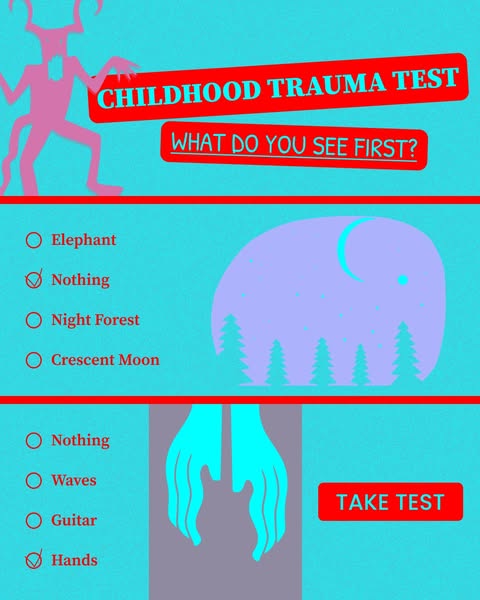
# Ad summary
The ad is a quiz that asks the viewer what they see first in the image. The options are Elephant, Nothing, Night Forest, Crescent Moon, Waves, Guitar, and Hands. The ad is designed to be engaging and to encourage the viewer to take the test.
# Brand positioning
The brand is not explicitly mentioned in the ad. However, the ad's focus on childhood trauma suggests that the brand is related to mental health or psychology. The brand's tone is serious and informative, but also engaging and interactive.
# Product
The product is a childhood trauma test. The test consists of a series of images and questions. The viewer is asked to choose what they see first in each image. The test is designed to help the viewer understand their childhood trauma.
# Visual style
The ad has a simple and clean visual style. The colors are bright and eye-catching. The images are cartoonish and easy to understand. The overall style is designed to be engaging and interactive.
# Hooks
Headline: CHILDHOOD TRAUMA TEST
# Funnel stage
Top of funnel (Awareness)
# Pain points
The ad implies that the viewer may have experienced childhood trauma and may not understand it.
# Benefits
- Understand your childhood trauma
# Call to action
TAKE TEST
# Point of view
- Customer: The entire ad is designed from the customer's point of view, as it asks them to take a test and choose what they see first.
# Storyline
- The ad starts with the title of the test, "CHILDHOOD TRAUMA TEST", which is intended to grab the viewer's attention and make them curious about the test. This is told from the brand's perspective.
- The ad then asks the viewer, "WHAT DO YOU SEE FIRST?", which is intended to engage the viewer and make them want to take the test. This is told from the brand's perspective.
- The ad then presents a series of images and questions, which are intended to help the viewer understand their childhood trauma. This is told from the customer's perspective.
- The ad ends with a "TAKE TEST" button, which is intended to encourage the viewer to take the test. This is told from the brand's perspective.
# Ad summary
This ad promotes a childhood trauma test by Impulse Brain Training. The ad features a woman presenting the test, followed by a series of visual prompts where the viewer is asked what they see first in ambiguous images. The ad concludes with a test result screen and a call to action to install the app.
# Brand positioning
Impulse Brain Training is presented as a provider of tools for self-discovery and understanding of psychological patterns, specifically related to childhood trauma. The brand aims to occupy a space of accessible mental health insights, offering a test that is both intriguing and potentially revealing. The brand aligns with values of self-awareness and personal growth, pushing against the norm of ignoring or downplaying the impact of childhood experiences. The brand positioning is both functional, providing a test, and emotional, tapping into the desire for self-understanding and healing.
# Product
The product is a childhood trauma test designed to reveal insights based on what the user notices first in a series of ambiguous images. The test presents a series of images, each with two options for what the viewer might see first (e.g., Elephant or Night Forest, Apple or Butterfly). The user selects their initial perception for each image. The test culminates in a result screen that describes the user's potential trauma type based on their choices, such as physical trauma, sexual trauma, emotional trauma, neglect, or witnessing violence. The test aims to provide a heightened sensitivity to potential threats and explain tendencies to be cautious and vigilant.
# Visual style
The ad has a polished yet slightly unsettling aesthetic. The editing style is a mix of static shots and quick cuts during the test selection. The production quality is high, with clean graphics and clear visuals. The visual motif is the use of ambiguous images and the color red, which creates a sense of intrigue and slight unease. The pacing is consistent, with a shift to slower pacing during the test result screen. The clicking sound effects are timed to the visual actions of the hand selecting options.
# Hooks
Spoken: Female 1: Honestly, it's a bit creepy, but what you notice first on the picture may reveal your childhood trauma type and it's scary how accurate it is.
Text overlay: Sami Wolivar (Tweet) / @sami.wolivar (Tweet) / Honestly, it's a bit creepy, but what you notice first on the picture may reveal your childhood trauma type and it's scary how accurate it is. (Tweet)
Visual: The shot features a woman standing on a stage in front of a large screen. The screen displays a graphic with various ambiguous images and text. The woman is light-skinned, in her late 20s to early 30s, and presents as female. She has long brown hair and is wearing a dark blouse and pants. She is gesturing towards the screen with a confident expression. The camera is stationary and framed at a medium distance. The lighting is bright and professional. A tweet overlay is visible at the top of the screen.
# Funnel stage
Middle of funnel (Consideration)
# Pain points
The ad implies that the viewer may be experiencing unresolved issues or patterns stemming from childhood trauma. The ad states, "what you notice first on the picture may reveal your childhood trauma type and it's scary how accurate it is."
# Value propositions
- Discover hidden aspects of your childhood trauma through a simple test.
- Gain insights into your behaviors and tendencies based on your test results.
- Prioritize your personal safety and security by understanding your potential threats.
# Benefits
- May reveal your childhood trauma type
- Provides a heightened sensitivity to potential threats
- Fosters a strong instinct for self-preservation
- Helps you prioritize personal safety and security
- Assists in creating stability amidst past challenges
# Features
- Childhood trauma test
- Ambiguous images
- Interactive selection
- Personalized results
# Call to action
INSTALL NOW
# Point of view
- Expert 10% – The ad opens with a woman presenting the test and explaining its potential insights.
- Brand 90% – The majority of the ad is presented from the brand's perspective, showcasing the test questions and results.
# Storyline
- 00:00–00:07 The ad begins with a woman standing in front of a screen, presenting a childhood trauma test. She explains that what you notice first in the picture may reveal your childhood trauma type and that it's scary how accurate it is. This moment is intended to pique the viewer's curiosity and suggest the test's potential for revealing hidden aspects of their past. The perspective is from the brand, with the woman acting as a spokesperson, conveying a tone of intrigue and slight caution.
- 00:07–00:08 The scene transitions to a screen displaying the text "CHILDHOOD TRAUMA TEST WHAT DO YOU SEE FIRST?" over a dark red abstract figure. This moment introduces the test itself and sets the stage for the interactive element. The perspective shifts to a direct presentation of the test, with a slightly ominous tone created by the visual style.
- 00:08–00:12 A hand with red nail polish appears, selecting "Night Forest" and "Butterfly" on the screen. This demonstrates how the test is taken and engages the viewer by showing the interactive process. The perspective is from a user taking the test, creating a sense of participation and curiosity.
- 00:12–00:15 The hand selects "Guitar" and "Young Woman" on the screen. This continues to show the interactive process of the test, maintaining viewer engagement and curiosity.
- 00:15–00:18 The hand selects "Bird" and "Man's Face" on the screen. This continues to show the interactive process of the test, maintaining viewer engagement and curiosity.
- 00:18–00:21 The hand selects "Hourglass" and "Tuxedo" on the screen. This continues to show the interactive process of the test, maintaining viewer engagement and curiosity.
- 00:21–00:24 The scene transitions to a screen displaying "YOUR TEST RESULT" with a funnel graphic illustrating different types of trauma. Text explains that the user has developed a heightened sensitivity to potential threats and prioritizes personal safety. An "INSTALL NOW" button appears at the bottom. This moment provides the payoff of the test, offering insights and a call to action. The perspective is from the brand, presenting the results and encouraging app installation.
# Ad summary
This ad promotes Impulse brain training, a mobile game designed to improve cognitive skills. The ad presents a challenge that it claims only people with ADHD can solve, then shows a hand failing to solve the puzzle in the app, and prompts the viewer to try it themselves.
# Brand positioning
Impulse Brain Training is presented as a mobile app designed to improve cognitive skills through engaging games and challenges. The brand positions itself as a tool for enhancing brain function, particularly for individuals with ADHD, by offering exercises that purportedly leverage their unique cognitive strengths. The brand aims to occupy a space in the consumer's mind as a fun and effective way to train the brain, aligning with a lifestyle of continuous self-improvement and cognitive enhancement. The brand pushes against the norm of traditional brain training methods by offering a gamified and accessible approach, making it appealing to a younger, tech-savvy audience.
# Product
Impulse Brain Training is a mobile app designed to improve cognitive skills through a variety of brain training exercises and games. The app is for anyone looking to enhance their cognitive abilities, with a particular emphasis on individuals with ADHD. The ad features a specific challenge within the app: connecting dots of the same color without overlapping lines. The USP is that this challenge is purportedly easier for people with ADHD to solve. The ad shows the app being used on a mobile device, with a hand interacting with the screen to connect the dots. The ad addresses the potential purchase barrier of skepticism by presenting the challenge as a fun and engaging way to test cognitive skills, rather than a dry or clinical training program. The ad encourages viewers to try the app and see if they can solve the challenge, implying that it's worth trying or buying to improve their cognitive abilities.
# Visual style
The ad has a clean and modern aesthetic, with bright colors and clear visuals. The editing style is simple, with static shots and smooth transitions. The production quality is polished, giving it a professional commercial feel. The pacing is consistent, with a moderate rhythm. The cuts and text are timed to the voiceover lines.
# Hooks
Spoken: 00:00–00:09 [Spanish] Solo las personas con TDAH pueden unir los puntos del mismo color sin superponer líneas.
Text overlay: 00:00–00:09 ¡Solo las personas con TDAH pueden resolverlo! (Caption box)
Visual: 00:00–00:09 A woman stands behind a transparent glass board with colored dots (pink, blue, yellow) arranged in a rectangular pattern. She wears a bright green button-down shirt and black pants. Her expression is neutral as she watches a hand (presumably hers, reflected in the glass) use a blue marker to draw lines connecting the dots. The background includes green plants hanging on the wall and a glimpse of a blue couch. The camera is stationary, capturing a medium shot of the woman and the board. The lighting is bright and even. The brand logo "IMPULSE BRAIN TRAINING" is visible in the lower-left corner.
# Funnel stage
Top of funnel (Awareness)
# Pain points
The ad implies that people may struggle with cognitive skills or feel that their brain isn't working at its full potential. The challenge presented in the ad highlights the frustration of being unable to solve a seemingly simple puzzle: "Solo las personas con TDAH pueden unir los puntos del mismo color sin superponer líneas."
# Value propositions
- The app offers a fun and engaging way to test and improve cognitive skills.
- The dot-connecting puzzle is presented as a challenge that is purportedly easier for people with ADHD to solve, suggesting a unique cognitive advantage.
# Benefits
- Improve cognitive skills
- Engaging and fun way to train the brain
# Features
- Brain training exercises
- Dot-connecting puzzle
# Call to action
TU TURNO
# Social proof
- None used.
# Point of view
- Brand 100% – The entire ad is presented from the brand's perspective, showcasing the app and its features.
# Storyline
- 00:00–00:09 00:00–00:09 The ad opens with a woman standing behind a glass board with colored dots, as a hand draws lines between the dots. The voiceover states that only people with ADHD can connect the dots of the same color without overlapping lines. The hand fails to solve the puzzle, indicated by a red X appearing over the board.
- 00:09–00:18 00:09–00:18 The scene transitions to a screen recording of the Impulse Brain Training app, showing a hand attempting to solve the same dot-connecting puzzle. The text overlay asks, "¿PUEDES RESOLVERLO?" (Can you solve it?) and instructs the viewer to connect the same color dots without overlapping lines. The hand fails to solve the puzzle, indicated by a red X appearing over the screen.
- 00:18–00:20 00:18–00:20 The screen displays a blurred image of the puzzle with a purple button that says "TU TURNO" (Your turn), prompting the viewer to try the challenge themselves.
# Ad summary
This ad promotes Impulse brain training games. The ad starts with a woman attempting to solve a puzzle on a glass wall. The puzzle involves connecting dots of the same color without overlapping lines. The woman fails, and the ad transitions to a screen recording of the game being played on a phone. The player fails to solve the puzzle, and the ad ends with a call to action to try the game.
# Brand positioning
Impulse is presented as a brain training app that offers games designed to improve cognitive skills. The brand positions itself as a tool for enhancing mental agility and problem-solving abilities. The ad uses a playful and challenging approach, suggesting that its games are not only fun but also beneficial for brain health. The brand aims to occupy a space in the consumer's mind as a provider of engaging and effective brain training solutions, aligning with a lifestyle that values mental fitness and continuous self-improvement. The brand pushes against the norm of passive entertainment by offering interactive and mentally stimulating content.
# Product
Impulse is a brain training app featuring a variety of games designed to improve cognitive skills. The ad showcases a specific game where the user must connect dots of the same color without overlapping lines. This game is presented as a challenge that tests problem-solving abilities and mental agility. The app is implied to be for anyone interested in enhancing their cognitive functions and keeping their mind sharp. The ad addresses the potential purchase barrier of perceived difficulty by presenting the game as engaging and fun, while also highlighting its cognitive benefits. The product is worth trying or buying because it offers a unique and interactive way to train the brain and improve mental skills.
# Visual style
The ad has a hybrid aesthetic, combining a UGC feel with polished commercial elements. The editing style includes quick cuts and static shots. The production quality is a mix of natural lighting and clean graphics. The pacing is consistent, with cuts timed to the music beats. The audio-visual sync is noticeable, with sound effects timed to the visual actions.
# Hooks
Spoken: 00:00–00:04: [Spanish] Solo las personas con TDAH pueden unir los puntos del mismo color sin superponer líneas.
Text overlay: 00:00–00:09: ¡Solo las personas con TDAH pueden resolverlo!
Visual: 00:00–00:09: A woman with long brown hair, wearing a bright green button-down shirt and black pants, stands in front of a glass wall. The wall has a black frame around it and colorful dots (pink, blue, yellow) are attached to the glass. The background includes green plants and a glimpse of a green couch. The woman is holding a blue marker and attempting to connect the dots of the same color without overlapping lines. The camera is stationary and shows a medium shot of the woman and the wall. The lighting is bright and natural. The logo "IMPULSE BRAIN TRAINING" is visible in the bottom left corner.
# Funnel stage
Top of funnel (Awareness)
# Pain points
The ad implies that viewers may struggle with problem-solving and mental agility, as demonstrated by the woman's failure to solve the puzzle. "¡Solo las personas con TDAH pueden resolverlo!"
# Value propositions
- Engaging and fun way to train the brain
- Unique and interactive way to improve mental skills
# Benefits
- Improve cognitive skills
- Enhance mental agility
- Test problem-solving abilities
# Features
- Brain training games
- Connect dots of the same color without overlapping lines
# Call to action
TU TURNO
# Point of view
- Customer 50% – The ad shows a customer interacting with the puzzle and the app.
- Brand 50% – The ad includes a direct call to action from the brand.
# Storyline
- 00:00–00:09 00:00–00:09: A woman stands in front of a glass wall with colorful dots and attempts to connect the dots of the same color using a marker, without overlapping lines. She fails to solve the puzzle. This moment is from the perspective of an observer, showing the woman's struggle and the complexity of the puzzle. The tone is playful and challenging, inviting the viewer to see if they can do better. This moment introduces the challenge and sets up the problem that the app aims to solve.
- 00:10–00:18 00:10–00:18: The scene transitions to a screen recording of the same game being played on a phone. A hand with purple nail polish attempts to connect the dots, but also fails. This moment is from the perspective of a user interacting with the app, showing the game's interface and the challenge of solving the puzzle. The tone remains playful and challenging, reinforcing the idea that the game is difficult but engaging. This moment continues the narrative by showing the game in action on the app.
- 00:19–00:20 00:19–00:20: A screen appears with the text "TU TURNO" (Your Turn), inviting the viewer to try the game. This moment is from the brand's perspective, directly addressing the viewer and encouraging them to take action. The tone is inviting and encouraging, suggesting that the viewer can also try the challenge. This moment concludes the narrative by providing a call to action.
How Other Health & Wellness Brands Advertise on Meta
Peer brands in Motion's library — click any brand to see their creative strategy, live ads, and AI breakdowns.