

# Ad summary
This ad for Fitbod fitness app begins with a playful critique of common mistakes guys in their 30s make at the gym, using a Ken doll and green slime. It then pivots to demonstrating how Fitbod solves these problems by using AI to personalize workout plans, track progress, and ensure users get the right exercises, sets, and weights. The ad emphasizes that Fitbod takes the guesswork out of workouts, leading to faster and more effective results. The ad ends with a clear CTA to download Fitbod.
# Brand positioning
Fitbod is presented as an AI-driven fitness app designed to eliminate the guesswork from workouts. The brand positions itself as a solution for individuals frustrated with generic or ineffective workout routines. It aligns with a performance-oriented lifestyle, emphasizing efficient and personalized fitness plans to optimize results. The brand directly addresses the common issues of skipping workouts, random exercises, and overthinking gym routines, offering a data-driven approach to fitness. Fitbod's positioning is functional, focusing on the performance benefits of its AI-powered workout tracking and planning.
# Product
Fitbod is a fitness app that uses AI to track every set, analyze recovery, and provide personalized workout plans. The app is for individuals who want to optimize their gym routines and see better results. The app offers features like tracking exercises, sets, and weights, and it analyzes a user's unique recovery needs to suggest the best exercises. It aims to eliminate the need for random exercises and overthinking by providing a structured, data-driven approach. The app provides specific exercises, sets, and weights to follow, taking the thinking out of working out. The key USPs are the AI-driven personalization, efficient workout planning, and progress tracking. The ad suggests users can avoid spinning their wheels and finally get results by downloading the app today.
# Visual style
The ad's aesthetic is a mix of playful and practical. The opening uses a Ken doll figure and green slime to illustrate common workout mistakes, adding a humorous touch. The following shots are filmed in a gym, featuring a male demonstrating various exercises. The editing style includes quick cuts and transitions between scenes to maintain a brisk pace. The production quality varies. The use of app screen recordings and a customer testimonial create a hybrid feel. The visual motifs include consistent placement of the Fitbod logo in the upper right corner and the use of overlaid text to emphasize key points. The pacing is moderate, with cuts timed to the speaker's lines.
# Hooks
Spoken: 00:00–00:02 Three mistakes every guy in his 30s makes in the gym.
Text overlay: 00:00–00:02 3 mistakes every guy in his 30s makes in the gym
Visual: 00:00–00:02 A close-up shot of a male Ken doll figure. The doll is shirtless with defined abs, and green slime is on its chest. A silver and pink face roller tool is used to maneuver the slime. The background is a solid, light blue wall.
# Funnel stage
Middle of funnel (Consideration)
# Pain points
The ad addresses the pain point of ineffective gym workouts. This is signaled through the line, "Three mistakes every guy in his 30s makes in the gym," highlighting issues like skipping workouts, doing random exercises, and overthinking routines.
# Value propositions
- Personalized, AI-driven workout plans that optimize results.
- Eliminates the need for random exercises and overthinking in the gym.
- Faster progress compared to generic workout plans.
# Benefits
- The thinking is done for you.
- I've personally seen more progress in three weeks with Fitbod than I did in three months of following random plans.
- Make it the year you actually get results.
# Features
- AI to track every set
- Analyzes your unique recovery
- Tells you exactly what exercises, sets, and weights to run next
# Call to action
Download Fitbod today.
# Social proof
- "I've personally seen more progress in three weeks with Fitbod than I did in three months of following random plans" – Male 1 (Customer)
# Point of view
- Customer 80% – A male using the Fitbod app to demonstrate results.
- Brand 20% – The Fitbod logo is displayed in the upper right corner.
# Storyline
- 00:00–00:02 00:00–00:02 A male voice states "Three mistakes every guy in his 30s makes in the gym" as a Ken doll figure is shown with green slime on its torso and a face roller.
- 00:02–00:05 00:02–00:05 The ad transitions to a man in a gym doing push-ups, with text overlay stating, "1. Skipping consistently and never actually pushing yourself."
- 00:05–00:08 00:05–00:08 The ad shifts to different exercise machines and activities within the gym. Text appears stating, "2. Doing random exercises with sloppy form."
- 00:08–00:12 00:08–00:12 The ad shows the man doing various exercises, with the text "3. Overthinking every single set with no real plan."
- 00:12–00:14 00:12–00:14 The speaker notes, "That's why I started using Fitbod."
- 00:14–00:16 00:14–00:16 The ad transitions to a screen recording of the Fitbod app with the phrase "This app uses AI."
- 00:16–00:17 00:16–00:17 An on screen text overlay states that the app is able "to track every set."
- 00:17–00:18 00:17–00:18 The speaker says the app can "Analyze your unique recovery,".
- 00:18–00:22 00:18–00:22 The speaker states that the app can "then tell you exactly what exercises, sets, and weights to run next."
- 00:22–00:24 00:22–00:24 A shot of the man doing dips follows, as he states, "The thinking is done for you."
- 00:24–00:25 00:24–00:25 The man is shown using the leg press, as the voiceover states, "You walk in, open the app, and lift."
- 00:25–00:31 00:25–00:31 The man performs different exercises, saying, "I've personally seen more progress in three weeks with Fitbod than I did in three months of following random plans."
- 00:31–00:36 00:31–00:36 The man is shown performing a leg press, with an on-screen text overlay, "Don't start 2026 spinning your wheels." He continues, "Make it the year you actually get results."
- 00:36–00:37 00:36–00:37 The man bench presses as he says, "Download Fitbod today."

How Fitbod Advertises on Meta
Updated Apr 19, 2026 · Refreshes weekly
Fitbod runs 428 active ads on Meta, shipping ~34 new creatives per week. Their library leans on Screen Recording28%, Demo17%, and Before and After9%. Recently, Fitbod is pushing AI-personalized workout plans as the smarter, cheaper alternative to personal trainers — with heavy emphasis on eliminating guesswork, progressive overload, and real results. Transformation stories (weight loss, muscle gain, confidence) and "stop winging it" messaging anchor nearly every ad, with a free trial as the consistent offer.
Indexed by Motion's Inspo Library.
The 20 Most Recent Fitbod Ads on Meta
# Ad summary
This video ad for Fitbod features a 40-year-old man's five-week fitness transformation using the app. It highlights his initial struggles with unstructured, ineffective gym routines ("winging it," "no real progress") and positions Fitbod as the solution that provides a personalized, smart plan. The ad chronicles his weekly progress, from experiencing "good soreness" to noticing visible physical changes ("Arms? Thicker. Shoulders? Popping.") and increased confidence. By week four, other gym-goers start noticing and asking about his program, adding social proof. The narrative culminates in week five with the man experiencing "real, steady progress" and feeling a sense of belonging in the gym. The ad concludes by showcasing Fitbod's user base and strong app store ratings, followed by a direct call to download the app, emphasizing the brand's promise: "Built for better."
# Brand positioning
The brand, Fitbod, is presented as a personalized and intelligent fitness solution that brings structure and progress to individual workout routines. It aims to occupy the mind space of someone seeking effective, tailored fitness guidance, moving away from unstructured, "winging it" gym sessions or generic YouTube routines. The brand aligns with values of progress, efficiency, and self-improvement, promoting a lifestyle where fitness goals are achievable through smart planning rather than aimless effort. It implicitly pushes against the norm of inconsistent or ineffective gym practices by offering a clear, adaptive path. The positioning is functional, emphasizing personalized workout plans and tangible results (muscle growth, increased confidence), and emotionally aspirational, promising a feeling of belonging and self-assurance in the gym.
# Product
The product is the Fitbod mobile application, a personalized workout planner designed to optimize gym routines and ensure progressive overload. It works by generating custom workout plans that adapt to the user's body, goals, and available equipment, preventing wasted workouts and plateaus. The product is for individuals, particularly those who are already going to the gym but lack structure, feel their progress has stalled, or are overwhelmed by generic workout information. Explicitly stated details include its ability to create a "plan that actually makes sense for his body and goals" and "keeps the workouts smart" so the user can push hard without overdoing it. Its USP is personalized adaptation, ensuring that the user's muscles are continually challenged, leading to visible results and increased confidence. The ad shows it being used on a smartphone, both at home (preparing for the gym) and during workouts to check exercises. The implied purchase barrier it addresses is the confusion, lack of progress, and potential injury from unstructured workouts. It tells the viewer the product is worth trying because it provides a clear, effective path to fitness goals, adapts to individual needs, and yields tangible results, making gym time productive and rewarding.
# Visual style
The ad features a hybrid visual style, blending polished, well-lit gym footage with screen recordings of the app interface. The gym scenes have a slightly gritty but clean aesthetic, using natural gym lighting that is bright and modern, creating a professional yet authentic feel. Editing rhythm is quick, with many cuts, particularly in the initial problem-setting and weekly progress segments, creating a dynamic pace. This rapid cutting helps maintain engagement and quickly conveys the passage of time and various activities. The pacing is consistently fast, with cuts often occurring with each new spoken sentence or phrase, syncing well with the voiceover. Visual motifs include consistent framing of the male subject during exercises, often showing his full body or upper torso, emphasizing his physique and transformation. The production quality leans towards polished commercial while retaining an element of personal, almost testimonial-like directness, especially when focusing on the main character's journey. Audio-visual sync is strong, with text overlays appearing precisely with the corresponding voiceover lines and visual changes.
# Hooks
Spoken: If a 40-year-old guy used Fitbod for 5 weeks straight, here's what would happen:
Text overlay: 40-year-old / Fitbod / 5 weeks
Visual: A muscular, shirtless Hispanic male (Male 1), with tattoos on both arms and a beard, is jumping rope without shoes on a dark grey gym floor. He is wearing black athletic shorts. The camera is stationary and tripod-style, framing him from the waist down to just above his head, capturing his full body. In the background, there's a colorful mural on a dark wall with cartoon-like, muscular figures (possibly anime-inspired). A black punching bag and a black industrial fan are visible on the left. The overall lighting is bright and even.
# Funnel stage
Middle of funnel
# Pain points
The central pain point is the lack of effective structure and consistent progress in one's fitness journey. The ad highlights this with "He realizes he's been winging it for years. Jumping between machines, chasing random routines off YouTube, no structure, no real progress." This signals the frustration of putting in effort without seeing tangible or sustainable results, leading to demotivation and inefficient gym time.
# Value propositions
- "plan that actually makes sense for his body and goals" - Value: personalized effectiveness, avoiding generic routines.
- "keeps the workouts smart, so he's pushing hard without overdoing it" - Value: safe and optimized training, preventing injury and burnout.
- "keeps adapting, and the results are showing" - Value: continuous progress and visible physical transformation.
- "no more second-guessing. No more wasted workouts." - Value: certainty, efficiency, and maximized effort.
- "real, steady progress and a routine that actually sticks" - Value: sustainable long-term fitness results and adherence.
# Benefits
- Realizes he's "been winging it for years" and now has a plan.
- No more "jumping between machines, chasing random routines off YouTube, no structure, no real progress."
- muscles are waking up
- pushing hard without overdoing it
- results are showing
- Arms? Thicker. Shoulders? Popping.
- Shirts are fitting tighter in the best way.
- Other guys at the gym start noticing.
- lifting heavier
- moving with confidence
- feels like he belongs here
- No more second-guessing.
- No more wasted workouts.
- real, steady progress
- routine that actually sticks
- got him locked in
# Features
- plan that actually makes sense for his body and goals
- keeps the workouts smart
- keeps adapting
# Call to action
Download Fitbod today.Try For Free
# Social proof
- "Other guys at the gym start noticing. One even asks what program he's on." (Implied verbal testimonial from Male 2)
- "Over 15 million people have leveled up their training with Fitbod." (Brand claim based on user numbers)
- "15M+ Downloads" (Statistic on app store banner)
- "70M+ Workouts logged" (Statistic on app store banner)
- "Apple Editor's Choice" (Badge on app store banner)
- "Kyle Campbell: The Student Becomes The Master" (User success story title on website screenshot)
- "Alec South: Meeting Motivation By Maxing Out" (User success story title on website screenshot)
- "Mark Pemberton: From Hopeless To Hopeful" (User success story title on website screenshot)
- "Alex Dacks: Overcoming Gym Intimidation To Gain Confidence And..." (User success story title on website screenshot)
# Point of view
- Customer 60% – The ad largely follows the experience and transformation of a single individual, showcasing his journey, feelings, and the results he achieves, making it highly relatable.
- Brand 40% – The ad uses a voiceover to explain the product's features, benefits, and overall message, and includes direct product shots and a final branding screen.
# Storyline
- 00:00–00:03 The video opens with a muscular, shirtless man jumping rope without shoes on a dark grey gym floor, with the text "40-year-old" appearing on screen, then "Fitbod" and "5 weeks." The voiceover immediately sets up a hypothetical scenario: "If a 40-year-old guy used Fitbod for 5 weeks straight, here's what would happen."
- 00:03–00:04 The voiceover continues, "Week one:" and the visual shifts to the man adjusting weights on a machine. This establishes the beginning of the transformation journey. The narrator maintains an objective, informative tone.
- 00:04–00:11 The man is shown adjusting weight on a machine, then a black and white split screen shows an empty gym and another showing treadmills with a subtle red overlay on "machines." This is followed by a screen capture of a YouTube search for "gym routines for..." showing various workout videos. The voiceover explains the pain point: "He realizes he's been winging it for years. Jumping between machines, chasing random routines off YouTube, no structure, no real progress." This moment identifies the problem Fitbod solves, framing the customer's prior experience as frustrating and ineffective. The perspective is still external narration, but it articulates the customer's internal struggle. The tone is explanatory and empathetic towards the common gym-goer problem.
- 00:11–00:12 The man walks through the gym, appearing somewhat aimless. The voiceover states, "No structure, no real progress." This visually reinforces the previous narrative point of his past struggles. The visual of him walking alone and seemingly without direction emphasizes the lack of a plan.
- 00:12–00:13 The visual switches to a close-up of the man's hands using the Fitbod app on his phone, showing a "Dumbbell Lunge" workout. The voiceover introduces the solution: "Fitbod gives him a plan that actually makes sense for his body and goals." This marks the turning point, introducing the product as the answer to the previously established pain point. The perspective shifts slightly to showcase the product's interface. The tone becomes hopeful and solution-oriented.
- 00:13–00:15 The man is shown in his kitchen, packing a gym bag, followed by him confidently entering the gym and placing a bar across his shoulders, smiling slightly. The voiceover connects these actions: "Fitbod gives him a plan that actually makes sense for his body and goals." This shows the immediate impact of having a plan: preparation and a positive attitude towards the workout. The visual shows a newfound purpose.
- 00:15–00:16 The voiceover announces, "Week two:" The man is standing confidently in the gym, posing slightly. This marks the next stage of his progress.
- 00:16–00:20 The man poses, flexing his back, then looks around, then poses again. The voiceover says, "The soreness hits different. Not the 'tweaked my back again' kind, but the 'yet, muscles are waking up' kind." This acknowledges a common early workout experience (soreness) but reframes it positively, indicating effective, pain-free progress thanks to Fitbod. The tone is encouraging and subtly humorous in its distinction of "soreness."
- 00:20–00:24 The man is performing a chest press on a machine, then a lat pulldown. The voiceover emphasizes, "Fitbod keeps the workouts smart, so he's pushing hard without overdoing it." This highlights a key benefit of Fitbod: preventing injury and optimizing effort. The visuals demonstrate him actively engaging in intelligent, structured exercises.
- 00:24–00:25 The voiceover transitions, "Week three:" The man is seen in a gym mirror, initially with his back to the camera, then turning to look at his reflection. This builds anticipation for visible results.
- 00:25–00:30 The man looks at himself in the mirror, then does a double-take, flexing his arms and shoulders, with text asking "Arms?" and "Shoulders?" The voiceover describes, "He catches a glimpse in the mirror and actually does a double take. Arms? Thicker. Shoulders? Popping." This is the moment of visible transformation, showcasing the physical results of using Fitbod. The man's surprised and pleased expression communicates the positive outcome.
- 00:30–00:34 The man continues to pose in the mirror, then performs pull-ups. The voiceover reinforces, "Shirts are fitting tighter in the best way. Fitbod keeps adapting, and the results are showing." This further illustrates the impact of the physical changes and highlights Fitbod's adaptive nature as the driver of these results. The visual of pull-ups demonstrates increased strength.
- 00:34–00:35 The voiceover declares, "Week four:" The man is shown selecting dumbbells from a rack in the gym. This signals continued progress and engagement.
- 00:35–00:38 The man is selecting weights, then another man approaches him, and the man opens the Fitbod app on his phone. The voiceover narrates, "Other guys at the gym start noticing. One even asks what program he's on." This introduces social proof and validation, showing that his transformation is noticeable to others and sparking interest. The perspective briefly shifts to an implied external observation.
- 00:38–00:43 The man is shown performing dumbbell presses on a bench. The voiceover states, "He's lifting heavier. Moving with confidence. And for once, he feels like he belongs here." This focuses on the internal and external benefits: increased strength, improved confidence, and a sense of belonging in the gym community. The visual shows him executing a challenging exercise with good form.
- 00:43–00:44 The voiceover announces, "Week five:" The man is performing lateral raises with a cable machine, then barbell squats. This signifies the culmination of his 5-week journey.
- 00:44–00:47 The man performs squats and bench presses. The voiceover summarizes his journey: "It's night and day. No more second-guessing. No more wasted workouts." This highlights the definitive change and the elimination of previous pain points.
- 00:47–00:52 The man continues with squats. The voiceover concludes the transformation narrative: "Just real, steady progress and a routine that actually sticks. Fitbod's got him locked in." This emphasizes long-term adherence and sustainable progress, positioning Fitbod as a reliable, lasting solution.
- 00:52–00:56 The screen shows a phone displaying the Fitbod website with user success stories and metrics like "15M+ Downloads" and "70M+ Workouts logged." The voiceover provides strong social proof: "Over 15 million people have leveled up their training with Fitbod." This transitions from the individual story to broader user success and credibility. The tone is authoritative and inspiring.
- 00:56–00:59 The man is shown performing a deadlift (blurry, background) while "FITBOD" appears as a text overlay, followed by a final screen with the brand logo and tagline. The voiceover delivers a direct call to action: "Time to train smarter. Download Fitbod today. Fitbod. Built for better." This serves as the clear directive for the viewer, summarizing the brand's promise and guiding them to the next step. The image becomes intentionally blurred as the brand elements take prominence. The tone is encouraging and decisive.
# Ad summary
A female creator shares her personal journey of overcoming gym intimidation and confusion in the weight room using the Fitbod app. The ad contrasts her past struggles with incorrect form and uncertainty with her current confidence and progress, showcasing how the app provides personalized workout plans, demo videos, and adapts to her training. She enthusiastically recommends Fitbod as the solution for anyone who feels similarly intimidated by the gym.
# Brand positioning
Fitbod is presented as an empowering and accessible solution for individuals, particularly those new or intimidated by structured strength training. The brand aims to occupy the space of a personal, intelligent, and confidence-building fitness companion in the consumer's mind. It aligns with values of personal growth, empowerment, and efficiency, promoting a lifestyle where fitness goals are achievable without the stress of self-doubt or guesswork. The brand pushes against the intimidating and confusing norms of traditional gym environments by offering clear, guided, and adaptive workout plans. Its positioning is a blend of functional (science-backed, personalized plans, demo videos) and emotional (empowerment, confidence, feeling capable).
# Product
Fitbod is a fitness application designed to provide personalized, science-backed workout plans. It works by allowing users to input their specific fitness goals, such as building muscle, gaining weight, getting stronger, getting lean and defined, reducing bodyweight, or improving sports performance. The app then generates a complete and tailored workout plan based on the user's strength, training ability, past workouts, and available gym equipment. A key unique selling proposition (USP) is that every single exercise in the plan includes a demo video, guiding users on exactly how to perform the movement, where they should feel it, and the appropriate pace. The app also features an adaptive algorithm that adjusts the workout plan as the user trains, effectively 'growing with you' to ensure continuous progress. It aims to address purchase barriers related to gym intimidation, lack of knowledge, poor form, and the general confusion of structuring effective strength training.
# Visual style
The ad features a dynamic, fast-paced editing style typical of social media content, blending a UGC (User-Generated Content) feel with moments of polished demonstration. It uses quick cuts, typically lasting 1-3 seconds per shot, creating an engaging and energetic rhythm. The production quality leans towards a hybrid approach: while the initial 'problem' scenes have a slightly less polished, handheld, and raw feel (especially the black and white close-up), the 'solution' and 'after' scenes are more polished, using tripod-like steady shots and clear lighting, though still maintaining an authentic, approachable vibe rather than a high-end commercial. Visual motifs include the use of vibrant blue and purple neon gym lighting, which creates a modern and slightly stylized atmosphere. The pacing is consistently quick throughout the ad, maintaining viewer engagement. Audio-visual sync is prominent, with cuts and text overlays frequently timed to the beats of the upbeat background music and the rhythm of the voiceover, enhancing the narrative flow and impact of key messages.
# Hooks
Spoken: The weight room used to make me want to cry.
Text overlay: POV: You stopped feeling embarrassed in the gym / used to make me / want to cry.
Visual: A young Caucasian woman in a black sports bra and olive green shorts with ankle weights performs bent-over reverse flies, holding a small dumbbell in one hand and supporting herself on a red and gray step platform. The setting is a dimly lit gym with blue and purple neon lighting, reflective surfaces, and various gym equipment in the background. The camera is eye-level and stationary, capturing her from a slightly low angle. The lighting is artificial and colorful, casting a cool tone. / The same young woman, wearing a black bralette with white trim and light green shorts, is seated on a black gym bench, holding a black dumbbell. She looks down and slightly to the side with a somber expression. The gym background is dark with purple lighting. The camera is eye-level, slightly zoomed in, and stationary. The overall tone is melancholic. / A close-up, black and white shot of the woman from the previous frame. She holds a dumbbell near her face, looking frustrated or annoyed, with a slight furrow in her brow and a faint, almost sarcastic smile. The lighting is dim, emphasizing the black and white contrast. The camera is close-up, eye-level, and stationary.
# Funnel stage
Consideration
# Pain points
The central pain point addressed is gym intimidation and the confusion surrounding strength training, leading to feelings of embarrassment, cluelessness, and a lack of progress. This is signaled by: "The weight room used to make me want to cry. No joke. I wanted to strength train so bad but I had no idea what I was doing, my form was all over the place, and I was just piecing together random workouts and praying they actually did something. I was so intimidated that I'd walk in, panic, and just go straight to the treadmill."
# Value propositions
- Personalized workout plans designed to fit your goals and abilities.
- Clear, visual guidance for every exercise to ensure correct form and efficacy.
- Adaptive training that evolves with your progress, preventing plateaus.
- Empowerment and confidence in the gym environment.
# Benefits
- No more guessing
- no more feeling clueless
- walk into the weight room like I own it
- hitting goals that I never thought were possible
- strength goes up every single week
- feel the best that I've felt in years
- changed everything for me
# Features
- Science-backed workouts
- tailored workouts
- complete plan
- demo video (for every single exercise)
- adjusts (the more you train)
- grows with you
# Call to action
just get Fitbod
# Social proof
- "The weight room used to make me want to cry." – Female 1 (Creator/User)
- "I had no idea what I was doing, my form was all over the place." – Female 1 (Creator/User)
- "I was so intimidated that I'd walk in, panic, and just go straight to the treadmill." – Female 1 (Creator/User)
- "Now I walk into the weight room like I own it." – Female 1 (Creator/User)
- "I'm hitting goals that I never thought were possible, my strength goes up every single week, and I feel the best that I've felt in years." – Female 1 (Creator/User)
- "It changed everything for me." – Female 1 (Creator/User)
# Point of view
- Customer 95% – The majority of the video is narrated by a user sharing her personal experience and transformation with the product, depicted through her direct address, emotional expression, and demonstration of product use.
- Brand 5% – A brief segment explicitly displays the Fitbod app's user interface and features, directly communicating product functionality.
# Storyline
- 00:00–00:02 The ad opens with a woman performing an exercise in a gym, with a prominent text overlay setting the 'POV'. This immediately establishes a relatable problem and hints at the solution, drawing the viewer into a personal narrative.
- 00:02–00:05 The narrator, a young woman, recalls her past struggles with gym intimidation. Visuals shift between color and black-and-white, showing her looking defeated or frustrated while holding a dumbbell, emphasizing the emotional pain of her previous experience. This sets up the 'problem' aspect of the problem-solution framework, shared from the customer's vulnerable perspective.
- 00:05–00:13 She continues to describe her lack of knowledge and poor form when attempting strength training. The visual shows her doing various exercises with visibly incorrect or awkward technique, illustrating the 'cluelessness' and 'all over the place' form she mentions. This further elaborates on the problem, highlighting the functional barriers she faced.
- 00:13–00:17 The narrator concludes her 'problem' description by explaining how intimidating the gym felt, causing her to panic and avoid the weight room altogether. The visual depicts her standing nervously with a barbell, being approached by a man (possibly a trainer or another gym-goer), and then turning away to walk past him, conveying her sense of discomfort and retreat. This reinforces the emotional pain point of gym anxiety.
- 00:17–00:18 The ad transitions abruptly to a phone screen displaying the Fitbod app, as the narrator announces 'But then I found Fitbod.' This marks the turning point in the narrative, introducing the product as the solution to all her previously described problems, shifting from problem-state to solution-state.
- 00:18–00:21 The video showcases the Fitbod app's user interface, demonstrating how users input their goals and how the app builds a complete plan. This provides a clear, functional overview of the product, delivered by the customer-turned-expert, explaining how the solution works.
- 00:21–00:26 The narrator highlights the app's demo video feature. The visual shows her performing a Romanian Deadlift alongside a small, overlaid demo video, clearly illustrating the benefit of precise guidance on form, target muscles, and pace. This visually confirms a key feature that directly addresses her previous problem of 'no idea what I was doing' and 'form all over the place'.
- 00:26–00:29 She reiterates the positive outcome of using Fitbod: 'no more guessing and no more feeling clueless.' The visual shows her sitting on a bench, looking up and smiling with a sense of relief, followed by her confidently performing side raises. This confirms the alleviation of her initial pain points, linking the product directly to her emotional transformation.
- 00:29–00:32 The narrator emphasizes Fitbod's adaptive nature, stating it 'grows with you.' The visual shows her performing cable rows from behind, highlighting the progression. This showcases another core feature—the app's intelligence and ability to scale with the user's progress—implying long-term value.
- 00:32–00:40 The narrative shifts back to her current empowered state, confidently proclaiming she 'walks into the weight room like I own it' and is 'hitting goals that I never thought were possible.' The visuals show her confidently and correctly using various gym machines, her posture strong and expression positive. This provides a powerful 'after' comparison, demonstrating the full extent of her transformation.
- 00:40–00:44 The ad concludes with a direct recommendation to 'just get Fitbod' for anyone who has felt intimidated by the weight room, reinforcing her personal endorsement: 'It changed everything for me.' The visual shows her confidently performing bicep curls with a bright smile, embodying her newfound confidence. This serves as a strong call to action and a final, personal testament to the product's effectiveness.
- 00:44–00:46 The Fitbod logo and tagline ('Built For Better.') appear on a black screen, providing clear brand identification and a memorable closing statement.
# Ad summary
This ad demonstrates the proper form for a dumbbell lateral raise using the BetterMe app.
# Brand positioning
BetterMe is presented as a fitness app that provides users with workout plans and demonstrations. The brand aims to occupy the space of a personal trainer in the consumer's mind, offering guidance and structure for workouts. The brand aligns with a lifestyle of health and fitness, promoting the value of proper form and technique. The brand pushes against the norm of generic workout routines by offering personalized plans and detailed demonstrations. The brand positioning is functional, focusing on performance and simplicity.
# Product
The BetterMe app is a fitness platform that provides users with workout plans and demonstrations. The app is for anyone looking to improve their fitness and learn proper form for exercises. The app features personalized workout plans, detailed exercise demonstrations, and the ability to track progress. The app addresses the purchase barrier of not knowing how to properly perform exercises by providing clear and concise demonstrations. The ad tells the viewer that this product is worth trying because it will help them improve their form and get the most out of their workouts.
# Visual style
The ad has a polished, commercial aesthetic with a focus on clear and concise demonstrations. The editing style is quick cuts, with smooth transitions between shots. The production quality is high-end, with a clean and professional look. The pacing is consistent, with a moderate BPM. The cuts and visual aids are timed to the music beats and voiceover lines.
# Hooks
Spoken: 00:00–00:02 [Upbeat music] It's everybody gonna hurt your way, you know what I'm saying?
Visual: 00:00–00:03 A woman with dark hair pulled into a bun, wearing a white tank top and brown shorts, stands in a gym with a dark gray wall. She is holding dumbbells and performing a lateral raise with incorrect form. Red arrows and an X appear over her shoulders and head, indicating the incorrect form.
# Funnel stage
Middle of funnel (Consideration)
# Pain points
The pain point is not knowing how to properly perform exercises, which can lead to injury or ineffective workouts. The ad visually demonstrates the incorrect form for a dumbbell lateral raise, highlighting the areas of tension and strain.
# Value propositions
- Learn proper form for exercises with detailed demonstrations
- Improve your fitness with personalized workout plans
- Track your progress and see results
# Benefits
- Improved fitness
- Proper form for exercises
- Avoid injury
# Features
- Personalized workout plans
- Detailed exercise demonstrations
- Progress tracking
# Call to action
None used.
# Point of view
- Customer 5% – The customer POV is communicated through the demonstration of the app interface.
- Brand 95% – The brand POV is communicated through the demonstration of the exercise and the use of visual aids.
# Storyline
- 00:00–00:03 00:00–00:03 The ad opens with a demonstration of an incorrect dumbbell lateral raise, with red markings indicating the areas of tension and strain. This is intended to highlight the potential for injury or ineffective workout if the exercise is performed incorrectly. The perspective is from the brand, showing what not to do. The tone is cautionary.
- 00:03–00:05 00:03–00:05 The ad transitions to show the correct form for the dumbbell lateral raise, with green markings highlighting the proper muscle engagement and alignment. This is intended to show the viewer the correct way to perform the exercise. The perspective is from the brand, demonstrating the proper technique. The tone is instructional.
- 00:05–00:11 00:05–00:11 The ad continues to demonstrate the correct form, with green markings highlighting the proper muscle engagement and alignment. This is intended to reinforce the correct technique and show the viewer how to avoid injury. The perspective is from the brand, demonstrating the proper technique. The tone is instructional.
- 00:11–00:13 00:11–00:13 The ad shows a hand interacting with the BetterMe app, selecting a workout plan. This is intended to show the viewer how the app can be used to find and follow workout plans. The perspective is from the customer, showing the ease of use of the app. The tone is practical.
- 00:13–00:19 00:13–00:19 The ad returns to the demonstration of the correct form for the dumbbell lateral raise, with green markings highlighting the proper muscle engagement and alignment. This is intended to reinforce the correct technique and show the viewer how to avoid injury. The perspective is from the brand, demonstrating the proper technique. The tone is instructional.
# Ad summary
A customer shares how Fitbod helped her lose 28 pounds and improve her workouts using personalized AI training. She highlights the app’s progressive overload and the ability to make gains without guesswork.
# Brand positioning
Fitbod is presented as an AI-powered workout app designed to personalize fitness routines for users aiming to lose weight, gain muscle, or get stronger. The brand positions itself as a solution to ineffective, random workouts and overpriced personal trainers, providing customized workouts that adapt with progressive overload. Fitbod aligns with a functional and modern lifestyle, offering ease, personalization, and proven results through AI technology, as highlighted by positive customer reviews and high app ratings.
# Product
Fitbod is an AI-powered workout app that personalizes workout routines to help users achieve their fitness goals. It customizes workouts with progressive overload, eliminating guesswork and adapting to individual needs. The app offers personalized plans and tracks progress, offering a smarter training experience that keeps things fun and works. Fitbod is designed for individuals who want to lose weight, gain muscle, or get stronger, providing a convenient and effective alternative to traditional gym workouts and personal trainers. It boasts over 315,000 five-star reviews and has been recognized as an Apple Editor's Choice, offering a proven and validated solution for those seeking better workout results.
# Visual style
The ad has a UGC feel with a mix of gym environments and outdoor settings. The editing style includes quick cuts and transitions between various workout scenes and app interfaces, creating a dynamic and engaging pace. Some shots appear to be professionally shot while others are more casual, aligning with a hybrid production quality. The pacing is consistent, maintaining a high energy level throughout the ad. Audio-visual sync is present, with text overlays and product actions timed to the voiceover.
# Hooks
Spoken: 00:00–00:02 I lost 28 pounds and my trainer is pissed.
Text overlay: 00:00–00:02 I lost 28lbs and / 00:00–00:02 my trainer is PISSED
Visual: 00:00–00:02 A woman with blonde hair, fair skin, and tattoos wearing a pink sports bra and white sweatpants is in a gym. She is bent over and doing a bent-over barbell row. In the background are exercise machines, a mirror, and a blue wall. The camera is stationary and shows a mid-shot of the woman.
# Funnel stage
Consideration
# Pain points
The ad highlights the frustration of wasting time at the gym with ineffective workouts and overpaying for personal trainers. “After six months of random workouts that barely did anything.”
# Value propositions
- AI-powered personalization: Tailored workouts that adjust to individual progress and goals
- Progressive overload: The app ensures continuous improvement by gradually increasing workout intensity
- Time and cost savings: Alternative to hiring a trainer and wasting time trying to plan workouts
- Proven effectiveness: Endorsed with 315,000 five-star reviews and an Apple Editor’s Choice award
# Benefits
- Keep making gains
- Without the guesswork
- Changes in just three weeks
- Takes the guesswork out of training
- Keeps things fun
- Actually works
# Features
- AI to personalize my workouts
- Progressive overload
# Call to action
Start training smarter with Fitbod and see the results you’ve been chasing.
# Social proof
- “No wonder Fitbod has over 315,000 5-star reviews.”
# Point of view
- Customer 100% – The entire ad is told from the perspective of a Fitbod user, sharing her experience and results, creating a relatable and persuasive message.
# Storyline
- 00:00–00:02 00:00–00:02 The ad opens with a woman doing a bent-over barbell row, claiming she lost 28 lbs and her trainer is angry. This serves as a hook, highlighting her success using an alternative method and suggesting the product may disrupt the status quo of traditional training.
- 00:02–00:08 00:02–00:08 The woman shares that she stopped planning her own workouts, overpaying for a trainer, and wasting time at the gym. This highlights the frustrations the app aims to solve.
- 00:08–00:14 00:08–00:14 The woman states that she switched to Fitbod, which uses AI to personalize workouts with progressive overload. The ad then shows the app's interface, including workout tracking, personalized plans, and calendar features, demonstrating its functional benefits.
- 00:14–00:16 00:14–00:16 The woman does a leg press, stating that Fitbod allows her to keep making gains without the guesswork. This reinforces the app's effectiveness.
- 00:16–00:23 00:16–00:23 The woman states that whether the viewer’s goal is to lose weight, gain muscle, or get stronger, she personally saw changes in just three weeks using Fitbod. The ad showcases various exercises being performed to illustrate that the app can address different fitness goals.
- 00:23–00:26 00:23–00:26 The woman states that after six months of random workouts that barely did anything, she switched to Fitbod. This highlights the contrast in results between using the app and not using it.
- 00:26–00:30 00:26–00:30 The woman shares that Fitbod has over 315,000 five-star reviews. A review, and a headline highlighting the results someone got is displayed. This serves as social proof and adds credibility to the app.
- 00:30–00:34 00:30–00:34 The woman says it takes the guesswork out of training, keeps things fun, and actually works. This is a summary of the key benefits of Fitbod.
- 00:34–00:38 00:34–00:38 The woman says to start training smarter with Fitbod and see the results you’ve been chasing. The ad ends with the Fitbod logo and tagline, reinforcing the brand's message.
# Ad summary
This ad promotes the Fitbod app by demonstrating how the app provides users with a personalized workout program with proper form and mechanics. The ad features user-generated style content with quick cuts and text overlays.
# Brand positioning
Fitbod is presented as a personalized fitness app with the goal of creating better workouts for everyone. The brand promotes itself as a solution for anyone who wants to optimize their workout routine and achieve better results. The brand positions itself as accessible to users of all levels of experience. Fitbod appears to be a digital disruptor that pushes against the idea that you need a personal trainer to succeed in getting fit.
# Product
Fitbod is a fitness app that creates personalized workout programs for users of all fitness levels. Fitbod ensures proper form, tempo, and mechanics for every single rep. It automatically applies progressive overload so that the user is always pushing just the right amount. Fitbod removes all guesswork in your workouts by telling you exactly when to go heavier. Overall, the app is designed to take the guesswork out of working out.
# Visual style
The ad has a UGC-style aesthetic. It has quick cuts from one scene to the next. The influencer is always shown in a small box on the bottom left or right of the screen, which makes the ad feel personal.
# Hooks
Spoken: Influencer 1: Let me know if you guys spot the mistake. Do you guys spot the mistake?
Text overlay: 00:00–00:39 / 00:00–00:03
Visual: 00:00–00:03: A split-screen shows an Asian man with a buzz cut and no shirt doing a dumbbell lateral raise in a gym. The top half of the screen has a green checkmark while the bottom half has a red X, implying one side is correct and one side is incorrect. In the bottom left corner is a smaller box with a headshot of the influencer who is talking. He is wearing a black baseball cap, a black hoodie, and has a mustache and goatee.
# Funnel stage
Middle of funnel (Consideration)
# Pain points
The ad implies that people waste time and effort going to the gym without seeing results. The ad addresses the problem that it is hard to know how to properly perform exercises and how much weight to lift.
# Value propositions
- Fitbod helps users achieve more progress in three weeks than they would in three months with a personal trainer.
- Fitbod makes workouts more efficient by taking out the guesswork.
# Benefits
- Shows you exactly how every movement should look
- You're always pushing just the right amount
- Tells you exactly when to go heavier
- Takes out the guesswork completely
# Features
- Proper form
- Proper tempo
- Proper mechanics
- Personalized program
- Progressive overload
# Call to action
Download Fitbod
# Social proof
- I've seen more progress within three weeks of Fitbod than I've seen in three months with a personal trainer – Influencer 1 (Customer)
# Point of view
- Customer 100% – This ad is communicated entirely from a customer POV.
# Storyline
- 00:00–00:03 The ad starts with a split-screen of a man doing the dumbbell lateral raise, with a green checkmark on the top half and a red X on the bottom half.
- 00:00–00:03 An influencer appears on the left-hand side of the screen and challenges the audience to spot the mistake. This opening sequence is meant to engage the audience and get them to pay attention.
- 00:03–00:08 The influencer explains that one can go to the gym six days a week for two-hour sessions and still get nowhere. This is designed to capture the attention of people who invest their time into working out and still do not see results.
- 00:08–00:10 The influencer explains why he tells everyone to download Fitbod. This frames the next section as his personal recommendation.
- 00:12–00:20 The influencer states that it doesn't matter if you have just started working out or have been going to the gym for years, Fitbod shows you exactly how every movement should look, in terms of proper form, tempo, and mechanics.
- 00:22–00:30 The influencer explains that Fitbod builds you a personalized program that automatically applies progressive overload so that you are always pushing just the right amount. He also mentions that it tells you exactly when to go heavier. This is meant to convey the benefits of the app.
- 00:31–00:35 The influencer claims that he has seen more progress within three weeks of Fitbod than he has seen in three months with a personal trainer. This is used as social proof to build trust.
- 00:35–00:39 The influencer concludes with a call to action to download Fitbod and not waste another rep. This creates a sense of urgency.
# Ad summary
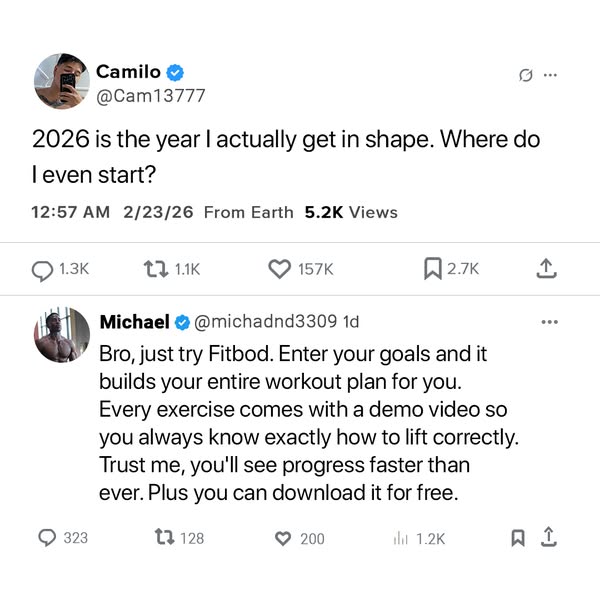
The ad is a replica of a social media post with one user expressing a desire to get in shape and another user recommending the Fitbod app. The second user highlights the app's ability to create workout plans based on individual goals and provide demo videos for each exercise, suggesting faster progress and free download.
# Brand positioning
Fitbod is presented as a workout app designed to help individuals achieve their fitness goals. The brand focuses on providing personalized workout plans tailored to the user's specific goals, making it easier for people to start and maintain a fitness routine. The app's emphasis on demo videos for each exercise addresses concerns about proper form and technique, aiming to make fitness accessible and effective for everyone. The brand occupies the space of personalized fitness guidance, pushing against generic workout routines by offering a customized experience and promoting the emotional benefit of faster progress and accessibility of a free download.
# Product
Fitbod is presented as a workout app that creates personalized workout plans for users based on their individual goals. It provides demo videos for each exercise, ensuring users know how to perform them correctly. This feature addresses a common barrier to entry for beginners who may be unsure of proper form. The app aims to help users see progress faster and is available for free download, which reduces the initial investment needed to start a fitness journey. The product is designed for anyone looking to get in shape but may not know where to start, offering a structured and guided approach to exercise.
# Visual style
The ad uses a platform-native style, replicating a social media feed to appear as organic content. The image quality is clean and legible, with a focus on presenting the information in a straightforward manner. The overall design mimics a real social media post, enhancing its authenticity and scannability in a feed.
# Hooks
Headline: 2026 is the year I actually get in shape. Where do I even start?
# Funnel stage
Middle of funnel (Consideration)
# Pain points
The primary pain point is the uncertainty and lack of direction when starting a fitness journey. As Camilo states, "Where do I even start?"
# Value propositions
- Personalized workout plan based on your goals
- Demo videos ensure correct form
- Faster progress with guided workouts
- Free download for immediate access
# Benefits
- You always know exactly how to lift correctly
- You'll see progress faster than ever
- You can download it for free
# Features
- Enter your goals
- Builds your entire workout plan for you
- Every exercise comes with a demo video
# Call to action
None used.
# Social proof
- "Trust me, you'll see progress faster than ever."
# Point of view
- Customer: The first post shows the user Camilo stating that they want to get in shape but don't know where to start.
- Customer: The second post shows the user Michael recommending Fitbod, which gives the audience a recommendation from a real person.
# Storyline
- A user named Camilo expresses a desire to get in shape but doesn't know where to start. This is from the customer's perspective, showcasing a common pain point among individuals looking to improve their fitness, immediately framing a relatable entry point to address customer pain points.
- Another user, Michael, responds by recommending Fitbod, highlighting its ability to create workout plans based on individual goals and provide demo videos for each exercise. This provides a direct solution from a user’s POV, showcasing the product's features as a solution to the problem presented.
- Michael assures Camilo that he will see progress faster and mentions that the app can be downloaded for free. By highlighting the benefit of faster progress and the free download, Michael reinforces the value proposition of Fitbod, enhancing its appeal to the potential customer. This provides additional motivation and reduces barriers to entry.
# Ad summary
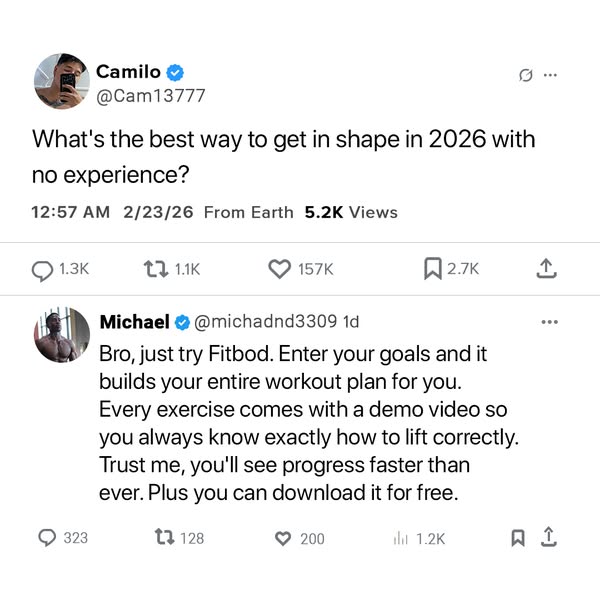
The ad is a screenshot of a social media post about the Fitbod app.
# Brand positioning
Fitbod is presented as a user-friendly fitness app designed to create personalized workout plans based on individual goals and experience levels. The brand aims to occupy the space of an accessible and effective fitness companion, especially for those new to working out. Fitbod promotes the value of structured, guided exercise by offering demo videos to ensure correct form. The brand's tone is encouraging and supportive, aiming to overcome potential barriers to entry by offering a free download and emphasizing fast progress. It sets itself apart by providing a customized approach to fitness training.
# Product
Fitbod is a fitness app that creates personalized workout plans based on the user's goals. Users can input their specific fitness goals, and the app generates a workout plan tailored to those objectives. The app provides demo videos for each exercise, ensuring users know how to perform the movements correctly. Fitbod promises faster progress and is available for free download, making it an accessible option for anyone looking to start or improve their fitness journey. This product is designed for individuals of all fitness levels, particularly beginners. The language used in the ad emphasizes its simplicity and effectiveness, highlighting that every exercise comes with a demo video to ensure users know exactly how to lift correctly. The ad addresses the hesitation or intimidation some might feel when starting a workout routine by providing guidance and structure.
# Visual style
The ad utilizes a platform-native style, mimicking a social media screenshot. The production quality appears to be a direct screen capture, without additional visual embellishments or high-polish effects. The overall aesthetic is clean and functional, prioritizing readability and familiarity. The typography is standard for social media posts, ensuring ease of scanning within the feed. The design aims to blend in with organic social media content, enhancing scannability by leveraging user familiarity with the layout.
# Hooks
Headline: What's the best way to get in shape in 2026 with no experience?
# Funnel stage
Middle of funnel (Consideration)
# Pain points
The main pain point is the uncertainty and lack of guidance when starting a fitness journey, especially with no prior experience. This is highlighted in the question: "What's the best way to get in shape in 2026 with no experience?"
# Value propositions
- Personalized workout plan tailored to your goals
- Demo videos to ensure you lift correctly
- See progress faster than ever
- Free download
# Benefits
- You'll see progress faster than ever.
# Features
- Enter your goals and it builds your entire workout plan for you.
- Every exercise comes with a demo video so you always know exactly how to lift correctly.
- You can download it for free.
# Call to action
None used.
# Social proof
- "Bro, just try Fitbod. Enter your goals and it builds your entire workout plan for you. Every exercise comes with a demo video so you always know exactly how to lift correctly. Trust me, you'll see progress faster than ever. Plus you can download it for free."
# Point of view
- Customer: The initial question posted by "Camilo" seeks advice on getting in shape, representing the perspective of someone looking for a solution.
- Customer: The response from "Michael" recommending Fitbod represents the perspective of someone who has used the product and is sharing their positive experience.
# Storyline
- The post starts with an individual, Camilo, asking for the best way to get in shape in 2026 with no experience. The message highlights the common question many people have when starting their fitness journey. This is presented from the perspective of a potential customer seeking guidance.
- Michael responds to Camilo's question by recommending Fitbod. He describes the app's features, such as personalized workout plans and demo videos. Michael's response aims to provide a solution to Camilo's query, positioning Fitbod as the answer to the problem of getting in shape without experience. The narrative has now shifted to the perspective of a customer who recommends Fitbod.
- Michael elaborates on the benefits of using Fitbod, promising faster progress and highlighting that the app is free to download. This aims to reinforce the value proposition of Fitbod, emphasizing its effectiveness and accessibility. This part of the story continues from the perspective of a satisfied user who encourages others to try the app.
# Ad summary
This ad features a man speaking about how he was not seeing results from long workouts, and how using Fitbod helped him to get in and out of the gym in under an hour and start seeing muscle growth. He calls out that Fitbod workouts are smarter, involve real progression, and keep you locked in and focused.
# Brand positioning
Fitbod is presented as a smart workout app that gives users the edge they need to get the physique they want. Fitbod helps users to train smarter and grow faster. The brand seeks to occupy the space in the consumer's mind that it is the smarter, faster way to grow muscles.
# Product
Fitbod is a workout app that helps users to train smarter and see faster muscle growth. Fitbod helps users to get in and out of the gym in under an hour by providing them with smarter workouts involving 4-6 lifts per session that are built around their goals. Fitbod tells users exactly when to go heavier or hit failure, removing the guesswork. The app tracks everything, including lifts, rest, and progress, helping users to stay focused. The product is for anyone who feels like they are spending too much time at the gym and not seeing the results that they want.
# Visual style
The ad has a somewhat polished feel, but the editing is a bit jumpy and the colors are slightly oversaturated. The ad uses a mix of color and black and white footage to communicate the man's progress. The pacing is fairly quick, with cuts happening every 1-2 seconds. The music does not appear to sync with the visuals.
# Hooks
Spoken: 00:00–00:01 [Enthusiastic] Working harder in the gym is overrated.
Text overlay: 00:00–00:01 Working harder in the gym is overrated
Visual: 00:00–00:01 The video opens with a split screen. The left side of the screen is a grayscale image of a man lifting weights. The right side of the screen is a colorized version of the same image. The man is shirtless, wearing black shorts and gray and black sneakers. Text overlay reads "Working harder in the gym is overrated".
# Funnel stage
Consideration
# Pain points
Spending hours in the gym and not seeing results. This is expressed in the line "I was lifting 6 days a week and still looked like I just started."
# Value propositions
- Smarter workouts get more results
- Stop guessing, train smarter
- Real progression
- No fluff, just proven lifts
# Benefits
- More muscle growth
- Stay focused
# Features
- Smarter workouts
- 4 to 6 lifts per session
- Built around your goals
- Tells you exactly when to go heavier or hit failure
- Tracks everything
- Lifts
- Rest
- Progress
# Call to action
None used.
# Social proof
- "Over 1 million lifters use Fitbod"
- "4.9 stars on the App Store"
# Point of view
- Customer 100% – The entire ad is told from the perspective of a user of the Fitbod app, who shows his body transformation and workouts.
# Storyline
- 00:00–00:01 The ad opens with a man at the gym and a voiceover stating that working harder in the gym is overrated.
- 00:01–00:07 The man states he used to lift 6 days a week and still looked like he just started, with 2-hour gym sessions, and still felt soft. This is from his perspective as someone who used to struggle with working out and is intended to hook the viewer.
- 00:07–00:10 He notes that other guys were getting bigger, while he was stuck. This continues the storyline that he struggled to grow muscles for a long time.
- 00:10–00:13 The man shares that a friend who is a trainer told him about Fitbod and everything changed. This serves as an inflection point.
- 00:13–00:16 Now, the man says he is in and out of the gym in under an hour and seeing way more muscle growth. This is intended to contrast with his prior experiences.
- 00:16–00:33 The man lists three reasons why Fitbod works: smarter workouts, real progression, and staying locked in. This communicates the core value props.
- 00:33–00:37 He says he has put on 5 pounds of lean mass in 6 weeks and that it finally shows. This emphasizes that Fitbod is effective.
- 00:37–00:42 The ad features information about the app including that over 1 million lifters use Fitbod and that it has 4.9 stars on the app store, communicating social proof.
- 00:42–00:45 The man tells the viewer to stop guessing, train smarter, and grow faster. This is intended to encourage the viewer to download Fitbod.
# Ad summary
A creator explains how she lost 30lbs after switching to the Fitbod app. She shares that she no longer plans her own workouts, overpays for a personal trainer, or wastes time at the gym. Instead, she uses the Fitbod app and saw changes in just three weeks. The creator uses the app to personalize workouts and keep making gains without guesswork.
# Brand positioning
Fitbod is positioned as the intelligent fitness app that eliminates the guesswork from workout planning. The brand is presented as a solution for individuals looking to lose weight, gain muscle, or simply get stronger. Fitbod uses AI to personalize workout routines with progressive overload, allowing users to see results in as little as three weeks. The brand aligns with a lifestyle focused on efficiency and effective training, pushing against the norms of time-consuming, self-planned workouts and expensive personal trainers. It offers a functional approach, emphasizing performance and simplicity.
# Product
Fitbod is an AI-powered fitness app designed to personalize workout routines for users based on their fitness goals, such as losing weight, gaining muscle, or getting stronger. The app customizes workouts using progressive overload, ensuring continuous progress without guesswork. It provides personalized workouts, tracks progress, and helps users avoid wasting time planning their own routines or overpaying for personal trainers. The app features a range of exercises, as seen on the phone screen, including options like farmer’s walk handles, trap bar, yoke, benches & racks, pull up bar, squat rack, flat bench, incline bench, and decline bench. It is designed for users who want efficient and effective training and takes the guesswork out of training.
# Visual style
The ad has a UGC feel with a mix of polished and slightly shaky shots, aiming for a relatable and authentic tone. The editing style includes quick cuts to maintain a brisk pace, with most cuts timed to align with the voiceover and music. The production quality is a hybrid of casual and commercial, with a balance of gym settings and app interface close-ups.
# Hooks
Spoken: 00:00–00:02: How I lost almost 30 pounds as a lazy gym girly.
Text overlay: 00:00–00:02: How I lost almost / 00:00–00:02: 30lbs as a lazy gym girly
Visual: 00:00–00:02: Inside a gym, a young, light-skinned woman with blonde hair, wearing a light pink sports bra and light gray sweatpants, is positioned mid-frame, bending at the waist, performing barbell rows. She has visible tattoos on her arms. Behind her are weight racks and gym equipment against a gray wall. The camera is stationary at eye level.
# Funnel stage
Middle of funnel (Consideration)
# Pain points
The ad directly addresses the pain points of inefficient workouts, expensive personal trainers, and the frustration of seeing minimal results after months of effort. "after six months of random workouts that barely did anything."
# Value propositions
- AI-driven workout personalization eliminates guesswork, providing efficient and effective training.
- Progressive overload ensures continuous progress and helps users achieve their fitness goals faster.
- The app's features make training fun and effective, increasing user engagement and results.
# Benefits
- Lose weight
- Gain muscle
- Get stronger
- Avoid guesswork in training
- Efficient training
# Features
- AI-driven workout personalization
- Progressive overload
- Workout tracking and reporting
# Call to action
Start training smarter with Fitbod and see the results you’ve been chasing.
# Social proof
- "No wonder Fitbod has over 315,000 5-star reviews" – Brand (On-screen text overlay)
# Point of view
- Customer 90% – The majority of the video is told from the perspective of a Fitbod user sharing their personal experience and results.
- Brand 10% – The brand's POV is presented through on-screen text highlighting customer reviews and the overall value proposition of Fitbod.
# Storyline
- 00:00–00:02 00:00–00:02: A woman is shown in the gym lifting a barbell. She is introducing the video by stating how she lost almost 30lbs as a lazy gym girly. The perspective is from the speaker introducing her story.
- 00:02–00:07 00:02–00:07: The woman is shown in black and white. The text reads, “I stopped planning my own workouts, I stopped overpaying for a personal trainer, I stopped wasting time at the gym.” The perspective is from the speaker who is explaining the lifestyle changes she has made to promote the Fitbod app.
- 00:07–00:09 00:07–00:09: A person’s hand is shown selecting different exercises on the Fitbod app. The text reads, “The only thing I did was switch to Fitbod.” The perspective is from the user who is demonstrating the ease of switching to the Fitbod app for workout planning.
- 00:09–00:14 00:09–00:14: A view of the Fitbod app with a calendar and workout report appears, followed by the presenter using a leg press machine. The text reads “Fitbod uses AI to personalize my workouts with progressive overload, so I keep making gains without any guesswork.” The perspective is from the user who is explaining the key features of the Fitbod app.
- 00:14–00:23 00:14–00:23: The woman is shown completing a variety of exercises. The text reads, “Whether your goal is to lose weight, gain muscle, or just get stronger, I personally saw changes in just three weeks, after six months of random workouts that barely did anything.” The perspective is from the speaker who is sharing her experience with Fitbod and highlighting the before and after results.
- 00:23–00:26 00:23–00:26: A screenshot of the Fitbod app on a customer story page is shown. The text reads, “No wonder Fitbod has over 315,000 5-star reviews.” The perspective is from the brand, showcasing positive customer feedback.
- 00:26–00:31 00:26–00:31: The speaker is shown completing additional exercises. The text reads, “It takes the guesswork out of training, keeps things fun, and actually works.” The perspective is from the user, reinforcing the key benefits of the Fitbod app.
- 00:31–00:33 00:31–00:33: The woman is shown completing additional exercises. The text reads, “Start training smarter with Fitbod and see the results you’ve been chasing.” The perspective is from the brand that is giving a call to action to potential users to start training smarter with Fitbod.
# Ad summary
This ad for the FITBOD app features a voiceover describing the benefits of the app, including that it is a smart training system built around your body, goals, and schedule. The ad shows people using the app and working out in the gym. The ad also features text overlays highlighting the key benefits of the app.
# Brand positioning
FITBOD is positioned as a smart and effective training system that differentiates itself from generic workout apps by offering a personalized approach to fitness. The brand presents itself as a solution for individuals who are tired of inconsistent results from workout plans. It aligns with values of effectiveness, customization, and scientific training. FITBOD aims to occupy the space of a sophisticated fitness tool that adapts to individual needs and progress, helping customers reach their fitness goals more efficiently.
# Product
FITBOD is a smart training system that is designed to be built around an individual's body, goals, and schedule. The app allows you to know exactly what to do from day one. The workout plan adapts as you get stronger. The app addresses the common problem of inconsistent workout routines that do not deliver results by tailoring the experience to the user's needs.
# Visual style
The ad has a polished and professional aesthetic. The video combines gym footage with direct shots of the app interface on a phone screen. The video transitions between scenes with quick cuts. The production quality is high, giving it a polished commercial feel. The visuals are timed to the voiceover lines, enhancing the message with relevant imagery.
# Hooks
Spoken: We're looking for 20 people who are done pretending consistency without a plan works.
Text overlay: We're looking for 20 people who are done pretending consistency without a plan works
Visual: 00:00–00:03: A medium shot of a muscular man with a light brown complexion stands against a gray wall. He is shirtless and flexes his chest muscles. The camera is static.
# Funnel stage
Middle of funnel (Consideration)
# Pain points
The ad highlights the pain point of people who are "done pretending consistency without a plan works." This frustration is visually represented by individuals struggling with their workouts.
# Value propositions
- Personalized training system: Tailored to your body, goals, and schedule.
- Adaptive training: The workout plan adapts as you get stronger.
# Benefits
- Stop guessing and hoping
- Actually see results
- Train smarter
- Stop wasting time
# Features
- Smart training system
- Built around your body, goals, and schedule
- Adapts as you get stronger
# Call to action
download Fitbod and start your free trial today.
# Social proof
- None used.
# Point of view
- Brand 100% – The ad is delivered by the voice of the brand, providing information, and encouraging viewers to download FITBOD.
# Storyline
- 00:00–00:03 The ad starts with a statement, accompanied by a shirtless man posing to show off his muscles.
- 00:03–00:06 00:03–00:06: The voiceover introduces FITBOD as an alternative to generic workout apps. The message is that FITBOD is more than just an app; it's a smart training system. The perspective is from the brand. The tone is informative and assertive.
- 00:06–00:09 00:06–00:09: The voiceover continues by explaining that FITBOD is built around the user's body, goals, and schedule. The perspective is from the brand, and the tone is informative and reassuring.
- 00:09–00:12 00:09–00:12: The voiceover states that the app helps users know exactly what to do from day one. The message is that the app removes guesswork and provides clear guidance. The perspective is from the brand. The tone is confident and solution-oriented.
- 00:12–00:15 00:12–00:15: The voiceover says that the plan adapts as you get stronger. The message is about the app's ability to grow with the user and ensure continued progress. The perspective is from the brand. The tone is positive and motivational.
- 00:15–00:17 00:15–00:17: The voiceover states that this is how your body is supposed to train. The message is that the app aligns with natural training principles. The perspective is from the brand. The tone is authoritative and knowledgeable.
- 00:17–00:20 00:17–00:20: The voiceover says that most people keep guessing and hoping, then encouraging viewers to switch up training methods and actually see results. This speaks to the frustration of ineffective workouts and offers FITBOD as the solution. The perspective is from the brand. The tone is empathetic and encouraging.
- 00:20–00:23 00:20–00:23: The voiceover mentions they are opening this to 20 people ready to stop wasting time. The message is about the exclusivity and urgency of the offer. The perspective is from the brand. The tone is urgent and selective.
- 00:23–00:28 00:23–00:28: The voiceover asks if you've been waiting for the perfect moment to train smarter, and suggests that you download FITBOD and start your free trial today. This serves as a direct CTA, encouraging immediate action. The perspective is from the brand. The tone is encouraging and decisive.
# Ad summary
An endorsement for Fitbod, a fitness app that creates personalized workouts, from a customer who was able to stay at 126 pounds using the app. The ad highlights how the app uses AI to personalize workouts, eliminates the need for a personal trainer, and results in people seeing real change in just three weeks.
# Brand positioning
Fitbod presents itself as a technologically advanced fitness solution, leveraging AI to personalize workout routines, challenging the norms of traditional workout planning. It positions itself as an alternative to expensive personal trainers and generic workout plans, making fitness efficient, effective, and data-driven. The brand promotes a lifestyle of informed, progressive fitness, where individuals can achieve their goals without the guesswork. By focusing on progressive overload and tailored workouts, Fitbod aims to occupy the space of a smart, personalized fitness companion for users seeking quantifiable results.
# Product
Fitbod is a fitness app that uses AI to personalize workout routines for users. The app analyzes user data to create workouts with progressive overload to help users achieve their fitness goals, whether to lose weight, gain muscle, or just get stronger. The app eliminates the need to plan workouts or pay for personal trainers, saving users time and money. It takes the guesswork out of training and keeps things fun and effective. The app also provides workout reports and data on muscle recovery, allowing users to track their progress and optimize their training.
# Visual style
The ad features a mix of polished gym shots and UGC-style content, creating a hybrid aesthetic. The editing includes quick cuts and smooth transitions, with a consistent pace of around 25 cuts per minute. Product actions and text overlays are timed with the voiceover.
# Hooks
Spoken: 00:00–00:02 How I got to 126 pounds and actually stayed there.
Text overlay: 00:00–00:03 How I got to 126lbs and actually STAYED there
Visual: 00:00–00:02 Foreground: A woman with blonde hair, wearing a light pink sports bra and white pants, is doing a barbell row. She has tattoos on her arms. Background: The gym, with weight racks, windows, and other gym equipment. The lighting is bright and natural.
# Funnel stage
Middle of funnel (Consideration)
# Pain points
The ad addresses the pain point of wasting time and money on ineffective workouts or expensive personal trainers: "I stopped overpaying for a personal trainer. I stopped wasting time at the gym."
# Value propositions
- AI-powered workout personalization leads to effective workouts.
- Eliminates the need to plan workouts or pay for personal trainers, saving users time and money.
- The app uses progressive overload to help users achieve their fitness goals.
# Benefits
- Effective workouts
- Saves time and money
- Helps users achieve their fitness goals
- Takes the guesswork out of training
- Keeps things fun
- See changes in just three weeks
# Features
- AI-powered workout personalization
- Progressive overload
- Workout reports and data
# Call to action
Start training smarter with Fitbod and see the results you've been chasing.
# Social proof
- "No wonder Fitbod has over 315,000 5-star reviews."
- The inclusion of text sharing “Our Customer Stories” builds social proof.
# Point of view
- Customer 100% – The entire ad is told from the perspective of a Fitbod customer, communicating their personal experience.
# Storyline
- 00:00–00:02 00:00–00:02 The creator is doing a barbell row as she explains how she was able to get to 126 pounds and stay there.
- 00:02–00:04 00:02–00:04 The creator is using dumbbells for a bicep curl as she shares that she stopped planning her own workouts.
- 00:04–00:06 00:04–00:06 The creator shows a text message with a personal trainer that says, "Good session, here's your invoice! $400" and shares that she stopped overpaying for a personal trainer.
- 00:06–00:08 00:06–00:08 The creator is lying down on an exercise mat and using a dumbbell as she states that she stopped wasting time at the gym.
- 00:08–00:10 00:08–00:10 The creator is on a phone, scrolling through the different exercise options available on the Fitbod app and explains that the only thing she did was switch to Fitbod.
- 00:10–00:13 00:10–00:13 The creator shows workout reports and other features of the Fitbod app to explain that the app uses AI to personalize workouts.
- 00:13–00:16 00:13–00:16 The creator is using the leg press at the gym while she explains that she keeps making gains without the guesswork because the app uses progressive overload.
- 00:16–00:21 00:16–00:21 The creator is standing on steps and doing a kettlebell sumo squat, then she is doing ab crunches on the floor as she explains that whether your goal is to lose weight, gain muscle, or just get stronger, Fitbod can help.
- 00:21–00:23 00:21–00:23 The creator is using a bicep curl machine as she states she personally saw changes in just three weeks.
- 00:23–00:26 00:23–00:26 The creator is doing the leg press as she shares that it's after six months of random workouts that barely did anything.
- 00:26–00:30 00:26–00:30 The creator shows customer testimonials and reviews to show that Fitbod has over 315,000 five-star reviews.
- 00:30–00:34 00:30–00:34 The creator is using dumbbells for bicep curls and the leg extension machine as she explains that Fitbod takes the guesswork out of training, keeps things fun, and actually works.
- 00:34–00:38 00:34–00:38 The creator highlights the app interface and encourages viewers to start training smarter with Fitbod and see the results they've been chasing.
# Ad summary
A creator reviews the Fitbod app, noting how the app focuses on form and mechanics of exercise moves and develops a personalized program for progressive overload.
# Brand positioning
Fitbod is presented as a fitness app that provides personalized workout programs designed to optimize progress and prevent wasted effort. It differentiates itself by focusing on proper form, mechanics, and progressive overload, effectively eliminating guesswork and ensuring users maximize their gym sessions, whether they are beginners or experienced gym-goers. By providing a structured and tailored approach to fitness, Fitbod aims to be a tool to help individuals achieve better results in less time compared to traditional personal training. The brand emphasizes efficiency, effectiveness, and personalization, positioning itself as a performance-driven solution for those serious about their fitness journey.
# Product
Fitbod is a fitness app that creates personalized workout programs and emphasizes correct form and progressive overload. It is designed for anyone from beginners to experienced gym-goers. The app uses the data to create a personalized program and automatically applies progressive overload. By emphasizing mechanics and proper form, the app helps you avoid wasting reps and provides more progress in three weeks than three months with a personal trainer. The app helps eliminate guesswork and tells you when to go heavier.
# Visual style
The ad has a UGC feel, with a person talking to the camera in selfie style in the corner with clips of gym goers doing different exercises and clips of the Fitbod app. The shots are lit well and show off the hard work that people put in at the gym. The editing is quick and snappy, with a lot of cuts per minute.
# Hooks
Spoken: Male 1: Let me know if you guys spot the mistake.
Text overlay: 00:00–00:03 / Spot the mistake
Visual: 00:00–00:03 Split screen. Top: A shirtless person is doing a dumbbell lateral raise exercise. A green check emoji is placed next to this person. Bottom: A shirtless person is doing a dumbbell lateral raise exercise. A red cross emoji is placed next to this person. Left: Male 1 in the corner. A logo for Fitbod is in the top right corner.
# Funnel stage
Consideration
# Pain points
People who may not be working out with correct form.
# Value propositions
- Personalized workout programs that improve mechanics
- Progressive overload to prevent wasted reps
# Benefits
- Proper form
- Proper tempo
- Proper mechanics
- You're always pushing just the right amount
- Takes out the guesswork completely
# Features
- Shows you exactly how every movement should look
- Builds you a personalized program
- Automatically applies progressive overload
- Tells you exactly when to go heavier
# Call to action
Download Fitbod
# Social proof
- “I’ve seen more progress within three weeks of Fitbod than I’ve seen in three months with a personal trainer.” – Male 1 (Expert)
# Point of view
- Expert 100% – The entire ad is told from the perspective of a male fitness expert who is giving advice and a testimonial about Fitbod.
# Storyline
- 00:00–00:03 The video begins with a question, asking if viewers can spot the mistake in a workout demonstration, signaling expertise and attention to detail.
- 00:03–00:08 The video shows the presenter and a clip of different gym goers doing different weightlifting exercises. The message is that many people can't spot the workout mistakes.
- 00:08–00:08 The presenter then shifts to suggesting that going to the gym frequently may not be enough, implying a need for more effective guidance.
- 00:08–00:11 The presenter pivots to introduce Fitbod as a solution and directs viewers to download the app.
- 00:11–00:15 Addressing a broad audience, the presenter states that Fitbod benefits both beginners and experienced gym-goers, implying a tailored experience for all levels.
- 00:15–00:21 The video provides a close-up view of the Fitbod app, showcasing its features, including showing the exact form for every movement, to ensure proper form, mechanics, and tempo are implemented.
- 00:21–00:25 The presenter explains that the app builds personalized programs that automatically apply progressive overload, emphasizing continuous improvement.
- 00:25–00:30 The presenter states that the app indicates when to increase weight, implying efficient and guided progression.
- 00:30–00:35 The presenter states that Fitbod removes the guesswork from working out and indicates he has seen more progress using the app than he had with a personal trainer.
- 00:35–00:40 The video ends with a call to action to download Fitbod and avoid wasting reps, ending on a note of optimized effort and expert advice.
# Ad summary
This ad features a creator who expresses that individuals hitting the gym may not be getting the progress they hoped for. He goes on to say that the Fitbod app can help with form, tempo, and mechanics. He says you will make more progress in three weeks with the app than you will in three months with a personal trainer.
# Brand positioning
Fitbod presents itself as a fitness app that focuses on proper form, proper tempo, and proper mechanics. The brand aims to occupy the space in the fitness app market as a tool that removes the guesswork. Fitbod encourages its users to avoid wasted reps by downloading the app for proper coaching on exercises. The brand promotes proper form for exercises and progressive overload in order to help users hit their fitness goals. Fitbod takes a functional approach to ensure users get the best results from their workouts.
# Product
Fitbod is a fitness app that aims to remove the guesswork of weightlifting for individuals of all levels. The app personalizes a workout program, automatically applies progressive overload, and tells users exactly when to go heavier on the weights. It also helps users with proper form, proper tempo, and proper mechanics. It's a tool that helps users to avoid wasted reps and see more progress than training with a personal trainer. It provides users with a personalized program that applies progressive overload to push users to lift the right amount of weight at the right time.
# Visual style
The ad is a mix of both polished and UGC-style footage. The editing style is a mix of quick cuts, screen recordings, and static shots. The pacing is consistent throughout the ad. The cuts are not timed to the music.
# Hooks
Spoken: Let me know if you guys spot the mistake. / Do you guys spot the mistake?
Text overlay: 00:00–00:03
Visual: 00:00–00:03: A split screen shows two women performing squats in a gym setting with yellow walls and mirrors. The top video shows a woman with light brown skin and dark hair in a braid. She is wearing a white sports bra and light blue leggings. A green check mark is next to her. The bottom video shows a woman with similar features wearing a black workout jumpsuit. A red X is next to her. The creator of the video is in the bottom left corner wearing a black hat. He has a mustache and light brown skin. The Fitbod logo is in the top right corner.
# Funnel stage
Middle of funnel (Consideration)
# Pain points
Many people waste their time at the gym by using improper form and mechanics. "You can be hitting the gym six days a week, two hour sessions, and still get absolutely nowhere."
# Value propositions
- The Fitbod app provides the value of a personal trainer without the expensive cost.
- Fitbod removes the guesswork of weightlifting. It is worth buying if you don't want to waste your time doing exercises with improper form.
# Benefits
- Shows you exactly how every movement should look. Proper form, proper tempo, proper mechanics
- Takes out the guesswork completely
- Don't ever waste another rep
# Features
- Personalized workout program
- Automatically applies progressive overload
# Call to action
Download Fitbod
# Social proof
- "I've seen more progress within three weeks of Fitbod than I've seen in three months with a personal trainer" – Creator 1 (Customer)
# Point of view
- Customer 100% – The ad is told from the perspective of a customer of the app.
# Storyline
- 00:00–00:03 The ad opens with a split screen, showing two different women doing squats, one with a green check and the other with a red X. The creator asks the viewer to 'spot the mistake'.
- 00:03–00:08 The creator notes that you can be hitting the gym 6 days a week for 2-hour sessions and still get nowhere.
- 00:08–00:11 The creator pivots to introduce Fitbod as the solution. He says that he tells everyone to download Fitbod and that he is very serious.
- 00:12–00:17 He continues by saying it doesn't matter if you are just starting out, or have been going to the gym for years, Fitbod shows you exactly how every movement should look.
- 00:18–00:20 He says Fitbod helps with proper form, tempo, and mechanics.
- 00:21–00:30 The creator says that Fitbod builds a personalized program, automatically applies progressive overload, and tells you when to go heavy.
- 00:31–00:35 He says that he has seen more progress with the app than he saw in 3 months with a personal trainer.
- 00:36–00:39 The ad ends with a call to action from the creator to download Fitbod and to not waste another rep.
# Ad summary
This ad promotes the Fitbod app by having a fitness expert break down common workout mistakes and how the app can improve the user's work out routine.
# Brand positioning
Fitbod is presented as a fitness app that helps users optimize their workouts for maximum efficiency. The brand focuses on precision and eliminating guesswork in fitness routines. It promotes itself as a resource that caters to both beginners and experienced gym-goers, by providing tailored instruction for all experience levels. Fitbod aims to position itself as a smart, data-driven alternative to traditional workout methods, suggesting that even those who dedicate significant time to the gym might not see results without the app's guidance. The brand presents a functional approach to fitness, emphasizing proper form, tempo, and mechanics. It avoids lifestyle-oriented messaging in favor of a more technical focus on optimizing workouts.
# Product
Fitbod is presented as an app designed to help users improve the effectiveness of their workouts. The app analyzes workout performance, demonstrates correct form and technique, and automatically adjusts workout programs based on individual progress. Fitbod helps users with precise details like proper form, tempo and mechanics. It is promoted for both beginners and experience gym goes as a way to optimize their workout. A key selling point is that the app eliminates guesswork by offering a personalized program and automatically applying progressive overload, ensuring users are always challenged appropriately. The app also tells you exactly when to go heavier by tracking metrics and form.
# Visual style
The ad uses a hybrid style combining raw footage of people working out with a fitness expert's reaction in the bottom corner. The overall aesthetic is natural and authentic. Editing includes quick cuts, creating a fast pace, with about 35 cuts per minute. The audio-visual sync is timed to the beat of the background music.
# Hooks
Spoken: Let me know if you guys spot the mistake. / Do you guys spot the mistake?
Text overlay: Spot the mistake
Visual: 00:00–00:03 Split screen showing a gym environment with rows of dumbbells in the background. Two women are shown doing tricep extensions with dumbbells. The top screen displays the exercise with a green check mark and the bottom screen displays the exercise with a red X mark. In the bottom left corner is a fitness expert with a mustache and baseball cap speaking directly to the camera.
# Funnel stage
Middle of funnel (Consideration)
# Pain points
The ad highlights the frustration of spending time at the gym without seeing desired results, suggesting that inefficient workouts could be the cause: "You can be hitting the gym 6 days a week, 2 hour sessions, and still get absolutely nowhere."
# Value propositions
- Optimize your workout with a personalized, professionally guided program.
# Benefits
- Takes out the guesswork completely.
- Don't ever waste another rep.
# Features
- Shows you exactly how every movement should look.
- Proper form.
- Proper tempo.
- Proper mechanics.
- Builds you a personalized program.
- Automatically applies progressive overload.
- Tells you exactly when to go heavier.
# Call to action
Download Fitbod
# Social proof
- "I've seen more progress within 3 weeks of Fitbod than I've seen in 3 months with a personal trainer." – Fitness Expert 1
# Point of view
- Expert 100% – The ad is entirely from the perspective of a fitness expert giving workout advice and endorsing the product.
# Storyline
- 00:00–00:02 The ad opens with a split screen showing the same exercise performed two different ways with the text "Spot the mistake."
- 00:00–00:02 The ad switches to a fitness expert in the lower left corner who points at the screen and asks if you can spot the mistake.
- 00:03–00:08 The ad transitions to a series of different people in the gym doing various exercises.
- 00:03–00:08 The fitness expert transitions and explains that people who go to the gym for long periods of time sometimes do not see the progress they want.
- 00:08–00:11 The fitness expert explains why they recommend Fitbod to everyone.
- 00:08–00:11 The ad switches to a screen recording of a user interacting with the Fitbod app.
- 00:11–00:15 The fitness expert explains that Fitbod is great for beginners and experienced gym goers alike.
- 00:15–00:18 The fitness expert explain that Fitbod shows you exactly how every movement should look.
- 00:15–00:18 The ad shows a screen recording of what the Fitbod app shows you when demonstrating exercises.
- 00:18–00:20 The fitness expert lists a few thing that Fitbod shows you about the exercises.
- 00:21–00:25 The fitness expert explains that Fitbod builds you a personalized program and automatically applies progressive overload.
- 00:26–00:30 The fitness expert explains that Fitbod ensures you are always pushing the right amount and tells you when to go heavier.
- 00:31–00:35 The fitness expert explains that he has seen more progress with Fitbod in 3 weeks than he saw in 3 months with a personal trainer.
- 00:35–00:39 The fitness expert encourage the viewer to download Fitbod and stop wasting reps.
# Ad summary
This ad features two men at a gym, one is exercising while following Fitbod on his phone, and the other makes fun of him for needing an app to workout. The ad focuses on the AI technology of the app to create a customized training plan. At the end, the man makes fun of the other says he will download the app tonight.
# Brand positioning
Fitbod is a fitness app that creates personalized workout routines based on AI for beginners, professionals, and anyone who wants to grow. Fitbod aims to occupy the space of a personal trainer that helps you at any level of training, and helps avoid working out blind.
# Product
Fitbod is a fitness app that uses AI to create personalized workout routines based on an individual's goals. This app is made for everyone, from beginners to professionals, to anyone who wants to grow. It ensures that you progress as you exercise, no matter where you start. The app is shown on the user's phone, with a list of target muscles and fit exercises. It also shows the different equipment available, such as bars, plates, benches, and racks.
# Visual style
This ad is has a UGC feel, and has static shots with smooth transitions. The production quality is minimal, meant to feel like a hybrid between a UGC and a commercial. The BPM is slow, as it is centered on a conversation. The visuals do not sync with any music.
# Hooks
Spoken: Male 1: No puedo creer que alguien esté usando el gimnasio así
Text overlay: 00:00–00:03 No puedo creer que alguien esté usando el gimnasio así
Visual: 00:00–00:01 Foreground: A man's back and shoulder is facing the camera. He is wearing a red shirt with a white and blue stripe on the sleeve. He has curly brown hair. He is holding a black device in his hand. In the background, there is a man sitting on a weight machine, using his phone. The gym setting is apparent through the weight machines and equipment throughout the space. / 00:01–00:03 Foreground: The man with curly brown hair turns his head to look at the camera. Background: A man sitting on the weight machine is checking his phone. There are various weight machines and equipment throughout the gym.
# Funnel stage
Middle of funnel (Consideration)
# Pain points
Some people don't know how to train correctly, or 'train blindly'.
# Value propositions
- Creates personalized routines based on goals using AI
- Good for all levels, beginners, professionals, and anyone who wants to grow
- Maintains progression no matter where you start
# Benefits
- Personalized workout plan
- Good for all levels
- Maintains progression
# Features
- Uses AI to create routines
- Creates personalized routines
# Call to action
None used.
# Social proof
- None used.
# Point of view
- Customer 60% – The ad is shown primarily from the perspective of two men using the app at a gym.
- Brand 40% – The brand's official voice is shown when describing the product and its features.
# Storyline
- 00:00–00:02 00:00–00:02 A man sitting on a weight machine checks his phone while another man walks up to him and states, "Lleva como cinco minutos en el telefono en esa maquina, amigo."
- 00:02–00:04 00:02–00:04 The man who was checking his phone is approached by the other man who asks why he is using his phone on the machine. It's from the perspective of someone curious about why someone would spend so much time on their phone during their workout.
- 00:04–00:07 00:04–00:07 The man exercising states that he is following his training on Fitbod, while the other man asks if he needs an app to tell him how to train. The perspective of the viewer is meant to be sympathetic with the exercising man, who is being harassed for using the app.
- 00:07–00:20 00:07–00:20 The man holding the phone shares that no one should train blindly, and that this app is for everyone, including beginners, professionals, and anyone who wants to grow. He continues to describe how the app uses AI to create personalized routines based on objectives, so no matter where you start, you keep progressing. Here, the perspective has shifted toward the product being displayed, as it is providing information about its features and why that benefits the user.
- 00:21–00:23 00:21–00:23 The man who was making fun of the other states that he's been convinced, and will download it tonight. The perspective is a positive outcome of the conversation, with the user now likely to download the app.
# Ad summary
This ad compares doing a full back workout at the gym versus at home. It features a woman demonstrating exercises using resistance bands attached to a door, and compares them to similar exercises done at the gym.
# Brand positioning
This ad presents a brand that offers resistance bands for at-home workouts. The brand aims to occupy a space in the consumer's mind as a convenient and effective alternative to traditional gym workouts. The brand aligns with a lifestyle that values fitness and convenience, pushing against the norm of needing a gym membership to achieve a full workout. The brand positioning is functional, emphasizing the simplicity and performance of the resistance bands for achieving a full back workout at home.
# Product
The featured product is a set of resistance bands designed for at-home workouts. The bands can be attached to a door using an anchor system, allowing users to perform a variety of exercises that mimic those done at the gym. The product is for individuals who want to work out at home without the need for heavy equipment or a gym membership. The ad highlights the versatility of the bands, showing how they can be used to perform exercises like lat pulldowns, cable face pulls, dumbbell rows, and cable rows. The ad addresses the purchase barrier of needing a gym by offering a convenient and effective alternative for a full back workout at home.
# Visual style
The ad has a UGC feel with a hybrid production quality. The editing style includes quick cuts and static shots. The pacing is consistent throughout the ad. The audio-visual sync is timed to the music beats.
# Hooks
Text overlay: FULL BACK WORKOUT / GYM VS HOME
Visual: 00:00–00:01: Close-up shot of a gray towel wrapped around a yellow resistance band attached to the top of a white door. The background shows a white washing machine and a light brown cabinet. The setting appears to be a laundry room or hallway in a home. / 00:01–00:02: A woman with her hair in a bun, wearing a white tank top and black shorts, approaches the white door and adjusts the black handles of the yellow resistance band. The background is a light brown wall.
# Funnel stage
Consideration
# Pain points
The central frustration is the need for a gym membership to achieve a full back workout. The ad visually demonstrates this frustration by showing the comparison between gym exercises and at-home exercises using resistance bands.
# Value propositions
- Achieve a full back workout without needing a gym membership
- Convenient and effective way to work out at home
- Versatile resistance bands allow for a variety of exercises
# Benefits
- Full back workout at home
- Convenient alternative to the gym
- Versatile exercises
# Features
- Resistance bands
- Door anchor system
# Call to action
None used.
# Point of view
- Customer 100% – The ad is presented from the perspective of a customer demonstrating how to use the resistance bands for an at-home workout.
# Storyline
- 00:00–00:01 The ad opens with a close-up of a resistance band attached to a door, setting the stage for an at-home workout.
- 00:01–00:02 00:01–00:02: A woman approaches the door and adjusts the resistance band, preparing for her workout. This moment conveys the ease of setting up the equipment for an at-home workout.
- 00:02–00:16 00:02–00:16: The woman demonstrates various back exercises using the resistance bands attached to the door. Each exercise is shown alongside a video of a similar exercise being performed at the gym, highlighting the comparison between the two workout environments. Text overlays indicate the name of each exercise and the number of sets and reps to perform at home. The perspective is from an observer, showcasing the effectiveness of the resistance bands for a full back workout.
# Ad summary
The ad for Fitbod begins by addressing the common failure of New Year's fitness goals by January 14th, illustrating the problem with examples of aimless gym routines, lack of structure, and no progress tracking. The male speaker shares his personal past struggles with "winging it" and quitting, showing a "before" physique. He then introduces Fitbod as the solution for 2026, demonstrating how its AI-powered personalization creates workout plans based on individual goals, experience, and available equipment. The ad shows the speaker's "after" physical transformation over 2 and 6 months, emphasizing visible progress and consistency. It further builds credibility with social proof, showcasing numerous user success stories from the Fitbod website and highlighting millions of downloads and logged workouts. The ad concludes by urging viewers not to "wing it" this year, to "start strong in 2026" with Fitbod, and to "Try Fitbod free," offering a clear call to action and trial.
# Brand positioning
The brand Fitbod is presented as the definitive solution for overcoming common fitness failures, particularly concerning New Year's resolutions. It aims to occupy the mind space of a reliable, intelligent, and results-oriented fitness partner. The brand aligns with values of consistency, progress, and personalized achievement, pushing against the common pitfalls of aimless gym routines and lack of motivation. Its positioning is functional, emphasizing data-driven, personalized workout plans and progress tracking, directly addressing the performance and simplicity aspects of fitness. It positions itself as an intelligent alternative to "winging it" or copying others, promising tangible results through a structured approach.
# Product
The product is Fitbod, a fitness application that generates personalized workout plans. It is for individuals who struggle with consistency, progress, and knowing what to do at the gym, especially those who tend to abandon fitness goals due to a lack of structure or visible results. The ad highlights that Fitbod "uses AI and billions of data points to build a completely personalized workout plan" based on the user's "goals, my experience, and the equipment I have." Key USPs include its AI-driven personalization, elimination of guesswork, and robust progress tracking ("Every workout is logged. Every muscle is tracked."). The app is shown generating circuits with specific exercises, sets, and reps (e.g., "Hip Thrust 3 sets - 8 reps", "Bench Dip 3 sets - 8 reps", "Burpee 3 sets - 6 reps", "Dumbbell Shoulder Press 3 sets - 7 reps - 35 lb", "Back Extensions 3 sets - 12 reps", "Bicycle Crunch 3 sets - 12 reps", "Walking - Treadmill", "Dumbbell Bent Over Row 3 sets - 10 reps", "Dumbbell Lateral Raise"). It also offers a calendar for past workouts. The ad implies usage occasions are anytime workouts, especially gym settings. It addresses purchase barriers by offering a solution to the frustration of wasted effort and lack of progress, promising consistency and actual results.
# Visual style
The ad features a hybrid visual style, blending scrappy, UGC-like shots with more polished, commercial-quality elements. The editing is fast-paced, featuring quick cuts between different exercises, gym environments, and app screenshots, contributing to a dynamic and engaging rhythm. Production quality ranges from handheld mirror selfies and slightly awkward exercise attempts (UGC feel) to more stable, well-lit gym footage and crisp app demonstrations (polished commercial). There are no strong visual motifs, but the camera work often directly addresses the viewer (mirror selfies, direct eye contact during some exercises) or uses a first-person perspective to enhance relatability. The pacing is consistently quick, with cuts occurring every 1-3 seconds, driving the narrative forward. Audio-visual sync is strong, with cuts often aligned with key spoken phrases or music beats, enhancing the impact of the message.
# Hooks
Spoken: This is why 90% of New Year fitness goals fail by January 14th.
Text overlay: This is why 90% of New Year fitness goals fail by January 14th
Visual: Medium shot of a muscular Black male with long dreadlocks, wearing black headphones, a black sleeveless top, and light gray sweatpants, kneeling and performing a cable triceps extension exercise at a gym. He is facing away and to the left of the camera, intensely focused on the exercise. The background shows other gym equipment and a patterned wall. The camera is stationary and at eye level, capturing the effort in the exercise.
# Funnel stage
Middle of funnel (Consideration)
# Pain points
The central pain point is the failure to maintain fitness resolutions and achieve consistent results due to a lack of structure and visible progress. This is signaled by: "This is why 90% of New Year fitness goals fail by January 14th" and "If you walk into the gym with zero plan and try to just wing it, you will fall off by week two. No structure. No progress tracking. No idea if what you're doing is even working." and "without seeing progress, motivation disappears fast."
# Value propositions
- Personalized workout plan based on your goals, experience, and equipment (eliminates guesswork and maximizes effectiveness).
- Structure and progress tracking (ensures consistency and visible results, preventing loss of motivation).
- Smarter way to train (leverages AI and data for optimal outcomes).
- Try Fitbod free (low-risk entry to experience the value).
# Benefits
- You will not fail your fitness goals by January 14th
- You won't fall off by week two
- You will have structure
- You will have progress tracking
- You will know if what you're doing is working
- You won't have to quit after two weeks
- Motivation won't disappear fast
- You will be able to start strong in 2026
- You will never have to guess
- You will actually see progress
- You will know exactly what to do when you walk into the gym
- It will finally get you consistent
# Features
- Uses AI and billions of data points to build a completely personalized workout plan
- Workout plan based on my goals
- Workout plan based on my experience
- Workout plan based on the equipment I have
- Every workout is logged
- Every muscle is tracked
- 15 million downloads
- 120 million workouts logged
# Call to action
don't wing it., Start strong in 2026., Try Fitbod free., Try For Free (Button on simulated website)
# Social proof
- "2 months using Fitbod" and "And seeing that progress is what finally got me consistent." – Male 1 (Creator)
- "6 months using Fitbod me consistent." – Male 1 (Creator)
- "With over 15 million downloads and 120 million workouts logged" – Male 1 (Voiceover, citing usage statistics)
- User transformation stories from the Fitbod website: "Alec South: Meeting Motivation By", "Mark Pemberton: From Hopeless To Hopeful", "Alex Dacks: Overcoming Gym Intimidation to Gain Confidence and Physical Strength", "Peter Botelho", "Lisa Alston", "Jennifer Steele" (External source, demonstrating user success).
# Point of view
- Customer 80% – The ad is predominantly delivered by a user sharing his personal journey with the app, interspersed with visuals of other gym-goers.
- Brand 20% – The app UI demonstration and the final brand logo reveal represent the official voice of the brand.
# Storyline
- 00:00–00:03 The video opens with a strong, muscular Black male performing a cable curl at a gym. A text overlay immediately introduces the problem: "This is why 90% of New Year fitness goals fail by January 14th". This is from a narrative voice-over perspective, setting a relatable problem-aware tone for the viewer. It establishes a sense of urgency and addresses a common pain point experienced by many attempting fitness resolutions.
- 00:03–00:07 A young light-skinned male with curly brown hair performs knee raises on a vertical knee raise machine at the gym. The voice-over explains the first reason for failure: "If you walk into the gym with zero plan and try to just wing it, you will fall off by week two." The camera uses an eye-level, third-person perspective. The intention is to illustrate the common mistake of lacking a structured plan, conveying a cautionary tone.
- 00:07–00:09 The same young light-skinned male now stands facing a cable machine, crossing his arms with resistance bands, looking confused. The voice-over adds: "No structure. No progress tracking." This builds on the previous point, showing the consequences of "winging it" by highlighting the lack of guidance and accountability. The tone is observational, emphasizing deficiencies.
- 00:09–00:11 A white male with a beard and short dark hair, wearing a black t-shirt and camouflage shorts, awkwardly attempts a bent-over barbell row on a bench. The voice-over continues: "No idea if what you're doing is even working." This visual reinforces the previous points about lack of structure and progress tracking, showing a specific example of ineffective, undirected exercise. The tone is empathetic, depicting a common struggle.
- 00:11–00:13 A person in white sneakers holds a dumbbell, then awkwardly tries to do an exercise, almost dropping it, filmed from a first-person perspective looking down at their feet and hands. The voice-over states: "That's exactly what I used to do." This shifts the narrative to a personal testimony, where the speaker identifies with the audience's past struggles, creating a bond of shared experience and a confessional tone.
- 00:13–00:16 The camera looks down at the speaker's legs on a leg press machine, with the speaker's reflection (a white male with blonde hair and sunglasses) visible in a mirror performing leg press. The voice-over elaborates: "I'd hop on random machines, copy whatever someone on YouTube was doing". This continues the personal anecdote, further illustrating the chaotic and unguided approach to fitness, deepening the relatability with a self-deprecating tone.
- 00:16–00:21 The speaker (white male with curly brown hair and beard) films himself shirtless in a bathroom mirror, showing a slightly out-of-shape physique, turning side-to-side. The voice-over continues: "And after two weeks I'd quit. Because without seeing progress, motivation disappears fast." This provides the emotional consequence of the lack of structure – giving up. The visual "before" shot visually proves the speaker's past struggle, making the narrative more impactful and the tone reflective and regretful.
- 00:21–00:23 The speaker (now appearing more muscular, white male with beard and short dark hair) performs dips at the gym. The voice-over shifts to a hopeful tone: "2026 is different because I'm using Fitbod." This marks the turning point in the narrative, introducing the solution to the problem. The visual transition to a more fit physique hints at the product's effectiveness.
- 00:23–00:29 A close-up on an iPhone screen displaying the Fitbod app, showing various workout planning screens and exercise lists. The background is a blurred gym setting. The voice-over explains the product's mechanism: "It uses AI and billions of data points to build a completely personalized workout plan based on my goals, my experience, and the equipment I have." This educates the viewer on how Fitbod solves the previous problems, using a clear, informative, and authoritative tone.
- 00:29–00:31 The speaker (white male with beard and short dark hair) performs a bench press at the gym, looking up at the barbell. The voice-over continues: "My experience, and the equipment I have." This emphasizes the personalization aspect again, showing the user actively engaged in a workout informed by the app. The tone is confident and reassuring.
- 00:31–00:34 The speaker (white male with beard and short dark hair) performs cable chest flies, looking directly at the camera with a confident expression. The voice-over states: "So I never have to guess, and I actually see progress." This directly addresses the pain points of uncertainty and lack of progress, highlighting the core benefits of Fitbod. The tone is triumphant and empowering.
- 00:34–00:38 The speaker (white male with beard and short dark hair) performs a dumbbell row at the gym. The voice-over returns to the New Year's resolution theme: "So the first time you walk into the gym in 2026, you already know exactly what to do." This reinforces the structured approach promised by Fitbod, projecting a proactive and prepared image for the user. The tone is encouraging and forward-looking.
- 00:38–00:40 The speaker (white male with beard and short dark hair) performs a bench press, looking intently at the bar. The voice-over lists tracking features: "Every workout is logged. Every muscle is tracked." This emphasizes the data-driven accountability and progress tracking, solidifying the product's utility. The tone is factual and reassuring.
- 00:40–00:43 The speaker (white male with curly blonde hair and beard) films himself shirtless in a mirror, flexing and showing a more defined physique than before. Text overlays indicate "2 months using Fitbod" and "And seeing that progress is what finally got me consistent." This is a "during" transformation shot, visually demonstrating the product's effectiveness and connecting it to the user's ultimate goal of consistency. The tone is proud and impactful.
- 00:43–00:44 The speaker (white male with curly blonde hair and beard) films himself shirtless in a mirror, flexing and showing an even more defined physique. Text overlay states "6 months using Fitbod me consistent." This is the "after" transformation shot, completing the visual progress journey and reinforcing the long-term benefits of the app. The tone is demonstrative and inspiring.
- 00:44–00:50 A screen recording of the Fitbod website showcasing user transformation stories (before-and-after photos, user names, and short story titles like "Alec South: Meeting Motivation By", "Mark Pemberton: From Hopeless To Hopeful", "Alex Dacks: Overcoming Gym Intimidation to Gain Confidence and Physical Strength", "Peter Botelho", "Lisa Alston", "Jennifer Steele"). The voice-over highlights social proof: "With over 15 million downloads and 120 million workouts logged, Fitbod is the smarter way to train in 2026." This provides external validation and reinforces the brand's credibility and widespread adoption, with an authoritative and confident tone.
- 00:50–00:52 The speaker (white male with beard and short dark hair) performs a dumbbell row, looking focused. The voice-over advises: "If you're serious about building muscle this year, don't wing it." This serves as a direct call to action, reinforcing the initial problem and urging the viewer to adopt a structured approach. The tone is direct and motivational.
- 00:52–00:54 The speaker (white male with beard and short dark hair) performs a dumbbell bench press. The voice-over concludes with a strong, encouraging message: "Start strong in 2026." This ties back to the New Year's resolution theme, offering Fitbod as the tool for a successful start. The tone is empowering and hopeful.
- 00:54–00:56 The speaker (white male with beard and short dark hair) performs cable chest flies, looking determined. The voice-over delivers the final CTA: "Try Fitbod free." This provides a low-barrier entry point for potential users, emphasizing accessibility. The tone is persuasive and inviting.
- 00:56–00:59 Black screen with the white "FITBOD" logo, then "BUILT FOR BETTER." This is a brand sign-off, solidifying the brand identity and its core mission. The tone is clean, professional, and impactful.
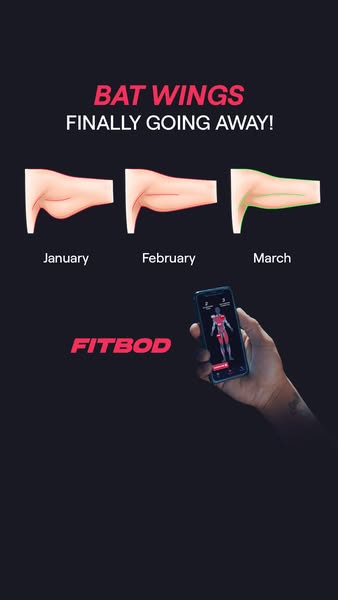
# Ad summary
This image ad demonstrates how the Fitbod app can reduce the appearance of 'bat wings' (loose skin on the upper arms) through consistent fitness tracking. It visually shows the transformation from January to March, alongside a demo of the app interface being used.
# Brand positioning
Fitbod presents itself as a fitness app that provides personalized workout plans. The brand's tone is encouraging and solution-oriented, focusing on achievable results through consistent use of its platform. It caters to users looking for structured fitness guidance by offering a technologically advanced approach to workout tracking and planning, moving away from generic fitness advice and potentially intimidating gym environments. The brand positions itself as a convenient and data-driven solution for targeted body transformations.
# Product
The Fitbod app is a fitness application designed to provide users with personalized workout plans tailored to their individual goals. As demonstrated in the ad, the app tracks muscle definition and likely provides customized exercises aimed at targeted body areas. The user interface, displayed on a smartphone, shows a 3D model of the body highlighting muscle groups. The app appears to offer progress tracking and visualizations, presumably offering workouts that can reduce 'bat wings' or loose skin on the upper arms over time. By using the app, users can presumably address the purchase barrier of not knowing how to target specific muscle groups or how to structure their workouts effectively.
# Visual style
The ad features a clean, digital aesthetic with a dark gray background and brightly colored text and graphics. The illustrations of the arms are simple and stylized, with a clear focus on demonstrating the transformation over time. The inclusion of a real hand holding the phone provides a human element and reinforces the app's ease of use. The red and white color scheme of the Fitbod logo and app graphics creates a cohesive and modern look.
# Hooks
Headline: BAT WINGS FINALLY GOING AWAY!
# Funnel stage
Top of funnel (Awareness)
# Pain points
The ad addresses the pain point of having 'bat wings' or loose skin on the upper arms, which is a source of insecurity for many people.
# Value propositions
- The Fitbod app provides personalized workout plans to help users reduce the appearance of 'bat wings' and achieve targeted body transformations through consistent fitness tracking.
# Benefits
- Reduce the appearance of 'bat wings' (loose skin on the upper arms)
- Achieve targeted body transformations
# Features
- Personalized workout plans
- Fitness tracking
# Call to action
None used.
# Social proof
- None used.
# Point of view
- Brand: The top caption highlights the main benefit that is tied to the brand's product.
- Customer: The app interface offers the perspective of a customer using the app to improve arm flab.
# Storyline
- The ad starts by highlighting the problem of 'bat wings,' immediately grabbing the attention of those self-conscious about this issue. The brand is addressing a very specific physical insecurity.
- The images show the before and after of an arm, with time stamps of January, February, and March. This visually demonstrates the transformation that can occur over time, as told by the brand, reinforcing the benefit of reducing arm flab.
- The ad concludes with a hand holding a phone displaying the Fitbod app. The customer is shown engaging with the app's interface, showing a 3D model, demonstrating how the product is used to achieve the results shown, as conveyed by the brand.
# Ad summary
The ad promotes the Fitbod app as a tool to reach weight loss goals with personalized workouts, replacing personal trainers.
# Brand positioning
Fitbod is presented as a cutting-edge fitness solution that utilizes AI technology to create personalized workout plans. The brand positions itself as an alternative to traditional, expensive personal trainers, offering a more efficient and cost-effective way to achieve fitness goals. It targets consumers who are looking for a data-driven approach to fitness, emphasizing personalized plans and tracked progress. The brand's tone is confident and forward-thinking, aligning with a lifestyle focused on convenience and technological advancement.
# Product
Fitbod is an AI-powered fitness app designed to personalize and track workout sessions. The app is for anyone looking to lose weight without the hassle of planning workouts or hiring expensive personal trainers. The key USP is that it uses AI to build personalized workout sessions and track progress. The ad states that users can see “more results in 3 weeks than 3 months of guessing” with personalized sessions. The app addresses the frustration of wasting time planning workouts and the high cost of personal trainers, offering a solution that is both efficient and affordable.
# Visual style
The ad has a polished aesthetic with bright lighting, creating a professional and motivating atmosphere. The editing style is straightforward with static shots, focusing on showcasing the exercise. The production quality appears high, enhancing the perception of the fitness app. Pacing is consistent with the rhythm of the exercise.
# Hooks
Text overlay: 00:00–00:11 POV: You go from 154lbs to 126lbs using AI in 2026
Visual: 00:00–00:11: A young woman with long brown hair in a ponytail, wearing a black workout top, black leggings, and white sneakers, is doing a barbell glute bridge on a weight bench in a gym. The gym has black walls with the words "LIFT HEAVY" in white block letters. The background shows rows of weight racks and machines. The camera is stationary and positioned at a side angle, capturing the woman's full body as she exercises. The lighting is bright and even, highlighting the gym equipment and the woman's form.
# Funnel stage
Consideration
# Pain points
The central frustration is the high cost and inefficiency of traditional workout planning and personal training. The ad addresses the pain of wasting time planning workouts and paying for expensive trainers: “You stopped wasting time planning your own workouts”, “You ditched your $100/hour personal trainer”.
# Value propositions
- AI-driven personalized workouts that deliver faster results than traditional methods.
- An affordable alternative to expensive personal trainers
# Benefits
- Stopped wasting time planning your own workouts
- Ditched your $100/hour personal trainer
- Saw more results in 3 weeks than 3 months of guessing
# Features
- AI builds your workouts
- Personalized sessions
- Tracked for results
# Call to action
None used.
# Social proof
- You saw more results in 3 weeks than 3 months of guessing.
# Point of view
- Customer 100% – The point of view is expressed through the text on screen.
# Storyline
- 00:00–00:11 The video begins with a woman doing a barbell glute bridge at the gym.
- 00:00–00:11 On-screen text, presented as a POV, appears that states the user goes from 154 lbs to 126 lbs using AI in 2026.
- 00:00–00:11 Additional text overlays appear around the frame, explaining the benefits. The text explains that the user stopped wasting time planning their own workouts, ditched their $100/hour personal trainer, downloaded Fitbod to let AI build their workouts, received personalized and tracked sessions, saw more results in 3 weeks than 3 months of guessing, and hit 126 lbs and never looked back.
How Other Sports & Fitness Brands Advertise on Meta
Peer brands in Motion's library — click any brand to see their creative strategy, live ads, and AI breakdowns.