

# Ad summary
A street interview with a young couple discussing their views on money in a relationship, including their approach to small, everyday spending and larger 'splurges,' as well as who pays on dates, while subtly promoting the Chime brand.
# Brand positioning
The ad presents Chime as a modern, accessible financial service that understands the practical realities and evolving social dynamics of personal finance, particularly for young adults. It positions itself as a partner in navigating financial conversations and everyday spending, implicitly supporting relationships where financial independence and mutual understanding are key. The brand appears to align with values of transparency, practicality, and a casual, relatable tone. It pushes against traditional, potentially rigid banking norms by focusing on realistic, everyday financial situations rather than complex financial products, emphasizing simplicity and a no-frills approach. Its positioning is primarily functional (managing money for everyday life and occasional splurges) with an underlying emotional appeal of financial peace and shared experiences within a relationship.
# Product
The ad features Chime, presented as a financial service primarily used for everyday money management. While no specific product features are explicitly detailed in spoken dialogue, the visual of a 'Chime' debit card implies it functions as a banking alternative or primary checking account. The product is for young adults and couples who are navigating financial decisions, both individually and as a pair. It's implied that Chime facilitates managing personal finances, enabling users to track spending, save for larger purchases ('splurges'), and handle daily transactions like buying food or transportation. The ad aims to convey that Chime fits into a lifestyle where financial practicality and shared experiences are valued, allowing users to manage their money efficiently for both small indulgences and bigger plans. The core USP is implied to be its simplicity and relevance to a contemporary, relationship-focused financial life.
# Visual style
The visual style is a hybrid between polished UGC and a commercial street interview. It feels authentic and conversational but with clear production quality (good lighting, clear audio, high-resolution footage). The editing is fast-paced with frequent cuts, reflecting a typical social media short-form video style. There are jump cuts between speakers and to visual effects. Visual motifs include the consistent use of bright green text overlays and playful emoji-like animations. Pacing is consistent and quick, keeping the viewer engaged. Audio-visual sync is strong, with text overlays and graphic elements appearing precisely when the corresponding words are spoken.
# Hooks
Spoken: As long as you look good and you're fed, there's no problem.
Text overlay: LOOK / chime
Visual: Medium shot of a young woman (Laura) with curly brown hair and a young man (Luca) with dark hair, standing on a wet urban street with large digital billboards in the background (Times Square). Laura is on the left, holding a small silver microphone to her mouth, looking at Luca who stands slightly to her right with his hands in his pockets. Both are wearing winter coats and scarves. Laura wears a black puffer jacket, a multicolored striped scarf, a light blue denim midi skirt, black boots, and a grey backpack. Luca wears a black and beige jacket, a red and black plaid scarf, dark brown pants, and black shoes. The camera is stationary, third-person POV, eye-level.
# Funnel stage
Top of funnel (Awareness)
# Pain points
The ad implicitly addresses the stress and potential conflict related to money in relationships, especially for young couples with limited income. The questions "Do you guys care how much your partner makes?" and "Does it matter who pays on a date?" directly touch on common financial anxieties and disagreements.
# Value propositions
- "As long as you look good and you're fed, there's no problem." (implies financial well-being covers basic needs)
- "Even a nice little like deli meal goes a long way." (small, affordable joys are valuable)
- "You just have to get creative." (financial creativity can lead to desired experiences)
- "We will save up and splurge for like the special occasions, like birthdays, anniversaries, fun stuff." (Chime supports saving for meaningful moments)
- "Two and a half years strong." (implies financial harmony contributes to relationship longevity)
# Benefits
- Enables simple, everyday financial transactions (implied by discussions of deli meals, smoothies, dates).
- Allows saving for larger experiences like travel ("splurges").
- Facilitates open communication and agreement on financial matters in a relationship ("Not yet. Two and a half years strong.").
# Call to action
None used
# Social proof
- "As long as you look good and you're fed, there's no problem." – Female 1 (Customer)
- "I personally on the record, do not care how much my partner makes. I am happy struggling together." – Male 1 (Customer)
- "Listen, as long as we can go on a date every now and then." – Female 1 (Customer)
- "Even a nice little like deli meal goes a long way." – Female 1 (Customer)
- "Shoutout my Deli guy, I love him. He makes me smoothies." – Female 1 (Customer)
- "What's been the biggest splurge recently?" – Male 1 (Customer)
- "The end of the summer when we took the train to Chicago." – Male 1 (Customer)
- "I think for two people working part-time, I think that's pretty big." – Female 1 (Customer)
- "The train itself was $100." – Male 1 (Customer)
- "You just have to get creative." – Male 1 (Customer)
- "If your idea of a date is an expensive place, that wasn't my idea, so I expect you to have the funds." – Female 1 (Customer)
- "It's like a place we both like, then I'm fine with splitting the bill, I guess." – Female 1 (Customer)
- "Don't worry, we will save up and splurge for like the special occasions, like birthdays, anniversaries, fun stuff." – Male 1 (Customer)
- "Not yet. Two and a half year strong." – Male 1 (Customer)
- "No, I'm pretty cheap." – Female 1 (Customer)
# Point of view
- Customer 100% – The entire ad is presented as an authentic street interview with two real individuals discussing their personal financial habits and relationship dynamics, directly speaking their own opinions and experiences.
# Storyline
- 00:00–00:02 A young woman (Laura) is speaking, holding a small silver microphone, while a young man (Luca) stands next to her. She says, "As long as you look good and you're fed, there's no problem." This sets a light-hearted, slightly flippant tone about financial priorities in a relationship. The audience experiences this from Laura's perspective as she delivers a relatable, casual take on basic needs.
- 00:02–00:05 The screen splits diagonally, showing Laura and Luca separately holding Chime debit cards to their mouths like microphones. Text overlays identify them as "LAURA" and "LUCA" with a graphic indicating "TOGETHER 2 YEARS". This introduces the individuals, their relationship, and subtly integrates the Chime brand and product into their shared narrative, implying Chime supports their long-term partnership.
- 00:05–00:08 Laura asks Luca, "Do you guys care how much your partner makes?" Luca gestures, seemingly considering his answer, while Laura holds the microphone. This is a direct question from Laura to Luca, addressing a common and potentially sensitive financial topic in relationships, creating intrigue and inviting the audience to ponder their own views.
- 00:08–00:11 Luca begins to speak, then gestures for Laura to go first. Laura laughs and says, "No, you go." This playful interaction highlights their dynamic and mutual respect in discussing finances, maintaining a light, personal tone.
- 00:11–00:16 Luca states, "I personally on the record, do not care how much my partner makes. I am happy struggling together." He speaks with a confident, open tone, making a strong statement about his values. This establishes his individual perspective on financial equality and shared hardship, resonating with a romantic ideal over material wealth.
- 00:16–00:20 Laura responds, "Listen, as long as we can go on a date every now and then." She expresses a practical yet modest desire for shared experiences, shifting the focus slightly from pure income to shared quality time. This is her continuing the conversation, offering a complementary but distinct view on what money means to their relationship.
- 00:20–00:24 Laura continues, "Even a nice little like deli meal goes a long way. Beef patty mild. $3." She emphasizes the affordability and simple pleasure of a small treat, highlighting that meaningful experiences don't have to be expensive. The imagery of a beef patty reinforces the down-to-earth and relatable nature of their financial habits.
- 00:24–00:30 Laura enthusiastically praises her "Deli Guy" for making smoothies that cost $8, calculating that her deli purchases total "unfortunately, $12." This moment adds humor and further grounds their financial realities in everyday, small purchases, showing that even modest expenses can add up, but are worth it for simple joys.
- 00:30–00:35 Luca asks about their biggest "splurge" recently, prompting Laura to recall a train trip to Chicago. This shifts the conversation to larger, planned expenses, showing they also save and spend on experiences.
- 00:35–00:38 Laura comments that for two people working part-time, "I think that's pretty big," referring to their Chicago trip. This provides context on their income level and emphasizes the significance of their "splurge," making it relatable for similar young, working individuals.
- 00:38–00:40 Luca reveals the train itself was "$100 bucks." This quantifies their "big splurge" and further grounds their financial story in specific numbers, making their experience tangible.
- 00:40–00:43 Luca states, "You just have to get creative." Laura then asks, "Does it matter who pays on a date?" This transitions the discussion back to date spending, highlighting their creative approach to managing money and introducing another common relationship money question.
- 00:43–00:48 Laura playfully asks about date payment, then offers her own condition: "If your idea of a date is some expensive place, that wasn't my idea, so I expect you to have the funds." This is a humorous but clear statement about her expectations and financial boundaries, emphasizing personal responsibility for date choices.
- 00:48–00:52 Laura continues, "It's like a place we both like, then I'm fine with splitting the bill, I guess." This demonstrates a balanced and fair approach to shared expenses, indicating mutual respect in financial arrangements.
- 00:52–00:53 Luca sarcastically asks, "What dates are you going on?" This is a playful jab at Laura's strict stance, adding to the light-hearted dynamic.
- 00:53–01:01 Luca reassures Laura, "Don't worry, we will save up and splurge for like the special occasions, like birthdays, anniversaries, fun stuff." This reiterates their shared financial goals and commitment to celebrating milestones, highlighting a healthy, forward-thinking approach to money in their relationship.
- 01:01–01:03 Laura smiles and nods, then Luca says, "Please believe me." This reinforces their bond and the authenticity of their financial agreement.
- 01:03–01:08 Laura asks, "Do you ever disagree on big ticket purchases?" Luca replies, "Not yet. Two and a half years strong," and holds up two fingers. This shows their current financial harmony and the strength of their communication, suggesting that with their approach (and perhaps Chime), financial arguments are avoided.
- 01:08–01:10 Laura states, "No, I'm pretty cheap." This adds a self-deprecating, relatable touch to her financial personality, reinforcing the idea that they are financially conscious.

How Chime Advertises on Meta
Updated Apr 19, 2026 · Refreshes weekly
Chime runs 1 active ads on Meta, shipping ~32 new creatives per week. Their library leans on Static To Video Hybrid100%. Recently, Chime is pushing its checking account hard, anchoring on SpotMe overdraft coverage (up to $200), fee-free banking, and a $350 sign-up bonus — with a secondary push on 3.75% APY savings and 5% cash back. The through-line is financial relief and accessibility for everyday people living paycheck to paycheck.
Indexed by Motion's Inspo Library.
The 20 Most Recent Chime Ads on Meta
# Ad summary
This ad promotes Chime, a financial technology company, with a sports theme to highlight their benefits such as fee-free banking. The ad features a foam finger and uses the phrase 'Something to cheer for' to tie into the sports theme.
# Brand positioning
Chime is presented as a modern, user-friendly financial technology company that emphasizes accessibility and value. The brand positions itself as a provider of fee-free banking, aiming to remove the traditional pain points associated with banking, such as hidden fees and charges. This aligns with a lifestyle that values transparency and convenience. Chime aims to occupy the space of a customer-centric financial service, offering innovative solutions while pushing against the traditional banking model. The brand positioning is functional, focusing on simplicity, cost savings, and accessibility, while also carrying an emotional appeal by promoting financial ease and cheerfulness.
# Product
Chime is introduced as a financial technology company that offers banking services without hidden fees. The ad highlights the benefit of 'fee-free banking,' making it accessible to a broad audience, particularly those looking for alternatives to traditional banks. A key feature is the ability to earn up to $350 with qualifying direct deposits when joining Chime. The product's USP is its commitment to providing financial services without the burden of fees, as well as offering an incentive for new users. The ad encourages viewers to join Chime to experience better banking.
# Visual style
The ad has a polished commercial aesthetic with bright colors and clear text overlays. The editing is simple with static shots. The production quality is high-end, creating a clean and professional look.
# Hooks
Text overlay: 00:00–00:07 chime / 00:00–00:07 Something to cheer for
Visual: 00:00–00:07: The shot features a green foam finger with the Chime logo on it in front of a blurry stadium background. Confetti is falling. The sky is light blue.
# Funnel stage
Top of funnel (Awareness)
# Pain points
The ad addresses the pain point of hidden fees and charges associated with traditional banking services.
# Value propositions
- Fee-free banking provides financial freedom and cost savings.
- Earning up to $350 offers a tangible incentive to switch to Chime.
# Benefits
- Banking without hidden fees or charges
- Ability to earn money by joining Chime
# Features
- Fee-free banking
- Earn up to $350 with qualifying direct deposits
# Call to action
None used.
# Social proof
- None used.
# Point of view
- Brand 100% – The ad uses the brand's official voice to communicate its value proposition and benefits.
# Storyline
- 00:00–00:07 The ad opens with a shot of a foam finger in front of a stadium.
# Ad summary
The ad features an interviewer asking a couple about money in relationships. The couple, who have been together for two years, share their thoughts and experiences on financial matters in their relationship. The ad highlights that the Chime Visa card helps with being financially empathetic in relationships.
# Brand positioning
Chime is presented as a modern, empathetic financial solution provider. The brand seeks to occupy a space in the consumer's mind that promotes financial well-being and healthy relationships. The brand aligns with values of transparency, equality, and mutual respect in financial dealings, contrasting with traditional financial institutions that might prioritize individual wealth accumulation over relationship harmony. Chime promotes a functional brand positioning by offering tools that facilitate open communication and empathetic financial management within partnerships.
# Product
The Chime Visa card is a financial tool designed to promote empathetic financial management within relationships. The card and associated app help couples avoid overspending and encourage transparent communication about finances. The ad suggests that the card is for individuals in committed relationships who value open and honest discussions about money. The featured function is how it facilitates empathy and prevents financial discomfort between partners, making it easier to manage shared expenses and financial decisions. The ad addresses the barrier of financial conversations causing tension in relationships by presenting the card as a way to encourage financial transparency and mutual respect.
# Visual style
The ad has a UGC feel, as it appears to be an on-the-street interview. The editing style is quick cuts between different speakers, but otherwise features static shots with smooth transitions. The production quality feels natural and unpolished. The pacing remains consistent throughout, matching the rhythm of the spoken word.
# Hooks
Spoken: Do you care how much your partner makes?
Visual: 00:08–00:10: The video shows the woman and man in Times Square. The woman is wearing a black coat, a cream colored sweater, and a white, purple, and pink scarf. The man is wearing glasses and a teal rain jacket.
# Funnel stage
Middle of funnel (Consideration)
# Pain points
The ad implies that a pain point is that financial discussions can often lead to conflict and discomfort within a relationship.
# Value propositions
- Promotes empathy and prevents financial discomfort between partners.
- Makes it easier to manage shared expenses and financial decisions.
# Benefits
- Helps avoid overspending
- Encourages financial transparency in relationships
# Features
- Chime Visa card
- App features
# Call to action
None used.
# Point of view
- Customer 90% – The ad is told from the point of view of the customers being interviewed.
- Brand 10% – The brand is shown as a logo at the beginning of the video.
# Storyline
- 00:08–00:11 The interviewer asks a woman and her partner how much their partner makes.
- 00:12–00:13 The woman responds that she does not care how much her partner makes. This is conveyed through her direct response and body language.
- 00:13–00:17 The woman explains that she would care if she always had to pay. This is conveyed through her tone and emphasis on the personal burden.
- 00:18–00:21 The woman explains that she doesn't like to take risks with her money and that the stock market makes her nervous. This is conveyed through her tone and expression.
- 00:21–00:27 The man says that being the more financially fortunate partner means he can't overspend. This is conveyed through his tone.
- 00:27–00:32 The man says that he and his partner have to be empathetic and financially mature. This is conveyed through his tone and expression.
- 00:32–00:34 The interviewer asks if it matters who pays on dates.
- 00:34–00:36 The man responds that it does matter. This is conveyed through his tone.
- 00:36–00:40 The woman explains that the man was chivalrous in the beginning. This is conveyed through her expression and tone.
- 00:40–00:41 The interviewer asks what she thinks the timeline is.
- 00:41–00:43 The man says two months. This is conveyed through his tone.
- 00:43–00:44 The woman says she'll put in.
- 00:45–00:49 The woman says that if one is purely making decisions based on money, they are not making great decisions. This is conveyed through her tone and facial expressions.
- 00:50–00:55 The woman says to look at who you are with and the value of them as a human being. This is conveyed through her tone and facial expressions.
# Ad summary
This ad features a cowboy sharing the benefits of Chime, highlighting its ease of use, overdraft protection, and early payday feature.
# Brand positioning
Chime is presented as a modern, accessible banking solution that challenges traditional banking norms by prioritizing customer financial well-being. The brand aims to occupy a space in the consumer's mind as a friendly alternative to traditional banks by promoting values of simplicity and financial empowerment. The absence of overdraft and monthly fees, plus the added benefit of getting paid up to two days early, is shown to push against competitor behaviors and traditional norms.
# Product
Chime is a checking account that can be opened in as little as two minutes. It offers up to $200 in overdraft protection through SpotMe, which applies to debit card transactions and cash withdrawals. Chime charges no overdraft fees or monthly fees and also offers the ability to get paid up to two days early. The ad suggests this product is for anyone wanting to keep their "hard earned cash where it belongs... in your pocket." This makes Chime worth trying or buying because it is easily accessible and financially rewarding.
# Visual style
The ad has a raw, UGC-like aesthetic with natural lighting and handheld camera work. The production quality is basic, supporting the casual tone and authenticity. The editing consists of quick cuts to maintain a brisk pace, around 24 cuts per minute, with edits often synced to the underlying music. The cowboy theme, combined with simple cuts, reinforces the easy-to-use nature of the product.
# Hooks
Spoken: 00:00–00:03 Open a Chime checking account in two minutes and they'll spot you up to $200.
Text overlay: 00:00–00:01 Paid Actor. Sponsored Content. / 00:01–00:02 checking account / 00:01–00:03 in two minutes / 00:02–00:04 up to $200*.
Visual: 00:00–00:01 A man with a long beard, wearing a cowboy hat, denim jacket, and jeans, walks down a muddy path. The background is a rural scene with trees and a glimpse of livestock. Text at the bottom reads "Paid Actor. Sponsored Content." / 00:01–00:02 The man feeds a horse hay through a green metal fence. Text at the bottom reads "Paid Actor. Sponsored Content." / 00:02–00:03 The man gives the horse more hay out of a plastic bin.
# Funnel stage
Top of funnel (Awareness)
# Pain points
The pain point is the frustration of overdraft and monthly fees associated with traditional banking, leading to financial instability and a feeling of being taken advantage of. "Keep your hard earned cash where it belongs, in your pocket."
# Value propositions
- Open a Chime checking account in two minutes.
- SpotMe will spot you up to $200: Financial security when you need it most.
- No overdraft fees or monthly fees: Keep more of your money.
- Get paid up to two days early: Access your money faster.
# Benefits
- Easy account opening
- Overdraft protection
- Avoid unnecessary fees
- Faster access to funds
# Features
- Open a Chime checking account in two minutes
- SpotMe will spot you up to $200
- No overdraft fees
- No monthly fees
- Get paid up to two days early
# Call to action
Apply now
# Point of view
- Brand 100% – The entire ad is narrated by a brand representative, communicating the brand's key messages and values.
# Storyline
- 00:00–00:01 The ad opens with a man walking down a muddy path on a farm. He begins to explain how easy it is to open a Chime checking account and the benefits of doing so.
- 00:01–00:08 He lists the features of a Chime account.
- 00:08–00:11 He emphasizes keeping your "hard earned cash where it belongs, in your pocket."
- 00:11–00:14 The cowboy encourages the viewer to apply now and then rides off on his horse.
# Ad summary
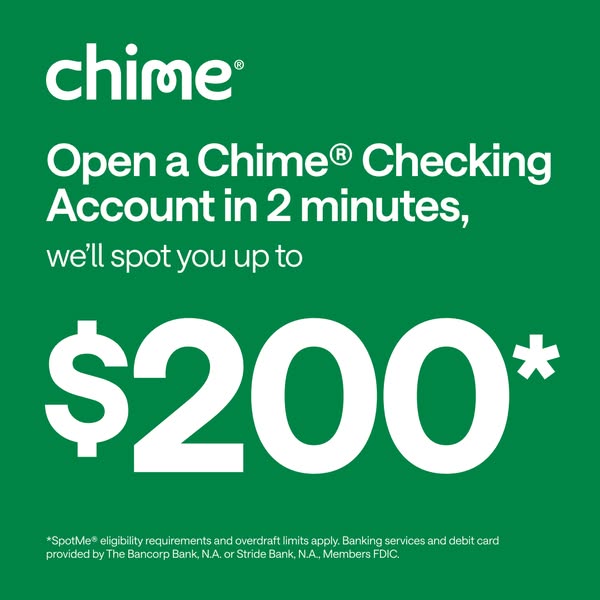
This ad promotes Chime's checking account, highlighting the ability to open an account in 2 minutes and the SpotMe feature that can spot you up to $200.
# Brand positioning
Chime is presented as a modern, accessible, and customer-centric financial technology company. The brand aims to occupy the space of a user-friendly alternative to traditional banking, emphasizing simplicity and financial support. Chime aligns with values of convenience and financial empowerment, pushing against the norms of traditional banks with their complex fees and processes. The brand positioning is both functional (easy account opening, overdraft assistance) and emotional (financial peace of mind).
# Product
The ad features Chime's checking account, which can be opened in 2 minutes. A key feature highlighted is SpotMe, which can spot users up to $200. The ad addresses the potential barrier of overdraft fees by offering a service that covers overdrafts up to a certain limit, subject to eligibility requirements and overdraft limits.
# Visual style
The ad has a clean and straightforward visual style with a solid green background and white text. The production quality is highly polished, with a focus on clear typography and a simple layout. The design is minimalist, emphasizing the key message and brand logo. The style is platform-native, suitable for in-feed placement with its easily scannable content.
# Hooks
Headline: Open a Chime® Checking Account in 2 minutes,
# Funnel stage
Middle of funnel (Consideration)
# Pain points
The ad addresses the pain point of time-consuming bank account setups and the potential for overdraft fees. "Open a Chime® Checking Account in 2 minutes" and "we'll spot you up to $200*" directly counter these frustrations.
# Value propositions
- Open a Chime® Checking Account in 2 minutes: This offers the value of quick and easy account setup.
- we'll spot you up to $200*: This offers the value of financial support and overdraft protection.
# Benefits
- Open a Chime® Checking Account in 2 minutes
- we'll spot you up to $200*
# Features
- Chime® Checking Account
- SpotMe
# Call to action
None used.
# Point of view
- Brand: The entire ad is from the brand's perspective, promoting the features and benefits of Chime's checking account.
# Storyline
- The ad starts by introducing the Chime brand, immediately establishing the source of the message. The intention is to familiarize the viewer with the brand name and logo.
- Next, the ad highlights the ease and speed of opening a Chime Checking Account, stating it can be done in 2 minutes. This is from the brand's perspective, aiming to attract customers with the promise of quick setup.
- The ad then emphasizes the SpotMe feature, offering to spot the user up to $200. This is presented from the brand's perspective, showcasing a key benefit of the Chime Checking Account.
- Finally, the ad includes a disclaimer about SpotMe eligibility requirements and overdraft limits, as well as banking services and debit card information. This is from the brand's perspective, providing necessary legal and regulatory information.

# Ad summary
The image ad for Chime promotes its checking account by highlighting the overdraft coverage feature and positions the brand as innovative and forward-thinking.
# Brand positioning
Chime is presented as a modern, accessible, and innovative financial technology company that challenges traditional banking norms. The brand aims to occupy the space of user-friendly and supportive financial services, particularly for those who may face overdraft fees or other barriers in traditional banking. Chime promotes financial freedom and convenience through its digital banking platform, aligning with a lifestyle of tech-savviness and financial empowerment. The brand pushes against the traditional banking system by offering overdraft coverage and other features designed to simplify financial management. Chime is positioning itself as functional with the SpotMe overdraft coverage, as well as emotional by providing financial support.
# Product
The product is a Chime checking account that offers overdraft coverage up to $200 through its SpotMe feature. The service allows users to overdraw their account without incurring fees, up to the specified limit. This feature is designed for individuals who may occasionally have insufficient funds to cover expenses. Explicitly stated product details include the SpotMe eligibility requirements and the overdraft limits ranging from $20 to $200. The product aims to address the common purchase barrier of overdraft fees by providing a safety net for debit card transactions and cash withdrawals. The ad shows that this product is worth trying or buying because it can alleviate the financial stress of overdrawing from an account.
# Visual style
The ad utilizes a high-quality, studio-shot visual style with a cartoonish design that is modern and playful. The visual motifs include a space theme. The image treatment includes background removal and drop shadows. The typography is large and bold to attract attention. The style is disruptive and contrasts the normal imagery used for financial products to gain attention in the feed.
# Hooks
Headline: Get a Checking Account that's out of this world with overdraft coverage up to $200*
# Funnel stage
Middle of funnel (Consideration)
# Pain points
The ad implies that the user is frustrated with the traditional banking system and is tired of paying overdraft fees. "Get a Checking Account that's out of this world with overdraft coverage up to $200*"
# Value propositions
- Get a checking account with overdraft coverage up to $200* to avoid overdraft fees.
# Benefits
- Out of this world checking account
- Overdraft coverage
# Features
- Checking account
- Overdraft coverage up to $200*
# Call to action
None used.
# Social proof
- None used.
# Point of view
- Brand: The entire image is created by the brand to showcase the features and benefits of the Chime checking account.
# Storyline
- The ad opens with a statement inviting viewers to 'Launch Your Finances', conveying the message that the brand and product are offering a fresh start and improved financial standing. This message comes from the brand, aiming to capture attention and introduce its value proposition.
- The ad highlights the core benefit of the Chime checking account: 'Get a Checking Account that’s out of this world with overdraft coverage up to $200*', emphasizing the extraordinary advantage of overdraft protection. This comes from the brand to persuade potential customers to consider switching to Chime.
- The ad visually reinforces the message of financial assistance by displaying a Chime debit card and large, three-dimensional '~$200*' text, signaling the accessible overdraft coverage. The customer is experiencing the relief and support offered by the brand.
- Finally, disclaimers regarding SpotMe eligibility and overdraft conditions are listed, providing transparency and legal context. The brand is clarifying the terms of the offer to ensure informed decision-making.
# Ad summary
This ad features a woman sitting in front of a wooden desk in an office setting with a pegboard wall behind her. A comment appears about keeping money in a sock being gross, and the woman emphatically agrees. She recommends using Chime to easily deposit cash at Walgreens or one of their ATMs across the country without fees, asking what the viewer is waiting for before telling them to download Chime today.
# Brand positioning
Chime is presented as a modern, fee-free banking solution aimed at making financial management easy and convenient. The brand aligns with a lifestyle that rejects outdated and inconvenient banking practices, promoting a streamlined, accessible approach to depositing cash. Chime differentiates itself by pushing against the norms of traditional banking by offering a hassle-free banking experience with no fees. The brand positioning is functional, emphasizing simplicity and convenience.
# Product
Chime is a financial technology company that provides banking services, including a mobile app and debit card. The ad focuses on Chime's cash deposit feature, allowing users to deposit cash easily at Walgreens or at one of Chime's tens of thousands of ATMs across the country. Chime is for anyone who wants a convenient, fee-free banking experience. This removes the barrier of inconvenience and fees typically associated with cash deposits at traditional banks. The ad emphasizes that there are "no fees" associated with depositing cash, making it a cost-effective alternative to traditional banking methods. Chime is portrayed as a modern solution that makes depositing cash super easy and convenient.
# Visual style
The ad features a polished yet approachable aesthetic. The editing style includes quick cuts, which keep the pacing consistent. The production quality is a blend of a polished commercial and a UGC feel, which supports the intended tone of being both professional and relatable. The ad maintains a consistent pace, enhancing viewer engagement.
# Hooks
Spoken: 00:00–00:02 Keeping money in a sock ain't cute. It's gross!!
Text overlay: 00:00–00:03 Reply to jojomojo555's comment / 00:00–00:03 Keeping money in a sock ain't cute.. it's gross!!🤢💸 (Comment) / 00:02–00:03 Rachel / 00:02–00:03 Member since 2022
Visual: 00:00–00:02 A woman with long blonde hair is sitting behind a wooden desk with her hands folded. She's wearing a brown button up shirt with a black blazer over it. She is centered in the frame and looking directly at the camera with a neutral expression. Behind her is a wall with pegs in it. The background includes decorative items on a shelf. The camera is still and the lighting is neutral. A comment box with a profile picture on the left and text on the right hovers over the middle of the woman.
# Funnel stage
Middle of funnel (Consideration)
# Pain points
The pain point is the inconvenience and outdated practice of keeping money in a sock, implying a lack of easy and modern alternatives for depositing cash. "Keeping money in a sock ain't cute.. it's gross!!"
# Value propositions
- Super easy cash deposits at Walgreens and ATMs: Combines ease of use with widespread accessibility, making banking more convenient than traditional methods.
- Fee-free banking: Offers a cost-effective solution for managing money, highlighting savings compared to traditional banks.
# Benefits
- Super easy to deposit cash
- Very convenient
- Fee-free banking
# Features
- Cash deposits at Walgreens
- Cash deposits at tens of thousands of ATMs all over the country
- Fee-free banking
# Call to action
Download Chime today!
# Point of view
- Brand 100% – The entire ad is delivered by a speaker representing the brand.
# Storyline
- 00:00–00:02 The ad begins with the presenter reacting to a comment stating that keeping money in a sock is "gross."
- 00:03–00:06 The presenter agrees with the comment about keeping money in a sock being gross and urges the audience not to do that.
- 00:06–00:13 Responding to the problem raised in the opening, the presenter promotes Chime as an easy solution for depositing cash at Walgreens or their ATMs nationwide.
- 00:14–00:17 Continuing the solution pitch, the presenter emphasizes that Chime offers fee-free banking and asks the viewer what they are waiting for.
- 00:17–00:18 Concluding the ad with a direct instruction, the presenter tells the viewer to download Chime today.
# Ad summary
This Chime ad promotes fee-free banking, offering access to up to $500 of your paycheck before payday. The ad features a basketball being spun on a fingertip, with the Chime debit card floating above it.
# Brand positioning
Chime is presented as a modern, technology-driven financial service that offers fee-free banking. The ad positions Chime as an alternative to traditional banking by highlighting the benefits of accessing your paycheck early and avoiding banking fees.
# Product
Chime offers a debit card and mobile banking app that allows users to start banking fee-free and get access to up to $500 of their paycheck before payday with qualifying direct deposits. The Chime Visa Debit Card is presented as a modern alternative to traditional banking, emphasizing convenience and accessibility.
# Visual style
The ad uses a clean, minimalist aesthetic with a focus on showcasing the Chime card and the spinning basketball. The green background and simple text overlays create a modern, approachable feel. The editing style employs static shots and smooth transitions. The pacing is consistent throughout the ad, with each visual element timed to match the overall rhythm. The production quality is polished and professional.
# Hooks
Text overlay: GAME DAY
Visual: 00:00–00:01 The Chime logo appears in the upper left-hand corner on a green background. Below it is the text, "GAME DAY." A hand is spinning a basketball on one finger. Above the basketball is a black Chime card, floating in the air. Below the hand and the basketball is fine print.
# Funnel stage
Top of funnel (Awareness)
# Pain points
The ad implies the pain point of traditional banking fees and the stress of waiting for payday.
# Value propositions
- The ability to start banking without fees, making financial services more accessible.
- Access to your paycheck up to two days early, providing financial flexibility.
# Benefits
- Start Banking Fee-Free^
- Plus get up to $500* of your pay before payday
# Features
- Fee-free banking
- Access to up to $500 of your pay before payday
- Qualifying direct deposits
# Call to action
None used.
# Social proof
- None used.
# Point of view
- Brand 100% – The ad is communicated from the brand's perspective, showcasing the benefits of using Chime.
# Storyline
- 00:00–00:00 The Chime logo appears in the upper-left-hand corner.
- 00:00–00:07 00:00–00:07 The ad shows a hand spinning a basketball on one finger as the background is a blend of greens. A Chime card floats above the basketball. The ad text appears to promote fee-free banking and receiving up to $500 of your pay before payday with qualifying direct deposits. The focus is on the bank's offerings.
# Ad summary
This ad for the Chime banking app highlights the app's ability to send money to anyone and start banking fee-free today. It features a person watching basketball on TV while using the app on their phone.
# Brand positioning
Chime is presented as a modern, user-friendly, and accessible banking solution. The brand aims to occupy the space of being a hassle-free alternative to traditional banking, with a focus on fee-free services. It aligns with a lifestyle that values convenience and sharing, as highlighted by the tagline 'Live it. Share it. Send it.' Chime promotes a functional approach by emphasizing the ease of sending money and avoiding fees.
# Product
Chime is a mobile banking app that allows users to send money to anyone and start banking without fees. The ad highlights the app's ability to send money, implying a user-friendly interface for digital transactions. It is designed for individuals who need a convenient, fee-free banking solution to manage their finances and share expenses with others. The ad addresses the purchase barrier of banking fees by explicitly stating the service is 'fee-free'. The app interface shows a balance of $50, indicating it can be used for everyday transactions.
# Visual style
The ad has a modern and casual aesthetic, with a focus on convenience and accessibility. The editing style is static, with a single shot throughout the ad. The production quality is polished and supports a relatable tone. The pacing is slow. There are no specific audio-visual sync elements.
# Hooks
Text overlay: 00:00–00:07: chime / 00:00–00:07: Send money / 00:00–00:07: to anyone
Visual: 00:00–00:07: The shot is from behind a person sitting on a couch, wearing a gray sweater. They are holding a smartphone in both hands, displaying the Chime app interface. In the background, a TV shows a basketball game. The living room setting is dimly lit. The camera is stationary.
# Funnel stage
Top of funnel (Awareness)
# Pain points
The primary pain point is the frustration of banking fees and the inconvenience of traditional money transfer methods. The ad addresses this by offering fee-free banking and easy money transfers, positioning itself as a solution to these common frustrations.
# Value propositions
- The ability to send money to anyone, positioning the app as user-friendly and efficient for digital transactions.
- Fee-free banking, eliminating common banking fees.
# Benefits
- Convenient money transfers
- Fee-free banking
# Features
- Send money to anyone
- Start banking fee-free today
# Call to action
None used.
# Social proof
- None used.
# Point of view
- Customer 100% – The ad shows a person using the app while casually watching TV, conveying a customer's perspective.
# Storyline
- 00:00–00:07 00:00–00:07: The ad shows a person sitting and watching a basketball game on TV while holding their phone in their hands, displaying the Chime app. This moment is intended to convey the ease of using the Chime app while doing everyday activities. The story is told from a third-person perspective, showing the user's experience with the app in a casual setting. The tone is relaxed and convenient.
# Ad summary
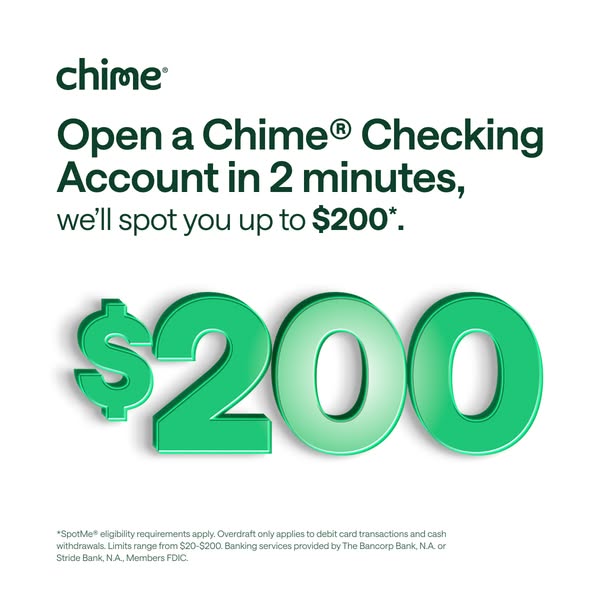
This image ad promotes Chime Checking Accounts. The ad claims you can open a Chime Checking Account in 2 minutes and they'll spot you up to $200.
# Brand positioning
Chime is presented as a modern, accessible, and financially supportive banking solution, contrasting traditional banking norms by emphasizing speed and immediate financial assistance. The brand occupies a space in the consumer's mind as a tech-forward alternative that offers quick account setups and financial support, particularly appealing to those who may need overdraft assistance. Chime aligns with values of convenience and customer empowerment, presenting a tone that is helpful and approachable rather than formal or intimidating.
# Product
Chime is promoting its checking account, highlighting the ease and speed of opening an account in just 2 minutes. The account offers a unique feature where Chime can spot you up to $200, suggesting overdraft protection. The primary benefit communicated is financial support when needed, positioning the checking account as a safety net for users who might occasionally overdraw. The ad addresses potential customer concerns about overdraft fees, positioning Chime as a solution that provides a financial cushion.
# Visual style
The ad has a clean and modern visual style with a focus on clarity and simplicity. It features a minimal design with a white background, bright color, and a 3D effect on the numbers, which is designed to quickly grab attention and promote ease of use.
# Hooks
Headline: Open a Chime® Checking Account in 2 minutes,
# Funnel stage
Middle of funnel (Consideration)
# Pain points
The ad addresses the pain point of needing money quickly, positioning the Chime checking account as a solution for those moments when customers need a quick financial spot: "we'll spot you up to $200*".
# Value propositions
- Open a Chime® Checking Account in 2 minutes, we'll spot you up to $200*.
# Benefits
- Ability to open a checking account quickly
- Potential for overdraft coverage up to $200
# Features
- Open a Chime® Checking Account in 2 minutes
- we'll spot you up to $200*
# Call to action
None used.
# Social proof
- None used.
# Point of view
- Brand: The entire ad is communicated from the brand's perspective, promoting the features and benefits of the Chime Checking Account.
# Storyline
- The ad starts by introducing Chime and its checking account, inviting viewers to open an account quickly. This serves as an attention-grabbing hook, told from the brand's perspective to highlight ease of access.
- Next, the ad states the feature where Chime can spot you up to $200. This emphasizes a key benefit of the checking account and is shown from the brand's perspective to illustrate the financial support offered.
- Finally, the ad visually showcases the amount Chime is willing to spot, $200, highlighting the monetary value and the immediate relief the customer can experience, shown from the brand's perspective to emphasize the value.
# Ad summary
This advertisement for Chime promotes fee-free banking and an opportunity to earn up to $350. It features a hand holding up a #1 fan glove with the Chime logo against a background of confetti falling at a sports arena. On-screen text highlights fee-free banking and the earning opportunity.
# Brand positioning
Chime is presented as a modern, accessible, and customer-focused financial technology company that stands apart from traditional banks by offering fee-free banking. The brand seeks to occupy a space in the consumer's mind as a tech-forward alternative to traditional banks, emphasizing simplicity and accessibility. The brand promotes financial ease by eliminating common banking fees, aligning with a lifestyle that values convenience and transparency. The use of modern visuals and a straightforward offer suggests an appeal to younger, tech-savvy individuals who may be wary of traditional banking systems. The brand pushes against traditional banking norms by highlighting the absence of fees and the opportunity to earn money, focusing on a functional and empowering approach to personal finance.
# Product
Chime is a financial technology service offering fee-free banking. It allows users to avoid charges typically associated with traditional banking, such as monthly maintenance fees, overdraft fees, or ATM fees at select locations. It offers the opportunity to earn up to $350 with qualifying direct deposits, incentivizing users to switch their primary banking relationship to Chime. The product is clearly aimed at individuals looking for a straightforward, transparent banking experience without the burden of traditional fees. The ad underscores the financial benefits and simplicity of using Chime, positioning it as a practical choice for managing everyday finances.
# Visual style
The ad has a polished, commercial aesthetic. The editing is static with no cuts. The production quality is high, using professional-grade video and graphic overlays. There are no distinct visual motifs, but the use of confetti and bright colors creates an upbeat tone. The pacing is slow, with static shots.
# Hooks
Spoken: 00:00–00:07: [Cheering]
Text overlay: 00:00–00:07: Something to cheer for / 00:00–00:07: Fee-free banking / 00:00–00:07: Join Chime / 00:00–00:07: and earn up to / 00:00–00:07: $350 / 00:00–00:07: with qualifying direct deposits
Visual: 00:00–00:07: In a blurred background, overhead lights illuminate a stadium or arena with dark seats. Gold and white confetti falls from above. In the foreground, a fair-skinned hand holds up a bright green foam fan glove with the Chime logo and a white “#1” symbol on the index finger. Text overlays appear: “Something to cheer for,” “Fee-free banking,” and “Join Chime and earn up to $350 with qualifying direct deposits.”
# Funnel stage
Middle of funnel (Consideration)
# Pain points
The ad implies that traditional banking fees are a source of frustration and expense for consumers.
# Value propositions
- Fee-free banking: transparent and accessible banking.
- Earn up to $350: financial incentive.
# Benefits
- Avoid banking fees
- Earn cash rewards
# Features
- Fee-free banking
- Opportunity to earn up to $350 with qualifying direct deposits
# Call to action
None used.
# Social proof
- None used.
# Point of view
- Brand 100% – The ad is told entirely from the brand’s perspective, presenting product features and benefits through visuals and on-screen text.
# Storyline
- 00:00–00:07 The ad opens with a celebratory scene of confetti falling in a sports arena, framing a Chime-branded foam finger being held up.
- 00:00–00:07 The scene visually implies success and celebration, associating these positive emotions with the Chime brand.
- 00:00–00:07 The perspective is from the brand, highlighting Chime's offerings and benefits.
- 00:00–00:07 As the confetti falls, text overlays appear to promote the value of fee-free banking and a cash earning opportunity with direct deposit.
- 00:00–00:07 The overlays further enhance the brand's message of financial freedom and ease.
- 00:00–00:07 The tone is upbeat and positive, designed to capture attention and create a favorable impression of Chime.
# Ad summary
This ad for Chime promotes the app and shows the 3.75% APY on savings with qualifying direct deposits, 5% cash back on spending with qualifying direct deposits and everyday credit building.
# Brand positioning
Chime is presented as a modern, tech-focused financial institution that offers fee-free banking, rewarding services, and everyday credit building. It aims to occupy a space in the consumer's mind as a rewarding and accessible banking solution that provides modern financial tools. The brand promotes the values of simplicity and financial empowerment, pushing against traditional banking norms by providing fee-free services and innovative features. Chime's positioning is both functional, with its emphasis on performance and simplicity, and emotional, as it promotes financial empowerment and rewards.
# Product
The advertised product is the Chime banking app and its associated services. Chime offers a fee-free banking experience with features like 3.75% APY on savings with qualifying direct deposits, 5% cash back on spending with qualifying direct deposits, and everyday credit building. The app shows balances for 'Available' funds ($1,246.91) and 'Savings' ($821.45) with a 'Higher APY'. The product is for individuals seeking modern and accessible financial tools to manage their money effectively and build credit. The ad highlights the ease of signing up, suggesting it takes only minutes. Chime aims to address the purchase barriers associated with traditional banking by offering fee-free services and promoting ease of use and rewarding benefits. The secured Chime Visa credit card is also shown.
# Visual style
The ad features a polished and modern aesthetic with smooth transitions and consistent use of the brand's signature green color. The editing style includes static shots of the product, with text overlays timed to the music beats. The production quality is high-end, giving the impression of a professional commercial. The pacing is moderate, with cuts timed to the music track, creating a consistent and engaging rhythm.
# Hooks
Spoken: 00:03–00:04 Female 1 [Rapping] 3.75% APY on savings
Text overlay: 00:03–00:06 3.75% APY² on savings / 00:03–00:06 WITH QUALIFYING DIRECT DEPOSITS
Visual: 00:03–00:11: The screen displays the Chime app interface within a phone. The app shows balances for 'Available' funds ($1,246.91) and 'Savings' ($821.45) with a 'Higher APY' designation. Overlaid text promotes “3.75% APY on savings with qualifying direct deposits”, “5% cash back on spending with qualifying direct deposits”, and “And everyday credit building”. The background is a gradient of green.
# Funnel stage
Middle of funnel (Consideration)
# Pain points
None used.
# Value propositions
- 3.75% APY on savings with qualifying direct deposits
- 5% cash back on spending with qualifying direct deposits
- Everyday credit building
# Benefits
- More rewarding fee-free banking
# Features
- 3.75% APY on savings
- 5% cash back on spending
- Everyday credit building
# Call to action
Sign up in minutes
# Social proof
- None used.
# Point of view
- Brand 100% – The entire ad is presented from the official voice of the brand, showcasing product features and benefits with scripted lines and visual demonstrations.
# Storyline
- 00:00–00:02 The screen displays a phone, Chime Logo, the phrase, “Get more rewarding fee-free banking at Chime,” and small print stating, “Chime is a financial technology company, not a bank. Banking services provided by The Bancorp Bank, N.A. or Stride Bank, N.A., Optional services and products may have fees or charges. Based on 2023 internal comparison to select traditional banks and fintech offerings.”
- 00:02–00:02 The display shifts to showing "plus much more."
- 00:03–00:06 The screen shows the Chime app. It displays the balances for the available and savings accounts. The phrase “3.75% APY on savings with qualifying direct deposits” appears.
- 00:06–00:09 The screen continues to show the Chime app and displays the phrase “5% cash back on spending with qualifying direct deposits”.
- 00:09–00:11 The screen continues to show the Chime app and displays the phrase “And everyday credit building”.
- 00:11–00:14 The ad transitions to showing the phone and a black Chime Visa credit card floating in front of a green background and the phrase “Sign up in minutes” is displayed.
# Ad summary
This ad promotes Chime, a financial technology company, highlighting its checking account features. The ad emphasizes the ease of opening an account, the potential for overdraft spotting up to $200, and the absence of monthly or overdraft fees. The ad positions Chime as a user-friendly banking app.
# Brand positioning
Chime is presented as a modern, user-friendly alternative to traditional banking. The brand emphasizes accessibility and financial support, particularly for those who may face overdraft fees or struggle with traditional banking systems. Chime aims to occupy a space in the consumer's mind as a hassle-free, supportive financial partner that prioritizes its customers' needs. The brand aligns with values of simplicity, transparency, and financial empowerment, pushing against the norms of hidden fees and complex banking procedures often associated with traditional banks. The brand positioning is both functional (offering specific financial services) and emotional (providing peace of mind and financial support).
# Product
The ad promotes Chime's checking account, highlighting its key features and benefits. The Chime checking account can be opened in 2 minutes and offers overdraft spotting up to $200. The account has no overdraft fees and no monthly fees. The ad emphasizes the ease of use and accessibility of the Chime banking app, positioning it as a user-friendly alternative to traditional banking. The product is for individuals seeking a straightforward, fee-free banking experience with the added benefit of overdraft protection. The ad addresses potential purchase barriers by explicitly stating the absence of fees and the availability of overdraft spotting.
# Visual style
The ad has a polished and modern aesthetic, with clean graphics and smooth transitions. The production quality is high, with a focus on visual clarity and engagement. The editing style features quick cuts and animated text overlays, timed to the music beats and voiceover lines. The pacing is consistent throughout the ad, maintaining a sense of energy and momentum.
# Hooks
Spoken: Open a Chime checking account in two minutes, and we'll spot you up to $200.
Text overlay: Open a Chime® Checking Account in 2 minutes / and we'll spot you up to $200*
Visual: 00:00–00:03: A white Chime debit card with the Chime logo in green and the Visa logo in blue is shown against a black background with white star-like particles. The card is animated with rocket boosters at the bottom, simulating a launch into space. The camera is stationary, focusing on the card as it moves upward. The lighting is bright, highlighting the card and text overlays.
# Funnel stage
Middle of funnel (Consideration)
# Pain points
The ad addresses the pain point of unexpected fees associated with traditional banking, specifically overdraft and monthly fees. "Plus, you'll pay no overdraft fees and no monthly fees."
# Value propositions
- Open a Chime Checking Account in 2 minutes and we'll spot you up to $200 – This connects the ease of opening an account with the financial benefit of overdraft spotting.
- Plus, you'll pay no overdraft fees and no monthly fees – This highlights the value of avoiding unnecessary fees, making the Chime checking account more appealing.
# Benefits
- No overdraft fees
- No monthly fees
- Spot you up to $200
# Features
- Checking account
- Overdraft spotting
- Mobile banking app
# Call to action
Apply now.
# Point of view
- Brand 100% – The entire ad is delivered from the official voice of the brand, showcasing product features and benefits.
# Storyline
- 00:00–00:03 00:00–00:03: The ad opens with a Chime debit card animated as a rocket ship launching into space, accompanied by text stating, "Open a Chime Checking Account in 2 minutes and we'll spot you up to $200." This message is intended to grab the viewer's attention by highlighting the ease of opening an account and the potential financial benefit. The perspective is from the brand, presenting a direct offer to the viewer. The tone is enthusiastic and inviting.
- 00:03–00:07 00:03–00:07: The ad continues by adding, "Plus, you'll pay no overdraft fees and no monthly fees," with animated text overlays emphasizing these benefits. This builds on the initial offer by addressing common pain points associated with traditional banking. The perspective remains from the brand, reinforcing the value proposition of the Chime checking account. The tone is reassuring and practical.
- 00:07–00:10 00:07–00:10: The ad concludes with a visual of a smartphone displaying the Chime app interface, accompanied by the text, "The #1 Most Loved Banking App. Apply now." This reinforces the brand's popularity and encourages immediate action. The perspective is still from the brand, providing a final call to action. The tone is confident and persuasive.

# Ad summary
This ad promotes Chime's new checking account sign-up bonus, offering up to $350 with qualifying direct deposits in the next 3 months. The ad features a clean and simple design with a focus on the monetary incentive.
# Brand positioning
Chime is presented as a modern and accessible financial institution, offering a checking account with a sign-up bonus. The brand aims to occupy a space in the consumer's mind as a user-friendly and rewarding banking option. The brand's tone is straightforward and promotional, focusing on the financial benefits of opening an account. Chime appears to be pushing against traditional banking norms by offering a sign-up bonus, which is not a common practice among established banks. The brand positioning is functional, emphasizing the monetary incentive for new customers.
# Product
The product being advertised is a new Chime Checking Account, which offers a sign-up bonus of up to $350. The ad specifies that the bonus is available with qualifying direct deposits in the next 3 months. The product is for individuals looking for a new checking account and are interested in earning a bonus. The ad addresses the purchase barrier of switching banks by offering a financial incentive to open a new account. The ad highlights the potential financial gain as the primary reason to try or buy the product.
# Visual style
The ad has a clean and simple visual style with a focus on text and a minimalist design. The production quality is high, with a polished and professional look. The visual motif is a straightforward presentation of information, with a clear hierarchy of text elements. The image treatment includes a consistent color scheme and clear typography. The ad's style is designed to be easily scannable and attention-grabbing in a feed.
# Hooks
Headline: Get up to $350 with a new Chime Checking Account.
# Funnel stage
Bottom of funnel (Conversion)
# Pain points
The ad implies the pain point of not having enough money or wanting to earn more. The offer of a $350 bonus is designed to alleviate this pain point by providing a financial incentive to open a new account.
# Value propositions
- Get up to $350 with a new Chime Checking Account.
# Benefits
- Get up to $350
# Features
- New Chime Checking Account
- Sign-up bonus
# Call to action
Open now
# Social proof
- None used.
# Point of view
- Brand: The entire ad is presented from the brand's perspective, promoting its checking account and sign-up bonus.
# Storyline
- The ad starts by highlighting the Chime brand and immediately introduces a "NEW ACCOUNT SIGN-UP BONUS", setting the stage for a promotional offer. The brand is telling the audience that there is an immediate benefit to paying attention.
- The ad then specifies the offer: "Get up to $350 with a new Chime Checking Account." This is the brand telling the audience the specific amount of the bonus, and what product it is tied to.
- The ad emphasizes the monetary value of the bonus with a large, bold "$350" graphic, reinforcing the financial incentive. The brand is telling the audience that the bonus is substantial and worth considering.
- The ad includes a call to action with an "Open now" button, prompting immediate action. The brand is telling the audience to take the next step and open an account.
- The ad provides additional details: "with qualifying direct deposits in the next 3 months", clarifying the conditions for receiving the bonus. The brand is telling the audience the requirements for the bonus.
- The ad includes a disclaimer about banking services and terms, providing transparency and legal information. The brand is telling the audience that they are operating within legal and regulatory guidelines.

# Ad summary
This ad promotes Chime, a fee-free banking service. The ad emphasizes its features, such as 5% cash back, 3.75% APY on savings, and everyday credit building with qualifying direct deposits.
# Brand positioning
Chime is presented as a modern and accessible financial technology company that aims to democratize banking services. The brand is positioned as a fee-free alternative to traditional banks, appealing to customers who are tired of hidden fees and complex banking procedures. By offering features like cash back, high-yield savings, and credit building, Chime targets individuals seeking simple and rewarding financial tools, making it an attractive option for those looking to improve their financial well-being without the burden of traditional banking costs.
# Product
The ad promotes Chime's fee-free banking services, highlighting key features such as '+ 5% cash back,' '+ 3.75% APY on savings,' and '+ Everyday credit building.' These benefits are available 'WITH QUALIFYING DIRECT DEPOSITS,' which implies that customers need to meet specific criteria to access these features. The product is for individuals looking for a modern, straightforward banking solution without the traditional fees associated with traditional banks. By emphasizing cash back, high APY savings, and credit building, the ad targets customers who are keen on growing their savings and enhancing their financial health. The product eliminates the purchase barrier of traditional banking fees by offering a fee-free service, making it an attractive option for those seeking a cost-effective banking solution.
# Visual style
The ad has a clean and modern visual style with a focus on simplicity and clarity. The design incorporates a vibrant green color scheme, creating a sense of freshness and trustworthiness. The background is a high-quality, studio-shot image of grass, providing a natural and inviting feel. The typography is bold and legible, ensuring key information stands out. The use of a button and overlaid text gives it a digital-native look, similar to elements found in app interfaces. Overall, the visual style is designed to be eye-catching and easily scannable in a social media feed.
# Hooks
Headline: FEE FREE banking
# Funnel stage
Middle of funnel (Consideration)
# Pain points
The ad aims to alleviate the frustration of traditional banking fees. The tagline 'FEE FREE banking' directly addresses the pain point of hidden or excessive fees that are commonly associated with traditional banks.
# Value propositions
- Chime provides fee-free banking services, saving customers from traditional banking fees.
- Cash back, high APY savings, and credit building are benefits that customers receive for free.
# Benefits
- Cash back rewards on purchases
- High-yield savings account
- Opportunity to build credit
# Features
- 5% cash back
- 3.75% APY on savings
- Everyday credit building
- Qualifying direct deposits
# Call to action
None used.
# Social proof
- None used.
# Point of view
- Brand: The entire ad communicates from the perspective of Chime, presenting its services, features, and benefits, aiming to create a positive brand image and attract new customers.
# Storyline
- The ad opens with the Chime logo, immediately establishing the brand identity and setting the stage for what is to come. This is conveyed from the brand's perspective to assure viewers of the ad's origin and legitimacy.
- Next, the ad presents a benefit-driven headline using fuzzy text that reads 'Get FEE FREE banking,' which is telling the audience that Chime offers banking services without the burden of fees. This message is communicated from the brand's perspective to highlight a core value proposition and grab the viewer's attention.
- The ad continues by offering a 'PLUS MUCH MORE' to hint at the other benefits that are included in the service and to encourage viewers to continue paying attention. This segment is conveyed from the brand's point of view to keep the audience engaged by showcasing additional value.
- The ad proceeds to highlight the key financial incentives available to Chime users, specifically mentioning '+ 5% cash back,' '+ 3.75% APY on savings,' and '+ Everyday credit building.' This provides direct and specific details about the rewards and value available to Chime customers, which is communicated from the brand's perspective.
- The ad wraps up with the disclaimer 'WITH QUALIFYING DIRECT DEPOSITS,' giving important conditions that apply to the benefits that were previously mentioned. The message is conveyed by the brand to manage expectations and give the audience clear information about eligibility requirements.
# Ad summary
This ad showcases the Chime banking app and its features, including cash back rewards, high APY on savings, and credit building. It aims to attract new users with its promise of fee-free banking and easy sign-up process.
# Brand positioning
Chime is presented as a modern, accessible, and rewarding alternative to traditional banking. The brand emphasizes fee-free services, aiming to disrupt the traditional banking model, which often includes hidden fees and complex structures. Chime positions itself as a financial technology company that prioritizes simplicity and rewards, making banking more appealing and beneficial for everyday users, especially those who may be underserved by conventional banks. The brand promotes financial well-being by offering features like cash back, savings APY, and credit building, all accessible through a user-friendly mobile app.
# Product
The ad promotes Chime as a financial technology platform offering various banking services through its mobile app. Key features include a spending account with cash back rewards, a savings account with a high 3.75% APY on savings when you have qualifying direct deposits, and credit-building tools. Chime is highlighted as a "fee-free" banking option. The app interface shows features like the SpotMe service ($200), cash back categories, and different balances for savings and spending. The Chime Visa card is also shown. The ad positions Chime as a convenient and rewarding way to manage finances, aimed at users looking for modern banking solutions.
# Visual style
The ad has a polished, modern aesthetic with a clean, minimalist design. The color scheme is dominated by a gradient of green shades, creating a consistent brand feel. The editing style uses smooth transitions and subtle zooms to highlight different features of the Chime app. The pacing is moderate, timed to match the music. The production quality is high, resulting in a professional and trustworthy feel.
# Hooks
Spoken: 00:06–00:07: [Singing] You fucked up but it's night
Text overlay: 00:06–00:08: 3.75% APY / 00:06–00:08: on savings / 00:07–00:08: WITH QUALIFYING DIRECT DEPOSITS
Visual: 00:06–00:08: A smartphone with a green frame displays the Chime app interface, showcasing savings and cash back balances. The app shows a savings balance of $821.45 with “Higher APY” and a 5% cash back balance of $82.35. Text overlays “3.75% APY on savings with qualifying direct deposits.”
# Funnel stage
Middle of funnel (Consideration)
# Pain points
The ad addresses the pain point of traditional banking fees and low savings interest rates. “Get more rewarding fee-free banking” signals frustration with traditional banking fees.
# Value propositions
- Get 5% cash back, plus much more
- Higher APY on savings
- Easy and fast sign up
# Benefits
- Get more rewarding banking
- Grow your savings with a high APY
- Build credit easily
# Features
- 5% cash back
- Fee-free banking
- 3.75% APY on savings with qualifying direct deposits
- Everyday credit building
- SpotMe
# Call to action
Sign up in minutes
# Social proof
- None used.
# Point of view
- Brand 100% – The entire ad uses the official voice of the brand to showcase the product features and benefits.
# Storyline
- 00:00–00:01 The ad opens with a visual of "Get 5% cash back", immediately highlighting a key reward.
- 00:01–00:02 It transitions to "plus much more", broadening the appeal and suggesting additional benefits beyond the initial cash back offer.
- 00:02–00:04 The screen displays a phone showing the app's interface, including an available balance and the SpotMe feature, providing immediate visual proof of the app's functionality.
- 00:04–00:05 The copy "Get more rewarding fee-free banking" positions Chime as a better alternative to traditional banking, directly addressing a key pain point.
- 00:06–00:08 The app interface showcases the 3.75% APY on savings, emphasizing the opportunity to grow savings with qualifying direct deposits.
- 00:08–00:10 The ad highlights the "everyday credit building" feature, appealing to users interested in improving their credit score.
- 00:10–00:13 The closing shot shows a phone and a Chime Visa card with the text "Sign up in minutes," providing a clear call to action and emphasizing ease of use.
# Ad summary
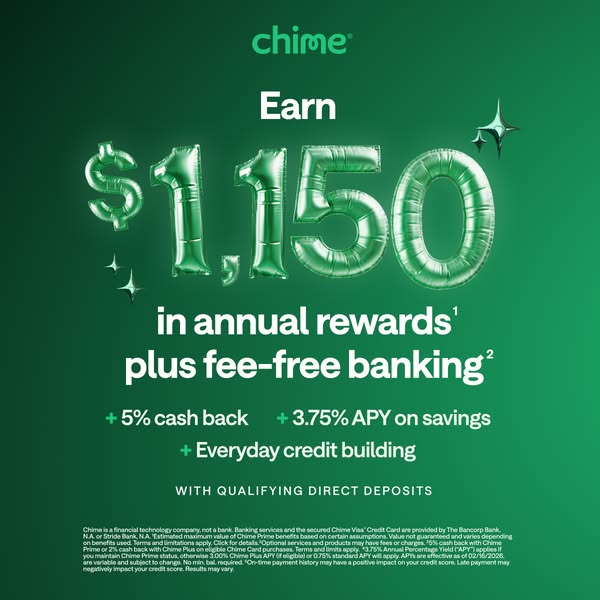
This ad for Chime promotes its fee-free banking services. The focal point of the ad is a claim of earning $1,150 in annual rewards, emphasized by balloon-shaped numbers. It also highlights benefits like 5% cash back, 3.75% APY on savings, and everyday credit building.
# Brand positioning
Chime is presented as a modern, accessible financial technology company that sets itself apart from traditional banks. It emphasizes fee-free banking and rewards, positioning itself as a user-friendly alternative that aims to provide financial benefits to its customers. The brand aligns with a lifestyle of convenience and financial empowerment, targeting those who seek accessible and rewarding banking solutions. Chime challenges the norms of traditional banking by offering services without hidden fees and providing opportunities for cash back, and APY on savings.
# Product
Chime promotes its banking services, emphasizing the potential to earn $1,150 in annual rewards. The ad highlights that it is a fee-free banking service. Additional benefits include 5% cash back, 3.75% APY on savings, and everyday credit building. The product aims to make banking more rewarding and accessible for users. The ad addresses the purchase barrier of hidden fees by highlighting the fee-free aspect of Chime's services, making it an attractive option for those looking to avoid traditional banking fees.
# Visual style
The ad has a polished and clean visual style with a focus on bright colors and clear typography. The balloon-shaped numbers and twinkling stars add a playful touch. The overall style is modern and inviting, designed to appeal to a broad audience. The design prioritizes scannability by using a simple layout and bold text.
# Hooks
Headline: Earn
# Funnel stage
Middle of funnel (Consideration)
# Pain points
The ad addresses the frustration of high banking fees and limited rewards. The focus is on providing fee-free services while offering opportunities to earn rewards.
# Value propositions
- Earn $1,150 in annual rewards plus fee-free banking
- 5% cash back
- 3.75% APY on savings
- Everyday credit building
# Benefits
- Earn $1,150 in annual rewards
# Features
- 5% cash back
- 3.75% APY on savings
- Everyday credit building
- Fee-free banking
# Call to action
None used.
# Social proof
- None used.
# Point of view
- Brand: Throughout the ad, Chime communicates the benefits of its banking services, emphasizing the potential for rewards and fee-free banking.
# Storyline
- The ad starts by capturing the viewer's attention with the headline 'Earn', introducing the primary selling point of the Chime service and setting the stage for the value proposition. The brand is presenting the opportunity to earn.
- The ad showcases the headline '$1,150' to emphasize the potential rewards. This is a visual element designed to immediately grab the viewer's attention and pique their interest in learning more. The brand uses the visual of balloon shaped numbers to draw the eye and present its offer.
- The image lists the additional perks, such as '5% cash back' and '3.75% APY on savings', the ad aims to inform the viewer of specific benefits and solidify the idea that Chime offers a rewarding banking experience. The brand is explaining what these benefits are.
- The ad concludes by stating 'WITH QUALIFYING DIRECT DEPOSITS', clarifying the conditions under which these benefits are accessible, thus reinforcing the overall message of value and reward, while ensuring transparency. The brand is telling the viewer how they can earn these rewards.

# Ad summary
This image ad for Chime promotes its fee-free banking services, including 5% cash back, 3.75% APY on savings, and everyday credit building with qualifying direct deposits.
# Brand positioning
Chime presents itself as a modern, accessible, and customer-centric financial technology company, not a traditional bank. The brand emphasizes simplicity and affordability by focusing on fee-free banking services and additional perks like cash back and APY on savings. Chime positions itself as a friendly alternative to traditional banks, aiming to attract customers who seek accessible and straightforward financial solutions.
# Product
Chime offers fee-free banking services, including access to a secured Chime Visa Credit Card. Customers can earn +5% cash back and +3.75% Annual Percentage Yield (APY) on savings. A key feature is everyday credit building, which is available with qualifying direct deposits. The ad highlights that these benefits come without the burden of traditional bank fees.
# Visual style
The ad employs a clean and inviting visual style, making use of textured 3D lettering against a plush background to create a soft, tactile feel. The color palette is predominantly green, evoking feelings of freshness, growth, and financial well-being. Overall, the visuals are designed to be approachable and emphasize the simplicity and accessibility of Chime's banking services.
# Hooks
Headline: Get FEE FREE banking¹
# Funnel stage
Middle of funnel (Consideration)
# Pain points
The primary pain point is the cost of traditional banking, specifically the fees and charges that can erode savings and income.
# Value propositions
- FEE FREE banking
- 5% cash back
- 3.75% APY on savings
- Everyday credit building WITH QUALIFYING DIRECT DEPOSITS
# Benefits
- FEE FREE banking
# Features
- 5% cash back
- 3.75% APY on savings
- Everyday credit building
- WITH QUALIFYING DIRECT DEPOSITS
# Call to action
None used.
# Social proof
- None used.
# Point of view
- Brand: This point of view appears throughout the ad, promoting the features and benefits of Chime's banking services.
# Storyline
- The ad begins by highlighting Chime's core offering: fee-free banking. This sets the stage by immediately addressing a major pain point for many consumers: the cost of traditional banking. The brand is communicating the value proposition from their perspective with the intention of grabbing attention by promising no fees on their banking services.
- Next, the ad lists several specific benefits, including +5% cash back, +3.75% APY on savings, and everyday credit building. This section supports the initial claim of fee-free banking by showing additional ways the customer benefits from Chime. The brand is communicating these benefits from their perspective with the intention of building trust by showing the added value of Chime's services.
- Finally, the ad mentions "WITH QUALIFYING DIRECT DEPOSITS" which explains the requirements for gaining access to credit building. The brand is including this from their perspective, using it to provide important context by clarifying that some features require qualifying direct deposits.
# Ad summary
This TikTok ad for Chime uses a voiceover to highlight the fact that you can open a Chime checking account in two minutes. The ad also states that Chime will spot you up to $200. The ad is set to a fast-paced song.
# Brand positioning
Chime is presented as a modern and accessible banking solution, emphasizing ease of use and quick access to financial services. The brand aims to occupy a space in the consumer's mind as a user-friendly alternative to traditional banking, focusing on simplicity and speed, as highlighted by the claim that a checking account can be opened in just two minutes. Chime aligns with a lifestyle of convenience and financial empowerment by offering features like overdraft protection (SpotMe) to provide a safety net for its users. The brand is positioned to push against the norms of traditional banking by promising a quicker and more straightforward account setup process. The brand positioning is both functional (simplicity, speed) and emotional (financial reassurance with overdraft protection).
# Product
Chime is advertising its checking account, which can be opened in just two minutes. The ad also mentions that Chime can "spot you up to $200," referring to its SpotMe overdraft protection feature. The product's USP is its speed and ease of account opening, as well as the potential financial safety net provided by SpotMe. The product is for individuals who want to quickly open a checking account with overdraft protection.
# Visual style
The ad has a very simple, straightforward style with a focus on the written information on the screen. The ad appears to be a polished commercial.
# Hooks
Spoken: 00:00–00:05 Open a Chime checking account in two minutes, we'll spot you up to $200.
Text overlay: 00:00–00:05 Open a Chime® Checking Account / 00:01–00:05 in 2 minutes, / 00:03–00:05 we'll spot you up to / 00:04–00:05 $200* / 00:05–00:05 *SpotMe® eligibility requirements apply. Overdraft only applies to debit card purchases and cash withdrawals. Limits range from $20-$200 Banking services and debit card provided by The Bancorp Bank, N.A, or Stride Bank, N.A, Members FDIC.
Visual: 00:00–00:07 The shot is a still frame on a bright green background. The Chime logo is in the upper left corner. The following words are in the middle of the frame in white: Open a Chime® Checking Account in 2 minutes, we'll spot you up to $200*. There is a note at the bottom in a smaller font that states "SpotMe® eligibility requirements apply. Overdraft only applies to debit card purchases and cash withdrawals. Limits range from $20-$200 Banking services and debit card provided by The Bancorp Bank, N.A, or Stride Bank, N.A, Members FDIC."
# Funnel stage
Middle of funnel (Consideration)
# Pain points
The ad addresses the difficulty and time commitment often associated with opening a bank account, contrasting it with the promise of opening a Chime checking account in just two minutes.
# Value propositions
- Open a Chime checking account in two minutes
- We'll spot you up to $200
# Benefits
- Open a Chime checking account in two minutes
- We'll spot you up to $200
# Features
- Checking account
- SpotMe overdraft protection
# Call to action
None used.
# Social proof
- None used.
# Point of view
- Brand 100% – The brand promotes its features and benefits.
# Storyline
- 00:00–00:07 The ad opens with a green screen and product information.
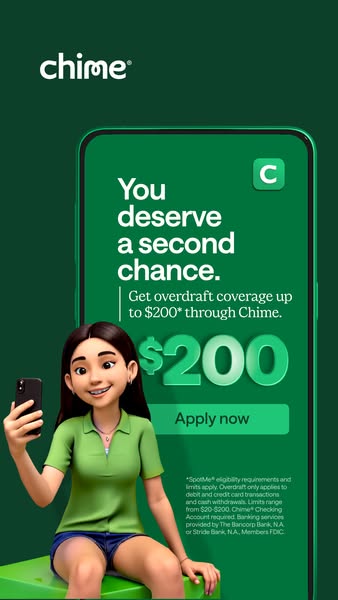
# Ad summary
This ad from Chime uses a cartoon rendering of a girl sitting on a pile of money to promote a second chance with up to $200 overdraft coverage.
# Brand positioning
Chime is presented as a modern and accessible financial institution. The brand aims to occupy the space of a supportive and understanding financial partner, particularly for those who may have faced financial difficulties in the past. By offering overdraft coverage, Chime positions itself as a solution for individuals seeking a safety net and a second chance in managing their finances. The tone is optimistic and encouraging. The brand pushes against traditional banking norms by focusing on accessibility and second chances.
# Product
Chime is advertising its overdraft coverage feature, which allows users to get overdraft coverage up to $200. This feature is designed for individuals who may need a financial safety net to cover unexpected expenses. The overdraft coverage applies to debit and credit card transactions, as well as cash withdrawals, with limits ranging from $20 to $200. Chime Checking Account is required to use this service. The advertised benefit is to provide users with a second chance and financial support when they need it most.
# Visual style
The ad utilizes a simple and cartoonish visual style with flat colors and 3D animated characters. The production quality appears to be high, with clean lines and polished rendering. The overall design is straightforward and aims for a friendly, approachable tone to communicate the financial services being offered.
# Hooks
Headline: You deserve a second chance.
# Funnel stage
Middle of funnel (Consideration)
# Pain points
The ad addresses the financial frustration of needing a second chance, suggesting that people may have experienced financial setbacks or challenges that require support and understanding.
# Value propositions
- Get overdraft coverage up to $200* through Chime
# Benefits
- Get overdraft coverage
- Second chance
# Features
- Overdraft coverage up to $200
- Debit and credit card transactions and cash withdrawals
- Limits range from $20-$200
- Chime Checking Account required
# Call to action
Apply now
# Social proof
- *SpotMe eligibility requirements and limits apply. Overdraft only applies to debit and credit card transactions and cash withdrawals. Limits range from $20-$200. Chime Checking Account required. Banking services provided by The Bancorp Bank, N.A. or Stride Bank, N.A. Members FDIC
# Point of view
- Brand: Throughout the ad, the brand's voice is used to communicate its understanding, the product features, and the value it offers. The ad tells the customer about the Chime product offering.
- Customer: The headline offers an empathetic perspective, expressing that they deserve a second chance.
# Storyline
- The ad starts by saying 'You deserve a second chance.' to encourage the audience to consider Chime's offering. The line is positioned from the brand's perspective to convey their understanding and empathy towards individuals facing financial challenges.
- Next, the ad explains how Chime can help by stating 'Get overdraft coverage up to $200* through Chime.' This is presented from the brand's POV to showcase the specific benefit and value Chime provides to potential customers.
- The ad shows the amount '$200' in a larger font to reinforce the amount of coverage someone could get with Chime's overdraft feature, emphasizing what customers can potentially gain.
- Finally, there is an 'Apply now' CTA, giving the customer a clear next step to start the application process. This directive comes from the brand in order to encourage immediate engagement.
How Other Finance Brands Advertise on Meta
Peer brands in Motion's library — click any brand to see their creative strategy, live ads, and AI breakdowns.