
# Ad summary
This ad promotes Asket's clothing brand, focusing on minimalist fashion. The ad features a person lying on a couch wearing a white button-up shirt and pants. The text overlay states, "Chosen once. Worn often" and the brand name "Asket." The ad emphasizes the long-term value and simplicity of the brand's clothing.
# Brand positioning
Asket is presented as a minimalist fashion brand, emphasizing simplicity and longevity. The ad promotes a timeless and versatile aesthetic, encouraging consumers to buy less and choose well-made garments that can be worn frequently. The brand seems to push against the fast-fashion trend of constant consumption, positioning itself as a sustainable and classic choice. The brand positioning is both functional (high-quality garments) and emotional (making conscious, long-lasting choices).
# Product
The featured product is a white, long-sleeve button-up shirt made by Asket. The shirt is a classic, minimalist design. The ad highlights the shirt's versatility, implying it can be worn in various casual settings. The text "Chosen once. Worn often" suggests the shirt is meant to be a long-lasting staple in one's wardrobe, conveying durability and timeless style. The shirt is presented as a versatile item that can be worn in relaxed settings.
# Visual style
The ad has a minimalist and clean aesthetic with soft, natural lighting. The shots are static with smooth transitions, giving it a polished and sophisticated feel. The production quality is high-end, aiming for a timeless, classic feel. The pacing is slow and deliberate.
# Hooks
Text overlay: 00:00–00:03 Chosen once. Worn often. / 00:00–00:03 Asket
Visual: 00:00–00:04 The shot is a medium close-up of a person lying on a dark gray couch. The person has light skin and dark hair and is wearing a white unbuttoned shirt. Their right hand is raised, partially covering their face. In the background, there is a blurred view of the room. The camera is static. Text overlay: "Chosen once. Worn often" and "Asket."
# Funnel stage
Top of funnel (Awareness)
# Pain points
The ad addresses the problem of fast fashion and disposable clothing. The ad aims to combat frequent purchasing and buying items that get tossed.
# Value propositions
- The shirt is designed to be "Chosen once. Worn often," emphasizing its lasting value and frequent use.
- Minimalist and classic design offers versatile wear.
# Benefits
- Timeless style
- Versatility
- Durability
- Worn often
# Features
- Classic white shirt
- Minimalist design
- Long sleeves
# Call to action
None used.
# Social proof
- None used.
# Point of view
- Customer 100% – The ad is told from the perspective of someone wearing the product, showing how it fits into their daily life in a casual setting.
# Storyline
- 00:00–00:02 00:00–00:02 The ad opens with a person lying on a couch, partially covering their face with their hand.
- 00:02–00:06 00:02–00:06 The camera zooms out to show the person is lying on a couch wearing a white shirt and pants. The text overlay "Chosen once. Worn often" and the brand name "Asket" appear.
- 00:06–00:17 00:06–00:17 The person is reading a book. The perspective conveys a relaxed and casual setting, emphasizing the comfort and versatility of the shirt.
- 00:17–00:25 00:17–00:25 The person is talking on a phone.
- 00:25–00:38 00:25–00:38 The person gets up from the couch.
How ASKET Advertises on Meta
Updated Apr 19, 2026 · Refreshes weekly
ASKET runs 159 active ads on Meta, shipping ~17 new creatives per week. Their library leans on Headline16%, Demo15%, and Cinematic B-Roll13%. Recently, ASKET pushes a "permanent collection" philosophy — fewer, better garments chosen once and worn for years — while countering fast fashion's planned obsolescence with proof points like 10 years and just 50 garments made. New denim styles (slim, loose, women's fits) and refined founding garments anchor the product side.
Indexed by Motion's Inspo Library.
The 20 Most Recent ASKET Ads on Meta
# Ad summary
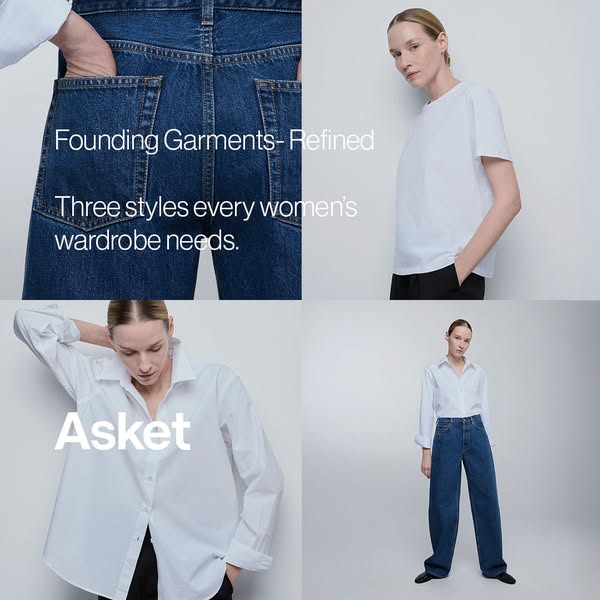
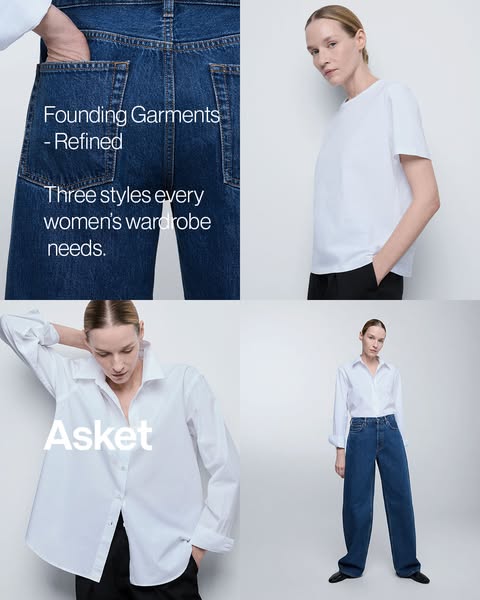
This collection ad features three clothing staples for women from Asket. The ad is visually clean and minimalist, showcasing high-quality denim jeans, a white t-shirt, and a white button-down shirt. The ad emphasizes foundational garments and refined style.
# Brand positioning
Asket is presented as a brand focused on providing refined, foundational garments for women. The brand emphasizes quality and timelessness, offering core wardrobe essentials. This positions Asket as a brand that values simplicity and durability over fleeting trends, targeting consumers who appreciate a minimalist and well-curated wardrobe. The brand's positioning is functional, emphasizing simplicity and quality.
# Product
The ad features three foundational clothing items for women. First, are a pair of dark wash denim jeans with a classic five-pocket design, shown in a close-up view that highlights the fabric's texture. Next is a plain white t-shirt with a standard crew neck and short sleeves. Lastly, there is a white button-down shirt, styled with a relaxed fit. These items are presented as versatile basics suitable for various occasions and body types, designed to serve as building blocks for a functional wardrobe. The jeans, t-shirt, and button-down shirt are all shown in a minimalist context.
# Visual style
The visual style is clean, minimalist, and high quality. The ad uses a grid layout to showcase the products. The lighting is soft and even, with a focus on neutral colors and a sophisticated aesthetic. The image treatment includes background removal and subtle color grading.
# Hooks
Headline: Founding Garments- Refined
# Funnel stage
Top of funnel (Awareness)
# Pain points
None used.
# Value propositions
- Providing a curated selection of essential wardrobe pieces to build a versatile style.
# Benefits
- Refined
- Three styles every women’s wardrobe needs.
# Features
- Founding Garments
# Call to action
None used.
# Social proof
- None used.
# Point of view
- Brand: The POV is consistent throughout the ad, promoting Asket's brand and highlighting the foundational garments they offer.
# Storyline
- The ad opens with a focus on the brand’s core concept. It shows close-up detail of the jeans while emphasizing quality and foundational style. The message being conveyed is that Asket offers garments that are refined and essential for every woman's wardrobe. This narrative is told from the brand's perspective.
- The ad transitions to showcase each of the key styles. This is done to illustrate the breadth of Asket's offerings. The message conveyed is that Asket provides a complete set of wardrobe staples. This section is also narrated from the brand's perspective.
- The final beat features the brand's logo overlaid on an image of the white button down shirt. This is intended to reinforce brand recognition and association with quality basics. The message here is from the brand, reiterating its name and style focus.
# Ad summary
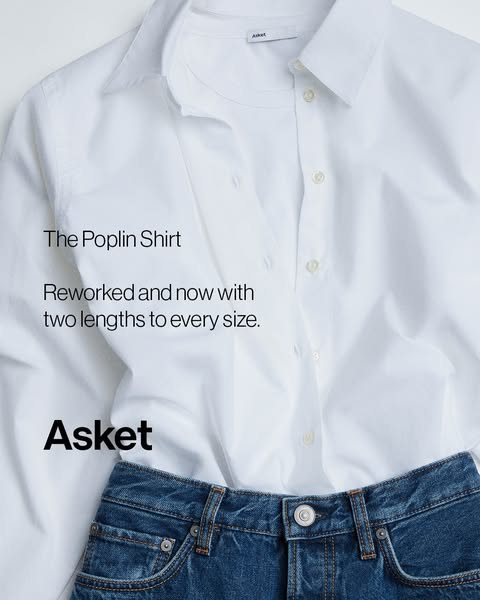
This ad showcases the Asket poplin shirt and its availability in two lengths for every size. The ad promotes the brand's attention to detail and commitment to providing well-fitting basics.
# Brand positioning
Asket positions itself as a brand focused on providing well-fitting, high-quality basics. The brand's identity centers around simplicity, functionality, and a meticulous attention to detail. By offering different lengths for each size, Asket addresses a common problem in the apparel industry, highlighting their commitment to inclusivity and meeting individual customer needs. The brand emphasizes functional benefits, such as a better fit, rather than emotional appeals or fleeting trends.
# Product
The featured product is the Asket Poplin Shirt, a classic button-down shirt made from poplin fabric. The shirt is presented in a clean, crisp white color. The ad highlights that the shirt has been reworked to include two lengths for every size, indicating an improved fit and greater customization options. The design appears simple and timeless, suggesting versatility and ease of wear. The focus on fit addresses the common challenge of finding perfectly sized clothing and positions the shirt as a thoughtfully designed wardrobe staple.
# Visual style
The ad utilizes a clean, minimalist aesthetic. The image is well-lit and features a simple composition with a focus on the product. The color palette is neutral, consisting primarily of white and blue. The overall effect is understated and emphasizes the quality and design of the clothing.
# Hooks
Headline: The Poplin Shirt
# Funnel stage
Middle of funnel (Consideration)
# Pain points
The ad addresses the common frustration of finding clothing that fits properly, as highlighted by the claim of "two lengths to every size."
# Value propositions
- The Poplin Shirt [is] Reworked and now with two lengths to every size.
# Benefits
- improved fit
- greater customization options
# Features
- Reworked
- two lengths to every size
# Call to action
None used.
# Social proof
- None used.
# Point of view
- Brand: The POV is consistently from the brand, showcasing the product and highlighting its features.
# Storyline
- The ad begins by showcasing the Asket Poplin Shirt, introducing the product and immediately conveying its style. This opening aims to grab attention and establish the product as the focal point, from a brand perspective.
- The ad emphasizes the shirt's reworked design, highlighting the availability of two lengths for every size. This detail underscores the brand's commitment to addressing fit issues and offering a tailored experience. This is told from the brand's perspective, emphasizing their innovation and customer-centric approach.
- The ad concludes with the brand name "Asket", reinforcing brand recognition. This ending serves to solidify the brand's identity in the viewer's mind, from a brand perspective.
# Ad summary
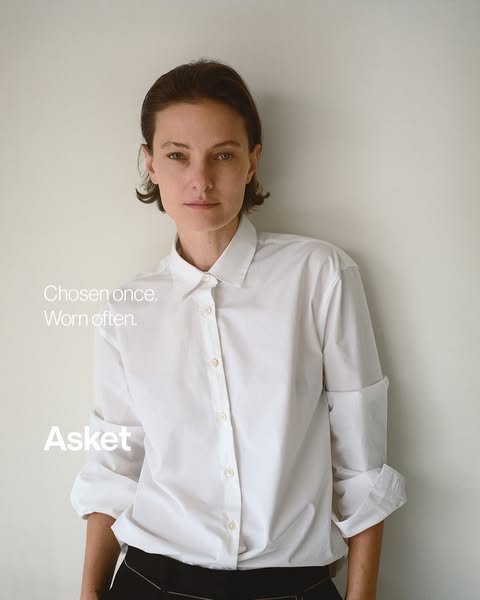
This ad features a model wearing a white, button-down shirt from Asket and emphasizes the brand's focus on timeless, versatile clothing.
# Brand positioning
Asket is presented as a brand focused on timeless and versatile clothing. The brand positions itself as a provider of essential, high-quality pieces designed to be worn often. There is a clear emphasis on sustainability and longevity, contrasting with fast fashion trends. The brand aims to occupy a space in the consumer's mind as a purveyor of classic, well-made garments that stand the test of time, aligning with values of mindful consumption and enduring style. The positioning is both functional, in terms of quality and durability, and emotional, in terms of promoting a lifestyle of intentionality and simplicity.
# Product
The product featured is a white, button-down shirt. It is depicted as a classic wardrobe staple, suitable for various occasions. The shirt appears to be made of high-quality material, with a crisp, clean look. It has a traditional collar and button-down front, with the sleeves casually rolled up. The product is presented as being durable and designed for frequent wear, as highlighted by the phrase "Chosen once. Worn often." The shirt is meant to be a timeless piece that resists fleeting fashion trends, emphasizing its enduring value and sustainability.
# Visual style
The ad has a minimalist and clean visual style, emphasizing the simplicity and timelessness of the product. The production quality appears to be highly polished, resembling a studio shot with controlled lighting. The image treatment includes subtle color grading to maintain a neutral and elegant tone. The typography is integrated seamlessly, with a clean and legible sans-serif font. The overall style is classic and understated, avoiding any trendy or distracting elements.
# Hooks
Headline: Chosen once. Worn often.
# Funnel stage
Top of funnel (Awareness)
# Pain points
The ad implicitly addresses the frustration of disposable fashion and the need for long-lasting, high-quality clothing. Quote: "Chosen once. Worn often."
# Value propositions
- Investing in durable clothing items
- Timeless piece that resists fleeting fashion trends
- Enduring value and sustainability
# Benefits
- Timeless style
- Versatility for various occasions
- Durability and frequent wearability
# Features
- White button-down shirt
- Classic wardrobe staple
- High-quality material
# Call to action
None used.
# Social proof
- None used.
# Point of view
- Customer: The ad features a model wearing the brand's shirt. This presents the product in a real-world context, offering a glimpse into the wearer's perspective and experience.
- Brand: The phrases "Chosen once. Worn often." and "Asket" promote the brand’s values and identity. This communicates its message and positioning directly to the audience.
# Storyline
- The ad opens with a close-up shot of a person wearing a white button-down shirt, suggesting a focus on the garment's quality and fit. This establishes the brand's emphasis on everyday wearability from the customer's POV.
- The text overlay, "Chosen once. Worn often," introduces the brand's commitment to sustainability and lasting style. The brand's POV intends to communicate the value of investing in durable clothing items that withstand frequent use.
- The brand name, "Asket," is displayed to reinforce brand recognition and associate the product with the brand's values and quality. This is delivered from the brand's POV to solidify their identity and offering.
# Ad summary
The Askut brand ad discusses how one of their biggest failures turned into their biggest success, ultimately making them who they are today. The narrator discusses how they started over, wear-tested for months, then opened pre-orders for only 200 pieces. Ultimately they took the feedback, refined the garment again, and now it is one of their highest-rated garments. The narrator suggests that garments don't need to be rushed, they can evolve over time, and that their collection may be complete but their garments are never finished.
# Brand positioning
Asket is presented as a sustainable and quality-focused clothing brand that values a permanent collection over fleeting trends. The brand aims to occupy a space of timelessness and continuous improvement, promoting values of patience, quality, and customer feedback. Asket positions itself against the norms of fast fashion, prioritizing durability, refinement, and thoughtful design over seasonal trends. The brand’s positioning is both functional (quality materials, careful construction) and emotional (the garments “evolve over time” and are “never finished,” implying constant improvement and customer input.
# Product
The featured product is a crewneck sweatshirt, initially launched in 2016 and relaunched after customer feedback. The ad highlights the initial problems with the measurements being off, which led to over 60% of the first run being defective. The sweatshirt was re-engineered with smaller runs, new yarns, and reworked construction and design, wear-tested for months, and pre-ordered in small batches to ensure quality and gather customer feedback. The ad emphasizes the sweatshirt's evolution through customer input and constant refinement, positioning it as a high-quality, constantly improving garment.
# Visual style
The ad has a clean and minimalist aesthetic with a focus on natural lighting and simple backgrounds. The editing style is relatively static, with cuts primarily between shots of the speaker and close-ups of the product. The production quality appears polished, creating a commercial feel. The pacing is moderate, with cuts timed to the speaker's voiceover lines, creating a sense of rhythm and engagement.
# Hooks
Spoken: 00:00–00:03 Ten years ago, this crewneck sweatshirt almost killed us.
Text overlay: 00:00–00:01 10 years (Top center) / 00:01–00:02 crewneck (Top center) / 00:02–00:03 killed us. (Top center)
Visual: 00:00–00:03 The shot features a light-skinned man in his 30s with light brown hair, wearing a white t-shirt and denim button-up shirt. He is positioned in front of a white wall with a dark gray metal shelf behind him. The shelf contains rows of neatly folded clothing, and there are some binders and other supplies on the upper shelf. The camera is stationary and framed from the chest up. / 00:01–00:03 Close-up of the man folding a light gray crewneck sweatshirt on a wooden table. He is wearing a white t-shirt and a denim button-up shirt, and his hands are visible as he folds the shirt. The background is a plain white, and the camera is stationary.
# Funnel stage
Middle of funnel (Consideration)
# Pain points
The main pain point is the risk of producing defective products due to rushed manufacturing and poor quality control. In the ad's own language the measurements were off, and badly.
# Value propositions
- Permanent Collection: Garments don't need to be rushed, they can evolve over time
- Constant Refinement: Feedback is collected from every single customer, and refined it again
- Highest-Rated Garments: Indicates quality, customer satisfaction, and reliability.
# Benefits
- Collection might be complete
- Garments are never finished
- Garments don't need to be rushed
- They can evolve over time
# Features
- Crewneck sweatshirt
- New yarns
- Reworked construction and design
# Call to action
None used.
# Social proof
- "Today, the Sweatshirt is one of our highest-rated garments."
# Point of view
- Brand 100% – Official voice of the brand discussing the brand's mission and products.
# Storyline
- 00:00–00:03 00:00–00:03 Ten years ago, this crewneck sweatshirt almost killed us.
- 00:03–00:09 00:03–00:09 In 2016, it was supposed to be our second ever product. We'd saved up enough to produce 900 pieces.
- 00:09–00:12 00:09–00:12 The launch went great – until the feedback came in.
- 00:12–00:15 00:12–00:15 Measurements were off. Badly.
- 00:15–00:19 00:15–00:19 We measured every sweatshirt we had left in inventory, and over 60% were defective.
- 00:20–00:25 00:20–00:25 We were out of money and had two options: Stop – or change how we work.
- 00:25–00:29 00:25–00:29 We started over. Smaller runs. New yarns. Reworked construction and design.
- 00:29–00:33 00:29–00:33 We wear-tested it for months, then opened pre-orders for just 200 pieces.
- 00:34–00:39 00:34–00:39 After delivery, we collected feedback from every single customer – and refined it again.
- 00:40–00:43 00:40–00:43 Today, the Sweatshirt is one of our highest-rated garments.
- 00:44–00:51 00:44–00:51 Our biggest failure taught us our biggest lesson: that with a permanent collection, garments don't need to be rushed. They can evolve over time.
- 00:52–00:55 00:52–00:55 Our collection might be complete – but our garments are never finished.
# Ad summary
This ad showcases the Asket brand's Oxford shirt and highlights its history, features, and quality. The ad emphasizes the shirt's timeless design and durability, positioning it as a classic garment that transcends trends.
# Brand positioning
Asket is presented as a clothing brand focused on timeless, durable, and well-crafted garments. It emphasizes quality and longevity over fleeting trends. The brand values classic design and careful production methods, promoting a sense of enduring style and thoughtful consumption. It aims to occupy a space in the consumer's mind that values quality and longevity of clothing while standing against the fast fashion industry.
# Product
The ad features the Asket Oxford shirt, a classic garment known for its breathable open weave, button-down collar to stay in place, and box pleat for movement. It is made from two-ply organic cotton Oxford cloth supplied by Somelos in Portugal. The shirt is yarn-dyed for depth and woven for structure and strength. It’s designed for activity, not meetings. The ad emphasizes that it breaks in, not down, highlighting its durability and timeless design. It is intended for everyday life.
# Visual style
The ad has a clean and minimalist aesthetic, with bright lighting and a focus on the product. The editing style includes a mix of static shots and quick cuts, with smooth transitions. The production quality is polished, giving it a commercial feel, and supporting a tone of sophistication and quality. The pacing is consistent, with cuts timed to voiceover lines.
# Hooks
Spoken: 00:00–00:02 Very few garments survive 100 years.
Text overlay: 00:00–00:02 few / 00:00–00:02 survive / 00:00–00:02 a hundred years.
Visual: 00:00–00:02 Medium shot of a light-skinned man, approximately 30 years old, wearing a white button-down shirt. He sits in front of a white wall with a shelf in the background, on which folded shirts are visible. The man looks directly at the camera and speaks. The lighting is bright and even.
# Funnel stage
Middle of funnel (Consideration)
# Pain points
The ad addresses the frustration of clothing trends that quickly go out of style and garments that don't last. This is highlighted by the line, "Very few garments survive 100 years."
# Value propositions
- Longevity and durability: The shirt is designed to last, making it a worthwhile investment.
- Timeless design: The shirt's classic style ensures it remains fashionable across decades.
- Quality materials and construction: Made with high-quality organic cotton and careful weaving techniques.
# Benefits
- Durability
- Timeless design
- Designed for activity
- Breaks in, not down
# Features
- Breathable open weave
- Buttoned-down collar to stay in place
- A box pleat for movement
- Two-ply organic cotton Oxford cloth
- Yarn-dyed
- Woven for structure and strength
# Call to action
None used.
# Social proof
- None used.
# Point of view
- Brand 100% – The entire ad is narrated by a person associated with the brand who shares the history, design and materials used to create the Oxford shirt.
# Storyline
- 00:00–00:02 00:00–00:02 Few garments survive a hundred years, setting up the scarcity and longevity that frames the value of this garment.
- 00:02–00:04 00:02–00:04 Introducing the shirt and beginning to unbutton it, hinting at the product reveal.
- 00:04–00:08 00:04–00:08 Contextualizing the shirt's origins in the late 1800s polo fields, giving a sense of heritage and history that suggests its longstanding quality.
- 00:08–00:11 00:08–00:11 Highlighting functional features like breathable weave and button-down collar, speaking to the quality of the shirt.
- 00:12–00:15 00:12–00:15 Explaining that a box pleat is added for movement, emphasizing activity.
- 00:15–00:17 00:15–00:17 Establishing that the product was made for activity and not meetings, framing the shirt's quality and purpose.
- 00:17–00:25 00:17–00:25 Charting the shirts history from the sport of polo, to campuses, to presidents, and into everyday life, stressing the versatility of the product and its timelessness.
- 00:25–00:28 00:25–00:28 Remarking on how little the shirt has changed over time, reiterating the idea of a perfect product.
- 00:28–00:34 00:28–00:34 Speaking about the shirts proportions, indicating it was right from the beginning and nothing needed to be corrected, emphasizing how great this shirt is.
- 00:34–00:39 00:34–00:39 Reinforcing that the shirt is archetypal and doesn’t belong to any decade, adding to its timelessness.
- 00:39–00:44 00:39–00:44 Explaining that the brand makes the shirts from two-ply organic cotton Oxford cloth supplied by Somelos in Portugal, giving insight into the quality and sourcing of the product.
- 00:44–00:49 00:44–00:49 Describing how the shirt is yarn-dyed for depth and woven for structure and strength, repeating the shirts reliability.
- 00:49–00:54 00:49–00:54 The voiceover explains that it takes over 50 steps from yarn to finished product, which highlights the amount of detail put into the shirt.
- 00:55–01:04 00:55–01:04 Concluding that the shirt works and is why it is still here, summarizing the importance of quality and timelessness.
- 01:05–01:06 01:05–01:06 Presenting the Asket logo, reminding viewers of the brand.
# Ad summary
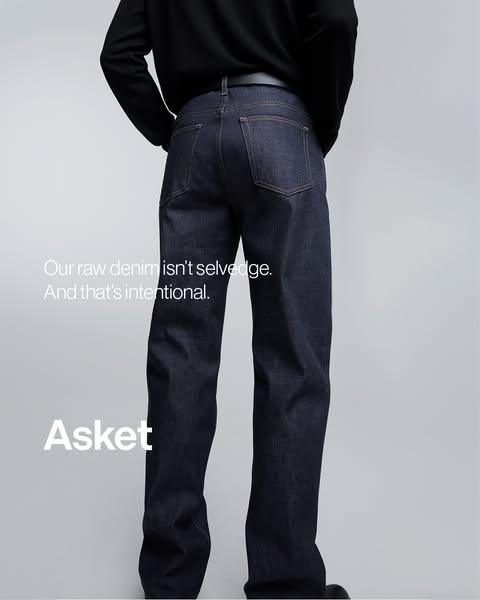
This ad challenges assumptions about raw denim by featuring ASKET's non-selvedge raw denim jeans. The ad uses a close-up shot of the jeans being worn to highlight their unique construction and quality, aiming to appeal to consumers who appreciate intentional design.
# Brand positioning
ASKET is presented as a brand that values intentionality and challenges traditional norms within the fashion industry. By explicitly stating that their raw denim is "not selvedge" and that this choice is "intentional," the brand positions itself as thoughtful and deliberate in its design choices. This approach suggests a focus on functionality and a departure from conventional aesthetics, appealing to consumers who appreciate transparency and purpose-driven design.
# Product
The ad showcases ASKET's raw denim jeans, specifically highlighting that they are intentionally designed without a selvedge edge. Raw denim is typically known for its rigid, unwashed state and potential for unique fading over time. The jeans are presented in a dark wash with visible stitching details, emphasizing quality and construction. The ad subtly challenges the assumption that selvedge is a necessary feature of high-quality raw denim, suggesting that ASKET prioritizes other aspects of design and functionality. The jeans are shown being worn, indicating their use as everyday apparel. By emphasizing the "intentional" choice to forgo selvedge, the ad addresses a potential purchase barrier for denim enthusiasts who equate selvedge with superior quality.
# Visual style
The ad uses a minimalist, studio-shot aesthetic. The lighting is soft and even, creating a clean and modern look. The focus is on the product, with a neutral color palette that emphasizes the texture and details of the denim. The typography is simple and legible, complementing the overall understated style. The image treatment is clean, with minimal retouching, lending it a highly polished feel.
# Hooks
Headline: Our raw denim isn’t selvedge.
And that’s intentional.
# Funnel stage
Middle of funnel (Consideration)
# Pain points
The ad addresses the assumption that selvedge is a necessary feature of high-quality raw denim. “Our raw denim isn’t selvedge” the ad copy explicitly acknowledges this concern and offers reassurance.
# Value propositions
- Non-selvedge raw denim: Appeals to consumers who appreciate intentional design and may be open to challenging traditional norms in fashion.
# Benefits
- challenges conventional assumptions about denim
- emphasizes thoughtful design choices
# Features
- raw denim
- not selvedge
- intentional
# Call to action
None used.
# Social proof
- None used.
# Point of view
- Brand: The brand asserts that their raw denim jeans are intentionally designed without selvedge to highlight their unique approach to denim construction.
# Storyline
- The ad opens by asserting “Our raw denim isn’t selvedge.” This statement immediately challenges a common expectation about raw denim, grabbing the audience's attention. The brand is telling this part of the story to directly address a potential misconception about their product.
- The ad continues with, “And that’s intentional.” The brand follows the initial statement with a clear explanation, reinforcing that their design choice is deliberate. The brand is telling the consumer that their jeans are intentionally designed this way to convey purpose and thoughtfulness behind the product.
- The ASKET logo is displayed. The brand wants to emphasize the overall brand quality and design.
# Ad summary
This image ad showcases different pieces of apparel from the brand ASKET and introduces a refined Founding Garments collection.
# Brand positioning
ASKET presents itself as a purveyor of refined founding garments, suggesting a focus on essential, high-quality pieces that form the foundation of a woman's wardrobe. The brand implies a sense of timelessness and enduring style, offering carefully selected styles designed to meet every woman's wardrobe needs. This positioning suggests a commitment to sustainability and mindful consumption, moving away from fast fashion trends toward durable, versatile items.
# Product
The ad features a curated selection of women's clothing, highlighting three essential styles that ASKET believes every woman needs in her wardrobe. First, it showcases a pair of dark wash denim jeans, suggesting a classic, versatile staple. Next, a basic white t-shirt is presented, emphasizing simplicity and essentiality. Finally, a white button-down shirt is featured, offering a more refined and polished option. Each garment is displayed on a model, demonstrating how it can be worn and styled. The ad subtly promotes the idea that these pieces are foundational, suggesting they can be mixed and matched to create various outfits.
# Visual style
The ad features a clean and minimalist visual style. The production quality is high, with professional studio shots and neutral backgrounds. The color palette is restrained, dominated by whites, blues, and blacks, conveying a sense of sophistication and simplicity. The grid layout, with each product highlighted in its quadrant, adds to the organized feel.
# Hooks
Headline: Founding Garments - Refined Three styles every women's wardrobe needs.
# Funnel stage
Top of funnel (Awareness)
# Pain points
The ad implicitly addresses the pain point of having a cluttered or incomplete wardrobe, suggesting that ASKET offers a solution by providing essential, versatile pieces that form the foundation of a well-curated collection.
# Value propositions
- Founding Garments - Refined Three styles every women's wardrobe needs.
# Benefits
- Refined
- Three styles every women's wardrobe needs
# Features
- Founding Garments
# Call to action
None used.
# Social proof
- None used.
# Point of view
- Brand: The entire image presents a brand-centric point of view, showcasing the garments in styled arrangements and emphasizing ASKET's role in providing wardrobe essentials.
# Storyline
- The brand, ASKET, leads with a bold statement that its foundational garments are refined and include three styles every woman's wardrobe needs. This opening positions ASKET as an authority on essential clothing and immediately establishes the core message of the ad.
- Next, a model wearing a basic white t-shirt and black pants. This visual supports the claim of refined garments and illustrates the t-shirt's simplicity and versatility.
- The focus shifts to the brand itself, visually displayed next to a model in a white button-down shirt and black pants. This beat highlights the brand's name and aesthetic, emphasizing its role in providing these essential pieces.
- The ad concludes by presenting a full outfit featuring the brand's jeans, worn with the white button-down shirt. The visual reinforces the idea that the brand offers complete, stylish looks for women.
# Ad summary
The ad features a male founder or spokesperson explaining the brand's philosophy and approach to clothing production. It starts by highlighting a common consumer pain point: having a closet full of clothes but nothing to wear, linking it to "planned obsolescence" in fast fashion. The brand, Asket, then introduces its alternative model of building a "permanent collection" with limited, continuously refined wardrobe archetypes. It emphasizes the use of natural, traceable materials that age well and break down naturally, transparent and exclusive European manufacturing for accountability, and inclusive sizing options. The ad concludes by stating that Asket's mission is to create "fewer garments, that matter more," highlighting their commitment to longevity and responsibility beyond purchase.
# Brand positioning
Asket positions itself as an antithesis to fast fashion, occupying a space that values longevity, quality, transparency, and sustainability over fleeting trends and mass production. The brand aims to be seen as a thoughtful, responsible choice for consumers who are tired of 'planned obsolescence' and seek fewer, but better, garments. It promotes values of craftsmanship, environmental consciousness, and ethical manufacturing, implicitly challenging the wasteful practices of mainstream fashion. The brand's positioning is primarily functional in its emphasis on durable materials and proper fit, but also deeply emotional in its appeal to a sense of responsibility, lasting value, and a more considered lifestyle.
# Product
The ad promotes a core collection of timeless, high-quality clothing essentials, referred to as 'wardrobe archetypes,' which include items like a white crewneck t-shirt, blue jeans, and a merino sweater. The products are designed for longevity and versatility, intended to be worn for ten years or more. They are explicitly made from natural, traceable materials such as organic cotton, regenerative wool, and European linen, which are highlighted for their ability to age better, breathe better, feel better on the body, soften with time, and break down naturally without microplastics. The brand also emphasizes its commitment to fit, offering length options for every size to accommodate diverse body types and preferences, countering the 'one ideal body' sizing approach. Additionally, the brand offers free repairs and takes back garments for end-of-life processing, extending the product's lifecycle and the brand's responsibility.
# Visual style
The ad features a clean, minimalist, and relatively polished visual style, leaning towards a 'docu-style commercial' feel. The editing uses a mix of static medium-wide shots of the spokesperson and quick cuts to close-ups of product details, hands interacting with fabric, and industrial processes. The production quality is high-end, utilizing clear lighting, crisp focus, and a muted color palette (whites, greys, blues, natural wood tones) that aligns with the brand's aesthetic of timelessness and simplicity. There's a subtle visual motif of hands meticulously working with fabric or garments, emphasizing craftsmanship and care. The pacing varies; spokesperson segments are slower and deliberate, while product/process demonstrations use quicker cuts. Audio-visual sync is prevalent, with cuts and on-screen text appearing precisely with the spoken words, enhancing clarity and impact.
# Hooks
Spoken: A decade ago, we were standing in front of our wardrobes, full of clothes, and still felt like we had nothing to wear.
Text overlay: A decade ago / we were standing / in front of our wardrobes, / full of clothes, / and still felt / like we had / nothing to wear
Visual: 00:00–00:01: A medium wide shot shows a young adult white male, seated on a modern black metal chair with a dark grey back and seat, in a minimalist room with light wooden floorboards. He is wearing a dark blue long-sleeved shirt and blue jeans, with brown canvas shoes and his hands clasped on his lap. He is looking slightly to the left, with a thoughtful expression. A large white multi-pane window with white curtains on either side dominates the background, letting in bright, diffused light. There is white text overlay 'A decade ago'. / 00:01–00:02: A close-up shot of the same male, shoulders up, directly addressing the camera. He has light brown hair styled slightly messy, blue eyes, and a fair complexion. He wears a dark blue crewneck shirt. He speaks with an earnest expression. White text overlay 'we were standing'. / 00:02–00:03: The close-up continues, with the man speaking. White text overlay 'in front of our wardrobes,'. / 00:03–00:04: The close-up continues, with the man speaking. White text overlay 'full of clothes,'. / 00:04–00:05: The close-up continues, with the man speaking. White text overlay 'and still felt'. / 00:05–00:06: The close-up continues, with the man speaking. White text overlay 'like we had'. / 00:06–00:06: The close-up continues, with the man speaking. White text overlay 'nothing to wear'.
# Funnel stage
Top of funnel (Awareness)
# Pain points
The central frustration is the cycle of 'planned obsolescence' in the fashion industry, leading consumers to constantly buy new clothes but still feel like they have 'nothing to wear'. The ad implicitly highlights the frustration of low-quality garments that don't last and the lack of truly timeless, well-fitting essentials. "A decade ago, we were standing in front of our wardrobes, full of clothes, and still felt like we had nothing to wear." (00:00-00:06). "But somehow, they were getting harder to find buried under constant trends and seasonal updates." (00:17-00:22).
# Value propositions
- Instead of launching collections every season, we would build one permanent collection. (value: timelessness, reduced consumer pressure)
- If a garment is meant to stay for ten years or more, you design it fundamentally differently. (value: durability, thoughtful design)
- You spend more time on fabric. On fit. On construction. On fibre sourcing. (value: superior quality, meticulous craftsmanship)
- You don’t rush it to market because it doesn’t have a three-week window to sell. (value: anti-fast fashion, considered production)
- We chose natural materials only because they are renewable, they age better, breathe better, and feel better on the body. (value: sustainability, comfort, longevity)
- traceable materials that soften with time instead of breaking down into microplastics. (value: environmental responsibility, natural aging)
- We chose to manufacture transparently and exclusively in Europe... because proximity creates accountability. (value: ethical production, transparency)
- We introduced length options to every size... A permanent garment deserves a fit that works for more frames and more preferences. (value: inclusivity, personalized fit)
- we offer free repairs and take them back when you’re done with them, regardless of their condition. (value: extended product life, circularity, brand responsibility)
- Responsibility does not end at checkout. (value: holistic sustainability, long-term commitment)
- We started it to create fewer garments, that matter more. (value: meaningful consumption, impactful production)
# Benefits
- still felt like we had nothing to wear (by providing essentials)
- pieces we actually relied on were always the same (by offering those essentials)
- garment is meant to stay for ten years or more
- design it fundamentally differently
- spend more time on fabric, on fit, on construction, on fibre sourcing
- don't rush it to market
- doesn't have a three-week window to sell
- materials are renewable
- they age better
- breathe better
- feel better on the body
- soften with time
- instead of breaking down into microplastics
- materials that can eventually return to the earth
- proximity creates accountability
- visit our factories
- understand every step from yarn to finished garment
- work with mills and manufacturers who take pride in their craft, their people and their planet
- fit that works for more frames and more preferences
- create fewer garments, that matter more
# Features
- one permanent collection
- limited range of wardrobe archetypes
- developed slowly
- refined continuously
- natural materials only
- organic cotton
- regenerative wool
- European linen
- traceable materials
- manufacture transparently and exclusively in Europe
- length options to every size
- free repairs
- take them back when you're done with them, regardless of their condition
# Call to action
None used.
# Social proof
- None used.
# Point of view
- Brand 100% – The entire video is narrated by a spokesperson who articulates the brand's philosophy, critique of the fashion industry, and product development strategy from the official brand perspective.
# Storyline
- 00:00–00:05 00:00–00:05: A decade ago, we were standing in front of our wardrobes, full of clothes, and still felt like we had nothing to wear.
- 00:00–00:05 This establishes a relatable pain point for the audience, suggesting a common frustration with modern wardrobes despite owning many items. It sets a reflective, slightly critical tone towards current consumption habits, narrated by a knowledgeable brand spokesperson.
- 00:06–00:09 00:06–00:09: We realised that the pieces we actually relied on were always the same.
- 00:06–00:09 This transitions from the problem to a key observation: the value of essential, reliable pieces. It reinforces the idea that consumers naturally gravitate towards foundational items, setting the stage for the brand's focus on such pieces. The spokesperson maintains a reflective tone, sharing a realization.
- 00:09–00:13 00:09–00:13: A white crewneck t-shirt. A pair of blue jeans. A merino sweater.
- 00:09–00:13 The speaker lists specific examples of these reliable pieces, making the observation concrete and relatable. This directly connects to the brand's product offering without explicitly naming it yet. The tone remains informative and grounded.
- 00:13–00:17 00:13–00:17: Garments that had existed for decades, sometimes even over a century.
- 00:13–00:17 This highlights the timeless nature of these core garments, implying that their inherent value transcends trends. The use of historical footage visually supports this point, creating a sense of heritage and tradition, contrasting with fast fashion's ephemeral nature.
- 00:17–00:22 00:17–00:22: But somehow, they were getting harder to find buried under constant trends and seasonal updates.
- 00:17–00:22 This reintroduces the problem, framing fast fashion as an obstacle to finding quality essentials. It uses the visual of someone examining a garment label to suggest a search for quality that is now obscured by superficial trends. The tone is critical of the industry status quo.
- 00:23–00:26 00:23–00:26: Fashion is built on renewal. It depends on us getting tired of what we already own.
- 00:23–00:26 This offers a deeper critique of the fashion industry's business model, explaining the underlying mechanism that drives overconsumption. The spokesperson's expression is serious and thoughtful, conveying a sense of exposing an uncomfortable truth.
- 00:27–00:29 00:27–00:29: It’s called planned obsolescence.
- 00:27–00:29 The speaker explicitly names the problem, using a formal term that adds weight to the critique and educates the viewer. His direct address reinforces the brand's informed stance.
- 00:30–00:32 00:30–00:32: Your clothing isn’t really meant to stay around for long.
- 00:30–00:32 This directly addresses the viewer, personalizing the critique and highlighting the transient nature of fast fashion garments. The tone is empathetic, acknowledging a shared consumer experience.
- 00:33–00:35 00:33–00:35: We decided to do something else.
- 00:33–00:35 This marks a turning point in the narrative, introducing the brand's solution as a direct response to the identified problem. The tone shifts to one of resolve and innovation, hinting at a new approach.
- 00:36–00:43 00:36–00:43: Instead of launching collections every season, we would build one permanent collection. A limited range of wardrobe archetypes, developed slowly and refined continuously.
- 00:36–00:43 The brand's core strategy is revealed: prioritizing timelessness and continuous improvement over seasonal trends. The visual shows clothing on hangers, implying the 'permanent collection,' and then design work, emphasizing the 'slow' and 'refined' development. The tone is deliberate and confident.
- 00:46–00:50 00:46–00:50: If a garment is meant to stay for ten years or more, you design it fundamentally differently.
- 00:46–00:50 This explains the brand's design philosophy, linking longevity directly to a different, more meticulous design process. The visual shows a hand measuring fabric, underscoring precision. The tone is informative and emphasizes quality.
- 00:51–00:54 00:51–00:54: You spend more time on fabric. On fit. On construction. On fibre sourcing.
- 00:51–00:54 The speaker lists specific areas of focus in their design process, detailing the commitment to quality. The visuals cycle through different stages of material processing (textile machine, sheep on a hill), illustrating the depth of their material consideration. The tone is detailed and thorough.
- 00:55–00:58 00:55–00:58: You don’t rush it to market because it doesn’t have a three-week window to sell.
- 00:55–00:58 This reiterates the contrast with fast fashion's rapid turnover, highlighting the benefit of a longer product lifecycle for the brand's approach. The spokesperson's direct gaze and slightly emphatic tone underscore the deliberate choice.
- 00:59–01:05 00:59–01:05: We chose natural materials only because they are renewable, they age better, breathe better, and feel better on the body.
- 01:05–01:05 This details the material selection criteria, emphasizing benefits for both the environment (renewable) and the wearer (comfort, durability). The visuals show hands interacting with soft fabrics and a model wearing a white t-shirt, appealing to sensory experience. The tone is clear and benefit-oriented.
- 01:06–01:14 01:06–01:14: Organic cotton, regenerative wool, European linen – traceable materials that soften with time instead of breaking down into microplastics.
- 01:06–01:14 Specific materials are named, adding credibility, and their sustainable attributes are highlighted, contrasting with synthetic alternatives and their environmental impact. The visual of a tag with 'Asket' and 'traceable' reinforces transparency. The tone is educational and highlights environmental responsibility.
- 01:15–01:16 01:15–01:16: Materials that can eventually return to the earth.
- 01:15–01:16 This concisely summarizes the eco-friendly lifecycle of their materials, emphasizing biodegradability. The visual of stacked, folded clothing continues to reinforce the product itself. The tone is responsible and forward-thinking.
- 01:18–01:22 01:18–01:22: We chose to manufacture transparently and exclusively in Europe.
- 01:18–01:22 The focus shifts to manufacturing ethics and location, promoting responsible production. Factory footage visually supports this claim, showing real production processes. The tone is direct and factual.
- 01:23–01:26 01:23–01:26: Not because it sounds romantic, but because proximity creates accountability.
- 01:23–01:26 This explains the strategic rationale behind European manufacturing, emphasizing ethical oversight rather than mere perception. The spokesperson's serious expression underlines the pragmatism and commitment to accountability.
- 01:27–01:36 01:27–01:36: It allows us to visit our factories, to understand every step from yarn to finished garment, and to work with mills and manufacturers who take pride in their craft, their people and their planet.
- 01:27–01:36 This elaborates on the benefits of local manufacturing, highlighting direct involvement in the production process and partnerships with ethical producers. Visuals of factory workers performing tasks reinforce the hands-on approach and pride in craftsmanship. The tone is one of deep involvement and respect.
- 01:39–01:45 01:39–01:45: We introduced length options to every size because most sizing systems are built on one 'ideal' body and just scaled up and down.
- 01:39–01:45 The brand addresses another common industry problem: restrictive sizing, and introduces its solution of inclusive sizing. The spokesperson explains the flaw in conventional sizing with a slightly exasperated but understanding tone.
- 01:46–01:47 01:46–01:47: Real people don’t look like that.
- 01:46–01:47 This makes an empathetic and realistic statement about body diversity, directly challenging unrealistic industry standards. The spokesperson's direct gaze seeks to connect with the viewer on a personal level.
- 01:48–01:52 01:48–01:52: A permanent garment deserves a fit that works for more frames and more preferences.
- 01:48–01:52 This links the concept of a 'permanent garment' to the importance of inclusive fit, emphasizing that enduring quality also means fitting well for a diverse range of people. The visual shows hands folding fabric, suggesting careful design for different body shapes. The tone is empathetic and customer-centric.
- 01:53–02:00 01:53–02:00: And because we expect our garments to last, we offer free repairs and take them back when you’re done with them, regardless of their condition.
- 01:53–02:00 The brand outlines its commitment to product longevity beyond the point of sale, offering services that counter the disposable nature of fast fashion. The close-up visual of a hand sewing a label and an 'Asket' tag reinforces the repair aspect and brand identity. The tone is one of extended responsibility.
- 02:01–02:03 02:01–02:03: Responsibility does not end at checkout.
- 02:01–02:03 This powerful statement summarizes the brand's holistic approach to sustainability and consumer commitment. It acts as a final, strong value proposition. The spokesperson's earnest expression conveys sincerity.
- 02:04–02:07 02:04–02:07: We didn’t start Asket to add more clothing to the world.
- 02:04–02:07 This re-states the brand's founding principle, emphasizing a purpose beyond mere commerce. The tone is purposeful and impactful, reinforcing their mission.
- 02:08–02:11 02:08–02:11: We started it to create fewer garments, that matter more.
- 02:08–02:11 This serves as the concluding mission statement, encapsulating the brand's core value proposition and desired impact. The spokesperson's direct gaze and calm, confident delivery leave a lasting impression of authenticity and conviction.
# Ad summary
This ad presents the Asket brand, positioning it as an alternative to the fast-fashion industry. It highlights Asket's commitment to permanent design and free repairs, promoting customer satisfaction and conscious consumerism.
# Brand positioning
Asket is presented as a clothing brand that stands against the practices of the fast fashion industry. The brand takes an opposing path through its unique method of only having one permanent collection, no seasonal sales, and no artificial deadlines. The brand positions itself as a brand that makes clothing to stay with you forever. Asket's brand promotes values that align with ethical consumerism and longevity, contrasting with the fleeting trends and planned obsolescence of typical fashion brands. Its positioning is both functional (high-quality materials, free repairs) and emotional (fewer regrets, more satisfaction) which appeals to consumers who want to make thoughtful, lasting purchases.
# Product
Asket's primary offering is high-quality, durable clothing designed to last. Rather than following seasonal trends, Asket focuses on a single, permanent collection crafted with better fibers and meticulous construction. The brand chooses to offer free repairs instead of replacements, signaling the quality and durability of the garments. The ad directly addresses purchase barriers by promising fewer regrets and fewer impulse buys, coupled with more satisfaction. By rejecting seasonal sales and artificial deadlines, Asket aims to instill confidence that their products are always worth the investment, encouraging a more thoughtful, less reactive approach to buying clothing. The items showcased throughout are presented with muted, neutral tones, suggesting the simplicity and timeless design of their clothing.
# Visual style
The ad has a clean and straightforward aesthetic, combining direct address with documentary-style footage. The editing style alternates between static shots of the brand representative speaking and quick cuts showcasing the production process and clothing details. The production quality is polished but not overly stylized, aiming for an authentic and informative feel. The pacing is moderate, maintaining a steady rhythm with cuts timed to voiceover lines. The overall visual style supports the brand's message of transparency, quality, and timeless design.
# Hooks
Spoken: Male 1: The fashion industry doesn't want you to be satisfied.
Text overlay: fashion / doesn't / to be
Visual: 00:00–00:02: Close-up shot of a man with fair skin and light brown hair, wearing a dark blue long sleeve shirt, sitting in front of a blurred background featuring a shelving unit with neatly folded clothes. He's looking directly at the camera and speaking with a slight smile, in a conversational tone.
# Funnel stage
Middle of funnel (Consideration)
# Pain points
The constant cycle of buying new clothes due to seasonal trends and planned obsolescence can lead to consumer dissatisfaction, financial strain, and environmental impact. The ad refers to these points in a conversational tone.
# Value propositions
- The value comes in the form of free repairs and not replacements.
- Timeless design.
# Benefits
- Fewer regrets.
- Fewer impulse buys.
- More satisfaction.
# Features
- One permanent collection.
- Free repairs instead of replacements.
- Better fibers.
- Meticulous construction.
# Call to action
None used.
# Social proof
- None used.
# Point of view
- Brand 80% – The majority of the ad is told from the brand's official perspective, detailing its philosophy, design process, and value proposition.
- Customer 20% – The ad suggests an implied customer POV by detailing the positive personal outcomes (fewer regrets, more satisfaction) expected from buying Asket clothing.
# Storyline
- 00:00–00:02 The ad begins with the founder/narrator speaking directly to the camera, framing the fashion industry's tendency to encourage constant consumption.
- 00:02–00:16 The ad goes on to support this claim with examples of business logic, with examples of seasonal drops, mid-season updates, and weekly launches, emphasizing the industry's reliance on rapid turnover.
- 00:17–00:20 Switching to the brand perspective, the narrator explains Asket's decision to take an "opposite path" ten years ago, establishing the brand's core philosophy of permanent design.
- 00:21–00:26 Asket's perspective continues to explain that their brand has "one permanent collection" and no seasonal sales, which reinforces the brand's anti-fast-fashion stance.
- 00:27–00:36 The ad states that clothing that's meant to last forever requires careful development, better fibers, and obsessive construction. The ad uses visuals to support the brand's perspective on the design process, and how Asket produces its products.
- 00:37–00:39 Moving from a visual of Asket branded clothing, the ad presents Asket as a brand with a plan, and that it offers free repairs instead of replacements, which underscores Asket's commitment to longevity and quality.
- 00:40–00:44 Returning to the brand perspective, the narrator assures the audience that the result is more than just a better product or something better for the planet. The ad suggests the consumer will experience benefits as well.
- 00:44–00:48 The ad states that as a consumer of Asket products, one can expect fewer regrets, fewer impulse buys, and more satisfaction.
- 00:49–00:56 From Asket's perspective, permanent design isn't activism, but common sense, which ends the ad with one final point, and the ad is closed with the Asket brandmark.
# Ad summary
An advertisement for the Asket sweatshirt, emphasizing its design and quality.
# Brand positioning
Asket is presented as a brand focused on essential, timeless garments, emphasizing continuous refinement and quality. The brand positions itself away from fast fashion, with a focus on a single, carefully developed product, the sweatshirt. It aims to occupy a space in the consumer's mind as a brand that values thoughtful design and enduring style over fleeting trends. The brand promotes a minimalist lifestyle, choosing a functional approach and focusing on the garment's improvement.
# Product
The advertised product is the Asket sweatshirt, a garment the brand describes as being at the center of continuous refinement. The sweatshirt is shown in grey and made of a soft-looking material. The ad highlights the sweatshirt's role in the brand's design process, suggesting it is a key product that embodies the brand's values of quality and thoughtful design. The sweatshirt's USP is its design and the idea that it represents a commitment to perfecting a single, essential item. The ad conveys that the sweatshirt is worth buying because it is part of the brand's design philosophy, and the brand's commitment to high-quality.
# Visual style
The ad has a polished aesthetic, reminiscent of a high-end commercial. The editing style is simple, consisting of static shots and smooth transitions. The production quality is high, which reinforces the brand's image of attention to detail. The pacing is slow and consistent, with few cuts per minute. The audio and visual elements are synced to create a calm and sophisticated tone.
# Hooks
Text overlay: 00:00–00:06 The Sweatshirt / 00:00–00:06 Asket
Visual: 00:00–00:02: A fair-skinned, light-haired model stands near a white wall. He is wearing a grey crewneck sweatshirt and dark-colored pants. Parts of a black camera are shown in the foreground. Text overlay reads "The Sweatshirt" and "Asket."
# Funnel stage
Top of funnel (Awareness)
# Pain points
None used.
# Value propositions
- Commitment to perfecting a single, essential item.
- Part of the brand's design philosophy
# Benefits
- Garment at the center of continuous refinement
# Features
- Crewneck sweatshirt
# Call to action
None used.
# Social proof
- None used.
# Point of view
- Brand 100% – The entire ad is presented from the brand's perspective, highlighting their product and philosophy.
# Storyline
- 00:00–00:13 00:00–00:13: The ad opens with a model in a grey Asket sweatshirt posing during a photoshoot. The text overlay states that the sweatshirt is the garment that taught the brand continuous refinement. The brand name is displayed to reinforce the product and the company's dedication to improvement.
# Ad summary
This ad is about ASKET and the movement toward a minimalist closet. The founder is featured and speaking about their intention of quality and sustainability. They did an experiment with men wearing only 8 items for a year, to see if less choice would result in more clarity. They believe that clothing shouldn't define you, but support who you already are.
# Brand positioning
ASKET presents itself as a sustainable and intentional brand of minimal, timeless garments designed to support rather than define the wearer. It is positioned as an antidote to the constant renewal and noise of the fashion industry, offering pieces that have been around for decades. The brand aligns with values of intention, quality, and clarity, advocating for investing in what one truly values and letting go of the rest. It stands apart from the fast-fashion industry that thrives on fleeting trends and new identities.
# Product
ASKET offers quality, durable garments designed to last and support the wearer's identity rather than define it. The advertised garments are classic and timeless pieces, as shown throughout the ad: a white t-shirt, black long-sleeved shirt, black sweater, light-blue button-down shirt, and dark wash jeans. The brand did an experiment where they asked 50 men to wear only eight garments for an entire year, not to prove durability, but to reveal the feeling of relief that comes with having less choice, less noise, and more clarity in their wardrobe. The garments are intended to help the wearer express themselves.
# Visual style
The ad has a polished and clean aesthetic, with a mix of studio-lit shots and bright, natural lighting. The editing style is smooth, with occasional quick cuts to historical footage and product shots. The production quality is high, giving off a commercial feel. The pacing is consistent, with audio-visual sync primarily in the historical shots and transitions between product categories.
# Hooks
Spoken: 00:00–00:03 Ever stared into a full wardrobe and felt like you had nothing to wear?
Text overlay: 00:00–00:03 stared into / 00:01–00:03 wardrobe / 00:02–00:03 nothing / 00:02–00:03 to wear?
Visual: 00:00–00:03 Medium shot of a fair-skinned man with short brown hair, wearing a dark blue long-sleeve t-shirt. He looks directly at the camera with a concerned expression. Behind him is a white wall and a shelf with folded clothing and boxes.
# Funnel stage
Top of funnel (Awareness)
# Pain points
The frustration of staring into a full wardrobe and feeling like you have nothing to wear.
# Value propositions
- Clothing shouldn't define who you are. It should support who you already are.
# Benefits
- Less choice
- Less noise
- More clarity
- Helps you express yourself
- Invest in what you truly value and let go of the rest
# Features
- Quality garments
- Durable garments
- Timeless pieces
# Call to action
None used.
# Social proof
- '
# Point of view
- Brand 100% – A founder speaks on behalf of the brand and its values.
# Storyline
- 00:00–00:03 00:00–00:03 A man looks directly at the camera and poses a question to the audience.
- 00:03–00:06 00:03–00:06 The man is sitting in a chair in front of a large window.
- 00:06–00:13 00:06–00:13 The man is close to the camera. He says that 'fashion feeds us constant renewal'.
- 00:13–00:17 00:13–00:17 Historical clips are shown of people wearing classic clothing.
- 00:17–00:23 00:17–00:23 The man is again sitting in the chair as he describes an experiment the brand ran.
- 00:23–00:26 00:23–00:26 The man is again sitting in the chair as he shares the biggest surprise that came from the experiment: the relief.
- 00:26–00:32 00:26–00:32 Close up images of people and clothing are shown as the man describes clarity from less choice.
- 00:32–00:36 00:32–00:36 The man is sitting in a chair as he describes how clothing shouldn't define you.
- 00:36–00:46 00:36–00:46 The man is close to the camera as he explains that the brand philosophy isn't about sacrifice, but intention.
# Ad summary
This ad showcases the brand Asket and their high quality clothing in minimalist design. The ad has a modern and classic aesthetic.
# Brand positioning
Asket is presented as a brand that values minimalism and high-quality wardrobe staples. The brand appears to position itself in opposition to fast fashion by promoting the idea of a smaller wardrobe that goes further, implying a focus on durable, timeless pieces. The brand's tone is understated and sophisticated, aligning with a lifestyle of considered consumption and classic style. The brand seems to ignore trends and instead focuses on functional, well-made garments that transcend fleeting fashion cycles.
# Product
The ad prominently features a white button-down shirt made by Asket. The shirt is presented as a versatile wardrobe essential, suitable for various occasions. While the specific material is not explicitly mentioned, the shirt appears to be made from high-quality fabric. There is also a navy pair of trousers featured in the ad. The ad focuses on the concept of a smaller, more curated wardrobe, suggesting that Asket products are designed to be foundational pieces that can be mixed and matched. The shirt's simplicity and timeless design are highlighted, addressing the purchase barrier of clothing that quickly goes out of style.
# Visual style
The ad has a polished, minimalist aesthetic. The editing style is characterized by static shots. The production quality is high-end, with clean lighting and a focus on showcasing the quality of the garment. The pacing is slow. Audio-visual sync is not emphasized, with the visuals serving to complement the background music.
# Hooks
Text overlay: 00:00–00:06 A smaller wardrobe goes further / 00:00–00:06 Asket
Visual: 00:00–00:06: A young woman stands in a bright white hallway. She has fair skin, short brown hair, and wears a white button-down shirt and dark blue pants. The camera frames her from the waist up. She looks directly at the camera with a neutral expression, then turns to her right to show her profile, then turns away from the camera. Behind her, a circular opening in the wall casts a soft glow. The lighting is bright and even. Text overlay reads 'A smaller wardrobe goes further' and 'Asket'.
# Funnel stage
Top of funnel (Awareness)
# Pain points
The ad addresses the common consumer frustration of wardrobes filled with disposable fashion items that don't last or hold value.
# Value propositions
- The curated wardrobe focuses on simple staples.
# Benefits
- A smaller wardrobe goes further
# Features
- High quality
# Call to action
None used.
# Social proof
- None used.
# Point of view
- Brand 100% – The ad communicates entirely through the brand's curated visuals and messaging.
# Storyline
- 00:00–00:06 A woman stands in a doorway, facing the camera with the text overlay, 'A smaller wardrobe goes further'.
- 00:12–00:17 The woman faces a bookshelf.
# Ad summary
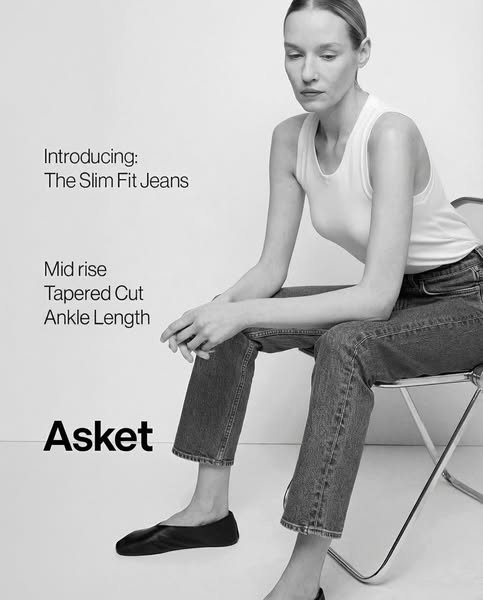
This black and white ad introduces the Asket brand's slim fit jeans, highlighting their mid-rise, tapered cut, and ankle length.
# Brand positioning
Asket presents itself as a purveyor of timeless, minimalist essentials. The brand leans into functional design, prioritizing quality and fit over fleeting trends, which is implied through the classic style of the jeans and the simple, unadorned aesthetic of the ad. The brand aims to occupy a space in the consumer's mind as a provider of core wardrobe staples that are both understated and well-crafted. By focusing on fundamental pieces like jeans, Asket signals a departure from fast fashion.
# Product
The product being advertised is "The Slim Fit Jeans" by Asket. These jeans are designed for a modern, streamlined silhouette. They feature a mid-rise waist that sits comfortably on the hips, a tapered cut that narrows slightly towards the ankle, and an ankle length. The functional features highlighted in the ad are meant to promote a flattering and versatile fit for a range of body types, making them a staple piece in any wardrobe. The simple description focuses on cut and fit to address concerns about finding well-fitting denim.
# Visual style
The ad has a minimalist aesthetic, with a black and white filter applied to the image. The lighting is soft and even, highlighting the textures of the fabric and the model's features. The image is a studio shot with high production quality, focusing on simplicity and clean lines. The typography is clean and legible, which contributes to the overall minimalist feel.
# Hooks
Headline: Introducing:
The Slim Fit Jeans
# Funnel stage
Top of funnel (Awareness)
# Pain points
None used.
# Value propositions
- None used.
# Benefits
- None used.
# Features
- Mid rise
- Tapered Cut
- Ankle Length
# Call to action
None used.
# Social proof
- None used.
# Point of view
- Brand: The entire ad is told from the brand's perspective, introducing a product and emphasizing its key features.
# Storyline
- The ad begins by introducing 'The Slim Fit Jeans' from Asket, immediately establishing what is being advertised. The brand is controlling the introduction of this new product line.
- Next, the ad highlights the key features of the jeans, noting their mid-rise, tapered cut, and ankle length. This information is presented from the brand's perspective, specifying what sets these jeans apart.
- Finally, the ad concludes with the brand name "Asket" displayed prominently, reinforcing brand recognition. The brand is ensuring its identity is clearly associated with the product features.
# Ad summary
This ad features the founder of Asket explaining the brand's quality denim standards. He describes how the company went to Japan to source KD77 fabric and that they use ring-spun heritage yarns and rope-dyed indigo. The ad speaks against the notion that selvedge denim is the best kind of denim, and the Asket founder argues that quality comes from caring, not from the stripe on the edge.
# Brand positioning
Asket is presented as a brand focused on creating quality denim pieces that defy convention. The brand directly challenges the idea that selvedge denim is automatically better or stronger. Instead, Asket emphasizes the importance of material quality and thoughtful production over traditional methods. This positions the brand as a modern, discerning choice for consumers who appreciate durability and sustainability in their clothing.
# Product
Asket's featured product is their denim line, specifically highlighting KD77 fabric sourced in Japan. The fabric is 13oz raw denim by Kurabo Industries. It is not selvedge, but instead uses ring-spun heritage yarns known for their strength and texture. The denim is rope-dyed indigo to give it depth and features a classic 3/1 twill. The denim is designed to break in over time, revealing the white core of the yarn and recording how the wearer moves, sits, and lives. The ad emphasizes that Asket cares about quality and the durability of their denim, not just the aesthetic aspects like the stripe on the edge.
# Visual style
The ad has a clean, minimalist aesthetic. The editing style is a mix of static shots and quick cuts, maintaining a consistent pacing that emphasizes key points made by the speaker. The overall production quality is polished, but not overly so, creating a professional yet approachable feel. The visual motifs include frequent cuts back to the speaker, the stark white backgrounds, and close-ups of the denim and its various components.
# Hooks
Spoken: Male 1: This isn't selvedge denim, and that's intentional.
Text overlay: This isn't / selvedge denim / and that's / intentional.
Visual: 00:00–00:01 A man with short, wavy brown hair, fair skin, and wearing a blue denim shirt over a white t-shirt looks directly at the camera and speaks. He has a slight smile and appears friendly and sincere. The background is a bright, neutral room with a shelf behind him containing neatly stacked clothes and files. / 00:01–00:02 The shot transitions to a close-up of hands carefully smoothing a dark, folded pair of denim pants on a light brown wooden table. The hands wear a silver ring and a watch. The camera zooms in slightly as the hands open up a section of the pants to reveal the inner seams. / 00:02–00:03 The shot zooms in further on the pants.
# Funnel stage
Middle of funnel (Consideration)
# Pain points
The ad challenges the perception that selvedge denim is automatically superior. Quote: 'Selvedge has become a symbol of quality. The red stripe. The old shuttle looms. The heritage story. But selvedge doesn't automatically make denim stronger.'
# Value propositions
- KD77 fabric, a 13oz raw denim, is sourced in Japan, which indicates high quality and unique value.
- Ring-spun heritage yarns are used instead of selvedge, indicating a focus on strength and texture which challenges traditional denim standards.
- Denim breaks in over time, which reveals the white core of the yarn and recording how you move, sit, and live, which creates personalized wear, making the denim unique to the user.
# Benefits
- Strength
- Texture
- Depth
- Breaks in over time
- Reveals the white core of the yarn
- Recording how you move, sit and live
# Features
- KD77 fabric
- 13oz raw denim
- Ring-spun heritage yarns
- Rope-dyed indigo
- Classic 3/1 twill
# Call to action
None used.
# Social proof
- None used.
# Point of view
- Brand 100% – The entire ad is told from the perspective of the brand, with the founder speaking directly to the camera to explain the brand's philosophy and product features.
# Storyline
- 00:00–00:02 The founder of Asket starts by stating 'This isn't selvedge denim, and that's intentional,' immediately going against a common perception of high-quality denim. This statement is intended to grab the viewer's attention by challenging a widely held belief, and establishes a perspective of expertise for the speaker and brand.
- 00:03–00:09 The narrative continues with 'In 2019, we went to Japan to decide how our denim should be made. To understand what actually makes denim great,' which shifts the focus to the brand's dedication to quality and the journey they undertook to source the right materials. This conveys a commitment to excellence and thoroughness.
- 00:11–00:16 Following that, the founder addresses the conventional view of denim, explaining that 'Selvedge has become a symbol of quality. The red stripe. The old shuttle looms. The heritage story.' This acknowledges the traditional markers of denim quality while setting up a contrast with the brand's approach.
- 00:16–00:29 The founder then pivots, asserting that 'But selvedge doesn't automatically make denim stronger. It just means it was woven on a narrower, older machine. Those looms produce less fabric. Often with more waste and higher energy consumption per meter.' This directly challenges the idea that selvedge denim is superior, highlighting the potential downsides of traditional production methods and showing the brand's counterintuitive thinking.
- 00:31–00:34 Continuing the argument against conventional wisdom, the founder clarifies that 'It's not wrong, it's just not what defines quality in our minds.' This reiterates the brand's unique perspective and reinforces the idea that they have a different standard for quality.
- 00:35–00:52 The storyline moves to detail the alternative approach of the brand: 'We stayed in Japan and sourced the KD77 fabric. A 13oz raw denim by Kurabo Industries. Not selvedge, but ring-spun heritage yarns for strength and texture. Rope-dyed indigo for depth. A classic 3/1 twill that breaks in over time, revealing the white core of the yarn and recording how you move, sit and live.' This showcases the brand's commitment to quality, detail and sourcing premium materials.
- 00:53–00:58 The narrative ends with the founder concluding, 'That's what makes denim great. We care about the quality. Not the stripe on the edge,' re-emphasizing the brand's unique value proposition and what they prioritize in their denim.
# Ad summary
This ad showcases the brand Asket, emphasizing its commitment to creating a permanent collection of clothing items made with natural materials, manufactured in Europe, and designed for longevity. The ad highlights Asket's values of permanence over novelty, offering repairs and buy-back services to ensure garments stay in use longer.
# Brand positioning
Asket positions itself as a sustainable and anti-fast fashion brand that values permanence, quality, and transparency. The brand creates a single, permanent collection of garments, refined relentlessly over time, instead of launching seasonal collections based on fleeting trends. By using natural materials, manufacturing exclusively in Europe, and offering repairs and buy-back services, Asket promotes a lifestyle of conscious consumption, focusing on enduring style and minimizing environmental impact. The brand differentiates itself by promising 'permanence' rather than 'novelty', emphasizing the lasting value and environmental responsibility of their clothing.
# Product
Asket offers a core collection of essential clothing items designed for longevity, quality, and minimal environmental impact. These garments are made from natural materials and manufactured exclusively in Europe. The brand focuses on refining existing designs rather than constantly introducing new, trendy products. Asket addresses the purchase barriers of fit and garment care by offering length options for a better fit and providing repair services to extend the lifespan of their clothing. Asket also offers a buy-back service, enabling customers to return their garments when they are done with them, reinforcing the brand's commitment to sustainability and circularity. The ad emphasizes that Asket’s products are made to last, resisting short-lived fashion trends in favor of enduring style and value.
# Visual style
The ad has a polished and clean aesthetic, with a focus on natural lighting and soft, diffused shots. The editing style combines static shots with quick cuts to maintain a steady pace, highlighting different stages of production and product features. The production quality is high, conveying a sense of sophistication and attention to detail, which aligns with the brand's emphasis on quality and permanence. The pacing is consistent, around 15 cuts per minute, which creates a calm yet engaging rhythm. Product actions are often synced with voiceover lines, emphasizing key points about the brand and its values.
# Hooks
Spoken: Male 1: In 10 years, we've made just 50 garments.
Text overlay: In 10 years, / we've made just 50 garments.
Visual: 00:00–00:01 A clapperboard is held in front of the camera, partially obscuring a fair-skinned man with light brown hair. His blue suit jacket is visible. The background is a bright, soft-lit closet with folded clothes on shelves. / 00:01–00:02 The camera shows a fair-skinned man with light brown hair, wearing a navy blue sweater and jeans, seated in front of a bright, soft-lit closet with folded clothes on shelves. He looks directly at the camera and speaks.
# Funnel stage
Middle of funnel (Consideration)
# Pain points
The ad addresses the frustration with fast fashion's emphasis on novelty and trends, leading to frequent purchases of low-quality items that quickly go out of style or fall apart. This is implied through the brand's focus on permanence and its rejection of seasonal drops and artificial expiration dates.
# Value propositions
- Permanence over novelty
- Sustainable and ethical production
- High-quality materials and craftsmanship
- Garments designed to last for a decade or more
- Support for a circular economy through repair and buy-back services
# Benefits
- Enduring style
- Sustainable practices
- Quality craftsmanship
- Longevity
- Minimal environmental impact
# Features
- Natural materials
- Manufactured only in Europe
- Length options for a better fit
- Garment repair service
- Buy-back program
# Call to action
None used.
# Point of view
- Brand 100% – The entire ad is told from the brand's perspective, with the founder explaining their philosophy and practices.
# Storyline
- 00:00–00:01 The ad opens with a clapperboard, immediately signaling a behind-the-scenes or documentary style.
- 00:01–00:02 00:01–00:02 A man sits in front of a neatly organized closet and states, 'In 10 years, we've made just 50 garments,' conveying a message of slow and deliberate production.
- 00:02–00:03 00:02–00:03 Quick cut to a man showing a leather bag sitting at a table.
- 00:03–00:05 00:03–00:05 The ad shows the production of fabric on an industrial machine. The voiceover continues, 'And it's not because we lack ideas,' setting up a contrast to the brand's deliberate approach.
- 00:05–00:11 00:05–00:11 The scene cuts to a man examining the stitching on an inside seam of a garment. He finishes the thought by saying, 'It's because we believe that honestly, most ideas don't deserve to exist,' reinforcing the brand's high standards.
- 00:11–00:15 00:11–00:15 The speaker emphasizes, 'We don't launch collections. We build one, single, permanent collection,' visually supported by workers handling and measuring clothes in an office setting.
- 00:15–00:18 00:15–00:18 A close up shot of a yellow measuring tape is shown. Continuing to state, 'and refine it relentlessly over time,' underscoring the commitment to continuous improvement and quality.
- 00:18–00:23 00:18–00:23 The speaker is now sitting in front of a window as he delivers the statement, 'Every garment has earned its place. If it can't justify existing for the next decade, we just don't make it,' highlighting the brand's focus on lasting value.
- 00:24–00:28 00:24–00:28 The hands of a worker are shown looking at a stack of clothes. The narration says, 'No trends. No seasonal drops. No artificial expiration dates,' which clearly pushes back against fast fashion norms.
- 00:28–00:35 00:28–00:35 Back to the man in front of the shelf of clothes as he says 'Instead, we refine. Version after version. Fit after fit. Fibre after fibre. Fabric after fabric,' showing repetitive refinement.
- 00:35–00:45 00:35–00:45 The brand ethos is reinforced with images of nature, manufacturing, and garment care, while the speaker states, 'We use natural materials, manufacture only in Europe, offer length options for a better fit, we repair your garments when they break down, and we take them back when you're done with them,' illustrating the company's sustainable practices.
- 00:46–00:50 00:46–00:50 The man examines a garment carefully as he makes the final statement, 'Our promise isn't novelty, it's permanence,' which encapsulates the brand's core value proposition.
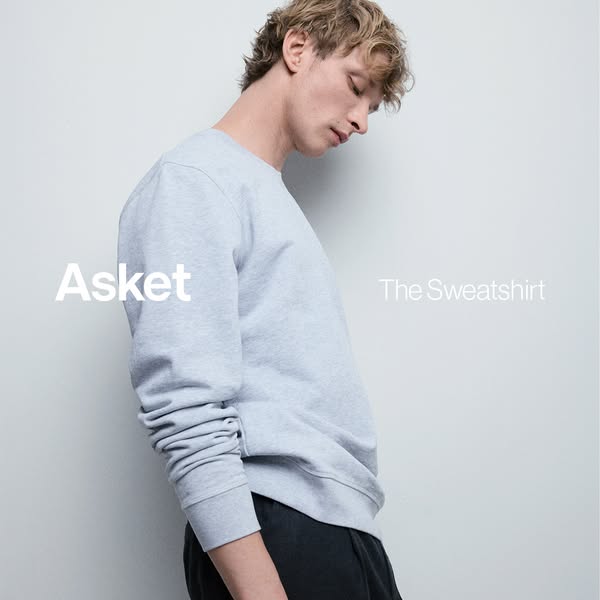
# Ad summary
An ad for Asket's sweatshirt features a man wearing the heather gray sweatshirt. The brand name is in the lower left and the product name is in the lower right of the image.
# Brand positioning
Asket is presented as a brand focused on timeless essentials for a minimalist wardrobe. The brand name is simply displayed in the lower left, followed by the type of garment in the lower right, signaling the brand's emphasis on core pieces of apparel. The simple design and high-quality photography suggest a commitment to quality and understated style, aiming for a timeless aesthetic rather than fleeting trends. This positioning appeals to consumers who value durable, classic clothing items and seek to avoid fast fashion.
# Product
The featured product is a sweatshirt in a heather gray color. It appears to be made from a soft, comfortable material, ideal for casual wear. The design is a classic crew neck style with ribbed cuffs and hem, emphasizing a relaxed fit. It is presented as a staple item, suitable for everyday wear. The sweatshirt is shown being worn, highlighting its fit and style, addressing the purchase barrier of not being able to see how it looks on a person. The ad promotes the sweatshirt as a fundamental piece, worth investing in for its simplicity and versatility.
# Visual style
The visual style is minimalist and clean, with a focus on showcasing the product in a straightforward and appealing manner. The image features a neutral color palette with a plain white background, which helps to highlight the product. The lighting is soft and diffused, contributing to the high-quality feel. The overall aesthetic is modern and understated, reflecting a sense of timelessness and sophistication. The style is highly scannable and helps to draw attention to the simple yet elegant design of the sweatshirt.
# Hooks
Headline: None used
# Funnel stage
Top of funnel (Awareness)
# Pain points
None used.
# Value propositions
- None used
# Benefits
- None used
# Features
- Sweatshirt
# Call to action
None used.
# Social proof
- None used.
# Point of view
- Brand: The POV is consistent throughout, with the brand showcasing its sweatshirt and brand identity.
# Storyline
- The brand name, 'Asket,' is displayed in the lower-left, signaling the brand's identity and initiating brand recognition. The brand is telling the audience its name and establishing its presence in the ad.
- The sweatshirt is worn by a man who has his head tilted down. The sweatshirt is heather gray and classic design and its overall fit and style are highlighted. The brand is visually showcasing the product, allowing the consumer to see how it will fit on the body.
- The text 'The Sweatshirt' appears in the lower-right of the image. The product is being clearly identified. The brand is telling the audience what item is being advertised.
# Ad summary
This ad features a person showing off their new favorite loose-fit jeans from Asket. The ad shows the jeans from multiple angles.
# Brand positioning
Asket is presented as a brand that offers high-quality, loose-fit jeans. The brand seems to focus on providing comfortable and stylish clothing options for everyday wear. The ad does not explicitly state any values or lifestyle associations, but the focus on a single product suggests a commitment to simplicity and quality over trend-chasing.
# Product
The product featured is a pair of loose-fit jeans from Asket. The jeans are a light blue wash with a classic denim texture. They have a relaxed fit through the legs and a standard five-pocket design. The ad emphasizes the comfort and style of the jeans, suggesting they are suitable for everyday wear. The jeans are presented as a versatile wardrobe staple that can be easily incorporated into various outfits.
# Visual style
The ad has a clean and simple aesthetic with a focus on showcasing the product. The editing style is straightforward with static shots and minimal transitions. The production quality is polished, giving the ad a professional feel. The pacing is consistent, with each shot held long enough to appreciate the details of the jeans.
# Hooks
Text overlay: My new favourite loose-fit jeans from Asket
Visual: 00:00–00:02: Close-up shot of a person wearing light blue, loose-fit jeans. The person is standing still, and the camera focuses on the texture and fit of the jeans. The background is a plain white wall.
# Funnel stage
Top of funnel (Awareness)
# Pain points
None used.
# Value propositions
- None used
# Benefits
- None used
# Features
- Loose-fit jeans
# Call to action
None used.
# Social proof
- None used.
# Point of view
- Customer 100% – The ad is presented from the perspective of a satisfied customer showcasing their new favorite jeans.
# Storyline
- 00:00–00:02 The ad opens with a close-up of the jeans, immediately introducing the product.
- 00:02–00:10 The person wearing the jeans stands in front of a white wall, showcasing the fit and style from different angles.
- 00:10–00:15 The person shifts their weight and adjusts the jeans, providing a dynamic view of how they move and fit.
- 00:15–00:25 The person continues to pose, highlighting the jeans' features and overall look.
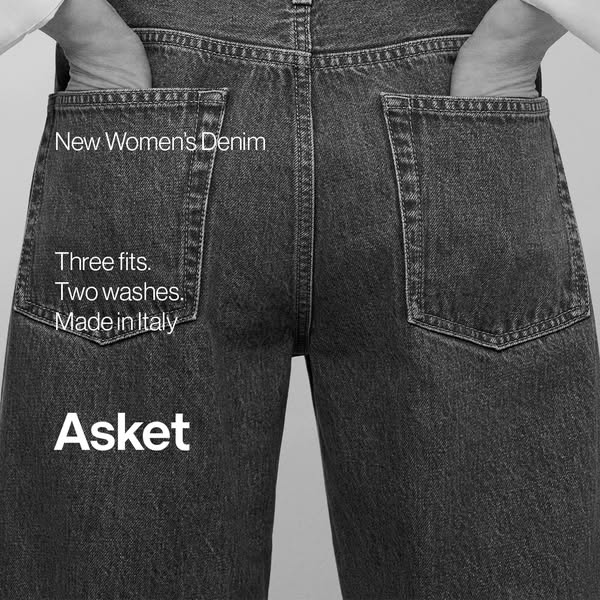
# Ad summary
This ad showcases the rear view of a pair of women's denim pants from ASKET, emphasizing the available fits, washes, and Italian craftsmanship.
# Brand positioning
ASKET is presented as a brand focused on quality and craftsmanship, specifically highlighting that its denim is made in Italy. The positioning suggests a focus on timeless, well-made garments, emphasizing a commitment to quality materials and construction. This implies a higher price point and a target audience that values durability and enduring style over fleeting trends.
# Product
The ad showcases new women's denim pants offered by ASKET. The denim is available in three fits and two washes, providing customers with options to suit their personal style and preferences. The pants are made in Italy, highlighting the brand's commitment to quality materials and construction. The focus on fit and wash options addresses potential purchase barriers related to finding the right size and style. The denim's origin in Italy serves as a USP, emphasizing luxury and quality.
# Visual style
The ad features a minimalist and clean aesthetic, with a focus on the product itself. The production quality appears high, with attention to detail in the denim's texture and construction. The image treatment is simple, with a black and white filter applied, which gives the ad a timeless and classic feel. The typography is clean and modern, integrated seamlessly into the image without overpowering the visual. The visual style is designed to convey a sense of quality and sophistication, aligning with the brand's positioning.
# Hooks
Headline: New Women's Denim
# Funnel stage
Middle of funnel (Consideration)
# Pain points
The ad addresses the difficulty in finding well-fitting and high-quality denim. Quote: "Three fits. Two washes."
# Value propositions
- Three fits for a personalized fit
- Two washes for different style preferences
- Made in Italy for a superior quality
# Benefits
- Variety in fit options
- Choice of wash
- Quality construction
# Features
- Three fits
- Two washes
- Made in Italy
# Call to action
None used.
# Social proof
- None used.
# Point of view
- Brand: The POV is consistent throughout the image, as the brand showcases its new women's denim line and highlights its key features.
# Storyline
- The ad opens with a close-up shot of the back of a pair of jeans to introduce ASKET's new women's denim line. This is done from the brand's perspective to immediately focus attention on the product's visual aspects such as the cut, color, and quality.
- Next, the ad highlights the denim's key features: 'Three fits. Two washes. Made in Italy.' From the brand's perspective, this provides essential information about the denim's variety and origin, reinforcing its value proposition.
- Finally, the ad displays the brand name 'Asket' in a simple and clean font, which acts as a subtle branding reminder at the end of the visual narrative, from the brand's perspective.
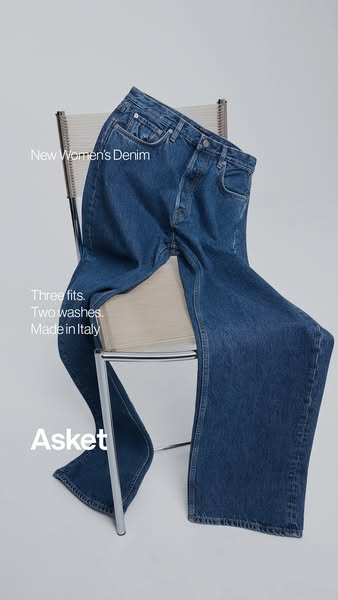
# Ad summary
This ad showcases Asket denim jeans. The product is positioned as a high-quality garment that is available in three fits and two washes and made in Italy.
# Brand positioning
Asket is presented as a brand that focuses on quality and craftsmanship. The mention of "Made in Italy" suggests a commitment to traditional manufacturing and high standards. There is an emphasis on simplicity and choice with the line "Three fits. Two washes." The brand seems to occupy a space in the market that values timeless style and thoughtful design.
# Product
The product featured is a pair of women's denim jeans by Asket. The jeans are made of a blue denim fabric with visible seams and a button fly. The jeans appear to be laid across the back of a chair. The ad highlights that the jeans come in "Three fits. Two washes." The line "Made in Italy" is included to highlight the quality of materials and manufacturing.
# Visual style
The ad uses a minimalist and clean aesthetic. The image is well-lit and features neutral colors. The focus is on the product, with minimal distractions.
# Hooks
Headline: New Women's Denim
# Funnel stage
Top of funnel (Awareness)
# Pain points
None used.
# Value propositions
- Three fits, allowing the customer to find the best fit for their body type.
- Two washes, offering the customer a choice in the appearance of the denim.
- Made in Italy, suggesting quality and craftsmanship.
# Benefits
- Not applicable
# Features
- Three fits
- Two washes
- Made in Italy
# Call to action
None used.
# Social proof
- None used.
# Point of view
- Brand: The POV is consistent throughout the image, with the brand showcasing its product, highlighting key features, and reinforcing brand identity.
# Storyline
- The ad begins by showing the product. This is to immediately grab the viewer's attention with an image of the product they are advertising, from the brand's perspective.
- The ad then shares key details about the product's availability and origin. This serves to quickly communicate the key selling points and value proposition, presented from the brand's perspective.
- The ad concludes by highlighting the brand name. This reinforces brand recognition and directs the viewer's attention to the brand offering, from the brand's perspective.
How Other Apparel Brands Advertise on Meta
Peer brands in Motion's library — click any brand to see their creative strategy, live ads, and AI breakdowns.