

# Ad summary
This ad promotes the Get Closer: Shadow Self Edition card game by Intelligent Change. The ad features a creator who describes how the card game is helping him to get in touch with his emotions.
# Brand positioning
Intelligent Change is presented as a company that provides tools for self-improvement. The brand focuses on products that help people to become more self-aware and accepting of themselves. The brand values personal growth and emotional intelligence. Intelligent Change seems to set itself apart by providing tools that make complex self-reflection more accessible and less overwhelming.
# Product
The advertised product is the Get Closer: Shadow Self Edition card game by Intelligent Change. The game is designed to help players connect with their emotions and become more self-aware. The game prompts players with questions that they wouldn't normally stop to answer, facilitating a safe and non-overwhelming environment for self-reflection. Each card contains a question designed to prompt introspection and honesty with oneself, allowing users to confront thoughts they might typically avoid. The game is positioned as a beautiful place to start for those curious about understanding themselves better without feeling overwhelmed.
# Visual style
The ad has a clean, modern aesthetic with a focus on natural lighting and authentic presentation. The editing style is relatively simple, featuring mostly static shots with occasional zooms to emphasize the product or the speaker's expressions. The video appears to be filmed in a home setting, giving it a UGC feel that resonates with social media platforms. The pacing is moderate, which helps maintain viewer engagement without feeling rushed.
# Hooks
Spoken: Male 1: I honestly didn't think a card game would make me feel like this.
Text overlay: 00:00–00:01: honestly / 00:01–00:02: card game / 00:02–00:02: this.
Visual: 00:00–00:02: A close-up, overhead shot displays the "Get Closer" card game box sitting on a wooden floor. The box is black with white text, and a gold sticker is visible. The camera angle is slightly tilted.
# Funnel stage
Middle of funnel (Consideration)
# Pain points
The central pain point is the difficulty in accessing and expressing one's feelings, as described in the ad: "When someone asks me how I'm feeling, my brain kind of freezes."
# Value propositions
- The card game provides a safe and non-overwhelming environment for self-reflection.
- The game helps to facilitate clarity and acceptance of oneself.
# Benefits
- It feels safe, not overwhelming
- Makes it so much easier to actually be honest with yourself
- I feel more clarity now
- More acceptance of parts of myself I used to ignore
# Features
- Card game with questions
- Shadow Self Edition
# Call to action
None used.
# Social proof
- "I honestly didn't think a card game would make me feel like this." – Male 1 (Creator)
- "I didn't realize how much I avoid certain thoughts until this." – Male 1 (Creator)
- "I feel more clarity now, and honestly, more acceptance of parts of myself I used to ignore." – Male 1 (Creator)
# Point of view
- Customer 100% – The entire ad is told from the perspective of a customer reviewing the product, sharing his personal experience and insights.
# Storyline
- 00:00–00:02 The ad opens with a close-up shot of the card game, introducing the product being reviewed.
- 00:02–00:11 The creator introduces himself as a naturally closed-off person who struggles to articulate his feelings.
- 00:11–00:14 The creator references the moment where he realized something was there, he just didn't know how to access it.
- 00:14–00:17 The creator pivots to present the card game as a tool to address the problem.
- 00:17–00:23 The creator demonstrates how the card game works by showing the box, cards, and sample questions.
- 00:23–00:27 The creator highlights the game's benefits, such as feeling safe, not overwhelmed, and making it easier to be honest with oneself.
- 00:27–00:29 The creator shares his personal experience, noting that he realized how much he avoids certain thoughts until using the game.
- 00:29–00:37 The creator emphasizes the game's role in guiding him to understand his feelings and gain clarity and acceptance of himself.
- 00:37–00:44 The creator concludes by recommending the game to those curious about self-understanding who want a non-intense approach.

How Intelligent Change Advertises on Meta
Updated Apr 19, 2026 · Refreshes weekly
Intelligent Change runs 27 active ads on Meta, shipping ~10 new creatives per week. Their library leans on Demo23%, Testimonial16%, and Montage12%. Recently, Intelligent Change is pushing its journaling and planning products — the Five Minute Journal, Productivity Planner, Life Designer Journal, and Get Closer card game — across two clear lanes: mental clarity and emotional connection. The through-line is escaping overwhelm and busywork to live more intentionally, whether that's stopping anxiety spirals, focusing on one priority, or deepening relationships.
Indexed by Motion's Inspo Library.
The 20 Most Recent Intelligent Change Ads on Meta
# Ad summary
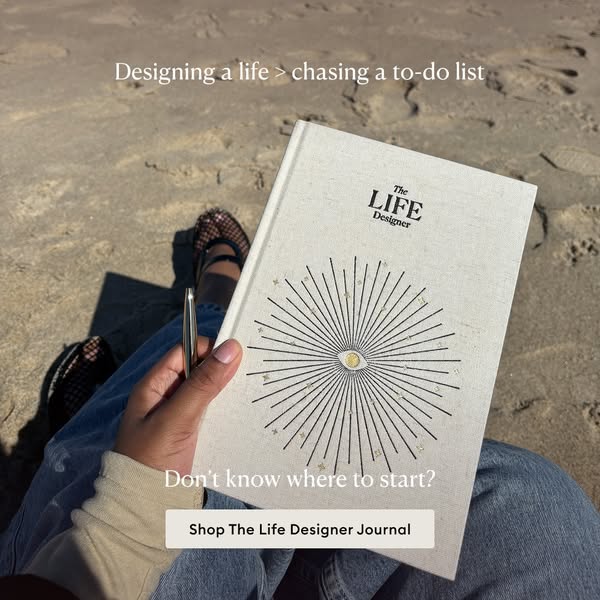
This ad for The Life Designer Journal uses a lifestyle image of a woman sitting on a beach with the journal in her lap, along with text that positions the journal as a tool to design one's life instead of just chasing a to-do list. It also contains a prompt: "Don't know where to start?", and a CTA to shop the journal.
# Brand positioning
The Life Designer brand positions itself as a tool for intentional living and personal development. The brand's name directly suggests a focus on actively shaping one's life rather than passively reacting to daily tasks. The ad aligns the brand with values of mindfulness, purpose, and self-direction. The brand's messaging contrasts with the common experience of being overwhelmed by to-do lists, offering a solution for those seeking a more balanced and fulfilling life. It leans toward an emotional positioning, appealing to those seeking a more intentional lifestyle.
# Product
The Life Designer Journal is presented as a tool to design a life instead of chasing a to-do list. The journal features a cover design with the brand name "The LIFE Designer" (on-package label text) and a graphic of a central eye-like shape radiating outward with lines, some of which terminate in star shapes. The ad addresses the potential purchase barrier of not knowing where to start by prompting with the question, "Don't know where to start?" The product is shown being used in a relaxed setting (on a beach), suggesting it can be used anywhere.
# Visual style
The ad features a lifestyle-focused, natural aesthetic. The production quality appears to be high but maintains a sense of authenticity through natural lighting and a real-world setting. The image treatment includes soft focus and desaturated colors, creating a calming effect. The typography is clean and minimal, integrated smoothly into the image. The overall style feels native to platforms like Instagram, aiming for a balance of scannability and aspirational lifestyle imagery.
# Hooks
Headline: Designing a life > chasing a to-do list
# Funnel stage
Middle of funnel (Consideration)
# Pain points
The primary pain point is the feeling of being overwhelmed and controlled by a never-ending to-do list, rather than living intentionally. This is signaled by the phrase "chasing a to-do list," suggesting a reactive, stressful, and unfulfilling way of life.
# Value propositions
- Move from chasing to-do list to designing a life
# Benefits
- Designing a life
# Call to action
Shop The Life Designer Journal
# Social proof
- None used.
# Point of view
- Brand: The opening statement and CTA position the brand as the voice offering a solution to intentional living.
- Customer: The image showing the journal on the beach shows the product in use in the customer's everyday life, as well as the prompt 'Don't know where to start?'
# Storyline
- The ad starts with a positioning statement: "Designing a life > chasing a to-do list." This sets up a contrast between intentional living and being overwhelmed by tasks, told from the brand's perspective to position the product as a solution.
- Next, the ad shows the product (The Life Designer Journal) in a lifestyle setting (on a beach). This illustrates a calm, relaxed moment, presumably the user's point of view, that contrasts with the chaos of chasing a to-do list, reinforcing the brand's positioning.
- The ad asks a question: "Don't know where to start?" This is a direct prompt to the viewer, presented as if the brand is asking, to acknowledge the potential challenge of beginning a journey of intentional living.
- Finally, the ad provides a call to action: "Shop The Life Designer Journal". This transitions from problem acknowledgement to offering the product as a solution, viewed from the brand's perspective.
# Ad summary
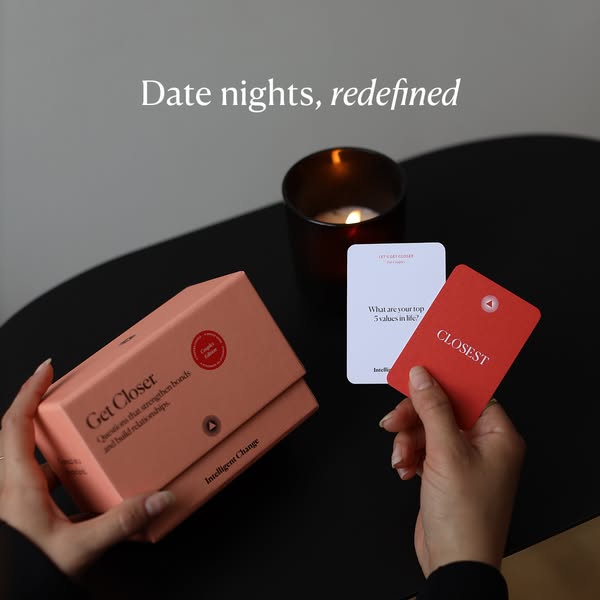
This image ad features the Intelligent Change 'Get Closer' card game. The ad displays the box with the game, along with some sample cards. It has a clean and simple aesthetic that focuses on enhancing intimacy and connection through thoughtful conversation.
# Brand positioning
Intelligent Change is presented as a brand focused on facilitating meaningful connections and personal growth. The brand aims to occupy a space in the consumer's mind that values intentionality, relationships, and self-improvement. The values, tone, and lifestyle are aligned with promoting mindful conversations and stronger bonds. This brand positions itself as a catalyst for positive change through products that encourage deeper understanding and communication. The positioning is primarily emotional, focusing on the fulfillment and enriched relationships that come from using their products.
# Product
The featured product is the 'Get Closer' card game by Intelligent Change, a set of cards designed to strengthen bonds and build relationships through thoughtful questions. The game is for couples or individuals looking to deepen their connections and engage in meaningful conversations. Each card contains a question intended to spark insightful discussions. The game is packaged in a peach-colored box with the product name and brand clearly labeled. The cards themselves are shown being held and displayed, with one card featuring the question, 'What are your top 5 values in life?' addressing a potential purchase barrier by demonstrating the kind of conversation the game facilitates.
# Visual style
The ad features a clean, lifestyle-oriented aesthetic with soft, diffused lighting that enhances the intimate mood. The shot is well-composed, giving it a polished, studio-shot appearance. The color palette is muted with peach, black, and white, making it appear sophisticated and approachable. The typography is modern and legible.
# Hooks
Headline: Date nights, redefined
# Funnel stage
Middle of funnel (Consideration)
# Pain points
The ad addresses the pain point of uninspired and superficial date nights. The text "Date nights, redefined" directly suggests a dissatisfaction with the current state of date experiences.
# Value propositions
- Strengthen bonds and build relationships through thoughtful questions with the 'Get Closer' card game.
- Date nights, redefined by offering a unique and meaningful experience.
# Benefits
- Redefined date nights
- Strengthened bonds
- Build relationships
# Features
- Questions that strengthen bonds
- Build relationships
# Call to action
None used.
# Social proof
- None used.
# Point of view
- Brand: Top caption ('Date nights, redefined') introduces the product's value proposition and sets the stage for a new kind of date night experience.
- Customer: Hands holding the product show the product in use, giving the customer a sense of how the product is experienced.
- Brand: The product box and card displayed provide a closer look at the product and its design.
# Storyline
- The ad opens by setting the context: 'Date nights, redefined,' inviting the viewer to reconsider their expectations for romantic evenings. This message, delivered from the brand's perspective, sets the stage for an innovative way to connect with a partner.
- The hands holding the 'Get Closer' game and sample cards illustrate the product in use, offering a tactile sense of how the game is experienced. Seen from the customer's perspective, this emphasizes the simplicity and approachability of the game.
- The visual arrangement with the product box and the lit candle creates an atmosphere of intimacy and intention, reinforcing the game's purpose in creating deeper connections. The brand uses this to suggest the emotional benefits of the product.
# Ad summary
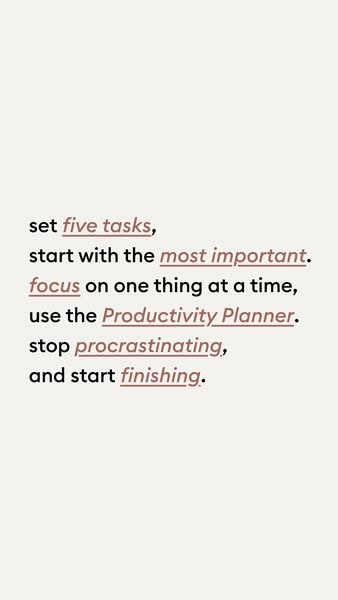
This ad gives a short list of tips to improve productivity.
# Brand positioning
This ad promotes a 'Productivity Planner' and offers a system for achieving productivity, focus, and completion of tasks. The brand positions itself as a provider of tools and methods to combat procrastination and enhance efficiency in task management. The brand emphasizes simplicity and actionable steps, suggesting that it stands against the complexity and overwhelm often associated with productivity methods. The brand aligns with values of focus, efficiency, and completion, aiming to help individuals achieve a sense of accomplishment and control over their workload.
# Product
The ad features a "Productivity Planner" designed to enhance productivity and focus. The planner helps users set five tasks, prioritize the most important, and concentrate on one thing at a time. It is intended for anyone looking to stop procrastinating and start finishing tasks. By using the Productivity Planner, individuals can combat procrastination and increase their ability to complete tasks efficiently. The ad suggests the planner is a straightforward and effective tool, offering a practical solution for managing tasks and improving focus.
# Visual style
The ad has a clean and minimalist visual style. It uses a neutral color palette, plain background, and straightforward typography to convey a sense of simplicity and focus. The production quality appears polished, with carefully arranged text and a cohesive color scheme. This style is likely intended to be scannable and attention-grabbing in a feed by standing out due to its simplicity and directness.
# Hooks
Headline: set five tasks,
# Funnel stage
Middle of funnel (Consideration)
# Pain points
The ad highlights the problem of procrastination, which is a common obstacle to productivity and achieving goals. The ad's direct call to “stop procrastinating” explicitly addresses this frustration and positions the product and tips as a solution.
# Value propositions
- Actionable productivity tips: Set five tasks, prioritize, and focus for efficient work.
- Use the Productivity Planner as a solution for task management and completion.
# Benefits
- Increased productivity
- Better focus
- Task completion
- Reduced procrastination
# Features
- Set five tasks
- Start with the most important
- Focus on one thing at a time
- Use the Productivity Planner
- Stop procrastinating
- Start finishing
# Call to action
None used.
# Social proof
- None used.
# Point of view
- Brand: All text and implied advice is coming from the brand, advocating for its product and productivity tips.
# Storyline
- The ad lists actionable tips for achieving productivity. It suggests the user should set five tasks. This is to introduce a manageable number of things to work on. The perspective is from the brand to the customer.
- The ad then advises the user to start with the most important task, which is to prioritize effectively. This is intended to help focus efforts where they matter most. The perspective is from the brand to the customer.
- The user is instructed to focus on one thing at a time. This emphasizes the value of concentrated effort. The brand wants to help the customer not be overwhelmed. The perspective is from the brand to the customer.
- The ad mentions using the Productivity Planner, introducing the product as a tool. The brand intends to offer a solution for achieving productivity. The perspective is from the brand to the customer.
- The ad tells the user to stop procrastinating and start finishing. The brand hopes to inspire action and completion. The perspective is from the brand to the customer.
# Ad summary
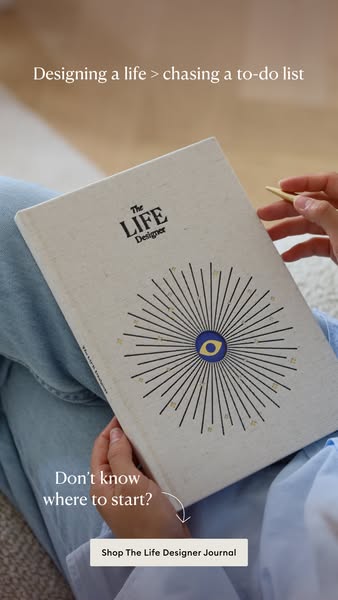
This ad promotes The Life Designer Journal. The ad features the journal and the headline states "Designing a life > chasing a to-do list". The text, "Don't know where to start?" appears next to an arrow that points towards a "Shop The Life Designer Journal" button at the bottom.
# Brand positioning
The Life Designer brand is positioned as a lifestyle company that promotes intentionality and purpose. Rather than simply managing tasks, the brand encourages consumers to design their lives with intention. This brand positioning pushes against the norm of task-oriented productivity, and promotes a more emotional experience of holistic well-being. The brand occupies a space in the consumer's mind as a tool for personal growth, with values rooted in mindfulness and conscious creation.
# Product
The Life Designer Journal is a tool intended to help individuals create intentional lives. It appears to be a hardcover journal with a cloth cover, designed with an eye-like symbol on the front. The journal is designed to help customers who may not know where to start with personal planning. The ad suggests that it is a means to design a life, rather than chase an endless to-do list, implying that the product is worth trying for those seeking a more meaningful and intentional lifestyle.
# Visual style
The ad features a neutral, lifestyle-oriented aesthetic. The production quality is high, with soft, diffused lighting. The image is minimally staged, focusing on the product in a natural, inviting setting. The typography is clean and modern, seamlessly integrated into the visual layout.
# Hooks
Headline: Designing a life > chasing a to-do list
# Funnel stage
Top of funnel (Awareness)
# Pain points
The ad addresses the frustration of feeling overwhelmed and not knowing where to start, communicated by the text "Don't know where to start?"
# Value propositions
- Design a life, rather than chase a to-do list
# Benefits
- Design a life
# Features
- Journal
# Call to action
Shop The Life Designer Journal
# Social proof
- None used.
# Point of view
- Brand: top caption. The brand is presenting the distinction of designing a life versus chasing a to-do list.
- Customer: middle caption. The customer is expressing the feeling of being overwhelmed or lost on where to start.
- Brand: bottom button. The brand is directly asking the viewer to shop The Life Designer Journal.
# Storyline
- The ad begins by presenting a fork in the road: designing a life versus chasing a to-do list. The brand presents this contrast to suggest that the product offers a more fulfilling approach to productivity, from the brand's POV.
- The ad displays the journal, which is a solution for people who don't know where to start. This presents a common barrier for customers from the customer's POV.
- The ad provides a direct call to action, inviting the viewer to shop The Life Designer Journal. The brand presents this as a clear next step for the viewer.

# Ad summary
The ad displays the Get Closer card game on top of a book, with the headline suggesting to stay in instead of going out.
# Brand positioning
Intelligent Change focuses on designing tools that help people achieve their goals. The brand is positioned for individuals who are seeking personal growth. They promote values of intentionality, self-awareness, and mindful action. Intelligent Change seems to be pushing against the norm of mindless consumerism. The brand positioning is more functional, aiming to improve productivity and well-being.
# Product
The product being advertised is the 'Get Closer' card game designed to strengthen bonds and build relationships through meaningful questions. It encourages partners to communicate and understand each other better. The product comes in a small box and can be easily stored or carried. A 'Couples Intimacy Bundle' is mentioned.
# Visual style
The ad uses a soft and inviting visual style, with a focus on creating a cozy atmosphere. The product is well-lit and prominently displayed, with a clean and simple background. The overall aesthetic is minimalist and calming, which aligns with the brand's focus on mindfulness and personal growth.
# Hooks
Headline: date night in > date night out
# Funnel stage
Middle of funnel (Consideration)
# Pain points
The ad addresses the pain point of needing engaging date night activities. The text "date night in > date night out" implies that people may struggle to find fulfilling date activities, and this product offers a solution.
# Value propositions
- The 'Get Closer' card game offers a way to strengthen bonds and build relationships through meaningful questions.
# Benefits
- Strengthens bonds
- Builds relationships
# Features
- Questions that strengthen bonds
- Questions that build relationships
# Call to action
Shop The Get Closer Couples Intimacy Bundle
# Social proof
- None used.
# Point of view
- Brand: The brand's point of view is seen in the product display and call to action, emphasizing the value and benefits of the 'Get Closer' card game.
- Customer: The customer's perspective is subtly implied through the visual arrangement, suggesting a cozy, at-home date night scenario.
# Storyline
- The image shows the two boxes of the 'Get Closer' card game. This indicates that there are different versions of the game available to play, with questions aimed to help build and maintain relationships.
- The text "date night in > date night out" suggests that staying in and playing the game is better than going out for a date. This message is from the brand's perspective and it is aimed to persuade people to buy this product.
- The call to action 'Shop The Get Closer Couples Intimacy Bundle' encourages viewers to purchase the product. This message is from the brand and it is a direct instruction to the viewer.
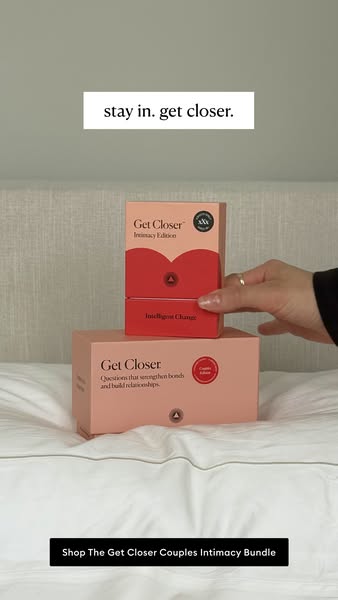
# Ad summary
The ad showcases a bundle of card games designed to foster deeper connections between couples. It uses a simple, visually appealing setup with the product boxes stacked on a bed and a hand pointing to the top box. The ad includes the tagline "stay in. get closer" and a direct call to action to shop the bundle.
# Brand positioning
The brand, Get Closer, aims to create intimate moments and strengthen relationships through thoughtfully designed card games. The brand values connection, closeness, and the importance of communication in relationships. It positions itself as a tool for couples to build stronger bonds, offering a unique and engaging way to spend quality time together. The brand's positioning is emotional, focusing on enhancing relationships and fostering intimacy rather than emphasizing functional performance or simplicity.
# Product
The featured product is a bundle of card games designed for couples to strengthen their relationships and foster intimacy. The bundle includes two distinct sets: the standard "Get Closer" card set, featuring questions designed to strengthen bonds and build relationships, and the "Intimacy Edition," designed to promote deeper emotional connection. The cards are packaged in coral-colored boxes, each featuring the brand name and a brief description of the set's purpose. These card sets aim to create meaningful conversations and help couples connect on a deeper level, offering a fun and engaging way to spend quality time together.
# Visual style
The ad has a clean and minimalist visual style with a focus on the product. The production quality appears to be studio-shot, with soft, natural lighting. The color palette is muted and calming, featuring coral and white tones. The typography is simple and legible. The overall aesthetic is modern and inviting, designed to appeal to couples seeking to enhance their relationship.
# Hooks
Headline: stay in. get closer.
# Funnel stage
Middle of funnel (Consideration)
# Pain points
None used.
# Value propositions
- stay in. get closer.
# Benefits
- get closer
# Features
- Questions that strengthen bonds and build relationships.
- Intimacy Edition
# Call to action
Shop The Get Closer Couples Intimacy Bundle
# Social proof
- None used.
# Point of view
- Brand: The overall point of view is from the brand, Get Closer, showcasing its products and highlighting the value of deeper connections between couples.
# Storyline
- The ad opens with a text overlay stating, "stay in. get closer," setting the intention to highlight the value of staying in and connecting more deeply with a partner, from the brand's perspective.
- Next, a product shot showcases the "Get Closer" card game bundle, comprised of the Intimacy Edition and a set of conversation-starting cards. This is done to present the physical products that enable couples to connect, coming from the brand's perspective.
- Finally, a hand gestures towards the "Intimacy Edition" card box, emphasizing its role in facilitating deeper connections. The brand is encouraging deeper exploration of the product, from the brand's perspective.
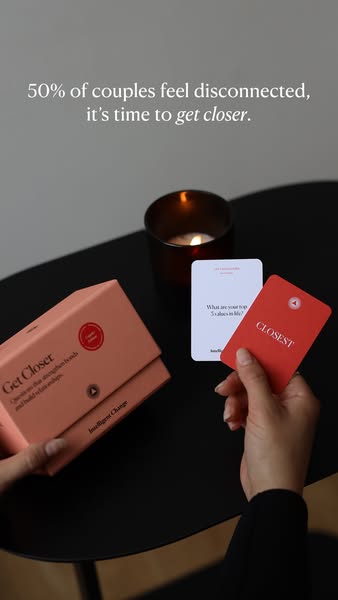
# Ad summary
Image ad for the card game "Get Closer" which helps couples get to know each other on a deeper level. The ad emphasizes the high percentage of couples who feel disconnected and it is time to get closer.
# Brand positioning
Intelligent Change is presented as a company dedicated to strengthening interpersonal connections and fostering meaningful dialogue. The brand positions itself as a facilitator of relationship enhancement. By addressing the concerning statistic that a significant portion of couples feel disconnected, the brand establishes a need for its product as a means to bridge this gap. This brand seems to address the emotional needs of its consumers and is positioned as a brand that encourages intentional and thoughtful communication.
# Product
The advertised product is the "Get Closer" card game by Intelligent Change, designed to facilitate deeper connections and bonding between couples. The product consists of a set of cards, each featuring questions intended to spark meaningful conversations. The cards aim to help couples strengthen their relationships and build lasting partnerships by fostering open communication and understanding. The cards are contained in a light red box with the title "Get Closer" and a small red seal on the top. One card on the table reads, "What are your top 5 values in life?"
# Visual style
The ad utilizes a clean and minimalistic aesthetic with a focus on a single product shot. The lighting is soft, creating a cozy atmosphere. The image is shot in a high-angle view, providing a clear view of the product and its components. The color palette is muted, with a focus on black, light red, and white. Overall, the visual style is polished, emphasizing the product's design.
# Hooks
Headline: 50% of couples feel disconnected, it's time to get closer.
# Funnel stage
Top of funnel (Awareness)
# Pain points
The ad highlights that a significant portion of couples (50%) feel disconnected.
# Value propositions
- "Get Closer" card game facilitates deeper connections and bonding between couples
# Benefits
- Get Closer
# Features
- Questions that strengthen bonds and build relationships
# Call to action
None used.
# Social proof
- None used.
# Point of view
- Brand: The copy stating the percentage of disconnected couples to be addressed by the product comes from the brand.
# Storyline
- The ad begins by stating that 50% of couples feel disconnected, immediately establishing a problem and concern for the viewer, delivered from the brand to highlight the common issue it aims to solve.
- Next, the ad transitions to introducing the product: The "Get Closer" card game. The audience gets a glimpse of the product's packaging and the cards being held by a person, showing an instance of product use. The brand is presenting its solution to the problem identified in the previous beat and showing the audience how to get closer.
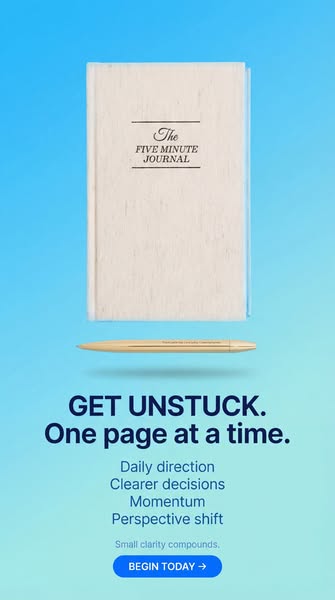
# Ad summary
This static image ad for The Five Minute Journal promotes the product as a tool to overcome feeling stuck. The ad features a clean, minimalist design with a journal, pen, and text highlighting benefits like daily direction and clearer decisions, alongside a call to action to begin today.
# Brand positioning
The Five Minute Journal positions itself as a tool for clarity, direction, and momentum in daily life. The brand aligns with values of mindfulness, productivity, and intentional living. It carves out a space in the market by offering a simple, actionable approach to self-improvement through journaling. Eschewing complexity, it opts for simplicity, making it approachable for those seeking quick, effective ways to enhance their daily routine. The brand’s positioning is functional, emphasizing the practical benefits of clarity and direction, yet it also carries emotional undertones of empowerment and self-discovery.
# Product
The Five Minute Journal is presented as a tangible tool designed to provide daily direction, clearer decisions, momentum, and a perspective shift. It is a physical journal with a minimalist design, featuring a hardcover with the product name (on-package label text) "The FIVE MINUTE JOURNAL" centered. The journal is intended for anyone seeking clarity and direction in their daily life. The ad addresses the barrier of feeling stuck by offering a simple solution: one page at a time. It emphasizes that small clarity compounds, suggesting that consistent use of the journal can lead to significant positive changes.
# Visual style
The ad features a clean and minimalist visual style. The production quality appears to be studio-shot, with soft lighting and a focus on product clarity. The image treatment includes background removal, which places the product on a simple gradient background. The typography is integrated in a clear and legible manner. The overall style contrasts the high-energy, visually busy content typically found on social media platforms by offering a calm and uncluttered viewing experience, likely to stand out and capture attention by being simple and direct.
# Hooks
Headline: GET UNSTUCK.
# Funnel stage
Middle of funnel (Consideration)
# Pain points
The central frustration is feeling stuck, likely due to a lack of direction or clarity in daily life. "GET UNSTUCK."
# Value propositions
- Get unstuck and gain daily direction, clearer decisions, momentum, and a perspective shift by using The Five Minute Journal.
# Benefits
- Daily direction
- Clearer decisions
- Momentum
- Perspective shift
- Small clarity compounds.
# Features
- One page at a time
# Call to action
BEGIN TODAY →
# Social proof
- None used.
# Point of view
- Brand: Throughout the entire image, the brand is presenting the product and its benefits to persuade potential customers.
# Storyline
- The ad opens by showcasing the product, The Five Minute Journal, to establish what is being offered. This is from the brand's perspective to immediately present the product's visual identity.
- The narrative shifts to address the audience's pain point of feeling stuck and promotes the journal as the solution. This comes from the brand to address a customer pain point.
- The ad details the benefits of using the journal, such as 'Daily direction,' 'Clearer decisions,' 'Momentum,' and 'Perspective shift.' This highlights the value of the product and is told from the brand's perspective.
- The ad concludes by emphasizing that 'Small clarity compounds' and features a call to action to 'BEGIN TODAY,' urging the viewer to start using the journal. This is from the brand offering a way to start building a habit.
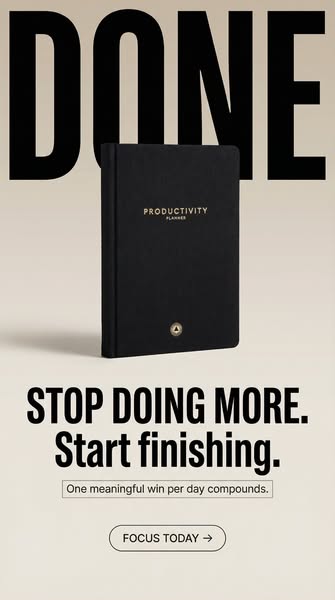
# Ad summary
An image ad for a productivity planner is displayed. The ad copy encourages viewers to focus on finishing tasks instead of just doing more.
# Brand positioning
The brand is positioned as a provider of productivity tools, specifically a planner designed to help users focus and achieve meaningful daily wins. It appeals to individuals seeking structure and accomplishment, emphasizing the power of consistency and focused effort. The brand is positioning itself as a tool for intentional productivity and personal growth, rather than merely a way to manage tasks.
# Product
The ad features a black hardcover planner labeled "PRODUCTIVITY PLANNER" (on-package label text) in gold lettering. The product is designed to facilitate focused daily progress and compounding wins. The planner aims to help users "stop doing more" and "start finishing", implying a move away from scattered effort and towards concentrated achievement. It's positioned as a tool that enables "one meaningful win per day", suggesting a straightforward, manageable approach to productivity. The planner helps to overcome potential barriers to productivity, such as feeling overwhelmed by multiple tasks or struggling with focus and consistency.
# Visual style
The ad uses a minimalist aesthetic with a focus on clean lines and a neutral color palette. The production quality appears to be highly polished, suggesting a studio-shot image. The visual motifs include a strong typographic emphasis with large, bold text and a simple product shot. The image treatment consists of soft lighting and subtle shadows, creating a sophisticated and professional look. The typography integration is large and bold, serving as the primary visual element. The style contrasts with typical platform trends by opting for a clean, high-design approach, which likely aims to capture attention through simplicity and clarity.
# Hooks
Headline: DONE
# Funnel stage
Consideration
# Pain points
The central pain point is the feeling of being overwhelmed by endless tasks without a sense of completion, as implied by the phrase, "STOP DOING MORE."
# Value propositions
- Focus on finishing tasks rather than just doing more, leading to a sense of accomplishment.
- Achieve one meaningful win per day for compounding progress, implying that consistent small steps lead to significant results.
# Benefits
- Stop doing more. Start finishing.
- One meaningful win per day compounds.
# Features
- Productivity planner
# Call to action
FOCUS TODAY →
# Social proof
- None used.
# Point of view
- Brand: The entire ad is crafted from the brand's perspective, showcasing its product, its value proposition, and a clear call to action.
# Storyline
- The ad opens with the large, bold word "DONE", set in an extra-large font which aims to immediately convey the message of accomplishment. This is the brand's way of setting the context around the finished product.
- The image then introduces the Productivity Planner, a physical tool designed to help achieve that state of 'done.' Here the brand is shifting from an abstract concept of completion, to showing how their planner can enable that.
- The ad then pivots into a more direct call-to-action that states, "STOP DOING MORE. Start finishing." The brand is using the language of a customer who is trying to reframe their work habits.
- The ad copy further reinforces the product's value by saying, "One meaningful win per day compounds." The brand is describing the product's value in terms of the benefit to the customer.
- Finally, the ad ends with a clear call to action button, "FOCUS TODAY →", which the brand is using to encourage immediate engagement and purchase.

# Ad summary
This image ad promotes a journal with structured morning prompts, evening closure, daily affirmation, and pattern interruption for those with racing thoughts. It encourages the viewer to 'START YOUR PRACTICE.'
# Brand positioning
The brand promotes itself as a tool to train your brain to look for good. It aims to occupy a space in the consumer's mind as a facilitator of positive mental habits and a structured approach to emotional well-being. The brand promotes values of mindfulness, intentionality, and self-improvement, aligning with a lifestyle of thoughtful reflection and proactive mental health management. It pushes against the norms of passive coping mechanisms and instead offers a structured practice for those with racing thoughts.
# Product
The product is a physical journal designed to help users manage racing thoughts and train their brain for positivity. It features structured morning prompts, evening closure exercises, daily affirmations, and pattern interruption techniques. These features are designed to provide a framework for intentional thought and emotional regulation. The journal is for individuals experiencing racing thoughts who are seeking a tangible, structured practice to manage their mental well-being. The ad addresses the barrier of unfocused, anxious thinking by offering a clear, actionable system.
# Visual style
The ad has a minimalist, clean aesthetic. It uses a muted color palette with off-white and black as the primary colors, creating a sense of calm and simplicity. The production quality is high, with a studio-shot image of the journal positioned to highlight its physical qualities. The typography is clean and legible, contributing to the overall sense of clarity and order. The visual style contrasts sharply with the chaotic concept of 'racing thoughts,' providing a visual cue of the brand's solution.
# Hooks
Headline: STOP THE SPIRAL.
# Funnel stage
Middle of funnel (Consideration)
# Pain points
The ad addresses the problem of 'racing thoughts,' offering a solution through structured journaling. The phrase 'For racing thoughts' explicitly identifies this pain point.
# Value propositions
- Train your brain to look for good.
# Benefits
- For racing thoughts.
# Features
- Structured morning prompts
- Evening closure
- Daily affirmation
- Pattern interruption
# Call to action
START YOUR PRACTICE →
# Social proof
- None used.
# Point of view
- Brand: The entire image is presented from the brand's perspective, showcasing the product and its features, and encouraging the audience to start their practice.
# Storyline
- The ad opens by declaring 'STOP THE SPIRAL,' immediately framing the issue of spiraling or racing thoughts. This is the brand telling the user that they understand the problem and are offering a solution.
- Next, the ad follows with a statement to 'Train your brain to look for good.' The brand is now shifting from problem to solution and promoting a concept of mental training. It's framing the brand as a supportive voice.
- The ad follows with a list of the benefits, including 'Structured morning prompts,' 'Evening closure,' 'Daily affirmation,' and 'Pattern interruption.' The brand is providing a detailed list of features that speak to the journal's utility.
- The ad ends with an offer to start your practice in a call to action. The brand is directly asking the viewer to take the next step.
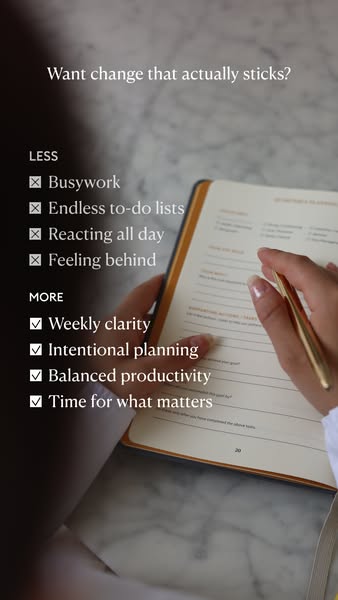
# Ad summary
This ad promotes a planning system and highlights the key aspects of less busywork, endless to-do lists, reacting all day, and feeling behind while showcasing the benefits of more weekly clarity, intentional planning, balanced productivity, and time for what matters.
# Brand positioning
The brand is presented as a solution for individuals seeking to improve their productivity and time management. It positions itself as a provider of tools and systems that combat common frustrations such as busywork, endless to-do lists, constant reactivity, and feelings of being behind. The brand aligns with values of clarity, intention, balance, and prioritizing what truly matters. Rather than simply offering another productivity tool, it stands for a more intentional and balanced approach to daily tasks and planning, helping customers regain control over their time and focus on their priorities. The brand aims for a functional and emotional positioning, promising performance and simplicity while empowering customers to achieve a sense of calm and control in their lives.
# Product
The product featured in this ad is a physical planner, designed to help users achieve "weekly clarity," "intentional planning," "balanced productivity," and "time for what matters." It appears to be a bound notebook with structured interior pages, providing a guided framework for organizing tasks and goals. The planner combats common productivity pain points such as "busywork," "endless to-do lists," "reacting all day," and "feeling behind." The planner is not just a blank slate, but a system that helps users prioritize and focus on important activities. The product differentiates itself by focusing on clarity and intention, rather than simply increasing the volume of tasks completed. The ad highlights the benefits of structured planning for individuals seeking a more balanced and productive lifestyle.
# Visual style
The ad has a clean, lifestyle-focused visual style. The production quality appears high, with natural lighting and a shallow depth of field. The composition is simple, focusing on the product in use. The image treatment involves subtle color grading to create a warm and inviting tone. The typography is integrated cleanly, with legible fonts and strategic use of emphasis. The overall style is modern and minimalistic, aligning with the brand's positioning of simplicity and intentionality.
# Hooks
Headline: Want change that actually sticks?
# Funnel stage
Top of funnel (Awareness)
# Pain points
The ad highlights the common pain points of feeling overwhelmed and unproductive in daily life, as expressed through "Busywork", "Endless to-do lists", "Reacting all day", and "Feeling behind."
# Value propositions
- Achieve real, lasting change by prioritizing what matters most.
- Transform your approach to planning and productivity with weekly clarity and intentionality.
- Reduce stress and overwhelm by eliminating busywork and constant reactivity.
# Benefits
- Less Busywork
- Less Endless to-do lists
- Less Reacting all day
- Less Feeling behind
# Features
- Weekly clarity
- Intentional planning
- Balanced productivity
- Time for what matters
# Call to action
None used.
# Social proof
- None used.
# Point of view
- Brand: Top headline asks a question to engage the viewer and introduce the topic of sustainable change.
- Brand: The 'less' section highlights common pain points in time management that the planner aims to solve.
- Customer: The 'more' section highlights what the customer can gain from using the planner.
# Storyline
- The ad opens by posing the question "Want change that actually sticks?" to engage viewers and set the intention to introduce a planning solution that leads to lasting change. The brand asks this question from a high level, hoping to get the target user to ask this of themselves, so they realize they need this product to see results.
- The ad identifies current pain points by listing aspects the target user would like to have "less" of: "Busywork," "Endless to-do lists," "Reacting all day," and "Feeling behind." From the brand's perspective, this emphasizes common frustrations that the planner aims to solve and create a desire for an alternative.
- The ad then introduces the aspirational outcomes the user can expect by listing what they'll have "more" of: "Weekly clarity," "Intentional planning," "Balanced productivity," and "Time for what matters." These outcomes are presented from the perspective of the customer to demonstrate the positive results of using the planner.
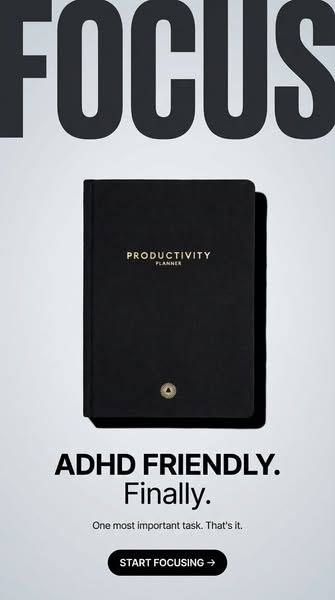
# Ad summary
This ad showcases a black 'Productivity Planner' targeted towards individuals with ADHD, highlighting its focus-driven design. The ad emphasizes that this planner helps with concentrating on the most important task and encourages viewers to 'Start Focusing'.
# Brand positioning
The brand is presented as a provider of productivity tools, specifically catered to individuals who struggle with focus, such as those with ADHD. It positions itself as a solution-oriented brand, offering products that help users concentrate and accomplish their tasks. The brand seeks to occupy a space in the consumer's mind as a provider of targeted and effective productivity aids.
# Product
The product is a black 'Productivity Planner', designed to help users focus on tasks. The planner is featured prominently with the words 'PRODUCTIVITY PLANNER' in gold on the cover. The ad presents it as a practical tool for individuals with ADHD, addressing the challenge of maintaining focus. The USP is that it aids in concentrating on 'One most important task.' The ad language makes it clear that the product is simple and effective for improving productivity.
# Visual style
The ad has a minimalist and clean visual style. It features a monochromatic color scheme with a light gray background and black text, creating a modern and focused aesthetic. The product is prominently displayed with clear typography, emphasizing simplicity and functionality. The design aims to be straightforward and professional, aligning with the purpose of a productivity tool.
# Hooks
Headline: FOCUS
# Funnel stage
Middle of funnel (Consideration)
# Pain points
The ad implies a struggle with focus and productivity, particularly for individuals with ADHD, where it is difficult to concentrate on and complete important tasks. The text 'ADHD FRIENDLY. Finally.' and 'One most important task. That's it.' strongly suggest the product aims to alleviate this difficulty.
# Value propositions
- ADHD FRIENDLY. Finally.
- One most important task. That's it.
# Benefits
- One most important task.
# Features
- ADHD FRIENDLY
# Call to action
START FOCUSING →
# Social proof
- None used.
# Point of view
- Brand: The brand's POV is represented through the product display and the call to action.
# Storyline
- The ad begins by highlighting the word 'FOCUS' in large, bold letters, immediately drawing attention to the core theme of the product. This sets the stage and establishes the central problem the planner aims to solve, told from the brand's perspective as it highlights the core benefit of the product to the viewer.
- Next, the ad introduces the black 'Productivity Planner,' positioned centrally in the frame. This beat showcases the tangible solution offered by the brand, as seen from the brand's perspective.
- The ad then emphasizes that the planner is 'ADHD FRIENDLY,' directly addressing a specific audience and their needs. This reassures potential customers that the product is designed with them in mind, from the brand's perspective.
- The phrase 'Finally.' implies a sense of relief and resolution. This messaging speaks to the long-sought solution the planner provides, as it is understood from the customer's perspective.
- The line 'One most important task. That's it.' simplifies the approach to productivity, suggesting ease of use and effectiveness. This focuses on the simplicity of the product, offering the brand's perspective on its unique selling point.
- Finally, the ad concludes with a call to action, 'START FOCUSING →,' guiding the viewer to take the next step towards improving their focus and productivity. This is the brand's direct invitation for customers to engage with their solution.
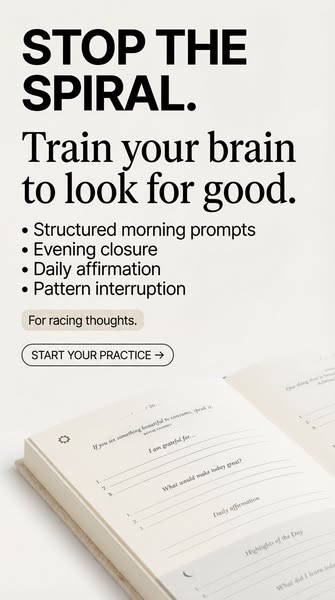
# Ad summary
This ad promotes a journal that helps train your brain to focus on the positive by offering daily structure and prompts to help reframe your thinking.
# Brand positioning
The brand offers a wellness product positioned to support mental health, with a focus on proactive and positive daily habits. It seems to push against passively accepting racing or negative thoughts, instead promoting accessible tools to train your brain through structured exercises like journaling. The brand promotes an emotionally intelligent and growth-oriented lifestyle, framing its products around building simple, manageable habits that lead to tangible mindset shifts.
# Product
The product is a guided journal designed to help users train their brain to focus on the good. It includes structured morning prompts, evening closure exercises, daily affirmations, and pattern interruption techniques to address racing thoughts. Each page of the journal offers space to write and reflect on prompts such as "If you see something beautiful to someone, speak it. Melvin B Tolson" and "I am grateful for..." followed by three numbered lines to write on. The journal prompts the user to answer questions such as "What would make today great?", as well as a space for a daily affirmation and highlights of the day.
# Visual style
The ad has a clean, minimalist aesthetic with a focus on typography and open space. The production quality appears to be high, with soft, natural lighting and a muted color palette, lending a sense of calm and sophistication. The typography is bold and legible, and the overall layout is well-organized and easy to scan. The image treatment suggests a slightly desaturated color grading, contributing to the understated and intentional look.
# Hooks
Headline: STOP THE SPIRAL.
# Funnel stage
Middle of funnel (Consideration)
# Pain points
The ad addresses the pain point of racing thoughts, offering a solution for those struggling with anxiety or overthinking. The headline "STOP THE SPIRAL" directly signals the frustration of being caught in a cycle of negative or anxious thoughts.
# Value propositions
- The journal provides structure (morning prompts, evening closure, daily affirmations) to help train your brain to focus on the positive.
# Benefits
- Train your brain to look for good
# Features
- Structured morning prompts
- Evening closure
- Daily affirmation
- Pattern interruption
# Call to action
START YOUR PRACTICE
# Social proof
- None used.
# Point of view
- Brand: The headline and body copy introduce the product and its features while prompting a direct response.
# Storyline
- The ad starts with a direct and somewhat alarming headline, “STOP THE SPIRAL.” This captures the viewer’s attention by immediately addressing a common struggle with negative or racing thoughts from the brand.
- The ad offers a solution: “Train your brain to look for good.” This reframes the struggle by presenting the product as a tool for positive change and sets the stage for a more hopeful perspective, told from the brand's POV.
- The ad lists the specific features of the journal: “Structured morning prompts,” “Evening closure,” “Daily affirmation,” and “Pattern interruption.” These features highlight the structured approach the journal offers for managing thoughts. This is a feature list provided by the brand intended to emphasize the product's concrete tools.
- The ad includes a small line of text that reads, "For racing thoughts." This addresses a specific pain point, reinforcing the product's relevance to those struggling with anxiety or overthinking. This is told from the brand's POV.
- The ad includes a call to action: “START YOUR PRACTICE →”, encouraging immediate engagement. This prompts the viewer to take the next step, with the brand driving the action.
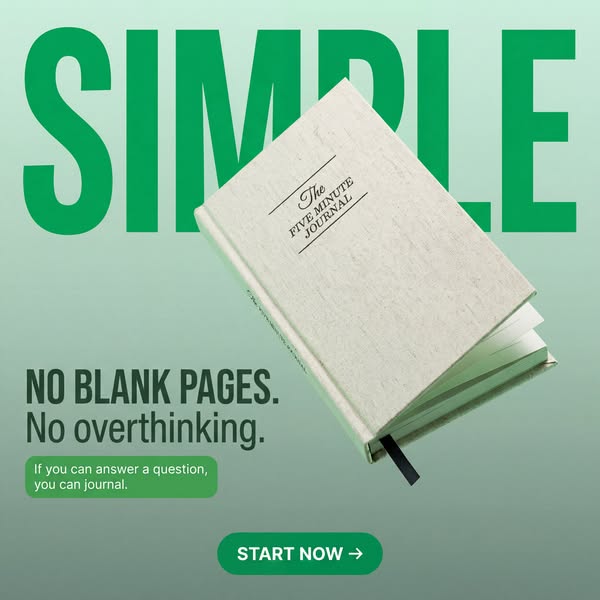
# Ad summary
This image ad promotes the Five Minute Journal. The ad emphasizes the simplicity of journaling by using the journal and answering simple questions.
# Brand positioning
The Five Minute Journal is presented as a simple and effective tool for mindfulness and personal growth. The brand aims to occupy a space in the consumer's mind as an antidote to the perceived complexity and time commitment associated with traditional journaling. It aligns with values of simplicity, accessibility, and mindful living, promoting a lifestyle where even busy individuals can cultivate self-reflection and gratitude. The brand pushes against the norm of blank page intimidation by framing journaling as an easy-to-start habit, functional and emotionally rewarding, offering a practical solution for those seeking a balanced and intentional approach to daily life.
# Product
The Five Minute Journal is a guided journal designed to simplify the practice of daily reflection and gratitude. The journal is for anyone who wants to incorporate mindfulness into their routine without the intimidation of blank pages. It features pre-set questions that eliminate overthinking and make journaling accessible to all. The journal's main USP is its simplicity, offering a streamlined format that requires minimal time investment. By addressing the purchase barrier of feeling overwhelmed by blank pages, the ad highlights how the journal makes it easy to cultivate a daily journaling practice, regardless of previous experience.
# Visual style
The ad features a clean and minimalist visual style. The production quality appears to be studio-shot with attention to lighting and composition. The design incorporates a gradient background and bold typography for emphasis. The image treatment includes background removal and subtle color grading. The overall style is simple and direct, designed to be easily scannable in a feed.
# Hooks
Headline: SIMPLE
# Funnel stage
Middle of funnel (Consideration)
# Pain points
The ad addresses the pain point of potential users feeling overwhelmed or intimidated by the blank pages of a traditional journal. The ad states, "NO BLANK PAGES. No overthinking," which emphasizes the product's solution to this common frustration.
# Value propositions
- The product is simple and easy to use.
# Benefits
- If you can answer a question, you can journal.
# Features
- NO BLANK PAGES
- No overthinking
# Call to action
START NOW →
# Social proof
- None used.
# Point of view
- Brand: The entire image conveys the brand's perspective by highlighting the simplicity and accessibility of their product.
# Storyline
- The image presents the word "SIMPLE" in large, green, bold font. This is to convey the key selling point of the product, from the brand's perspective, that the journal is easy to use.
- The ad then features a photograph of the physical journal. This is to give the customer a visual and the brand's perspective of the product itself and its simple design.
- Next, the words "NO BLANK PAGES. No overthinking." are presented in bold, which emphasizes the key features and benefits of the product. This is meant to address the customer's potential concerns or barriers to journaling.
- Finally, the text "If you can answer a question, you can journal." is featured with a green rectangle button that says, "START NOW→" to prompt immediate action. This is the brand's perspective to encourage the customer to purchase the journal.
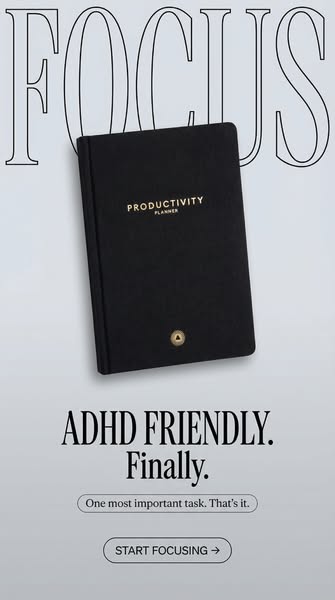
# Ad summary
This image ad features a black productivity planner against a gray background. The ad appeals to people with ADHD by stating the planner is 'ADHD Friendly.' The ad focuses on the productivity aspect of the planner.
# Brand positioning
This brand is presented as sophisticated and focused on productivity. The planner's design is sleek, with minimal branding, suggesting a focus on functionality over ostentation. The brand positions itself as a solution for individuals with ADHD, indicating it is attentive to specific needs and challenges related to focus and organization. The use of simple language and design, such as the callout to 'one most important task,' positions the brand as a provider of straightforward, effective tools against the chaos of daily life. The brand appears to value simplicity, focus, and tailored solutions, carving out a niche for itself by addressing the productivity challenges of a specific audience with thoughtfully designed tools.
# Product
The featured product is a black 'PRODUCTIVITY PLANNER' designed to help users focus and increase productivity. The planner is promoted as 'ADHD FRIENDLY,' indicating it has features or a structure tailored to assist individuals with attention deficits. The planner appears to be a hardcover book with gold lettering and a small circular gold detail near the bottom, adding a touch of elegance to its functional design. The ad emphasizes simplicity and focus by highlighting 'One most important task. That's it,' which suggests the planner promotes prioritizing and accomplishing key objectives. The planner seems to address the common purchase barrier of feeling overwhelmed or unfocused by presenting itself as a tool to streamline tasks and enhance productivity, especially for those who may struggle with attention-related challenges.
# Visual style
The ad has a clean and minimalist visual style with a focus on simplicity. The production quality appears polished with balanced lighting and a neutral color palette. The typography is integrated in a straightforward manner with sans-serif fonts. This style is not strongly platform-native, but its simplicity should enhance scannability in-feed.
# Hooks
Headline: ADHD FRIENDLY. Finally.
# Funnel stage
Middle of funnel (Consideration)
# Pain points
The ad targets the struggle to focus, especially among individuals with ADHD, who may find it challenging to prioritize tasks and maintain concentration. The ad's opening highlights the pain point by saying 'ADHD FRIENDLY. Finally.'
# Value propositions
- Designed to improve focus by focusing on one most important task
# Benefits
- Focusing
# Features
- ADHD FRIENDLY
- One most important task. That's it.
# Call to action
START FOCUSING →
# Social proof
- None used.
# Point of view
- Brand: The entire ad reflects the brand's point of view by showcasing its product, emphasizing its features and benefits, and encouraging viewers to take action.
# Storyline
- The ad grabs the viewer's attention with the large word 'FOCUS' that's in the background. This sets the context for the ad and gets the audience thinking about productivity. This is from the brand's perspective.
- Next, the ad showcases the product, a black 'PRODUCTIVITY PLANNER', to visually introduce what is being advertised. This gives the viewer a clear idea of what is being discussed and what they will potentially purchase. This is from the brand's perspective.
- The ad copy 'ADHD FRIENDLY. Finally.' is displayed to signal the planner's suitability for a specific audience. This copy is placed prominently to highlight the planner's targeted benefit. The brand is telling the viewer that this is a solution that is tailored to their needs.
- The phrase 'One most important task. That's it.' describes the planner's minimalist approach to productivity, simplifying task management. The brand is speaking to the core value proposition. The audience is being told about its specific method for helping people to focus and be productive.
- Finally, the ad presents a call to action, 'START FOCUSING,' to prompt immediate action from the viewer and lead them toward purchase or further engagement. The brand is attempting to convert the viewer into a customer and directing them to take action to make a purchase.
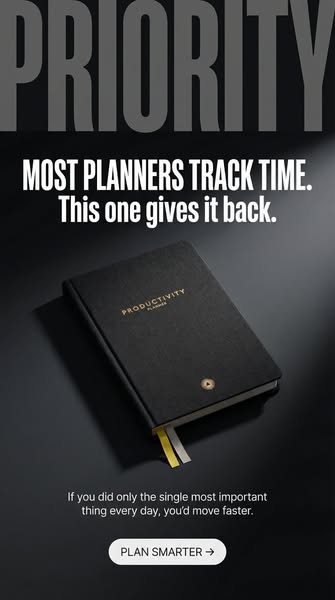
# Ad summary
This ad promotes a productivity planner that helps users focus on the most important task each day to move faster and accomplish more.
# Brand positioning
The brand is presented as a solution to the common problem of time management. It positions itself against traditional planners that simply track time, highlighting its planner as one that gives time back to the user. The brand aligns with values of productivity, efficiency, and intentionality, appealing to individuals who seek to optimize their daily routines and achieve their goals more effectively. Its approach is functional, focusing on the practical benefits of its productivity-focused planner.
# Product
The product is a productivity planner designed to help users focus on the single most important task each day to move faster and achieve their goals. It is aimed at individuals seeking to improve their time management and increase productivity. The planner's key selling point is its ability to help users prioritize and accomplish their most important tasks, leading to increased efficiency and faster progress. The ad addresses the common frustration of feeling overwhelmed by daily tasks and offers a solution by providing a structured approach to task management.
# Visual style
The ad has a sleek and minimalist visual style with a focus on the product. The use of a black background and gold lettering creates a sense of sophistication and luxury. The product is well-lit, highlighting its features and design. The overall aesthetic is clean and modern, aligning with the brand's positioning as a solution for productivity and efficiency.
# Hooks
Headline: PRIORITY
# Funnel stage
Middle of funnel (Consideration)
# Pain points
The pain point is the common frustration of time management. "MOST PLANNERS TRACK TIME."
# Value propositions
- If you did only the single most important thing every day, you'd move faster.
# Benefits
- gives it back
# Features
- Productivity Planner
# Call to action
PLAN SMARTER →
# Social proof
- None used.
# Point of view
- Brand: The POV is consistent throughout the ad, as the brand is promoting its product and highlighting its benefits.
# Storyline
- The ad begins by emphasizing the concept of 'PRIORITY' to capture the viewer's attention and highlight the central theme of the message. The brand is establishing the context and setting the stage for the problem it intends to solve.
- The ad contrasts the brand's planner with other planners in the market. It is positioned as a solution to the common frustration of time management by stating, 'MOST PLANNERS TRACK TIME. This one gives it back'. This is told from the brand's perspective.
- The brand shares the philosophy that focusing on the single most important task each day will lead to faster progress. It communicates to the user that 'If you did only the single most important thing every day, you'd move faster'. This is told from the brand's perspective.
- The ad ends with a call to action, encouraging the user to 'PLAN SMARTER' to start using the planner and experience the benefits of focused productivity. This is told from the brand's perspective.
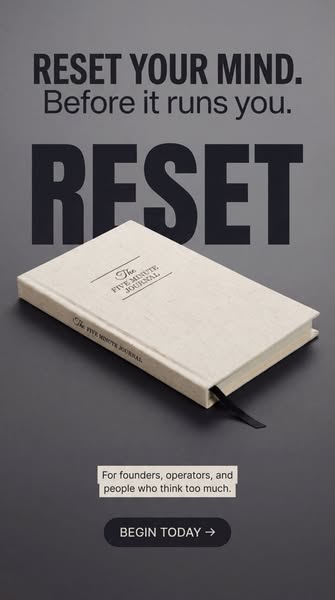
# Ad summary
This ad for The Five Minute Journal uses a single product shot with layered text elements to directly address overthinkers, founders, and operators who want to reset their minds. It features a close-up of the journal against a simple backdrop with a call to action to 'Begin Today.'
# Brand positioning
The Five Minute Journal offers a tangible tool designed to promote mindfulness and mental clarity. It is positioned as a product for individuals in high-stress roles such as founders and operators, and for anyone who tends to overthink. The brand aligns with values of productivity, mental health, and simplicity, offering a way to counteract the chaos of daily life with a structured, reflective practice. The brand pushes against the always-on, high-intensity norms of modern work culture by providing a method to reset and refocus in just five minutes.
# Product
The product is The Five Minute Journal, a physical journal designed for daily reflection and mindfulness. It appears to be a hardcover book with a cream-colored fabric cover. The journal features the brand name, 'The FIVE MINUTE JOURNAL' (on-package label text). Its USPs are its simplicity and the short time commitment required, making it accessible for busy individuals. The ad addresses the purchase barrier of time constraints by presenting it as a quick, efficient way to improve mental well-being. The journal is suitable for anyone looking to incorporate a mindful practice into their daily routine, particularly founders, operators, and overthinkers.
# Visual style
The ad has a clean, minimalist aesthetic with a focus on typography and a single product shot. The production quality is high, with a studio-shot feel. The color palette is limited to grayscale tones, which creates a calming and sophisticated mood. The typography is bold and straightforward, ensuring the message is easily scannable. The overall design is simple, focusing on the product and its key message.
# Hooks
Headline: RESET YOUR MIND. Before it runs you.
# Funnel stage
Top of funnel (Awareness)
# Pain points
The ad directly addresses the problem of an overactive mind that is "running you," suggesting a state of mental overwhelm and lack of control. The ad's opening line, "RESET YOUR MIND. Before it runs you," clearly signals this frustration.
# Value propositions
- The ad does not directly state explicit value propositions, but it promises a mental reset by targeting "founders, operators, and people who think too much" implying the journal can help busy professionals and overthinkers alleviate stress and improve focus.
# Benefits
- RESET YOUR MIND
# Call to action
BEGIN TODAY →
# Social proof
- None used.
# Point of view
- Brand: The entire image functions as a direct pitch for The Five Minute Journal.
# Storyline
- The ad copy makes a direct appeal to the viewer's state of mind. It uses the phrases 'RESET YOUR MIND. Before it runs you,' aiming to capture the attention of those who feel overwhelmed by their thoughts. The brand is speaking directly to the consumer, highlighting a common problem and suggesting a solution.
- A single product shot is displayed, showcasing The Five Minute Journal as a tactile, physical object. It visually represents the solution being offered to the audience. The brand wants to showcase the journal's tangible qualities.
- The ad identifies the target audience as 'For founders, operators, and people who think too much,' clarifying who the product is for and reinforcing the relatable problem of overthinking. The brand is speaking directly to its core customer base and using inclusive language.
- A call to action, 'BEGIN TODAY →' prompts the viewer to take immediate action and purchase the journal. The brand encourages the viewer to act now.
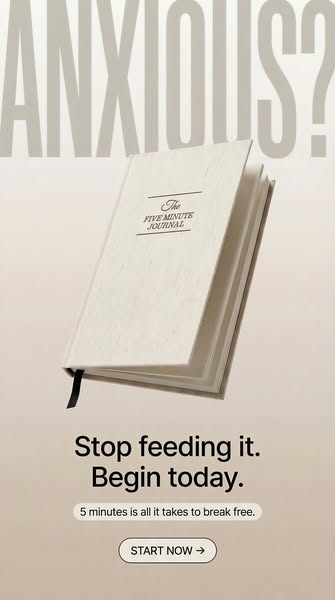
# Ad summary
This ad addresses anxiety by presenting The Five Minute Journal as a way to manage it by starting today. It encourages the viewer to stop feeding their anxiety and to break free with just 5 minutes of journaling.
# Brand positioning
The Five Minute Journal is positioned as a tool for managing anxiety and promoting mental wellness through quick, daily journaling. The brand aligns with values of mindfulness, self-improvement, and taking proactive steps toward mental well-being. It contrasts with the common approach of letting anxiety persist by offering a simple, manageable solution that can be incorporated into everyday life. The brand positioning is functional, focusing on the simplicity and effectiveness of the journal, while also offering emotional benefits related to mental health.
# Product
The featured product is The Five Minute Journal, a physical journal designed to help users manage anxiety and improve their mental well-being. It is intended for anyone experiencing anxiety and looking for a quick, effective way to break free from it. The journal requires only 5 minutes of daily use. The ad addresses the barrier of anxiety management by offering a simple, time-efficient solution that can be incorporated into busy lifestyles.
# Visual style
The ad has a clean, minimalist aesthetic with a focus on the product. The neutral color palette and simple typography give it a modern and calming feel. The lighting is soft and diffused, highlighting the texture of the journal and creating a sense of tranquility. The overall style is polished and professional, suggesting a high-quality product and brand.
# Hooks
Headline: ANXIOUS?
# Funnel stage
Top of funnel (Awareness)
# Pain points
The ad highlights the common struggle with anxiety, using the question "ANXIOUS?" to immediately connect with individuals who experience this feeling.
# Value propositions
- "5 minutes is all it takes to break free." The product offers a simple and effective way to manage anxiety with a minimal time investment.
# Benefits
- Stop feeding it.
- Begin today.
- break free
# Features
- 5 minutes is all it takes to break free.
# Call to action
START NOW →
# Social proof
- None used.
# Point of view
- Brand: From the opening question of "ANXIOUS?" to the CTA of "START NOW →", the brand consistently presents its product as the solution to anxiety management.
# Storyline
- The ad begins by posing the question "ANXIOUS?" in large, bold text. This serves to immediately grab the attention of viewers who struggle with anxiety and introduces the problem that the product aims to solve, told from the brand's perspective.
- Next, the ad shows a product shot of "The Five Minute Journal", positioning it as the solution to the problem introduced in the first frame, from the brand's perspective.
- The brand advises the viewer to "Stop feeding it. Begin today." The brand presents itself as an advisor offering a solution to a problem. It progresses the narrative by directly addressing the viewers problem with a potential solution.
- The brand gives a time investment required for use by stating "5 minutes is all it takes to break free." It is intended to show the viewer how little time it takes to use the product and see results. This advances the narrative by offering a tangible result.
- Finally, the brand ends with a call to action button that says "START NOW →". It offers the viewer a way to find out more information. It is intended to provide the viewer an avenue to pursue purchasing the product. This concludes the narrative by urging the user to invest in the product now.
# Ad summary
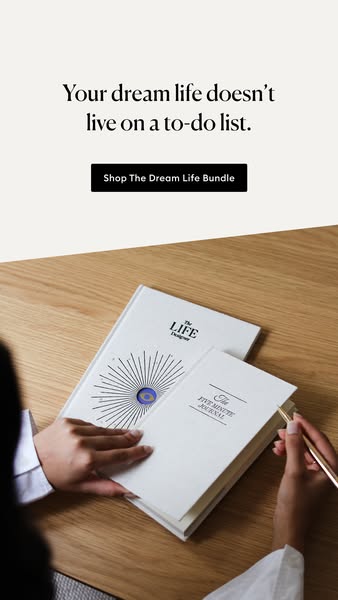
This image ad promotes The Dream Life Bundle, suggesting that it helps users achieve their dream life by moving beyond to-do lists. It features a lifestyle shot of the product in use, on a wooden table.
# Brand positioning
This brand, exemplified by The Life Designer and The Five Minute Journal, aims to position itself as a tool for intentional living and personal growth. It targets individuals seeking to move beyond the mundane 'to-do list' mentality and actively pursue their dream life. The brand aligns with values of mindfulness, goal-setting, and self-improvement, promoting a lifestyle where intentionality and reflection are prioritized. It goes against the norm of passive task management and instead encourages proactive creation of a fulfilling life, and is emotional through empowerment.
# Product
The advertised product is The Dream Life Bundle, consisting of The Life Designer and The Five Minute Journal. The Life Designer appears to be a planner-style notebook intended to help users intentionally design aspects of their lives. The Five Minute Journal is a smaller notebook, presumably for quick and regular reflection, for anyone looking to improve their well-being. The bundle aims to help users move beyond task management and focus on creating their dream life. This product presents itself as a barrier to not achieving a better and fulfilled life.
# Visual style
The ad has a clean, minimalist aesthetic. The image is well-lit and features a neutral color palette, conveying a sense of calm and sophistication. The product is prominently displayed and the focus is on simple, uncluttered visuals. The lifestyle setting and subtle hand interaction create a sense of personal connection. Overall, the design is highly polished, giving off a studio-shot quality.
# Hooks
Headline: Your dream life doesn't live on a to-do list.
# Funnel stage
Top of funnel (Awareness)
# Pain points
The core pain point is the feeling that one's dream life is unattainable when stuck in the routine of managing daily tasks, which is conveyed through the phrase "Your dream life doesn't live on a to-do list."
# Call to action
Shop The Dream Life Bundle
# Social proof
- None used.
# Point of view
- Brand: The top caption and shop button are from the brand, telling users to reject to-do lists and buy the product.
# Storyline
- The ad opens by challenging the viewer's current approach to life, stating that a 'dream life doesn't live on a to-do list.' This message is from the brand's perspective and is designed to make the viewer question their current habits and consider a more intentional approach to life.
- The ad then promotes The Dream Life Bundle as the solution, with a 'Shop' call to action. This is also from the brand's perspective, as they offer their product as a means to achieving the viewer's dream life. The presentation progresses the narrative from problem (to-do list mentality) to solution (The Dream Life Bundle).
- The ad shows a user interacting with The Five Minute Journal in a cozy setting. This offers the customer's point of view, demonstrating how the product can be integrated into daily life.
How Other Productivity Brands Advertise on Meta
Peer brands in Motion's library — click any brand to see their creative strategy, live ads, and AI breakdowns.